Does the UK only have a few days of gas? What the storage headlines mean
Headlines keep counting Britain’s gas in “days”. The number is real, but it measures what is sitting in storage on one date, not the gas the country can get. Here is what the storage figures do and do not tell you, what Centrica and National Gas have actually said, and what, if anything, to do at home.
No. The “days of gas” figure divides what was sitting in Great Britain’s storage sites on one date by a winter day’s demand; it is not the gas available to the country, most of which arrives continuously from the North Sea, Norwegian pipelines, LNG ships and interconnectors, with storage supplying 8% of demand in winter 2024/25. Storage was reported at about 30% full in late August 2026, against 46% a year earlier, and Centrica says Rough, the largest site, is “practically empty” while it seeks a government support scheme; bills are rising because of wholesale gas prices, which Ofgem links to the conflict in the Middle East. The government expects enough gas on an average winter’s day over the next four years (DESNZ, December 2025), National Gas has warned that supply margins are tightening and will publish its outlook for this winter in October 2026, and as of 22 September 2026 no gas balancing warning was in force.
By Tom Calder · Updated 22 September 2026 · Sourced to DESNZ, National Gas, NESO, Ofgem, HMRC, the North Sea Transition Authority, Hansard, the Utility Regulator, UKHSA, the NHS, nidirect, mygov.scot and the outlets named
Who actually said what
The March figure came from National Gas data: about 6,700 GWh in store, which the outlets converted to roughly a day and a half of winter demand. A National Gas spokesperson said storage levels were “broadly in line with what we would expect at this point in the year and are comparable to this time last year”, adding that “storage makes up only a small part of Britain’s diverse gas supply mix”. Steve Reed, the Communities Secretary, told Times Radio the country’s gas stores were “in line with what you would expect at this time of year” and that “we don’t see any immediate threat to our supplies from places like the North Sea” (London Loves Business, 9 March 2026).
Most of the late-summer headlines trace to Chris O’Shea, chief executive of Centrica, owner of Rough, the largest storage site. He wrote on LinkedIn that “We have almost no gas in storage in the UK for the coming winter”, and he wants ministers to introduce a “cap-and-floor” financing mechanism for Rough (The Telegraph, via Yahoo Finance, 27 August 2026). Writing in The Times, he said Rough “is practically empty, as markets currently do not make it financially viable” and that if the government does not include it in its “existing regulatory support model”, it “will remain empty over the winter and close by spring” (Mirror, via AOL, 3 September 2026). Centrica says it stands ready to invest £2 billion of its shareholders’ money in Rough “with the right regulatory support framework” (The Telegraph, via Yahoo Finance, 27 August 2026): a real dispute, but a case being put to ministers by the site’s owner.
The same coverage put British storage at about 30% full in late August 2026, against 46% a year earlier, citing Bloomberg data (The Telegraph, via Yahoo Finance, 27 August 2026). For comparison, National Gas’s outlook for last winter, 2025/26, gave Great Britain a supply margin of 83 million cubic metres on a one-in-twenty peak day (DESNZ, Statutory Security of Supply Report, December 2025). The government’s response to Centrica was that “the future of Rough storage is a commercial decision for Centrica”, while it remains open to discussing proposals on all storage sites (The Telegraph, via Yahoo Finance, 27 August 2026).
A price story ran alongside the storage headlines on 22 September. The BBC reported that Ineos was pausing production at its three plants at Saltend, near Hull, with its founder Sir Jim Ratcliffe saying UK gas prices were “12 times the level in the US and 8 times that of China”; the BBC added that the wholesale price of natural gas had almost doubled in the UK and Europe since July, after disruption to supplies through the Strait of Hormuz. The plants are stopping because gas is expensive, not because it is unavailable: Ineos said it could not compete, and the BBC reported it was looking to buy liquefied natural gas directly from the US. For households the same price rise shows up in bills, through the price cap, rather than in gas running out.
How much storage Britain has, and why it is small
Great Britain has eight storage sites, with a maximum storage capacity of 3.2 billion cubic metres and a maximum delivery rate of 117 million cubic metres a day (DESNZ, Statutory Security of Supply Report, December 2025). Seven are medium-range sites that can cycle gas regularly; the eighth is a long-range site that cycles seasonally. In winter 2024/25 storage supplied 8% of demand on the transmission system; in the winters before, between 4% and 7% (DESNZ, December 2025).
Rough, off the east coast of England in the southern North Sea, is the largest site and the one long-range store, which fills and empties by season (DESNZ, December 2025); Centrica calls it the UK’s “only large-scale gas storage facility” (Mirror, via AOL, 3 September 2026). On 21 April 2026 the North Sea Transition Authority granted Centrica a production and storage consent for Rough until 30 April 2027, so the regulator is not shutting it. But Centrica says Rough is “practically empty” because markets do not currently make it financially viable, and the Mirror, citing unnamed sources, reported that no gas had been injected this year. Centrica wants government support before investing further.
Why so little? The government’s answer, given in the Commons on 13 January 2025 by energy minister Michael Shanks, was that “our varied sources of gas supply mean that the UK is less reliant on storage than some other European countries”: the UK continental shelf, Norway, LNG and two interconnectors. Whether that still holds is what the government’s gas security consultation, which closed on 18 February 2026, is meant to settle; only an interim response has been published so far (18 August 2026).
Where Britain’s gas actually comes from
Averaged over five years, 43% of UK gas supply came from the UK Continental Shelf, 35% by pipeline from Norway, 21% as LNG by ship and 1% through the interconnectors from Belgium and the Netherlands (DESNZ, Statutory Security of Supply Report, December 2025). Storage is not a source: gas has to arrive from one of those four before it can be put in store.
In January to March 2026 Norway supplied 54% of gas imports; compared with the same quarter of 2025, LNG imports rose 17%, with the United States providing around 37% of total gas imports. UK production fell 8.5% as the North Sea declines, and demand fell 5.1%, driven by a 17% fall in gas used for electricity generation, due in part to record wind output (DESNZ, Energy Trends, 30 June 2026). North Sea gas production has fallen 74% since its 2000 peak, and the UK has been a net importer of gas since 2004 (DESNZ, 18 August 2026).
A four-nations point the headlines never make: the storage figures, the N-1 test and the National Gas and NESO assessments cover Great Britain only; the DESNZ supply figures above are UK-wide. Northern Ireland has a separate gas network, regulated by the Utility Regulator rather than Ofgem, but the government notes its “reliance on gas supplies from Great Britain” (DESNZ, November 2025). National Gas carries gas to the island of Ireland through the Moffat interconnector in Scotland (National Gas, 22 June 2026), and the Scotland–Northern Ireland Pipeline runs from Twynholm in Scotland to Ballylumford in Northern Ireland (Mutual Energy). So GB’s supply position matters there too.
Why ‘days of storage’ is the wrong measure
Britain runs its gas system on flows, not a stockpile. In National Gas’s words, “Storage is an important part of the gas system, but it is only one element of a much wider and more diverse supply mix. Focusing on storage in isolation can give a misleading picture of how Britain’s system operates” (National Gas, 30 April 2026). The formal security test, the “N-1” standard, asks whether the system could still meet demand if its single largest supply source failed; National Gas describes it as a test of physical supply capability, not an assessment of how much gas could realistically be delivered (National Gas, February 2026).
Headlines also muddle stock with capacity. The 6,700 GWh of March 2026 was a snapshot of what was in store at the end of a winter, not the 3.2 billion cubic metres of maximum capacity, which includes Rough. And most British storage is not simply filled once a year: National Gas says Great Britain’s storage operates on a “flexible, fast-cycling basis”, with levels rising and falling as gas is injected and withdrawn, unlike the seasonal approach in many European countries, where sites are refilled over summer (National Gas, 14 April 2026).
The formal warning system is rarely used. A Gas Deficit Warning signalled a potential risk to the day’s physical balance of supply and demand; it asked shippers to bring more gas or use less, and Ofgem noted it “does not necessarily mean there is insufficient gas available”. The first issued under that name, which dated from 2012, came on 1 March 2018, during the “Beast from the East”. Ofgem approved renaming it the Gas Balancing Notification on 24 July 2019 (decision UNC685), with effect from 1 October 2019. DESNZ describes these notifications as “rarely issued” (December 2025); National Gas can also issue a margins notice as a precaution when forecast demand exceeds supply for the next day, even by a small margin. National Gas’s system data showed no balancing notification in force on 22 September 2026.
Where the winter 2026/27 outlook stands
As of 22 September 2026 the document that will state this winter’s gas margins has not been published. National Gas said in February 2026 that “the margins for winter 2026/27 will be published in our Winter Outlook in October 2026”. Until it appears, any figure quoted for this winter is last winter’s or a snapshot.
What has been published is mixed, and worth reading precisely. Looking four years ahead, DESNZ said in December 2025 that “on an average winter’s day, we expect that we will continue to be able to supply sufficient gas for all our needs”, while noting that interconnectors can meet 17% of demand in winter 2025/26, falling to 12% from winter 2026/27 (DESNZ, Statutory Security of Supply Report, December 2025). For last winter, 2025/26, National Gas found Great Britain could meet a one-in-twenty peak day with a supply margin of 83 million cubic metres (DESNZ, December 2025), and Glenn Bryn-Jacobsen, its director of energy resilience and systems, said that Winter Outlook showed “the short-term outlook is robust, even in the unlikely event of major infrastructure disruption” (NESO, 26 November 2025). NESO’s first Gas Security of Supply Assessment (26 November 2025) looked further ahead, focusing on winters 2030/31 and 2035/36. It found gas supply “expected to be sufficient to meet demand under seasonal normal weather conditions”. The shortfall it identified comes on a one-in-twenty peak day if the single largest piece of gas infrastructure were lost: in 2030/31 in every scenario, and in 2035/36 only if progress on decarbonisation is slow.
In February 2026 National Gas warned that, without intervention, Great Britain “could move into a marginally negative N-1 supply infrastructure position in the short-term”. It said supply margins were declining mainly because of falling UK Continental Shelf production and lower interconnector availability, that the warning was unconfirmed at the time of writing, and that the margins for winter 2026/27 would be published in October 2026. N-1 is a stress test of whether infrastructure could meet demand if the single largest supply source failed, not a forecast that household supply will fail. For the electricity side, see power cuts this winter and the power cuts tracker.
Policy is undecided. DESNZ consulted on gas security from 26 November 2025 to 18 February 2026, received 115 responses, and on 18 August 2026 published an interim response promising a fuller, “minded to” position “in due course”. The interim response says a long-term support scheme is “most likely to be of benefit to GB’s gas storage operators and two bi-directional gas interconnectors”, and that respondents who commented on its form, such as cap and floor or a regulated asset base, reached no consensus. Centrica wants a cap-and-floor scheme for Rough, so Rough’s future turns on that choice.
The Emergency Kit Checklist
The GOV.UK Prepare essentials on one printable page — tick them off as you go and keep it with the kit. Free, no catch.
Download it straight away. We'll also send the occasional briefing when something genuinely matters — severe weather, live incidents, real price drops. Nothing else.
What it means for your household
The link between these headlines and your home is price, not supply. Ofgem’s cap for 1 October to 31 December 2026 rises 4%, or £60 a year, to £1,723 for a typical dual-fuel household paying by direct debit; Ofgem says this “reflects higher wholesale gas prices as a result of the ongoing conflict in the Middle East”, and gas bills rise 8% (Ofgem, 26 August 2026). Ofgem says electricity bills stay broadly stable because VAT is removed from household electricity bills in Great Britain from 1 October 2026 to 31 March 2027 (HMRC, 8 September 2026). The cap applies in England, Scotland and Wales; Northern Ireland is not covered by it or by the VAT cut, its gas industry is regulated by the Utility Regulator, and electricity there keeps 5% VAT. If you are reading this before 1 October 2026, take a meter reading before 1 October. Check whether switching or fixing beats the cap, and see help with energy bills if money is tight.
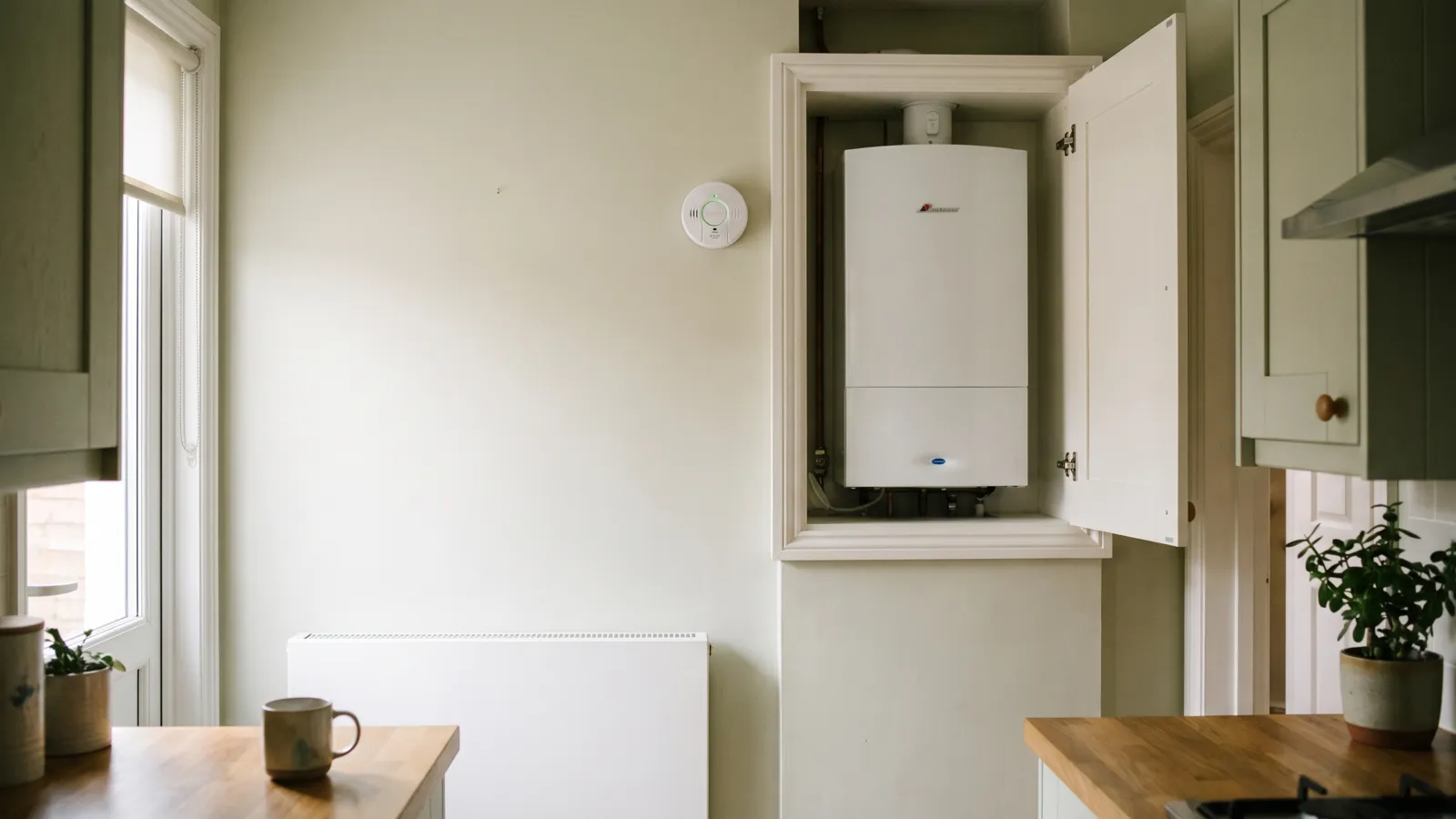
Beyond the bill, the basics hold. Have gas, oil and solid-fuel appliances checked by a registered engineer, and fit an audible carbon monoxide alarm meeting EN 50291 in each room with a fuel-burning appliance (Public Health England, 16 November 2015, on GOV.UK; UKHSA; nidirect). If you smell gas, call the free National Gas Emergency Service on 0800 111 999 in Great Britain; in Northern Ireland call the NI Gas Emergency Service on 0800 002 001. If anyone at home has reached State Pension age, is pregnant or has young children, or has a disability or long-term condition, join the Priority Services Register: your supplier and your network operator both keep one, and if you have different suppliers for gas and electricity you need to contact each (Ofgem). That is the Great Britain scheme; in Northern Ireland, ask your gas supplier about its care scheme, and if anyone relies on electricity for healthcare needs, join NIE Networks’ Customer Care Register.
Plan for what winter actually brings: power cuts, keeping warm if the heating fails and frozen pipes. Help differs by nation: England, Wales and Northern Ireland have the Winter Fuel Payment and the weather-triggered Cold Weather Payment; Scotland has replaced them with its own Pension Age Winter Heating Payment and an annual Winter Heating Payment paid whatever the weather (GOV.UK; mygov.scot; nidirect).
What not to do
Do not treat a storage percentage as a countdown: “30% full” or “a day and a half” describes one part of the system on one date. Do not buy bottled gas, paraffin heaters or a generator because of a headline, and never run a generator or barbecue indoors, because of the carbon monoxide risk. No official assessment published so far says household gas supply is at risk this winter; the one that covers it is due in October 2026.
Do not switch the heating off in cold weather to beat the price; cold homes carry their own health risk. Do not fix a tariff in a hurry because of a headline; compare it against the cap first. And do not read Centrica’s warnings as a neutral forecast: the company may be right about Rough, but it wants a government-backed support scheme before investing £2 billion of its shareholders’ money, the government says Rough’s future is “a commercial decision for Centrica” (The Telegraph, via Yahoo Finance, 27 August 2026), and while the government expects enough gas on an average winter’s day (DESNZ, December 2025), the National Gas assessment that covers this winter has not yet been published.
Common questions
Has Britain ever had a formal gas supply warning?
Yes, rarely. On 1 March 2018, during the “Beast from the East”, National Grid issued the first Gas Deficit Warning under that name, which dated from 2012. It was a call for shippers to bring more gas or use less, and Ofgem said such a warning “does not necessarily mean there is insufficient gas available”. Ofgem approved renaming it the Gas Balancing Notification in July 2019, with effect from 1 October 2019. DESNZ describes these notifications as rarely issued, and none was in force on 22 September 2026.
Is Rough closed?
Not as of 22 September 2026. On 21 April 2026 the North Sea Transition Authority granted Centrica a production and storage consent for Rough until 30 April 2027. But Centrica says the site is “practically empty” and will stay empty over the winter and close by spring unless the government includes it in a regulatory support scheme.
Will my gas be cut off this winter?
Nothing published so far says household supply is at risk. DESNZ said in December 2025 that it expects enough gas on an average winter’s day over the next four years, and for winter 2025/26 National Gas found a supply margin of 83 million cubic metres on a one-in-twenty peak day (DESNZ, December 2025). In February 2026 National Gas warned that margins are tightening and could turn marginally negative on its N-1 test without intervention; that test asks whether infrastructure could cope if the largest supply source failed, and is not a forecast that household supply will fail. The Winter Outlook covering 2026/27 is due from National Gas in October 2026; this page will be updated when it appears.
Why are gas bills rising if there is no shortage?
Because wholesale gas costs feed into the price cap whether or not supply is physically short. Ofgem says the rise reflects “higher wholesale gas prices as a result of the ongoing conflict in the Middle East”. Its cap for 1 October to 31 December 2026 is up 4% to £1,723 for a typical dual-fuel household paying by direct debit, with gas bills up 8% (announced 26 August 2026). The cap covers England, Scotland and Wales, not Northern Ireland.
Do these figures cover Northern Ireland?
Partly. The storage figures and the National Gas and NESO assessments cover Great Britain only; DESNZ’s supply-mix figures are UK-wide. Northern Ireland has a separate gas network regulated by the Utility Regulator, but it relies on gas supplies from Great Britain, which reach the island of Ireland through the Moffat interconnector, so GB supply still matters there. Ofgem’s price cap and the electricity VAT cut do not apply there. Its gas emergency number is 0800 002 001 rather than 0800 111 999.
Sources: DESNZ, Statutory Security of Supply Report 2025 (December 2025: storage capacity, deliverability, five-year supply mix, 2025/26 peak-day margin) · DESNZ, Energy Trends UK, January to March 2026 (published 30 June 2026) · DESNZ, Gas System in Transition: Security of Supply — consultation document (26 November 2025) · DESNZ, Gas System in Transition: Security of Supply — Interim Response (18 August 2026) · Hansard, Commons urgent question on Gas Storage Levels (13 January 2025) · National Gas, Understanding gas storage – beyond the headlines (30 April 2026) · National Gas, Securing Britain’s Energy policy paper (February 2026) · National Gas, 2026 Gas Summer Outlook (14 April 2026) · National Gas and NESO, Working together to keep Britain’s energy secure — joint Q&A (22 June 2026) · NESO, Mitigations to protect future security of gas supply identified — Gas Security of Supply Assessment (26 November 2025) · North Sea Transition Authority, Rough consent granted (21 April 2026) · Ofgem, Energy price cap will rise by 4% from October 2026 (26 August 2026) · Ofgem, Energy price cap unit rates and standing charges · Ofgem, UNC685 decision: renaming the Gas Deficit Warning as the Gas Balancing Notification (24 July 2019, effective 1 October 2019) · Ofgem, Join your supplier’s Priority Services Register · HMRC, Revenue and Customs Brief 10 (2026): Temporary zero rate of VAT for domestic electricity in Great Britain (8 September 2026) · Public Health England on GOV.UK, Reduce the risk of carbon monoxide poisoning over winter (16 November 2015) · UKHSA, Carbon monoxide: general information · NHS, Carbon monoxide poisoning · nidirect, Gas safety and carbon monoxide · firmus energy (24-hour NI Gas Emergency Service, 0800 002 001) · Phoenix Energy, Gas Supplier Care Schemes (Northern Ireland; gas emergency number 0800 002 001) · NIE Networks, Customer Care Register · Utility Regulator, Gas (Northern Ireland) · Mutual Energy, Gas (Scotland–Northern Ireland Pipeline) · GOV.UK, Cold Weather Payment (including Scotland’s Winter Heating Payment) · mygov.scot, Pension Age Winter Heating Payment · mygov.scot, Winter Heating Payment · nidirect, Winter Fuel Payment · nidirect, Cold Weather Payment · London Loves Business, “UK holds barely a day and a half of winter demand in storage” (9 March 2026) · Share Talk, “UK left with just two days of gas as Middle East flows falter” (8 March 2026) · The Telegraph via Yahoo Finance, “British Gas boss warns UK risks winter fuel shortage” (27 August 2026) · Mirror via AOL, “UK’s biggest gas storage site ‘practically empty’ – raising threat of even higher bills” (Graham Hiscott, 3 September 2026) · Energy Live News, “Lack of gas storage pushes prices to 3 year high” (3 September 2026) · BBC News — Ineos pauses production at Hull plants, blaming high UK gas prices (22 September 2026). PreparedBritain is independent and not affiliated with HM Government.
More viral headlines, checked against what was actually saidSee them all →Keep reading
All food & growing guides →Will there be food shortages this Christmas?
Most years bring a “Christmas shortage” headline. Here is what actually happened in 2021, 2022, 2023 and 2025, where…
Is there going to be a milk shortage in the UK?
A “milk shortage warning” is in the headlines as drought cuts what dairy farms produce. Deliveries are down a few…
Use-by vs best before: which food dates actually matter
The FSA's rule: use-by is safety, best before is quality. Which foods are genuinely fine past the date — tins, dried…