Best first aid kits & home safety alarms (2026)
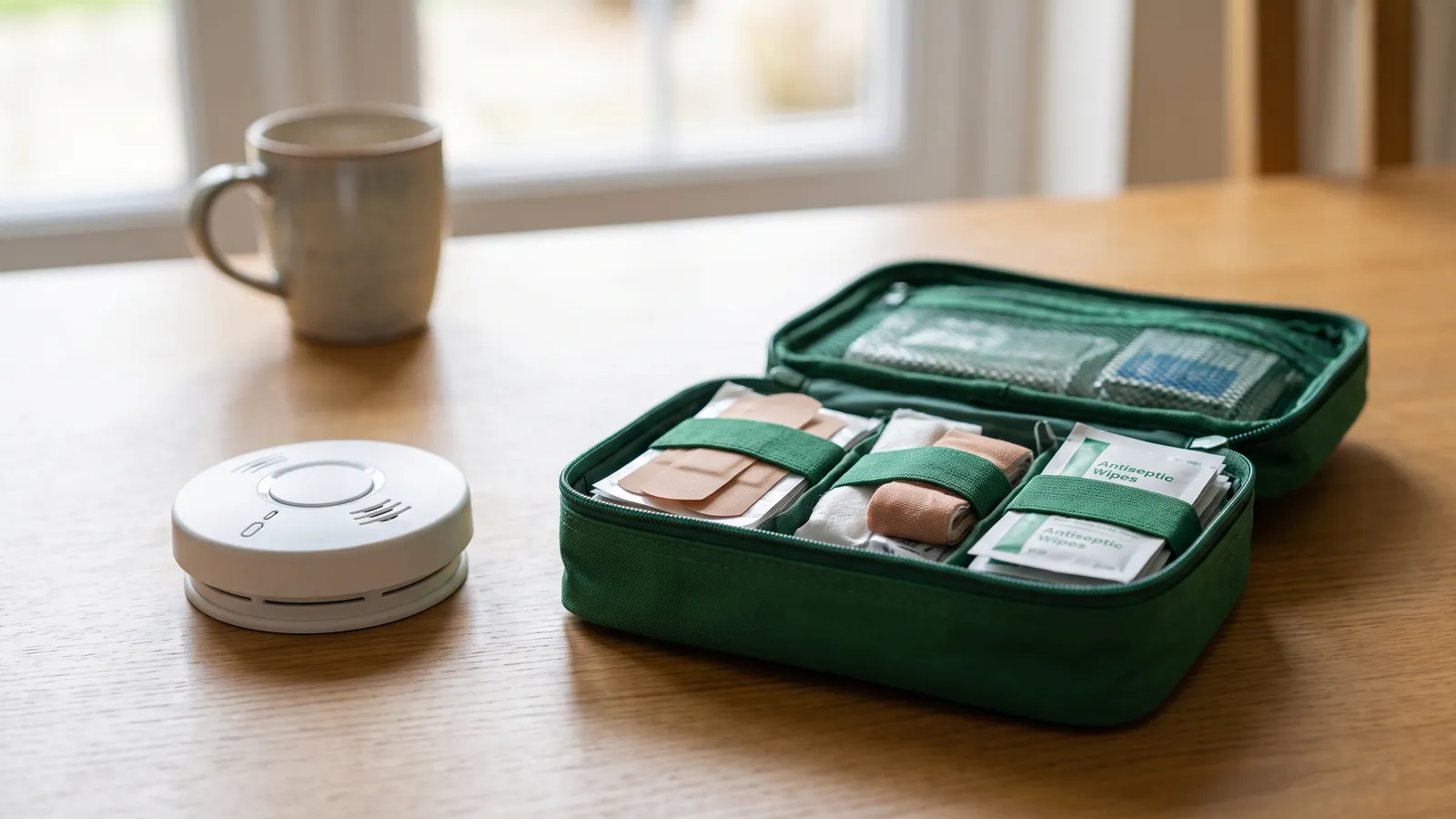
The dull kit that matters most. A proper first aid kit, a carbon-monoxide alarm and a smoke alarm are cheap, legally sensible, and the highest-value things on any preparedness list. Here's what to buy.
By Tom Calder · Updated 20 September 2026 · 6 products, 5 of 6 price-tracked
Before you buy
This is the dull cluster that outranks everything else on value. A CO alarm and working smoke alarms cost £40–60 all-in and are the items on this site most likely to actually save a life; the first aid kit handles everything smaller. Buy the alarms first, then the kit, then think about anything fancier.
For kits, BS 8599-1 is the British Standard worth knowing — it defines workplace and vehicle kit contents, and 'BS 8599-1 compliant' on a home kit means someone thought harder than 'fifty plasters'. What no kit includes: your medicines. Add paracetamol, antihistamines, any prescriptions and a thermometer, and check dates annually.
Placement beats specification for alarms: smoke alarms on every level (test monthly), a CO alarm in any room with a fuel-burning appliance — boiler, log burner, gas fire — and near where you'd run a camping stove's extension lead. Sealed 10-year-battery models remove the flat-battery failure mode entirely.
Top pick: FireAngel Carbon Monoxide Alarm. A dependable, BSI Kitemark-certified carbon monoxide alarm with a 10-year sealed battery, so there is nothing to remember beyond a monthly test. For most UK homes it is the sensible, no-fuss choice.
| Item | Type | Pieces | Price | |
|---|---|---|---|---|
| FireAngel Carbon Monoxide AlarmTOP PICK | Carbon monoxide (electrochemical sensor) | 1 | £22.00as of 20 Sep 2026, 12:29 BST · DetailsProduct prices and availability are accurate as of the date/time indicated and are subject to change. Any price and availability information displayed on Amazon.co.uk at the time of purchase will apply to the purchase of this product. | Check price → |
| FireAngel Smoke Alarm | Optical (photoelectric) | 1 | — | Check price → |
| St John Ambulance Large First Aid Kit | Workplace kit (BS 8599-1:2019 compliant), large | 152 | £44.50as of 20 Sep 2026, 12:29 BST · DetailsProduct prices and availability are accurate as of the date/time indicated and are subject to change. Any price and availability information displayed on Amazon.co.uk at the time of purchase will apply to the purchase of this product. | Check price → |
| Lifesystems Waterproof First Aid Kit | Waterproof watersports first aid kit | 32 | £21.99as of 20 Sep 2026, 12:29 BST · DetailsProduct prices and availability are accurate as of the date/time indicated and are subject to change. Any price and availability information displayed on Amazon.co.uk at the time of purchase will apply to the purchase of this product. | Check price → |
| Kitchen Fire Blanket | Fibreglass (BS EN 1869) | 1 | £11.50as of 20 Sep 2026, 12:29 BST · DetailsProduct prices and availability are accurate as of the date/time indicated and are subject to change. Any price and availability information displayed on Amazon.co.uk at the time of purchase will apply to the purchase of this product. | Check price → |
| Foil Emergency Survival Blankets (pack) | Aluminised Mylar foil (silver, both sides) | 4 | £6.02as of 20 Sep 2026, 12:29 BST · DetailsProduct prices and availability are accurate as of the date/time indicated and are subject to change. Any price and availability information displayed on Amazon.co.uk at the time of purchase will apply to the purchase of this product. | Check price → |
ⓘ As an Amazon Associate, PreparedBritain earns from qualifying purchases. We may earn a commission when you buy, or a fee when you request a quote, through our links — it never affects what we recommend. Amazon prices come from Amazon's own product data and show the date and time they were retrieved. Prices at other retailers are checked by us, less often. Prices and stock can change at any time, so always check the retailer's price before you buy.
FireAngel Carbon Monoxide Alarm
4.5Who it's for: Households wanting a fit-and-forget CO alarm to sit near any fuel-burning appliance.
A dependable, BSI Kitemark-certified carbon monoxide alarm with a 10-year sealed battery, so there is nothing to remember beyond a monthly test. For most UK homes it is the sensible, no-fuss choice.
- 10-year sealed lithium battery lasts the life of the alarm - no battery swaps or low-battery chirps to chase
- EN 50291 certified and BSI Kitemark approved, from an established UK fire-safety brand
- Loud 85dB alarm and simple to install; works standalone with no wiring
- The battery is sealed, so the whole unit must be replaced after about 10 years
- The standard model has no digital display, so you cannot see a live CO reading
Don't buy if You want a real-time digital ppm readout or a mains-wired, interlinked system - choose the digital FA3322 or a linked FireAngel Pro model instead.
as of 20 Sep 2026, 12:29 BST · Details
Product prices and availability are accurate as of the date/time indicated and are subject to change. Any price and availability information displayed on Amazon.co.uk at the time of purchase will apply to the purchase of this product.FireAngel Smoke Alarm
4.5Who it's for: Reliable everyday protection on landings, hallways and living rooms.
A dependable, no-fuss optical alarm from an established UK brand, with a sealed 10-year lithium battery so there are no 9V cells to replace or forget. It meets EN 14604 and does exactly what a good smoke alarm should, at a sensible price.
- Sealed 10-year lithium battery means fit-and-forget for the life of the unit, with no annual battery changes
- Optical sensor is well suited to the smouldering fires most common in homes, and is the type recommended for escape routes
- Well-priced, widely stocked in UK DIY and trade outlets, with a test/hush button and a low-battery sleep-easy function
- Standalone unit does not interlink, so if one alarm sounds the others stay silent
- Optical-only, so it responds more slowly than a heat or multi-sensor alarm to fast-flaming fires, and is not suitable for kitchens
Don't buy if Don't buy this standalone model if you need interlinked alarms across the house — a legal requirement in Scotland and for many rented and new-build homes — where the FireAngel interlinked or Pro Connected range is the right choice instead; and use a heat alarm, not this, in the kitchen.
St John Ambulance Large First Aid Kit
4.0Who it's for: Larger households, home offices or small workplaces wanting a comprehensive, standards-compliant kit from a trusted name.
A properly stocked, British Standard-compliant kit backed by the country's best-known first-aid charity, and it feels it: durable case, quality dressings and sensible contents. For a single small household it's more kit than you strictly need, but the completeness and provenance are genuinely reassuring.
- Complies with BS 8599-1:2019 and comes from St John Ambulance, so the contents and quality are trustworthy rather than guesswork
- Comprehensive coverage - burn dressings, foil blankets, eye pads, wound wipes, gloves and 100 plasters in a durable, wall-mountable box
- Rated for 100+ people in low-risk settings, so it comfortably covers a busy family home or a small team
- Costs noticeably more than a generic home first-aid kit, and much of the piece count is plasters
- It's a wall-box workplace kit, not a compact grab-bag, so it's less suited to the car or a rucksack
Don't buy if You only want a small grab-and-go kit for the car, a day pack or a one- or two-person household - a smaller SJA Universal or a compact kit will do the job for less money and take up less space.
as of 20 Sep 2026, 12:29 BST · Details
Product prices and availability are accurate as of the date/time indicated and are subject to change. Any price and availability information displayed on Amazon.co.uk at the time of purchase will apply to the purchase of this product.Lifesystems Waterproof First Aid Kit
4.0Who it's for: Kayaking, canoeing and other outdoor trips where a kit is likely to get wet.
A well-made, genuinely waterproof kit with CE-certified contents, sensibly organised for watersports and outdoor use. Solid value if wet-weather durability matters more than sheer piece count.
- Genuinely waterproof outer case that keeps contents dry in canoes, kayaks and wet weather
- CE-certified contents organised by category, with watersports-relevant items like a resuscitation face shield and burn gel
- Compact and light enough to stow in a drybag or rucksack
- Contents are geared to outdoor/watersports use rather than a comprehensive home or family kit
- Costs more than a basic home first aid kit for a fairly modest 32-item count
Don't buy if You want a large home or vehicle first aid kit to cover a whole household. This is a compact, waterproof grab kit for outdoor and water activities, not a full domestic kit.
as of 20 Sep 2026, 12:29 BST · Details
Product prices and availability are accurate as of the date/time indicated and are subject to change. Any price and availability information displayed on Amazon.co.uk at the time of purchase will apply to the purchase of this product.Kitchen Fire Blanket
4.0Who it's for: A cheap, no-maintenance backstop for small hob and pan fires, mounted by the kitchen door.
A sensible, low-cost bit of kit that smothers a small pan or hob fire in seconds when an extinguisher would be overkill. Pay the extra pound or two for one certified to BS EN 1869 (look for the Kitemark) and mount it near an exit, not above the cooker.
- Smothers small cooking fires instantly with no mess, no servicing and a shelf life of years
- Cheap enough to fit every kitchen, and doubles as a wrap for clothing that has caught alight
- Wall-mounts with quick-release tabs so it is ready to grab one-handed
- Quality varies widely; the cheapest uncertified marketplace blankets can scorch or burn through
- Most are effectively single-use and should be binned after any real fire
Don't buy if Skip the bargain-bin uncertified blankets from marketplace sellers, and never rely on any blanket for a large or spreading fire; if flames are past a small pan, get everyone out and call 999.
as of 20 Sep 2026, 12:29 BST · Details
Product prices and availability are accurate as of the date/time indicated and are subject to change. Any price and availability information displayed on Amazon.co.uk at the time of purchase will apply to the purchase of this product.Foil Emergency Survival Blankets (pack)
4.0Who it's for: A near-free line item that belongs in every grab bag, car and first-aid kit.
For a couple of pounds these do exactly one job well: reflect back most of your body heat to fend off shock and hypothermia while you wait for help. Treat them as a sensible backstop, not a substitute for proper warm clothing or a real sleeping bag.
- Extremely cheap and light, so there's little reason not to stash one in every bag, car and kit
- Packs down smaller than a phone yet opens to a full adult 210 x 130cm, reflecting around 90% of body heat
- Also work as an emergency windbreak, rain sheet or ground signal, adding versatility for the price
- Thin and prone to tearing; most are effectively single-use once unfolded and hard to refold
- Noisy, sweaty and offers little padding from cold ground on their own
Don't buy if Don't rely on one as your main cold-weather layer for planned hikes or camping in exposed conditions. For that, spend more on a reusable Blizzard-style bag or a proper bivvy; the foil sheet is a get-you-through-an-emergency item, not a comfortable overnight solution.
as of 20 Sep 2026, 12:29 BST · Details
Product prices and availability are accurate as of the date/time indicated and are subject to change. Any price and availability information displayed on Amazon.co.uk at the time of purchase will apply to the purchase of this product.The Emergency Kit Checklist
The GOV.UK Prepare essentials on one printable page — tick them off as you go and keep it with the kit. Free, no catch.
Download it straight away. We'll also send the occasional briefing when something genuinely matters — severe weather, live incidents, real price drops. Nothing else.
We verify every product's specifications against at least two independent sources, re-check its UK price and stock on a schedule where we can track it automatically, and cross-check safety-relevant claims against official guidance. Where we've bought and used a product ourselves we say so on its review; where we haven't, our verdict is a considered spec-and-evidence comparison, not a hands-on test — and commissions never change a ranking either way. Read our full methodology →
Guides that go with this
A simple, practical household emergency plan — the official GOV.UK Prepare approach: contacts, meeting points,…
Medicine supply gaps are common and usually managed. The safe, calm response — order in good time, never stock…
Common questions
What's the difference between a £10 and a £30 first aid kit?
Usually dressing quality and range — the cheap kit is plasters and little else, the better one adds proper wound dressings, bandages, gloves and tools. BS 8599-1 compliance is the quick quality filter.
What do first aid kits never include?
Medicines. Painkillers, antihistamines, children's doses and your prescriptions all need adding, along with a thermometer. The kit is the hardware; the pharmacy layer is yours.
Where should a carbon monoxide alarm go?
In every room with a fuel-burning appliance — boiler, gas fire, log burner — placed at head height, one to three metres from the appliance, per the manufacturer's instructions. Sealed 10-year models save the battery ritual.
How many smoke alarms do I need?
At least one per storey, ideally in hallways and landings on the escape route, tested monthly. In rented homes in England landlords must provide them on every storey by law — but testing is on you.
Should I keep a fire blanket?
In the kitchen, yes — mounted where you can grab it without reaching over the hob. Use it on small contained fires only if it's safe to try; if a fire is growing, get everyone out, close doors behind you and call 999. Never throw water on a fat fire.
How often should I check the first aid kit?
Once a year alongside the rest of your emergency kit: replace dated dressings and medicines, restock anything used, and check the alarms' test buttons while you're at it.