Basic first aid in the UK: the steps for the emergencies that matter most
Basic first aid for UK households, step by step from the official guidance: the primary survey, calling 999 or 111, adult CPR and defibrillators, the recovery position, choking, severe bleeding, stroke, heart attack and hypothermia.
If someone is unresponsive and not breathing normally, call 999 (or 112) on speakerphone and start CPR straight away: push hard and fast in the centre of the chest, at least 5 cm but no more than 6 cm deep, at 100 to 120 compressions a minute. If you haven’t been trained in rescue breaths, give continuous compressions; the 999 call handler will talk you through it. Send someone for a defibrillator: anyone can use one, and it tells you what to do. Someone who is unresponsive but breathing normally goes in the recovery position. For choking, give five back blows then up to five abdominal thrusts. For severe bleeding, press firmly on the wound. For a stroke, use FAST and call 999. Use 111 when it’s urgent but not life-threatening, or you’re not sure. Children and babies need different steps: see St John Ambulance or the British Red Cross. Reading this is a start, not training: a short course is the thing that makes it stick.
By Tom Calder · Updated 4 November 2026 · Sourced to St John Ambulance, Resuscitation Council UK, the NHS, NHS 111 and the British Red Cross. This page is a summary of their guidance, not a substitute for a first aid course.
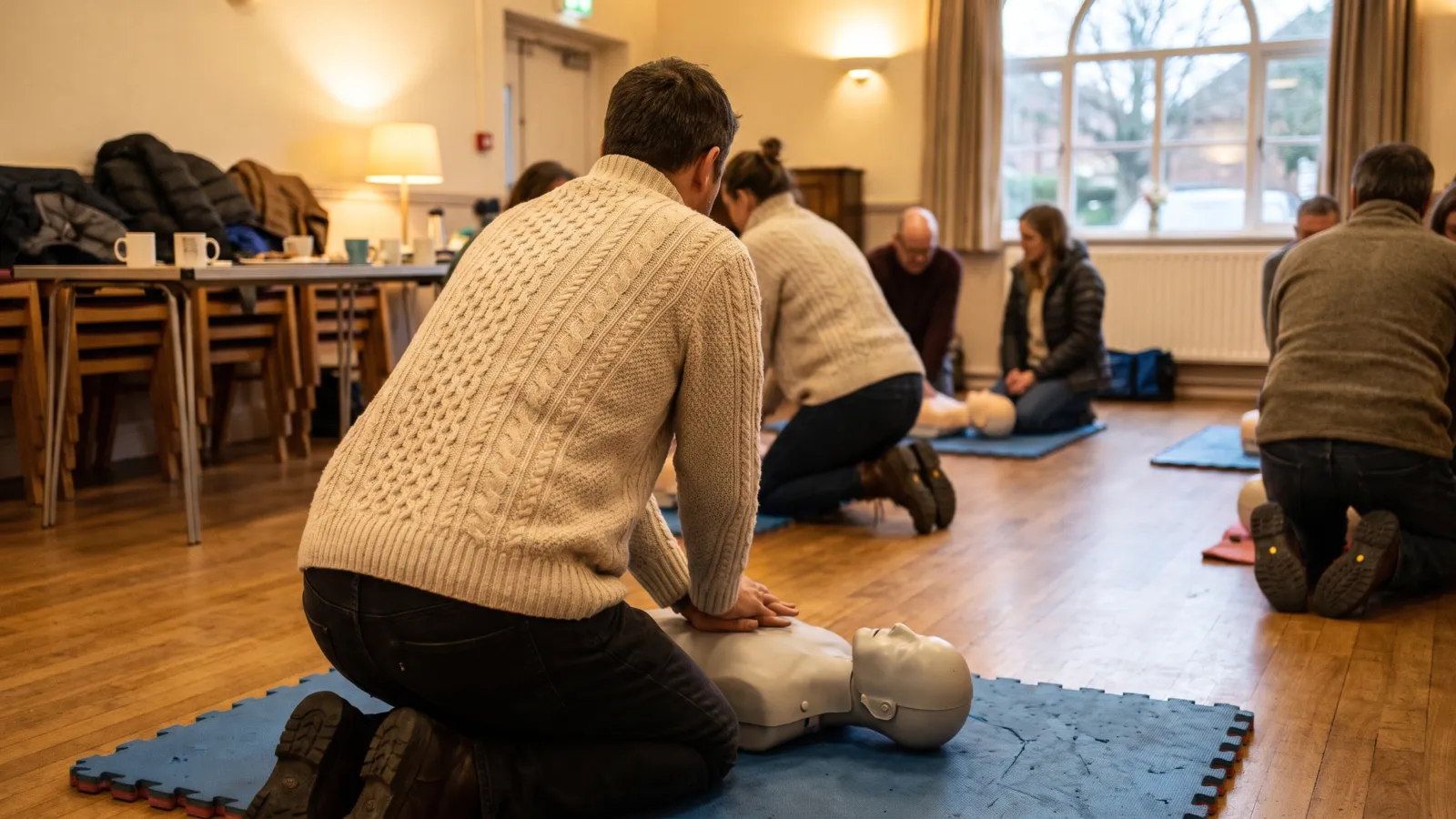
Danger in first aid: start with the primary survey
St John Ambulance teaches a short sequence called the primary survey, DR ABCDE. It is a quick way to find and deal with anything life-threatening, in order of priority. American material sometimes uses C-A-B. The UK steps below are the ones to follow here.
D for Danger. Before you go near anyone, make sure the area is safe for you: traffic, fire, electricity, gas, water. A second casualty helps no one. R for Response. Kneel by their chest, gently shake their shoulders and ask loudly whether they’re all right and can open their eyes. If there’s no response, shout for help, and have a helper call 999 or 112. If you’re on your own, put your phone on speaker and call yourself.
A for Airway. Put one hand on their forehead and tilt the head back, then use two fingers of the other hand to lift the chin. B for Breathing. Keeping the airway open, look, listen and feel for normal breathing for up to 10 seconds. Occasional, irregular gasps are not normal breathing: St John Ambulance says they are common in the early stages of cardiac arrest. If they are not breathing normally, start CPR (below). If they are unresponsive but breathing normally, put them in the recovery position and call 999 or 112.
C for Circulation. Look for severe bleeding and control it with direct pressure. If there is life-threatening bleeding, St John Ambulance says to deal with it with direct pressure before you manage the airway. Once anything life-threatening is dealt with, the later steps are checking for things like confusion, stroke signs or a head injury, and looking for hidden injuries or a medical alert bracelet.
999 or 111: which number to call
Call 999 for a life-threatening emergency: someone unresponsive or not breathing normally, choking that hasn’t cleared, severe bleeding, signs of a stroke or a heart attack. 112 reaches the same emergency services. The call handler will ask where you are, what has happened and for a contact number, and can give you first aid instructions while help is on the way. Put the phone on speaker so your hands are free to follow them. The NHS says calling 999 does not always mean an ambulance is sent: you may be told to go to A&E or somewhere else instead.
Use NHS 111 when you think you need medical help now but it isn’t life-threatening, or you’re not sure whether to call 999. In England you can use 111 online, the NHS App or call 111; there’s text relay on 18001 111, British Sign Language through signvideo.co.uk/nhs111, and you can ask for an interpreter. For a child under 5, call 111 rather than using 111 online. In Scotland it’s NHS 24 on 111, in Wales NHS 111 Wales, and in Northern Ireland nidirect points you to the right service. If in doubt about a life-threatening problem, call 999.
Adult CPR, step by step
Resuscitation Council UK says to suspect cardiac arrest in anyone who is unresponsive, to treat gasping or other abnormal breathing as a sign of it, and to start CPR if in doubt. Call 999 straight away on speaker. The call handler will give CPR instructions: they assume you haven’t been trained, so they’ll talk you through chest compressions only, and through compressions with rescue breaths if you tell them you know how. They’ll also ask whether there’s a defibrillator nearby and can direct someone to the nearest one.
Start CPR where they are. It works best on a firm surface, but Resuscitation Council UK’s 2025 guidance is not to move someone from a bed to the floor: start on the bed. Kneel beside them. Put the heel of one hand on the centre of their chest, put your other hand on top and interlock your fingers. Keep your arms straight with your shoulders directly above your hands, and press down at least 5 cm but not more than 6 cm, letting the chest come back up fully after each push without leaning on it. Go at 100 to 120 compressions a minute (about two a second), with as few pauses as possible, and follow the call handler’s instructions on speed.
If you haven’t been trained in rescue breaths, or you’re unable or unwilling to give them, do continuous chest compressions. If you have been trained, give 30 compressions then 2 rescue breaths, and repeat. Keep going until emergency help arrives and takes over, the person shows signs of life and starts breathing normally, a defibrillator tells you to stop while it analyses, or you’re too exhausted to continue. If there’s a helper, swap every one to two minutes with as little interruption as possible.
If you’re alone, don’t leave the person to go and look for a defibrillator. If someone else is there, send them for one while you keep pushing.
NewSee this for your own homeHome Alerts: your postcode's power cuts, warnings and floods, on one screen. Free for your own home. Sign up in a minute.Start free →Using a defibrillator (AED)
Resuscitation Council UK is clear that anyone can use an automated external defibrillator (AED), and no training is needed. Switch it on (some switch on when you open the lid) and do what its voice or screen tells you. While you keep doing compressions, a helper bares and dries the chest and sticks the pads on in the positions shown on them. If a bra is in the way of the pads, remove it.
When the machine says it is analysing, make sure nobody is touching the person. If it advises a shock, tell everyone to stand back and press the shock button when told (fully automatic models give the shock themselves after a warning). Straight after the shock, or if no shock is advised, restart compressions and keep following the prompts. If the person starts breathing normally but stays unresponsive, put them in the recovery position and leave the pads on.
The Circuit is the national defibrillator network, brought to you by the British Heart Foundation with partners including NHS England, Resuscitation Council UK and St John Ambulance. It gives NHS ambulance services details of defibrillators across the UK, which is how the 999 call handler can direct your helper to the nearest registered one. Some ambulance services also use GoodSAM, an app that alerts nearby trained responders to a suspected cardiac arrest.
Children and babies are different
CPR, choking and the recovery position all have different steps for children and for babies under one year old, starting with how you check them and how hard you press. We don’t summarise them here. Use the official step-by-step pages from St John Ambulance, or the British Red Cross’s free first aid learning for babies and children, and if it happens, the 999 call handler will guide you.
The recovery position
Use the recovery position for an adult who is not responding to you but is breathing normally. Kneel beside them, straighten their legs and take off their glasses or anything bulky in their pockets. Put the arm nearest you at a right angle to their body, elbow bent and palm up. Bring their other arm across their chest and hold the back of that hand against the cheek nearest you.
With your other hand, pull their far knee up so the foot is flat on the floor. Keeping their hand pressed to their cheek, pull on the far leg to roll them towards you onto their side, then adjust the top leg so that it is bent at a right angle. Tilt the head back and lift the chin to keep the airway open. Call 999 or 112 if no one has yet, and keep checking their response until help arrives. If they’re in this position for 30 minutes, roll them onto the other side.
If you suspect a spinal injury, St John Ambulance says to use the recovery position only if they can’t keep their airway open, keeping the head and spine in line as you turn them; with a helper, one of you steadies the head while the other turns.
Choking (adult)
Ask, “Are you choking?” If they can speak, cough or breathe, encourage them to keep coughing and remove anything you can see in their mouth. If they can’t, act straight away.
Have them lean forward, support their upper body with one hand, and give five sharp back blows between the shoulder blades with the heel of your other hand, checking their mouth after each one. If that hasn’t cleared it, stand behind them, put your arms round their waist, make a fist and place it between their belly button and the bottom of their chest. Grasp it with your other hand and pull sharply inwards and upwards, up to five times, checking their mouth each time.
If it still hasn’t cleared, call 999 or 112 straight away and keep repeating five back blows and five abdominal thrusts until help arrives. If they become unresponsive, start CPR.
Severe bleeding: direct pressure first
Press directly and firmly on the wound, using a sterile dressing if you have one or a clean, non-fluffy cloth if you don’t. Get a helper to call 999 or 112; on your own, use your phone on speaker so you can keep pressing. Secure the dressing firmly with a bandage to keep the pressure on, but not so tight that it cuts off the circulation. If there’s an object in the wound, don’t pull it out: press on either side of it instead.
Heavy blood loss can lead to shock, so help them lie down, raise their legs and keep them warm while you wait.
Tourniquets: St John Ambulance says most bleeding can be controlled with direct pressure, and that a tourniquet is for catastrophic bleeding from a limb that direct pressure hasn’t stopped. If that happens, the 999 call handler may tell you to use one, or to improvise one; follow their instructions, and if you’re unsure, ask them. A tourniquet is painful, must never be placed on a joint, and once it is on it should not be loosened.
Burns and scalds
Hold the burn under cool running water for 20 minutes, as soon as possible (within 3 hours). Don’t put creams, oils or butter on it. Once it has cooled, lay cling film over it rather than wrapping it round. Our burns guide has the full NHS sequence and the signs that mean 999 or A&E.
Stroke: think FAST
The NHS uses the word FAST. Face: has it dropped on one side; can they smile? Arms: can they lift both arms and keep them there? Speech: is it slurred or muddled? Time: time to call 999. The NHS says to call 999 even if the symptoms have stopped, if they happened in the last 24 hours.
While you wait, keep them comfortable and supported, and reassure them. St John Ambulance says not to give them anything to eat or drink, because swallowing may be difficult. Keep checking their response, and if they become unresponsive and stop breathing normally, start CPR.
Heart attack
A heart attack is not the same as a cardiac arrest. The NHS lists chest pain that can feel crushing or squeezing and may spread to the arms, neck and jaw; shortness of breath; feeling or being sick; sweating; and pale, blue or grey skin. Call 999 and say you think it’s a heart attack. Nobody should drive themselves to A&E.
Help them sit on the floor, knees bent, with their back, head and shoulders supported. St John Ambulance says to give one 300mg aspirin tablet to chew slowly, unless they’re under 16 or allergic to aspirin, and to let them take their own angina medication if they have some. Keep checking them, and if they become unresponsive and stop breathing normally, start CPR.
Hypothermia
Signs include shivering; pale, cold, dry skin that may turn blue or grey; slurred speech; slow breathing; and tiredness or confusion. The NHS says to call 999 or go to A&E if you think someone has hypothermia.
Get them indoors or somewhere sheltered as quickly as possible. Take off any wet clothing and wrap them in a blanket, sleeping bag or dry towel, with their head covered; outdoors, insulate them from the ground and don’t leave them alone. If they’re fully awake, give a warm non-alcoholic drink and something sugary such as chocolate.
Don’t use a hot bath, hot water bottle or heat lamp to warm them, don’t rub their arms, legs, hands or feet, and don’t give them alcohol.
A first aider checklist for home
Know your address, and where your nearest public defibrillator is. Keep a phone charged. Keep a basic first aid kit where everyone in the house can find it, with gloves, dressings, a bandage and scissors, plus any medicines the household relies on. Our checklist covers what to put in it, and our kit page compares ready-made kits.
Trauma kits and emergency medical kits with tourniquets, chest seals and haemostatic gauze are designed for catastrophic bleeding. St John Ambulance says most bleeding can be controlled with direct pressure, so for an ordinary household a well-stocked basic kit and the skills on this page do far more.
Where to learn first aid properly
The British Heart Foundation’s RevivR is a free online CPR course that takes about 15 minutes; all you need is a cushion and your phone or tablet. The British Red Cross has free step-by-step guides, videos and a free first aid app, runs free first aid workshops (which don’t give a qualification), and runs courses you can book. St John Ambulance runs first aid courses across the country.
Practising compressions on a manikin, with someone correcting your hand position and depth, is what makes this stay with you. If you can, book a session with someone else in your household.
Common questions
What are the basic steps of first aid?
UK first aid starts with the primary survey: check for Danger, check for a Response, open the Airway, check Breathing for up to 10 seconds, then look for severe bleeding (Circulation). If someone is unresponsive and not breathing normally, call 999 and start CPR. If they’re unresponsive but breathing normally, put them in the recovery position and call 999.
How fast and how deep should CPR compressions be?
For an adult, Resuscitation Council UK says at least 5 cm but not more than 6 cm deep, at 100 to 120 compressions a minute, letting the chest come back up fully between each one. The 999 call handler will help you keep the pace.
Do I have to give rescue breaths?
No. If you haven’t been trained, or you’re unable or unwilling to give rescue breaths, give continuous chest compressions. If you are trained, the adult ratio is 30 compressions to 2 breaths.
Can I use a defibrillator without training?
Yes. Resuscitation Council UK says anyone can use an AED and no training is needed. Switch it on and follow its spoken or on-screen instructions. Keep doing CPR while the pads go on, and make sure nobody touches the person while it analyses or gives a shock.
What is C-A-B in CPR?
C-A-B (compressions, airway, breathing) is an order you’ll see in American material. In the UK, St John Ambulance teaches a quick check first: danger, response, open the airway and check breathing for up to 10 seconds. Resuscitation Council UK says to call 999 without delay for anyone who is unresponsive, and if in doubt, to assume cardiac arrest and start chest compressions.
When should I call 111 instead of 999?
Call 999 for a life-threatening emergency. Use NHS 111 (online, the NHS App or by phone) when you need medical help urgently but it isn’t life-threatening, or you’re not sure whether to call 999. In Scotland 111 is NHS 24; Wales has NHS 111 Wales.
Do I need a trauma kit at home?
For most households, no. Tourniquets, chest seals and haemostatic dressings are for catastrophic bleeding. St John Ambulance says most bleeding can be controlled with firm direct pressure, which needs only a dressing or a clean cloth. A well-stocked basic first aid kit covers ordinary household needs.
Sources (21)
- St John Ambulance — Primary survey (DR ABCDE), read 4 November 2026
- St John Ambulance — How to do CPR (adult), read 4 November 2026
- Resuscitation Council UK — 2025 Adult basic life support guidelines (depth at least 5 cm but not more than 6 cm; 100–120 per minute; speaker phone; dispatcher-assisted CPR; anyone can use an AED), read 4 November 2026
- St John Ambulance — How to use a defibrillator (AED), read 4 November 2026
- St John Ambulance — How to put someone in the recovery position, read 4 November 2026
- St John Ambulance — Choking (adult), read 4 November 2026
- St John Ambulance — Severe bleeding, read 4 November 2026
- St John Ambulance — How to respond to a life-threatening bleed (tourniquets), read 4 November 2026
- NHS — Stroke: symptoms (FAST), read 4 November 2026
- St John Ambulance — Stroke, read 4 November 2026
- NHS — Heart attack, read 4 November 2026
- St John Ambulance — Heart attack (aspirin 300mg, not under 16 or if allergic), read 4 November 2026
- NHS — Hypothermia, read 4 November 2026
- St John Ambulance — Hypothermia, read 4 November 2026
- NHS — When to call 999, read 4 November 2026
- NHS — When to use NHS 111, read 4 November 2026
- GOV.UK — 999 and 112: the UK's national emergency numbers, read 4 November 2026
- British Red Cross — Learn first aid (free guides, app and workshops), read 4 November 2026
- British Heart Foundation — RevivR, learn CPR in 15 minutes, read 4 November 2026
- The Circuit — the national defibrillator network, read 4 November 2026
- GoodSAM — emergency response platform (cardiac responder alerts), read 4 November 2026
PreparedBritain is independent and not affiliated with HM Government.
The Emergency Kit Checklist
The GOV.UK Prepare essentials on one printable page — tick them off as you go and keep it with the kit. Free, no catch.
Download it straight away. We'll also send the occasional briefing when something genuinely matters — severe weather, live incidents, real price drops. Nothing else.
Latest from our live data
All stories → News · 3 NovVampire devices: the '£200' is 13 gadgets added up; turning a home off standby saves about £45
 News · 2 NovCold Weather Payment opens: £25 a freezing week; last winter 40 of 71 stations triggered none
 News · 31 OctEarliest polar vortex breakdown on record forecast for November: what it means for the UK
Keep reading
All fire, gas & first aid guides →Why is my smoke alarm beeping or chirping? How to stop it, and how to test it
What a smoke alarm’s chirp, beeps and full alarm each mean, how to stop the chirping safely, how to find which…
Where to put smoke alarms, and hardwired vs interlinked alarms: the UK rules
Where to fit smoke and heat alarms in a UK home, the difference between hardwired, battery and sealed 10-year…
Basic survival skills for UK walkers and drivers: staying warm, sheltered and found
The survival skills UK rescue teams actually ask for: plan and tell someone, stay warm and out of the wind, use a…
