Where to put smoke alarms, and hardwired vs interlinked alarms: the UK rules
Where to fit smoke and heat alarms in a UK home, the difference between hardwired, battery and sealed 10-year alarms, why interlinking matters, and what the law asks of owners and landlords in Scotland, England, Wales and Northern Ireland.
Fit at least one smoke alarm on every level of your home, on the ceiling in the hallway and on each landing, and keep it about 30cm from walls and lights. Don’t put smoke alarms in kitchens or bathrooms; a heat alarm goes in the kitchen. Interlinked alarms all sound when one detects a fire, and they can be wired or linked by radio. Every home in Scotland must have interlinked alarms. In England, Wales and Northern Ireland the legal duties fall on landlords, not owner-occupiers.
By Tom Calder · Updated 4 November 2026 · Sourced to GOV.UK fire safety advice, the Scottish Government, Scottish Fire and Rescue Service, London Fire Brigade, legislation.gov.uk, Welsh Government, the NI Department for Communities and nidirect, read on 4 November 2026
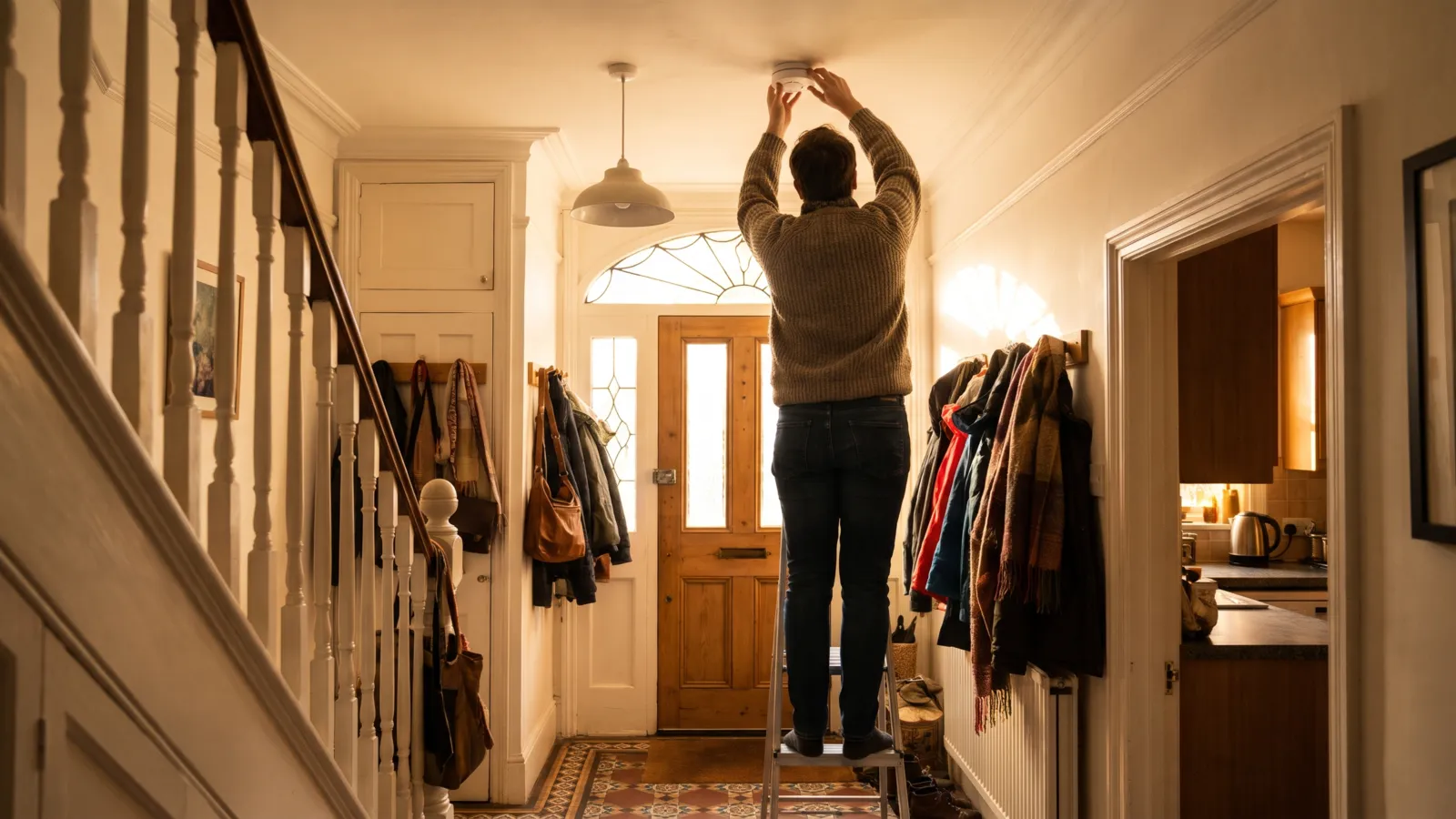
Where to put smoke alarms: every level, hallways and landings
GOV.UK’s fire safety advice starts with one rule: “Fit at least one smoke alarm on every level of your home.” It says the ideal position is “on the ceiling, in the middle of a room, and on the hallway and landing”. Those are the escape routes, so an alarm there hears smoke from the rooms off it and wakes people before the way out fills.
One per level is the minimum, not the target. London Fire Brigade says smoke alarms “should be fitted in all rooms where a fire may start”, and adds: “Don’t just fit a smoke alarm in your hall and landing – also fit them in any room where a fire can start.” Its examples include any room where you smoke or leave appliances plugged in, and Scottish Fire and Rescue Service says to fit smoke alarms in the bedrooms too. If anyone at home would be slow to get out, extra alarms buy them time.
Smoke alarms stay out of kitchens and bathrooms. GOV.UK says: “Don’t put alarms in or near kitchens or bathrooms where smoke or steam can set them off by accident.” False alarms matter, because an alarm that keeps going off when you cook tends to end up with its battery out. For the kitchen, GOV.UK says “Heat alarms can detect fires in kitchens where smoke alarms should not be placed.”
Recommended position: on the ceiling, away from walls and lights
Smoke rises and spreads across the ceiling first, so that is where an alarm sees it soonest. Scottish Fire and Rescue Service says: “The best place for a smoke alarm is on the ceiling.” It adds: “Try and keep them 30cm (12 inches) away from any walls, lights, doors, heating or air-conditioning vents.”
London Fire Brigade allows one exception: “Fit smoke alarms on a ceiling (or high up on a wall, if the instructions state it is suitable for wall mounting).” Only wall-mount an alarm whose instructions say it can be. For an open-plan ground floor, the Scottish Government’s guidance for its own rules says an alarm “should be no more than 7.5 metres from any point in the room”, and that it should be a heat alarm if the space includes the kitchen. It is a useful rule of thumb anywhere.
Hardwired, battery or sealed 10-year smoke alarms
There are three kinds. Standard battery alarms are, in GOV.UK’s words, “the cheapest option, but the batteries need to be replaced every year.” Sealed 10-year alarms have a battery built in for the life of the alarm: GOV.UK says “Ten-year sealed battery smoke alarms are the best option,” and London Fire Brigade also advises choosing one with a 10-year or long-lasting sealed battery. Hardwired (mains) alarms run off your home’s electricity.
GOV.UK says “Mains-powered alarms are powered by your home power supply and have a back-up battery in case of a power cut,” and that “They need to be installed by a qualified electrician and, like battery alarms, they do require testing.” Building Regulations in England expect hardwired alarms in new homes: Approved Document B says smoke alarms “should be mains operated” and have “a standby power supply, such as a battery (rechargeable or non-rechargeable) or capacitor”, to at least Grade D2 Category LD3 of BS 5839-6 for most homes, the British Standard for fire alarms in homes. Existing homes don’t have to be upgraded to match, unless building work adds a new habitable room above or below the ground floor, such as a loft conversion.
Whatever the type, the upkeep is the same. GOV.UK says to “Test your smoke alarms at least monthly” by pressing the button until the alarm sounds; Scottish Fire and Rescue Service and nidirect go further and say weekly. A ten-year alarm is replaced whole after ten years. If an alarm goes off by mistake, GOV.UK says never disconnect it or take the batteries out.
NewSee this for your own homeHome Alerts: your postcode's power cuts, warnings and floods, on one screen. Free for your own home. Sign up in a minute.Start free →Interlinked smoke alarms, wired or wireless, and why they matter
Interlinked alarms are connected so that, as GOV.UK puts it, “when one alarm detects a fire they all go off together.” A fire that starts in the kitchen at night sets off the alarm on the landing outside your bedroom, instead of sounding behind two closed doors. GOV.UK says this “is useful if you live in a large house or over several levels”, and London Fire Brigade notes it matters most where someone may be slower to escape.
Alarms can be interlinked by cable between mains alarms, or wirelessly by radio. The Scottish Government says both mains-wired and sealed-battery alarms that meet its rules are “interlinked by radio frequency and do not need WiFi.” Radio interlinking means no new cables between floors, which is why wireless interlinked sealed-battery sets are the common choice for homeowners who don’t want an electrician. Interlinked alarms usually have to come from one maker’s compatible range, so check before mixing brands.
Interlinking a heat alarm in the kitchen with the smoke alarms elsewhere is what Scotland’s rules and Northern Ireland’s private-tenancy rules require, and it is sensible anywhere. For people who are deaf or hard of hearing, GOV.UK says strobe light and vibrating pad alarms are available.
Smoke alarm regulations in Scotland: interlinked alarms in every home
Scotland has the strictest rules, and they cover every home, owned or rented. From February 2022 the Scottish Government says “Every home in Scotland must have interlinked fire alarms.” Each home needs one smoke alarm in the living room or the room you use most, one smoke alarm in every hallway and landing, and one heat alarm in the kitchen. “All smoke and heat alarms should be attached to the ceiling and be interlinked.”
Two kinds of alarm meet the rules: sealed tamper-proof alarms with long-life lithium batteries “which can last up to 10 years”, or mains-wired alarms, which “must be fitted by a qualified electrician”. Where there is a carbon-fuelled appliance such as a boiler, fire or stove, or a flue, you also need a carbon monoxide alarm in that room; it doesn’t need to be linked to the smoke alarms, and gas cookers and hobs don’t need one.
Paying for the alarms is the responsibility of the homeowner or landlord; council and housing association landlords must make sure their tenants’ homes comply. Alarms in different flats don’t need to be linked to each other. The standard is part of the tolerable standard for housing, and the Scottish Government’s guidance says councils may use their powers to require owners to carry out work, with any action expected to be “proportionate, rational and reasonable.” The Scottish Government put the cost for an average three-bedroom house at around £220, and lower-income older or disabled homeowners may get help from Care and Repair Scotland.
England: the Smoke and Carbon Monoxide Alarm (Amendment) Regulations 2022
In England the law is about rented homes. Since 1 October 2022 the Smoke and Carbon Monoxide Alarm (Amendment) Regulations 2022 have applied to both private landlords and social landlords (registered providers of social housing). A landlord must make sure there is a smoke alarm on every storey where there is a room used as living accommodation, and a carbon monoxide alarm in any room used as living accommodation that has a fixed combustion appliance, other than a gas cooker.
The landlord must check the alarms are working on the day a new tenancy begins, and repair or replace an alarm as soon as reasonably practicable once told it is faulty. The regulations don’t say what type of alarm to use, so battery, sealed or mains alarms all count, and interlinking isn’t required. Councils enforce them and can impose a civil penalty of up to £5,000 per breach on a landlord who doesn’t comply with a remedial notice.
The government’s guidance is plain that “These regulations do not apply to owner occupiers.” If you own your home in England, no law makes you fit a smoke alarm, but the fire service advice above applies to everyone, and new homes and some building work must meet the Building Regulations.
Wales and Northern Ireland: what landlords must fit
In Wales, the Renting Homes (Wales) Act 2016 changed how all landlords rent homes on 1 December 2022. Under the Renting Homes (Fitness for Human Habitation) (Wales) Regulations 2022, a landlord must make sure there is a working smoke alarm on every storey, each one connected to the electrical supply and interlinked with the other mains alarms. A carbon monoxide alarm must be in any room with a gas, oil or solid-fuel appliance. A home that fails these rules is treated as unfit for human habitation. These are renting rules; they don’t place a duty on owner-occupiers.
In Northern Ireland, the Smoke, Heat and Carbon Monoxide Alarms for Private Tenancies Regulations (Northern Ireland) 2024 apply to private tenancies granted on or after 1 September 2024, and existing private tenancies had to comply by 1 December 2024. The home needs a smoke alarm in the room most used for daytime living, a smoke alarm in every circulation space such as halls and landings, a heat alarm in every kitchen and a carbon monoxide alarm in any room or circulation space with a flue or a fixed combustion appliance other than a gas cooker. Smoke and heat alarms must be on the ceiling and interlinked, and installed and maintained to BS 5839-6. Not keeping alarms working is an offence. The guidance covers private tenancies only; for everyone else, nidirect’s advice is smoke alarms on every floor, tested weekly.
Buying smoke alarms: what to look for
Start with what you have. If your alarms sound when you press the button and the date on the back is under ten years ago, keep them. If you rent, ask your landlord first, because in all four nations most landlords must provide the alarms the law requires (Northern Ireland’s rules cover private tenancies only). London Fire Brigade and many other fire services offer free home fire safety visits and can fit alarms for people at higher risk.
If you are buying, look for a smoke alarm made to BS EN 14604 and a heat alarm to BS 5446-2, the standards named in Approved Document B, the official guidance to the Building Regulations. Most homes are well served by sealed 10-year alarms for the hallway and landings, a heat alarm for the kitchen, and interlinking if your home has more than one floor. In Scotland and for a Northern Ireland private let, interlinking isn’t optional: choose either a radio-interlinked sealed-battery set or mains alarms fitted by an electrician, all from one maker’s range. A Welsh let needs mains-powered alarms, interlinked.
Common questions
Where should smoke alarms be placed in a home?
At least one on every level, on the ceiling, in the hallway and on each landing, ideally in the middle of the ceiling and about 30cm from walls and lights. London Fire Brigade also advises one in any room where a fire may start, such as the living room. Keep smoke alarms out of kitchens and bathrooms, where cooking and steam cause false alarms, and fit a heat alarm in the kitchen instead.
Are hardwired smoke alarms better than battery ones?
Not for detecting smoke; the difference is power and fitting. Hardwired (mains) alarms run off the house supply with a backup battery, and must be fitted by a qualified electrician. Sealed 10-year battery alarms need no wiring and their battery can’t be removed, and GOV.UK calls them the best option for most homes. New homes in England are built with mains alarms under the Building Regulations; Wales requires them in rented homes.
What are interlinked smoke alarms, and do wireless ones count?
Interlinked alarms all sound together when one detects a fire, so you hear a fire on another floor. They can be linked by cable or wirelessly by radio. In Scotland, the government says both sealed-battery and mains alarms that meet its rules are interlinked by radio and don’t need WiFi, so wireless interlinked alarms meet the Scottish standard. Linked alarms usually must come from the same maker’s range.
Do I legally need smoke alarms if I own my home?
In Scotland, yes: since February 2022 every home must have interlinked smoke and heat alarms, and a CO alarm where there is a carbon-fuelled appliance or flue, though the Scottish Government says it is not a criminal offence if owners can’t meet the standard. In England, the government says the smoke and CO alarm regulations “do not apply to owner occupiers”, and the rules in Wales and Northern Ireland are for landlords too. Fire services still advise every household to have working alarms on every level.
What smoke alarms must a landlord fit?
In England, a smoke alarm on every storey with living accommodation and a CO alarm in any living room with a fixed combustion appliance other than a gas cooker, for private and social landlords. In Wales, mains-powered interlinked smoke alarms on every storey. In Northern Ireland (private landlords), interlinked ceiling smoke alarms in the main living room and every circulation space plus a kitchen heat alarm. In Scotland, the same interlinked standard as every home.
Can I put a smoke alarm in the kitchen?
Fire services say no: smoke and steam from cooking set smoke alarms off by mistake, and GOV.UK says not to put alarms in or near kitchens or bathrooms. Fit a heat alarm in the kitchen instead, which reacts to a rise in temperature rather than smoke, and interlink it with the smoke alarms in the rest of the home. Every home in Scotland, and privately rented homes in Northern Ireland, must have a kitchen heat alarm.
Sources (20)
- GOV.UK: Fire safety in the home (accessible version)
- London Fire Brigade: Smoke alarms and heat alarms
- Scottish Fire and Rescue Service: Smoke and heat alarms
- gov.scot: Fire and smoke alarms in Scottish homes
- gov.scot: Changes to fire safety laws (from February 2022)
- gov.scot: Fire and smoke alarms, what each home needs
- gov.scot: Fire and smoke alarms, installation of alarms
- gov.scot: Fire and smoke alarms, where and what to buy
- gov.scot: Fire and smoke alarms, what the alarms must have
- gov.scot: Tolerable standard guidance, satisfactory fire and carbon monoxide detection
- legislation.gov.uk: The Smoke and Carbon Monoxide Alarm (Amendment) Regulations 2022 (SI 2022/707)
- legislation.gov.uk: The Smoke and Carbon Monoxide Alarm (England) Regulations 2015 (SI 2015/1693)
- GOV.UK: Smoke and carbon monoxide alarms, explanatory booklet for landlords
- GOV.UK: Smoke and Carbon Monoxide Alarm (England) Regulations, explanatory booklet for local authorities
- GOV.UK: Approved Document B (fire safety) volume 1, dwellings
- GOV.WALES: Housing law has changed, Renting Homes
- GOV.WALES: Fitness of homes for human habitation, guidance for landlords
- legislation.gov.uk: The Renting Homes (Fitness for Human Habitation) (Wales) Regulations 2022, regulation 5
- Department for Communities NI: Smoke, Heat and Carbon Monoxide Alarms for Private Tenancies Regulations (NI) 2024, guidance notes
- nidirect: Fire safety in the home
PreparedBritain is independent and not affiliated with HM Government.
The Emergency Kit Checklist
The GOV.UK Prepare essentials on one printable page — tick them off as you go and keep it with the kit. Free, no catch.
Download it straight away. We'll also send the occasional briefing when something genuinely matters — severe weather, live incidents, real price drops. Nothing else.
Latest from our live data
All stories → News · 3 NovVampire devices: the '£200' is 13 gadgets added up; turning a home off standby saves about £45
 News · 2 NovCold Weather Payment opens: £25 a freezing week; last winter 40 of 71 stations triggered none
 News · 31 OctEarliest polar vortex breakdown on record forecast for November: what it means for the UK
Keep reading
All fire, gas & first aid guides →Basic survival skills for UK walkers and drivers: staying warm, sheltered and found
The survival skills UK rescue teams actually ask for: plan and tell someone, stay warm and out of the wind, use a…
Asda, Aldi, Tesco and Sainsbury's recalls checked: what the official notices list, and when
We read the Food Standards Agency's alerts and the government's product safety list. Recalls naming Asda, Aldi,…
Run out of your medication? How to get an emergency supply in the UK
What to do if you run out of a regular medicine anywhere in the UK: the pharmacist's emergency supply, NHS 111, what…
