Best portable power stations for a power cut (2026)
A power station is a big, quiet, indoor-safe battery — enough to keep the fridge, router and phones alive through a blackout. Here's how the UK's main options compare on the two things that matter, capacity and price, tracked daily.
By Tom Calder · Updated 20 September 2026 · 10 products, 6 of 10 price-tracked
Before you buy
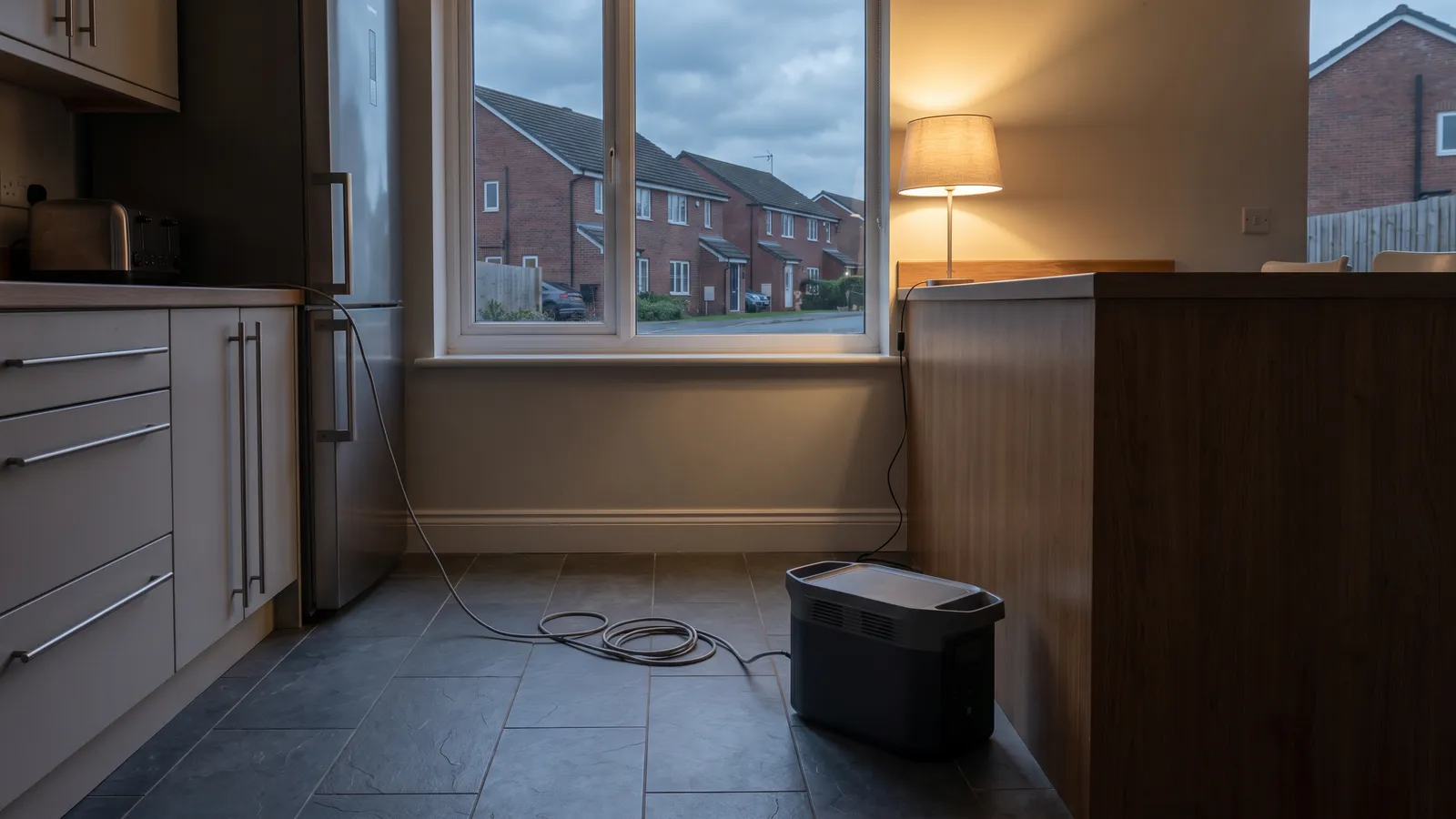
Size by watt-hours against what you actually want to run. A modern fridge draws roughly 100–200W while cycling, a router 10–15W, phone charging a few watts — so a 1,000Wh unit realistically keeps fridge, router and phones going for the better part of a day, while a 300Wh unit is phones, lights and the router only. Write down your must-run list before you shop; it decides your budget.
Check the output watts as hard as the capacity. A 300W inverter will not run anything with a heating element or big motor — kettles and most heaters draw 2–3kW and are off the menu on almost every portable unit. Battery chemistry matters too: LiFePO4 (LFP) cells are rated for thousands of cycles and a decade of use, worth the small premium over older NMC packs.
Two practical points. Fast mains recharge (an hour or so on recent models) means you can top up between forecast and outage. And unlike a petrol generator, a power station is silent and emits nothing, so it's safe indoors — which for most UK households is the whole argument.
Top pick: Jackery Explorer 1000 v2 Portable Power Station. A well-judged, genuinely portable unit that covers most household outage needs without fuss. The long-life LiFePO4 battery and fast recharge make it a sensible one-off buy — just wait for it to drop from its inflated RRP.
| Power station | Capacity | Output | Weight | Price | |
|---|---|---|---|---|---|
| Jackery Explorer 1000 v2 Portable Power StationTOP PICK | 1,070 Wh | 1,500 W | 10.8 kg | £418.99as of 20 Sep 2026, 12:29 BST · DetailsProduct prices and availability are accurate as of the date/time indicated and are subject to change. Any price and availability information displayed on Amazon.co.uk at the time of purchase will apply to the purchase of this product. | Check price → |
| Anker SOLIX C1000 Portable Power Station | 1,056 Wh | 1,800 W | 12.9 kg | — | Check price → |
| Jackery Explorer 2000 v2 Portable Power Station | 2042Wh Wh | 2200W W | 17.5kg kg | £807.00as of 20 Sep 2026, 12:29 BST · DetailsProduct prices and availability are accurate as of the date/time indicated and are subject to change. Any price and availability information displayed on Amazon.co.uk at the time of purchase will apply to the purchase of this product. | Check price → |
| EcoFlow DELTA 3 Classic Portable Power Station | 1,024 Wh | 1,800 W | 12.1 kg | £399.00Checked 20 Sep · indicative — not price-tracked | Check price → |
| EcoFlow River 2 Max Portable Power Station | 512 Wh | 500 W | 6.1 kg | £328.99as of 20 Sep 2026, 12:29 BST · DetailsProduct prices and availability are accurate as of the date/time indicated and are subject to change. Any price and availability information displayed on Amazon.co.uk at the time of purchase will apply to the purchase of this product. | Check price → |
| Jackery Explorer 300 Plus Portable Power Station | 288 Wh | 300 W | 3.75 kg | — | Check price → |
| EcoFlow River 2 Portable Power Station | 256 Wh | 300 W | 3.5 kg | £209.00Checked 20 Sep · indicative — not price-tracked | Check price → |
| Bluetti EB3A Portable Power Station | 268 Wh | 600 W | 4.6 kg | £219.00Checked 20 Sep · indicative — not price-tracked | Check price → |
| Bluetti AC180 Portable Power Station | 1,152 Wh | 1,800 W | 16 kg | £599.00Checked 20 Sep · indicative — not price-tracked | Check price → |
| Anker 757 PowerHouse Portable Power Station | 1,229 Wh | 1,500 W | 19.9 kg | — | Check price → |
ⓘ As an Amazon Associate, PreparedBritain earns from qualifying purchases. We may earn a commission when you buy, or a fee when you request a quote, through our links — it never affects what we recommend. Amazon prices come from Amazon's own product data and show the date and time they were retrieved. Prices at other retailers are checked by us, less often. Prices and stock can change at any time, so always check the retailer's price before you buy.
Who it's for: Keeping the essentials going through a power cut — fridge, phones, router, lights and small medical devices.
A well-judged, genuinely portable unit that covers most household outage needs without fuss. The long-life LiFePO4 battery and fast recharge make it a sensible one-off buy — just wait for it to drop from its inflated RRP.
- Long-life LiFePO4 cells rated to ~4,000 cycles (roughly a decade of regular use), so it won't need replacing mid-decade
- Recharges from empty in about an hour on mains — useful if you get warning of an outage
- Quiet in use and, at 10.8kg for 1,070Wh, easy enough for one person to move room to room
- 1,500W ceiling and 1,070Wh capacity won't run high-draw items like kettles or most electric heaters for any meaningful time
- Poor value at full RRP; only worth it when discounted
Don't buy if Your goal is to run heating or a kettle during an outage — a 1,500W limit won't cope with a 2–3kW load. And if you only need to keep phones and a laptop alive, a £30–£90 power bank does that for a fraction of the price.
as of 20 Sep 2026, 12:29 BST · Details
Product prices and availability are accurate as of the date/time indicated and are subject to change. Any price and availability information displayed on Amazon.co.uk at the time of purchase will apply to the purchase of this product.Who it's for: A household wanting a dependable ~1kWh backup to keep phones, laptops, the router, lights and a fridge going through a power cut.
A well-built, quiet 1kWh unit with safe LiFePO4 cells and unusually fast recharging, making it one of the more sensible mid-size backups for a British home. Just wait for a discount, as the RRP rarely reflects the real price.
- Long-life LiFePO4 battery rated for 3,000 cycles with a 5-year warranty
- Very fast recharge (roughly a full charge in under an hour from the mains) and 600W solar input
- Clear app monitoring and 11 ports cover almost any small-appliance need in an outage
- At 12.9kg it is portable but not light to carry far
- The 1800W ceiling and ~1kWh capacity won't sustain high-draw appliances like kettles, electric heaters or ovens
Don't buy if You need to run high-wattage appliances such as a kettle or electric heater, or want more than a few hours of fridge-plus-essentials runtime — step up to a 2kWh+ station. Equally, if you only need to keep phones and a laptop topped up, this is overkill and a power bank costs a fraction.
Who it's for: Whole-home backup during power cuts, and off-grid trips
A genuine step up on the outgoing 2000 Plus — noticeably lighter for the same 2kWh capacity, with a LiFePO4 cell rated for thousands of cycles. It isn't cheap, but it's built to still be working a decade from now. Its 2200W inverter briefly surges to 4400W for motor start-ups, and the LiFePO4 cells are rated for years of weekly cycling.
- LiFePO4 battery rated to 4,000 cycles — Jackery quotes roughly 10 years of typical use
- Around 35% lighter and smaller than the outgoing Explorer 2000 Plus for the same capacity
- Fast recharge — around an hour to full from the mains
- No modular expansion battery — unlike the discontinued 2000 Plus, capacity is fixed at 2042Wh
- Still a big outlay for a single-unit power station
Don't buy if you want to scale capacity over time — the 2000 Plus it replaces took add-on battery packs up to 12kWh; this model doesn't, so buy for the capacity you'll actually need.
as of 20 Sep 2026, 12:29 BST · Details
Product prices and availability are accurate as of the date/time indicated and are subject to change. Any price and availability information displayed on Amazon.co.uk at the time of purchase will apply to the purchase of this product.Who it's for: Keeping a fridge, router, phones and a few lights running through a multi-hour power cut, for households who won't need to expand capacity later.
The best-value model in EcoFlow's current 1kWh range, and the lowest-priced of its three: the same 1,800W output and LFP chemistry as the DELTA 2, a slightly faster 45-minute 0-80% mains recharge, and a 10ms UPS switchover. The trade-off is that this 'Classic' model's capacity is fixed: unlike the DELTA 2 there is no extra-battery port, so 1,024Wh is what you get.
- LFP cells EcoFlow rates for a 10-year lifespan, backed by up to 5 years' warranty (3 years standard, 2 more when registered in the EcoFlow app)
- Recharges 0-80% in 45 minutes on the mains (60 minutes to full), with a built-in 10ms UPS switchover for sensitive electronics like a router or NAS
- 1,800W continuous output (3,600W surge; up to 2,400W via X-Boost) covers most household essentials
- Unlike the DELTA 2, there is no extra-battery expansion port, so 1,024Wh is a hard ceiling — the standard DELTA 3 or DELTA 3 Plus (1-5kWh expandable) exist if you might want more later
- No 12V car-style DC output port, unlike the standard DELTA 3 / DELTA 3 Plus
- Only 5 outputs (2 AC, 1 USB-A, 2 USB-C), fewer than EcoFlow's DELTA 3 and DELTA 3 Plus
Don't buy if You only need to keep phones, a tablet and a laptop topped up — a much cheaper power bank does that job. And skip this specific 'Classic' model if you think you'll want to add capacity later, since it has no expansion port; the standard DELTA 3 or DELTA 3 Plus do.
EcoFlow River 2 Max Portable Power Station
4.2Who it's for: Keeping the essentials going in a power cut — fridge, broadband router, phones and a few lights.
A well-judged mid-size unit for household backup: the long-life LFP battery, genuinely fast recharge and quiet operation make it a sensible first power station. Just size it to essentials, not the whole house.
- LFP (lithium iron phosphate) battery rated for roughly 3,000 cycles / ~10 years — far longer-lived than older lithium units
- Recharges 0-100% in about an hour from the mains, so it is ready again quickly between outages
- Light (~6.1kg), quiet, and ships with proper UK 3-pin sockets plus a 100W USB-C port
- 512Wh is modest — enough for low-draw essentials for several hours, not for running a home for a day
- Native 500W output means high-wattage appliances need X-Boost, and it still will not run a kettle, oven or electric heater
Don't buy if You want to power high-draw appliances (kettle, microwave, heaters) or keep much of the home running — the capacity and 500W output are too small; step up to a Delta-class unit instead.
as of 20 Sep 2026, 12:29 BST · Details
Product prices and availability are accurate as of the date/time indicated and are subject to change. Any price and availability information displayed on Amazon.co.uk at the time of purchase will apply to the purchase of this product.Jackery Explorer 300 Plus Portable Power Station
4.0Who it's for: Keeping phones, a laptop, the router and a few lights going through a short power cut.
A well-made, genuinely portable LiFePO4 unit that does one job well: topping up your essential devices during a brief outage. It is not a whole-home backup, and you pay a small premium for the Jackery name.
- LiFePO4 cells rated for years of regular use and backed by a 5-year warranty, so it should long outlast a cheap power bank
- Light (3.75kg) and quiet, with a 100W USB-C port that will fast-charge a laptop
- Recharges from flat to full in around two hours on the mains
- 288Wh is modest - it will recharge devices several times over, not run appliances for long
- The 300W inverter rules out kettles, microwaves, hairdryers and most heaters
Don't buy if You want to keep a fridge, kettle or heating running through a longer outage - for that you need a 1,000Wh+ station, not this.
EcoFlow River 2 Portable Power Station
4.0Who it's for: Keeping phones, a laptop, the router and a couple of lights going through a short power cut.
A well-built entry-level unit with long-life LiFePO4 cells and a genuinely fast one-hour recharge. Sensible for essentials during a brief outage, but its small 256Wh battery and 300W rated output mean it is a top-up device, not a whole-home backup.
- LiFePO4 cells rated for around 3,000+ cycles (roughly 10 years of regular use) — outlasts cheaper lithium rivals
- Recharges 0-100% from the mains in about an hour, so it is easy to keep topped up ahead of forecast disruption
- Sub-30ms EPS switchover lets it double as a small UPS for a router, CPAP or similar low-draw essential
- 256Wh is genuinely small — realistically phones, a laptop, router and lights, not appliances
- 300W rated AC output (600W X-Boost surge) rules out kettles, microwaves and most heaters
Don't buy if You want to run anything with a heating element or motor — a kettle, microwave, fridge or heater — for any length of time; the 256Wh capacity and 300W output are too small, and you should step up to the River 2 Max/Pro or a 1,000Wh-plus unit.
Bluetti EB3A Portable Power Station
4.0Who it's for: Keeping phones, a Wi-Fi router and a couple of lights running through a short power cut.
A well-built, compact entry-level unit with a long-life LiFePO4 battery and genuinely fast recharging. The 268Wh capacity is modest, so treat it as a lifeline for small essentials rather than a whole-home backup.
- LiFePO4 cells rated for 2,500+ cycles, so it should last many years of occasional use
- Recharges quickly (up to ~430W), useful for topping up between outages or off a car
- Compact and light at 4.6kg with a sensible port mix, including 100W USB-C and a wireless pad
- At 268Wh the runtime is limited — fine for phones, routers and lights, not sustained use
- Won't meaningfully run high-draw items like kettles, heaters or fridges beyond brief surges
Don't buy if You need to keep a fridge-freezer or any heating going for hours — step up to a 500Wh–1,000Wh+ unit instead.
Who it's for: Keeping the essentials running through a day-long power cut - fridge or freezer, router, phones, lights, and a kettle in short bursts.
A genuinely capable mid-size backup: safe LiFePO4 chemistry, a strong 1,800W output, and unusually fast recharging make it a sensible household power-cut buy. The catch in 2026 is timing - Bluetti has largely replaced it with the Elite 100 V2, so check that model's price before committing.
- LiFePO4 cells rated for 3,500+ cycles and a 5-year warranty, so it should outlast several cheaper units
- 1,800W handles most household essentials, and recharges from flat to 80% in roughly 45 minutes on mains
- Well-specified port array (twin AC, 100W USB-C, wireless pad) covers a whole family's devices at once
- At ~16kg it is a two-handed lift, not something you will casually carry room to room
- 1,800W is not enough for high-draw heating appliances (fan heaters, kettles plus oven together), so it is a bridge, not a mains substitute
Don't buy if You are buying new today - the near-identical Bluetti Elite 100 V2 has superseded it, usually costs less, and improves on charging and app control, so buy that instead unless you find the AC180 heavily discounted. Also skip it if your real need is running an electric heater or cooker through an outage; a 1,800W station cannot do that job.
Who it's for: Keeping a fridge, lights, router and phones running through a multi-hour power cut, with a long-life battery.
A well-built, long-life LiFePO4 station that recharges fast and carries a 5-year warranty, so it is dependable for running household essentials through an outage. It is now an ageing model, so it only makes sense at a genuine discount rather than near its old RRP.
- LiFePO4 cells rated for 3,000+ cycles and backed by a 5-year warranty, so it should last a decade of occasional use
- Fast recharge (roughly an hour to 80%) and a clean 1500W pure sine wave output that covers most home essentials
- Nine outputs including two high-power USB-C ports and a built-in LED light bar
- Heavy at nearly 20kg with no wheels or trolley handle, so not a grab-and-go unit
- 1500W ceiling won't run a kettle, oven or electric heater, and it is an older model now undercut by newer 2025-26 stations
Don't buy if You need to run high-wattage appliances like a kettle or electric heater, want something light enough to carry easily, or can find a newer station with more capacity and headroom for similar money.
The Power Cut Action Card
One page for the kitchen drawer: what to do first, what to have ready, how long food keeps, and how to stay warm without risking carbon monoxide. Free, no catch.
Download it straight away. We'll also send the occasional briefing when something genuinely matters — severe weather, live incidents, real price drops. Nothing else.
We verify every product's specifications against at least two independent sources, re-check its UK price and stock on a schedule where we can track it automatically, and cross-check safety-relevant claims against official guidance. Where we've bought and used a product ourselves we say so on its review; where we haven't, our verdict is a considered spec-and-evidence comparison, not a hands-on test — and commissions never change a ranking either way. Read our full methodology →
Guides that go with this
The free number to save today, what to have ready, food safety, staying warm safely, and the compensation you …
A calm, sourced look at the 'national blackout' scenario: why it's a low-likelihood risk the grid is engineere…
Common questions
How long will a power station run a fridge?
A typical fridge-freezer averages 100–200W as it cycles, so a 1,000Wh station manages roughly 5–8 hours of real running time, and a 2,000Wh unit around twice that. Keeping the fridge door shut stretches it further — food keeps safe about four hours in an unopened fridge anyway.
Can a power station run a kettle or heater?
Almost never. Kettles and electric heaters draw 2–3kW, beyond the output of all but the largest home-backup units. Boil water on a camping stove outdoors instead, and plan warmth around layers and blankets rather than electric heating.
What does LiFePO4 mean and does it matter?
It's a lithium iron phosphate battery — the newer chemistry rated for 3,000+ charge cycles versus several hundred for older packs. For a device you'll own for a decade, it's the spec worth paying a little more for.
Can I charge one from solar in the UK?
Yes — most accept a folding solar panel, and a 100W panel in decent British summer light genuinely tops up smaller units. Treat solar as a useful extender in a long outage, not a fast charger: UK winter light is weak.
How should I store it between power cuts?
Somewhere cool and dry, topped up every few months. Most manufacturers recommend keeping lithium units at partial charge for long-term storage and refreshing them periodically — check your model's manual, and set a calendar reminder alongside your kit check.
Power station or petrol generator?
For most homes, the power station: silent, no fuel to store, no fumes, safe indoors. A generator only makes sense for sustained multi-day backup of heavy loads — and it must run outdoors, well away from doors and windows, because of carbon monoxide.