BLUETTI Elite 200 V2 vs EcoFlow DELTA 3 Max: which 2kWh power station should you buy?
Three 2kWh power stations compared on what actually differs: output, solar, charging, expansion, cycle rating, weight and warranty, with worked runtimes for a fridge-freezer, boiler and router.
Pick the EcoFlow DELTA 3 Max Plus if you might ever add a battery, want a 3kW appliance within the rating, or plan serious solar: it is the only one of the three that grows. Pick the BLUETTI Elite 200 V2 for the longest published cycle rating (6,000-plus) and a five-year warranty with no registration condition, if you can live with the heaviest unit and a fixed capacity. Pick the EcoFlow DELTA 3 Max for two kilowatt-hours at the lowest weight, for a fridge, router, lights and boiler controls, if you are sure you will never expand and solar is an afterthought; it is capped at 500W of solar. All three hold about 2kWh, so a fridge-freezer runs for roughly one to three days on each, depending on its age; the differences are output, solar, expansion, weight and warranty, not hours.
By Tom Calder · Updated 12 October 2026 · Sourced to BLUETTI, EcoFlow, Vaillant, the European Commission and the Food Standards Agency
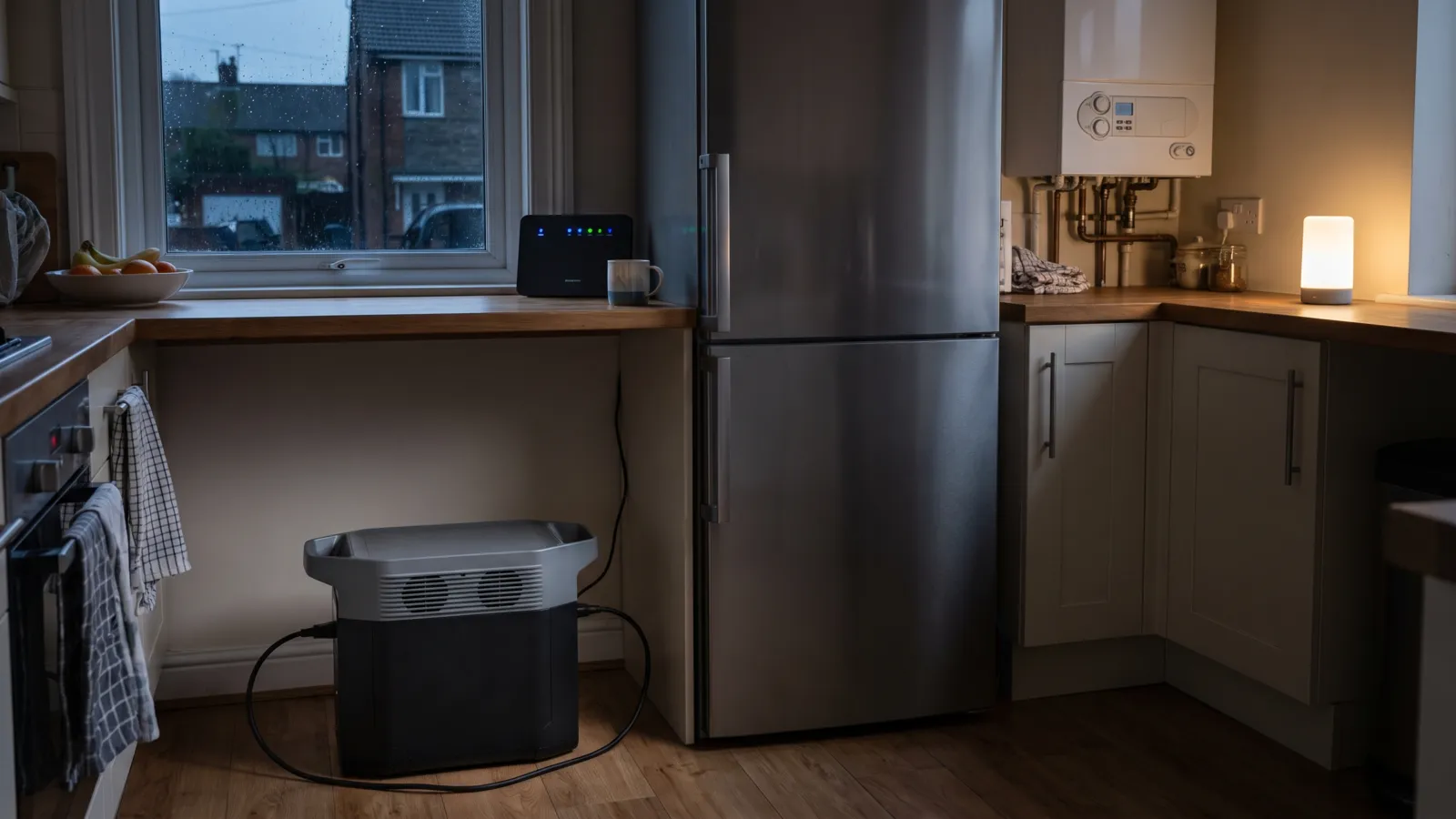
Same 2kWh battery, so what actually differs?
All three hold about two kilowatt-hours of lithium iron phosphate (LFP) battery: BLUETTI lists the Elite 200 V2 at 2,073.6Wh, and EcoFlow lists both the DELTA 3 Max and the DELTA 3 Max Plus at 2,048Wh. A one per cent difference in capacity is not a reason to choose one over another, and it means a fridge-freezer, a router or a boiler’s controls run for broadly the same hours on each.
What differs is everything around the battery: the continuous output (2,600W, 2,400W and 3,000W), how much solar each accepts, whether you can add a battery later, the cycle rating the maker is willing to publish, the weight, and the warranty. Those are the things to choose on, and this guide takes them in turn. If you have not settled on the 2kWh class yet, read what size power station do I need first; the callout further down explains when a 1kWh unit does the same job.
DELTA 3 Max vs DELTA 3 Max Plus: EcoFlow’s own table
EcoFlow sells the DELTA 3 Max in two versions and its series page leads with the Plus, so the “3,000W output” and “up to 10kWh” lines at the top of that page describe the Max Plus, not the Max. EcoFlow’s specifications page puts the two side by side: the same 2,048Wh battery, the same 68 minutes to full from a 2,300W mains input, the same 25dB-or-less noise figure at 600W, the same 3+2-year warranty, and dimensions within 3mm of each other.
The Plus gains on almost every other line. EcoFlow lists 3,000W continuous against 2,400W, a 6,000W surge against 4,800W, X-Boost to 3,900W against 3,200W, 1,000W of solar input (two 500W ports) against 500W, 13A per mains socket against 10A, 0–80% in 47 minutes against 51, 1,000W alternator charging against 500W, a 378W 12V output with an Anderson port against 126W, a 140W USB-C against 100W, and an extra-battery port the Max does not have. The cost is 1.8kg: EcoFlow gives the Max as about 20.3kg and the Plus about 22.1kg.
The practical reading: the Max is the lighter, simpler unit for a household that wants two kilowatt-hours for a fridge, router and lights, and will never add to it. The Plus is for anyone who wants a 3kW appliance within the rating, serious solar, or the option to grow. If you buy an EcoFlow at this size and are unsure which, the extra-battery port is the question to answer honestly.
Output: 2,600W, 2,400W or 3,000W, and what Power Lifting and X-Boost mean
On the maker’s figures, the Elite 200 V2 delivers 2,600W continuously, the DELTA 3 Max 2,400W and the DELTA 3 Max Plus 3,000W. For a fridge-freezer, router, lights and a boiler’s controls, all three have far more headroom than you will use. The ratings matter when you want to run a heating appliance. EcoFlow’s DELTA 3 page lists kettles at 1,200–3,000W, so the Max Plus is the only one here that runs a 3kW kettle within its continuous rating, at the limit with nothing else on. The Elite 200 V2 runs one rated up to 2,600W within its rating, and the Max one up to 2,400W.
Each maker also advertises a figure above its rating. BLUETTI’s Power Lifting lets the Elite 200 V2 run “pure resistive loads of up to 3,900W”, which it illustrates with kettles, electric blankets and hair dryers. EcoFlow’s X-Boost gives 3,200W on the Max and 3,900W on the Max Plus. Neither is extra power: both let a heating element rated above the inverter run at reduced power rather than trip the unit, so a kettle boils slowly. Do not plan either mode around a fridge or anything else with a compressor, and do not read 3,900W against 3,200W as a real difference.
Surge is different again: short-term headroom for the moment a compressor starts. EcoFlow lists 4,800W for the Max and 6,000W for the Max Plus. We found no surge figure for the Elite 200 V2 on BLUETTI’s UK page, and its 3,900W Power Lifting number is not one, so do not treat it as such. BLUETTI’s manuals for this range warn that motors and compressors may start at two to four times their rated power; a domestic fridge-freezer rated at 100–240W starts well within any of these three units.
NewSee this for your own homeHome Alerts: your postcode's power cuts, warnings and floods, on one screen. Free for your own home. Opening in October; the first 100 on the list get in first.Join the list →Fridge-freezer, boiler controls and router at home: honest runtimes
Capacity, not output, sets the hours. A fridge-freezer’s compressor cycles on and off, so over a day it averages far less than its rating plate: about 12–51W on its energy label (the kWh a year divided by 8,760 hours), with older and American-style models at the top. The European Commission’s estimates put the average fridge-freezer sold in 2020 at 181 kWh a year, roughly 21W, and the 1990 average at 477 kWh, roughly 54W.
On the runtime formula BLUETTI publishes for the Elite 200 V2 (90 per cent depth of discharge, 85 per cent inverter efficiency, about 10W of the unit’s own draw), 2,048Wh runs an efficient 12W fridge-freezer for about 71 hours, roughly three days; a 2020-average 21W one for around two days; and an older 51W one for about 26 hours. The Elite 200 V2’s extra 25Wh adds under an hour. EcoFlow publishes no equivalent formula, so expect similar, not identical, hours from the two DELTAs. Our fridge-freezer guide has the working and the settings that stop a unit switching itself off overnight.
A gas boiler needs electricity only for its pump, fan and controls: about 35–123W while firing on the Vaillant, Worcester Bosch and Ideal installation manuals in our boiler guide, and 3W or less on standby. Add a 15W router and a fridge-freezer averaging 21W, and treat the boiler as firing half the time (about 30W averaged), and the load is roughly 66W. With 10W of self-draw, the same formula gives 2,048Wh about 20 hours of fridge, broadband and heating. That is enough for most UK cuts; for a multi-day storm outage, only the Max Plus can add a battery.
The boiler cannot simply be plugged in: its manual calls for a fixed connection through a fused spur, so running it from a power station needs an electrician-fitted changeover arrangement, and anything inside the boiler casing is Gas Safe work. Set the power station up first: EcoFlow’s DELTA 3 manuals say to set the AC timeout to “never” for a fridge, and BLUETTI’s manual says to switch ECO mode off for fridges and for devices under 60W, such as a router, or the unit may switch itself off. EcoFlow’s manuals say its units are not intended for life-sustaining medical equipment; see running medical equipment in a power cut.
Charging: mains, solar, generator and car
From the mains, all three take 2,300W. EcoFlow lists the DELTA 3 Max at 0–80% in 51 minutes and 0–100% in 68, and the Max Plus at 47 and 68. BLUETTI lists the Elite 200 V2 at 0–80% in about 1.1 hours with TurboBoost. In a power cut that matters little, since there is no mains to charge from; it matters if you expect short, repeated cuts, or want the unit full again between a warning and a storm. BLUETTI’s manual puts a cap on the mains input current in its app, if you want a slower charge.
Solar is where the Max falls behind. BLUETTI gives the Elite 200 V2 1,000W of solar input at 12–60V and up to 20A; EcoFlow gives the Max Plus 1,000W across two 500W ports but the Max only 500W. EcoFlow’s series page says 1,000W of solar takes the Max Plus from 0–80% in about 96 minutes; a 500W cap roughly doubles that on the Max, and in a British winter real panel output is a fraction of the rated figure. If solar is central to your plan, read portable solar panels and the honest winter figures in solar as power-cut backup.
EcoFlow lists two further inputs on both DELTAs that BLUETTI’s UK page does not for the Elite 200 V2: generator charging up to 2,400W, and alternator charging while driving with EcoFlow’s alternator charger (500W through the XT60 port on the Max, 1,000W through the 4+8 port on the Max Plus). Both DELTAs also take a 12V or 24V car input at 8A, which is slow. A generator is a different purchase with its own carbon monoxide rules; our power station vs generator guide weighs them, and if you already own one, how to use a generator safely covers the outdoor-only placement that applies to generators and not to power stations.
Expansion, cycle ratings, warranty and UK support
Expansion is the clearest dividing line. BLUETTI says the Elite 200 V2 is not expandable and has no power-bank mode: what you buy is what you have. EcoFlow’s compare table gives the DELTA 3 Max a plain “NO”. Only the DELTA 3 Max Plus has an extra-battery port: EcoFlow’s pages list a DELTA 3 Max Plus Smart Extra Battery taking it to 4kWh, and up to 10kWh with two DELTA Pro 3 extra batteries. Its product page has said the adapter needed for the second battery was still to be released, so confirm what is actually shipping before you count on the full 10kWh.
Cycle ratings are where BLUETTI is more forthcoming. It rates the Elite 200 V2 for 6,000-plus cycles. EcoFlow publishes no cycle count for either DELTA 3 Max on the UK pages we read; its series page gives the Max Plus a life of over ten years, footnoted as its own estimate. All three use LFP cells. For a household that uses the unit through a few cuts a year, either rating is far more than you will ever use; the difference matters if you plan to cycle it daily with solar.
Warranty: BLUETTI’s UK page gives the Elite 200 V2 five years outright. EcoFlow gives both DELTAs “3+2 years”, meaning three as standard and two more only if you register the unit in the EcoFlow app, so do that on day one. Both brands have UK companies behind their UK stores: EcoFlow sells through ECOFLOW INNOVATION UK LTD in London, and BLUETTI’s UK imprint names POWEROAK ENERGY UK CO., LTD in Chesterfield, with a freephone line and round-the-clock chat. Your Consumer Rights Act rights against the retailer sit on top of either warranty.
Weight, noise and switchover
These are all two-handed boxes. EcoFlow lists the DELTA 3 Max at about 20.3kg and the Max Plus at about 22.1kg, both 494mm long; BLUETTI lists the Elite 200 V2 at 24.2kg in a shorter, deeper case. About 4kg separates the Elite 200 V2 from the Max. At these weights, any of them is best set down once near what it will power; if you expect to carry one between rooms or into a car, the Max is the lightest.
On noise, BLUETTI publishes 16dB under low loads with automatic fan control, and its manual gives a range of 16–50dB depending on load; EcoFlow gives “≤25dB” at 600W for both DELTAs. Those are measured at different loads, so they do not tell you which is quieter doing the same job.
Switchover is the time the unit takes to move from passing mains through to running from its battery when the power fails. BLUETTI gives the Elite 200 V2 “within 15ms”; EcoFlow’s DELTA 3 Max Plus manual gives 10ms, and we found no figure for the Max on EcoFlow’s UK pages. Both are quick enough for most routers, but neither is a promise: BLUETTI’s manual says its UPS is not for data servers or workstations that need a high-performance UPS. Test your own router by switching off the wall socket before you rely on it.
Who should pick which
Pick the EcoFlow DELTA 3 Max Plus if there is any chance you will add a battery, if you want a 3kW kettle or heater within the unit’s rating (at the limit, with nothing else on), or if 1,000W of solar is part of the plan. It is the most capable of the three and the only one that grows; you pay for that headroom whether or not you use it.
Pick the BLUETTI Elite 200 V2 if you want the longest published cycle rating and a five-year warranty with no registration condition, will cycle it often, say daily with 1,000W of solar, and can live with the heaviest unit and a capacity fixed forever. It sits between the two DELTAs on output: 2,600W runs a kettle rated up to 2,600W within its rating, and a 3kW one only slowly through Power Lifting.
Pick the EcoFlow DELTA 3 Max if you want two kilowatt-hours for the fridge, router, lights and boiler controls at the lowest weight of the three, are certain you will not expand, and solar is an afterthought. For a typical British power cut of a few hours that is not a compromise. Before buying any of them, check how often cuts actually hit your area on the power cuts tracker and what this winter looks like; the kit builder shows what the rest of a household kit needs.
Common questions
Is the EcoFlow DELTA 3 Max Plus worth it over the DELTA 3 Max?
Only if you will use what it adds. EcoFlow’s own table shows the same 2,048Wh battery and the same 68 minutes to full; the Plus adds 3,000W output against 2,400W, 1,000W of solar against 500W, an extra-battery port the Max lacks, faster alternator charging and bigger 12V and USB-C outputs, for 1.8kg more. For a fridge, router and lights the Max is enough. For a 3kW kettle within the rating, serious solar or a battery later, the Plus is the one.
Can I add an extra battery to the BLUETTI Elite 200 V2?
No. BLUETTI says the Elite 200 V2 is not expandable and has no power-bank mode, so 2,073.6Wh is what you have. The EcoFlow DELTA 3 Max is also fixed. Only the DELTA 3 Max Plus has an extra-battery port: EcoFlow lists a Smart Extra Battery taking it to 4kWh and up to 10kWh with two DELTA Pro 3 extra batteries, though its page has said the adapter for a second battery was still to come, so check what is shipping.
Will any of these run a gas boiler in a power cut?
Electrically, yes: a gas boiler draws about 35–123W while firing on the Vaillant, Worcester Bosch and Ideal manuals in our boiler guide, trivial against 2,400–3,000W. The problem is wiring, not wattage. Boilers are wired to a fused spur, so running one from a power station needs an electrician-fitted changeover arrangement, and any work inside the boiler casing is for a Gas Safe registered engineer. Do not cut the plug off an extension lead and improvise.
Which is lighter, the Elite 200 V2 or the DELTA 3 Max?
The DELTA 3 Max. EcoFlow lists it at about 20.3kg and the Max Plus at about 22.1kg; BLUETTI lists the Elite 200 V2 at 24.2kg. All three are two-handed lifts. If you expect to carry a unit between rooms or into a car, the Max is the one to pick.
Which has the longer warranty?
The BLUETTI Elite 200 V2, on paper: BLUETTI’s UK page gives five years and mentions no registration step. EcoFlow gives the DELTA 3 Max and Max Plus “3+2 years”: three years as standard and two more only once you register the unit in the EcoFlow app. Register on the day it arrives and the two match at five. Your statutory rights against the retailer under the Consumer Rights Act apply regardless of either.
How long will a 2kWh power station run a fridge-freezer?
On the formula BLUETTI publishes for the Elite 200 V2 (90 per cent depth of discharge, 85 per cent inverter efficiency, about 10W of self-draw), 2,048Wh gives about 71 hours for an efficient 12W fridge-freezer, around two days for the 2020 European average of roughly 21W, and about 26 hours for an older 51W one. Expect similar hours from both DELTAs, which hold the same capacity. First set EcoFlow’s AC timeout to “never” or switch BLUETTI’s ECO mode off, or the unit may shut down between compressor cycles.
Sources (14)
- BLUETTI UK — Elite 200 V2 product page2,073.6Wh; 2,600W AC output; Power Lifting for pure resistive loads up to 3,900W; 2,300W AC input, 80% in 1.1 hours with TurboBoost; 1,000W solar at 12–60V, 20A; 6,000-plus cycles; 24.2kg; 16dB under low loads; UPS within 15ms; not expandable, no power-bank mode; runtime formula; 5-year warranty
- BLUETTI — Elite 200 V2 user manualUS edition; cited for Power Lifting, ECO mode off for fridges and loads under 60W, app input-current setting, UPS limits, compressor start-up and the 16–50dB noise range
- BLUETTI UK — Imprint (POWEROAK ENERGY UK CO., LTD, Chesterfield; freephone; 24/7 chat)
- EcoFlow UK — DELTA 3 Max Series pagePlus-led headline figures; compare table: weights, 2,400W vs 3,000W, 4,800W vs 6,000W surge, X-Boost, solar 500W vs 1,000W, 1,000W solar 0–80% in 96 min, alternator 500W XT60 vs 1,000W 4+8 port, expansion ‘NO’ vs up to 10kWh, 3+2-year warranty on app registration, ≤25dB at 600W, Max Plus ten-year life estimate
- EcoFlow UK — DELTA 3 Max Plus specificationsside-by-side Max and Max Plus: 2,048Wh; 20.3kg and 22.1kg; 494mm length; 10A vs 13A per socket; 2,300W input, 51/47 min to 80%, 68 min to full; generator 2,400W; alternator 500W/1,000W; car 12/24V 8A; USB-C 100W vs 140W; 12V 126W vs 378W with Anderson; compatible extra batteries, up to 10kWh with two DELTA Pro 3
- EcoFlow UK — DELTA 3 Max Plus product pageSmart Extra Battery to 4kWh; 2–10kWh expandable; ‘covers essential power needs during a 4–8 hour outage’; expansion adapter release note
- EcoFlow — DELTA 3 Max Plus user manualAC timeout ‘never’ for fridges; X-Boost; 10ms UPS; not intended for life-sustaining medical equipment
- EcoFlow UK — DELTA 3 Series page (kettles listed at 1,200–3,000W)
- EcoFlow UK — Warranty policy (per-model terms)
- EcoFlow UK — Contact us (ECOFLOW INNOVATION UK LTD, London)
- European Commission — Fridges and freezersaverage refrigerator-freezer sold used 477 kWh/a in 1990 and 181 kWh/a in 2020
- Vaillant — ecoTEC plus combi and system installation instructionsfixed connection through a switched fused spur; electrical power consumption
- legislation.gov.uk — Gas Safety (Installation and Use) Regulations 1998, Regulation 3 (competence to work on gas fittings)
- GOV.UK / Food Standards Agency — Food safety in a power cutfridge cold for up to 4 hours; full freezer frozen for up to 48 hours, 24 if half full
PreparedBritain is independent and not affiliated with HM Government.
The Power Cut Action Card
One page for the kitchen drawer: what to do first, what to have ready, how long food keeps, and how to stay warm without risking carbon monoxide. Free, no catch.
Download it straight away. We'll also send the occasional briefing when something genuinely matters — severe weather, live incidents, real price drops. Nothing else.
Latest from our live data
All stories → News · 21 OctOnly 4 in 100 adults have three days of bottled water at home, the government's survey shows
 News · 21 OctFood inflation held at 1.3%. Wholesale cabbage and cauliflower are up a third. Both are true
 News · 21 OctAldi recall: shoppers warned of hairdryer electric shock or fire risk. How to check yours
Keep reading
All power cuts & energy guides →Boiler not working after a power cut? What to check, safely
Power is back but the boiler is not. The safe checks in order: wait, clock and timer, pressure gauge, one reset, a…
EcoFlow DELTA 3 vs DELTA 3 Plus vs DELTA 3 Classic: which one should you buy?
Three EcoFlow 1kWh power stations with the same battery and the same 1,800W output, compared on what actually…
BLUETTI Elite 30 V2 vs EcoFlow RIVER 3 Plus: which small power station for a router, phones and lights?
Two near-identical 288Wh and 286Wh power stations compared on what differs: sockets, USB-C, weight, charging,…
