Running medical equipment in a power cut: CPAP, oxygen, insulin fridges and stairlifts
What CPAP machines, oxygen concentrators, insulin fridges and stairlifts draw in a power cut, when a power station helps, and why the Priority Services Register comes first.
By Tom Calder · Updated 21 July 2026 · Sourced to Ofgem, the NHS & Ofcom
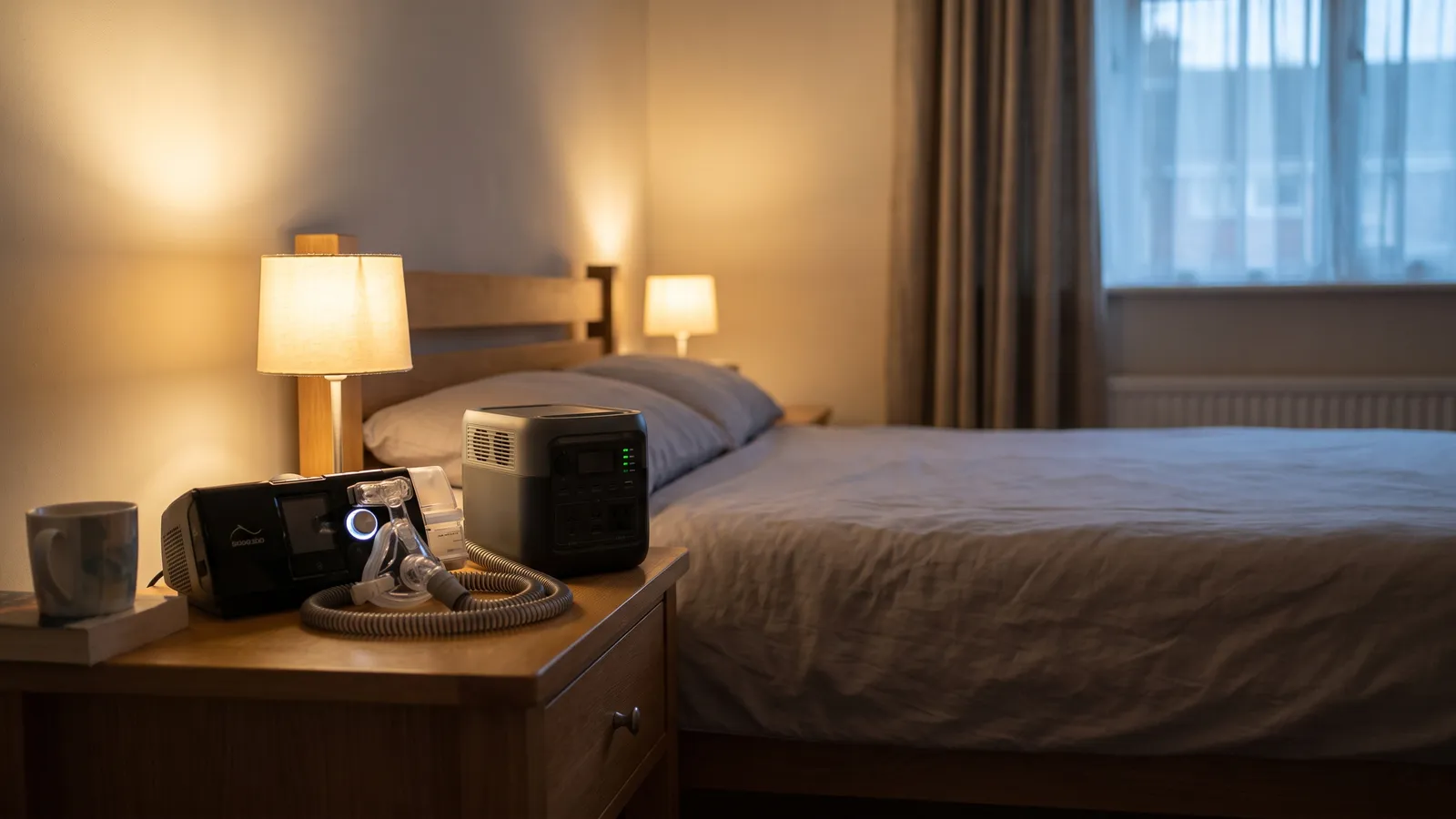
The plan matters more than the gadget
If someone in your home depends on mains electricity for their health — a CPAP machine, an oxygen concentrator, a nebuliser, home dialysis, a stairlift or a powered hoist — the single most valuable thing you can do costs nothing and takes about ten minutes: join the Priority Services Register (PSR). It is a free service run by every energy supplier and regional network operator and overseen by Ofgem. Registering flags your household for advance notice of planned power cuts, priority contact and welfare support during unplanned ones, and, in longer outages, practical help arranged by your network operator.
Register in advance — the register only helps if you are on it before the lights go out. Sign up with both your electricity supplier and your Distribution Network Operator, because they are separate organisations. Save the free power-cut number, 105, in your phone: it connects you straight to your network operator to report a cut and ask for help. You can also check whether an outage is known and being worked on.
Know your numbers: what each device draws
Before you buy any battery, find the wattage on the device label or in its manual, then match it to a power source rated in watt-hours (Wh). As a rough guide: a CPAP draws about 30–60W (or 90W and up with a heated humidifier and heated tube); a home oxygen concentrator runs continuously at roughly 300–600W; a small medical or under-counter fridge uses about 50–100W while its compressor cycles; and most modern stairlifts run off rechargeable batteries, drawing no mains power during a trip at all.
Watt-hours tell you runtime. A 1,000Wh portable power station will run a 40W CPAP for something like 15–20 hours once you allow for conversion losses — comfortably a night or two. The same station will run a 350W oxygen concentrator for under three hours. That single contrast is the whole story: portable batteries suit low, intermittent loads and fall well short of continuous high-draw equipment.
CPAP: the device a power station genuinely suits
CPAP is the best fit for home battery backup because the draw is low and the need is predictable. Size a lithium iron phosphate (LiFePO4) power station, or a dedicated CPAP battery, to at least a full night, and switch the heated humidifier and heated tube off — they can more than double consumption. Use the machine's DC lead if it has one; running through the mains inverter wastes power.
Clinically, missing a single night of CPAP is uncomfortable rather than dangerous for most people with sleep apnoea, but follow whatever your sleep clinic has told you. A good-quality power bank of the correct voltage covers many travel CPAP units. Never leave a car engine running to power an inverter overnight — that is a carbon monoxide risk, not a backup plan.
Oxygen and dialysis: a clinical plan, not a purchase
For life-sustaining equipment — home oxygen, and especially home dialysis — the honest answer is that no consumer gadget is your backup. Oxygen concentrators pull 300–600W around the clock, which drains even a large power station in hours, and home dialysis has no domestic workaround. Home oxygen users are normally issued a backup cylinder and a 24-hour emergency number for exactly this situation; make sure you know where your cylinder is, how to switch to it, and your supplier's out-of-hours line, and call them to replace a cylinder once you have used it.
This is exactly what the Priority Services Register and your clinical team exist to cover. Ask your oxygen or renal team directly what their power-cut protocol is, and write it down before you need it rather than trying to improvise on the night.
Insulin fridges and stairlifts: usually less urgent than they feel
Two things people rush to protect often need less than they think. Insulin has a large buffer: the vial or pen you are currently using can be kept at room temperature — below the figure on its leaflet, typically 25–30°C — for up to 28 days, and a closed fridge holds its cold for hours. So a short power cut is rarely an insulin emergency: keep the fridge door shut, and remember that only your spare, unopened stock needs the 2–8°C fridge over longer periods.
Most domestic stairlifts are battery-driven and charge from the mains, so they keep working for a number of trips during an outage — check your model's manual for how many, and keep it on charge when not in use. The bigger blind spot is communication: telecare alarms and the new digital landlines stop working in a power cut without battery backup, which matters if a vulnerable person relies on them.
Why not a petrol generator
It is tempting to reach for a petrol or diesel generator, but for indoor medical use it is the wrong tool and a genuine danger. Generators produce carbon monoxide — a colourless, odourless gas that can kill — and must never be run indoors, or in a garage, shed or any enclosed or partly enclosed space, even with a door open. Running a lead in from outside brings its own hazards, and the fumes, noise and refuelling make a generator impractical beside a sickbed.
For medical loads, a sealed LiFePO4 power station is the right answer: no fumes, silent, and safe to use indoors. A computer-style UPS only bridges seconds to minutes for a clean shutdown, so it is not a runtime solution. Whatever you use, fit a carbon monoxide alarm — and if you ever do run a generator, keep it well away from the house.
Common questions
Will my CPAP work on a portable power station or power bank?
Yes — CPAP is the medical device best suited to battery backup. A 1,000Wh LiFePO4 power station typically runs a CPAP for 15–20 hours with the heated humidifier switched off; use the DC lead if your machine has one, since the mains inverter wastes power. Check your machine's wattage on its label first, and size the battery to at least a full night.
How long will an oxygen concentrator run on a power station?
Not long. Concentrators draw about 300–600W continuously, so even a large 1,000Wh station lasts only a couple of hours. Portable batteries cannot realistically cover home oxygen through an outage — your home oxygen supplier's backup cylinder and 24-hour emergency line are the answer, alongside registering on the Priority Services Register.
Does the Priority Services Register provide backup power?
Not a guaranteed electricity supply. The PSR gives you advance warning of planned cuts, priority contact and welfare support, and in prolonged outages your network operator may arrange help such as alternative heating or accommodation. It is free, and you should register in advance with both your supplier and your network operator — but plan any power backup with your clinical team rather than relying on the register to keep a device running.
Is my insulin still safe if the fridge loses power?
Almost always, for a short cut. The insulin you are currently using can sit at room temperature for up to 28 days, below the temperature stated on its leaflet, and a closed fridge stays cold for hours. Keep the door shut; only long outages threaten unopened spare stock, which needs 2–8°C. If in doubt, check the leaflet or ask your pharmacist.
Will my stairlift work during a power cut?
Usually yes. Most modern stairlifts run on rechargeable batteries that charge from the mains, so they keep working for a limited number of journeys during an outage. Check your model's manual for the exact number, and keep the lift on charge at its parking point when not in use.
Can I run a generator in the garage to power medical equipment?
No. Petrol and diesel generators release carbon monoxide and must never be used indoors, or in a garage or shed, even with the door open — the risk of fatal poisoning is real. Use a LiFePO4 power station indoors instead, and fit a carbon monoxide alarm.
Sources: Ofgem — Join your supplier's Priority Services Register · NHS — Home oxygen treatment · NHS Highland — Contingency planning for power outages: home oxygen · NHS — Storing and travelling with insulin · NHS — Carbon monoxide poisoning · Ofcom — Protecting customers during the migration to digital landlines (power-cut battery backup) · Energy Networks Association — Power Cut 105. PreparedBritain is independent and not affiliated with HM Government.
The Power Cut Action Card
One page for the kitchen drawer: what to do first, what to have ready, how long food keeps, and how to stay warm without risking carbon monoxide. Free, no catch.
Download it straight away. We'll also send the occasional briefing when something genuinely matters — severe weather, live incidents, real price drops. Nothing else.
Keep reading
All power cuts & energy guides →Power station vs generator: which home backup is right for you?
Power station or generator for UK home backup? A calm, sourced guide: most short power cuts need silent indoor…
How to prepare for a power cut
The free number to save today, what to have ready, food safety, staying warm safely, and the compensation you may be…
Which radio actually works in a UK power cut?
Long wave closed in June 2026, and half the wind-up radios on sale here advertise an American weather band that…