EcoFlow DELTA 3 Classic review
EcoFlow DELTA 3 Classic Portable Power Station
By Tom Calder
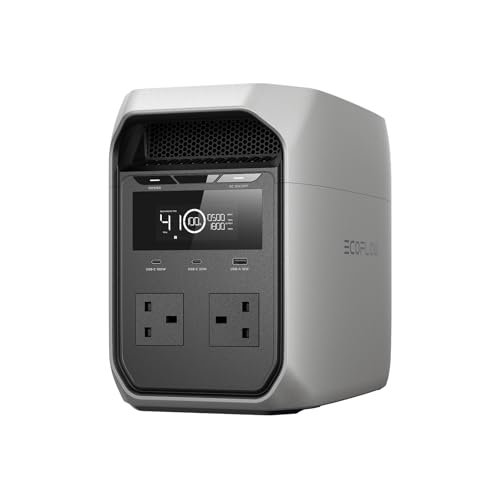
The best-value model in EcoFlow's current 1kWh range, and the lowest-priced of its three: the same 1,800W output and LFP chemistry as the DELTA 2, a slightly faster 45-minute 0-80% mains recharge, and a 10ms UPS switchover. The trade-off is that this 'Classic' model's capacity is fixed: unlike the DELTA 2 there is no extra-battery port, so 1,024Wh is what you get.
- Best for
- Keeping a fridge, router, phones and a few lights running through a multi-hour power cut, for households who won't need to expand capacity later.
- Skip it if
- You only need to keep phones, a tablet and a laptop topped up
as of 4 Nov 2026, 19:07 GMT · Details
Product prices and availability are accurate as of the date/time indicated and are subject to change. Any price and availability information displayed on Amazon.co.uk at the time of purchase will apply to the purchase of this product.We earn a commission if you buy through the retailer links on this page. It doesn't change our verdict. How we make money →
Researched, not used. We haven't used this product. This review is built from the maker's specifications, owner reports and our own sizing.
What we like
- LFP cells EcoFlow rates for a 10-year lifespan, backed by up to 5 years' warranty (3 years standard, 2 more when registered in the EcoFlow app)
- Recharges 0-80% in 45 minutes on the mains (60 minutes to full), with a built-in 10ms UPS switchover for sensitive electronics like a router or NAS
- 1,800W continuous output (3,600W surge; up to 2,400W via X-Boost) covers most household essentials
Worth knowing
- Unlike the DELTA 2, there is no extra-battery expansion port, so 1,024Wh is a hard ceiling — the standard DELTA 3 or DELTA 3 Plus (1-5kWh expandable) exist if you might want more later
- No 12V car-style DC output port, unlike the standard DELTA 3 / DELTA 3 Plus
- Only 5 outputs (2 AC, 1 USB-A, 2 USB-C), fewer than EcoFlow's DELTA 3 and DELTA 3 Plus
ⓘ As an Amazon Associate, PreparedBritain earns from qualifying purchases. We may earn a commission when you buy, or a fee when you request a quote, through our links. When two products are close, commission can decide which one we pick. A clearly better product always wins. Amazon prices come from Amazon's own product data and show the date and time they were retrieved. Prices at other retailers are checked by us, less often. Prices and stock can change at any time, so always check the retailer's price before you buy.
Our review
The plainest DELTA 3: 1,024Wh of LFP cells, 1,800W from two mains sockets, 12.1kg, and a 10ms switchover, with the ports and expansion of its siblings stripped out to reach a lower price. What matters is what is missing, because for a one-fridge, one-router household none of it is needed. It suits a home that wants a single evening's backup done well and knows it will never want more.
What the numbers mean
1,024Wh is about a unit of electricity, of which roughly 780Wh reaches your appliances by the site's planning method (90% depth of discharge, 85% inverter efficiency, 10W self-consumption). 1,800W continuous covers most plug-in appliances apart from kettles and heaters; the 3,600W surge starts a compressor, and X-Boost, which the Classic's manual says is enabled by default, lets heating loads up to 2,400W run at reduced voltage. EcoFlow quotes a ten-year lifespan for the full-tab LFP cells from internal simulation rather than a cycle count.
In a UK power cut
By our runtime method over the appliance-draw dataset, a fridge-freezer lasts 13 to 36 hours, a router 33 to 42 hours, a CPAP on blower alone 26 to 56 hours (9.5 to 25 hours with a heated humidifier), a laptop 10 to 20 hours, a television 3.5 to 18 hours and a gas combi boiler's electrics 6 to 17 hours. Fridge-freezer, router, four LED bulbs and a charging phone together give 4.5 to 14 hours; with the combi boiler, 2.5 to 8.5 hours. Boilers are hard-wired, so that needs an electrician's changeover first; the method is in will a power station run a fridge freezer.
The AC socket has an idle timeout, so for a fridge set it to never in the app. The UPS transfers in 10ms but only while the unit is plugged in with the appliance on its sockets, and EcoFlow says it is not for life-sustaining medical equipment. A 2.2kW kettle needs X-Boost and boils slowly; a 3kW one is too much.
How it compares
The EcoFlow DELTA 3 Plus is the same cells and inverter with four sockets, two 140W USB-C ports, a 12V car socket, 1,000W of solar and an extra-battery port to 5kWh, for 400g more. The BLUETTI Elite 100 V2 offers the same 1,024Wh and 1,800W at 11.5kg with 1,000W of solar and a car socket. The older EcoFlow DELTA 2 has the same capacity and output at 12.2kg and does take an extra battery. The brand's range is on EcoFlow power stations.
Living with it
The AC input is 1,400W and EcoFlow quotes 0 to 80% in 45 minutes in fast mode and 60 minutes to full. A full charge from empty costs about 27p at the Ofgem price cap rate of 26.32p per kWh for October to December 2026, before losses. Solar is 11 to 60V and 500W through one XT60 port; car charging is 12V at 8A, about 96W. Only an AC cable is in the box. Outputs are two mains sockets, a 100W and a 30W USB-C and one USB-A; there is no 12V socket for a car fridge. EcoFlow's UK spec table gives under 30dB at 600W, under 40dB at 1,200W and 50dB flat out. Wi-Fi, Bluetooth and a storm mode. Warranty is muddled: EcoFlow UK's policy table says five years, its UK spec page 3+2 years with app registration, so register it. Returns from uk.ecoflow.com run 30 days from delivery at the buyer's carriage cost.
Safety
The manual allows charging from 0°C to 45°C and discharge and storage from -10°C to 45°C, with 0°C to 30°C recommended for storage. It is IP20, so indoors and dry only. Cycle it every three months, leave it at about 60% in storage, and expect no warranty cover if it sits unused for six months. General advice is in our lithium battery fire safety guide; for CPAP and oxygen read running medical equipment in a power cut.
Our verdict
This is the sensible buy for a household whose list is the fridge-freezer, the router, phones and a lamp or two, with no plan to add solar panels or a second battery. It gives up ports most homes never use and keeps the parts that matter: the cells, the inverter and the 10ms switchover. If a car fridge, four sockets or a path to 5kWh is on your list, pay the difference for the Plus. Sizing help is in what size power station do you need.
A researched review, built from the maker's specs, manual and UK listings; facts checked 21 Oct 2026. Sources: EcoFlow UK — DELTA 3 Classic (1024Wh) product page; EcoFlow UK — DELTA 3 Classic specifications (ports, charge times, noise, temperatures, IP20, 3+2 years); EcoFlow UK store — DELTA 3 Classic listing (2.5 hours from 500W solar, model comparison); EcoFlow — DELTA 3 Classic user manual (online: X-Boost, UPS, AC timeout, storage); EcoFlow UK — DELTA 3 Classic support (quick start guide and safety instructions PDFs); EcoFlow UK — warranty policy (DELTA 3 Classic listed at 5 years); EcoFlow UK — refund policy (30-day returns on uk.ecoflow.com orders); Ofgem — energy price cap unit rates and standing charges (1 October to 31 December 2026).
Who shouldn't buy this
You only need to keep phones, a tablet and a laptop topped up — a much cheaper power bank does that job. And skip this specific 'Classic' model if you think you'll want to add capacity later, since it has no expansion port; the standard DELTA 3 or DELTA 3 Plus do.
Key specs
| Capacity | 1,024 Wh |
| Output | 1,800 W |
| Weight | 12.1 kg |
This is a Researched review: we haven't used this product. We check every specification against at least two independent sources, re-check the UK price on a schedule where we can track it automatically, and say plainly who it isn't for. Commissions never change a rating.
If this isn’t the one

Best for Keeping the essentials going through a power cut — fridge, phones, router, lights and small medical devices.
as of 4 Nov 2026, 19:07 GMT · Details
Product prices and availability are accurate as of the date/time indicated and are subject to change. Any price and availability information displayed on Amazon.co.uk at the time of purchase will apply to the purchase of this product.
Best for Households that want the fridge, router and phones covered for a long power cut and may add a second battery later — the expandable 1kWh choice.

Best for Keeping a fridge, router, phones and lights running through a long power cut — light, quiet, and close to the DELTA 3 Classic on price.
Questions
Can the EcoFlow DELTA 3 Classic run a fridge-freezer?
Yes. A fridge-freezer averaging 12 to 51W runs 13 to 36 hours on 1,024Wh by the site's runtime method, and the 3,600W surge covers the compressor. Set the AC timeout to never in the EcoFlow app first.
How long does the DELTA 3 Classic take to charge?
EcoFlow quotes 0 to 80% in 45 minutes in fast mode and 0 to 100% in 60 minutes from the mains at 1,400W. EcoFlow UK gives 2.5 hours from 500W of solar. A car socket supplies about 96W, so allow more than ten hours from one.
Does the DELTA 3 Classic have a 12V car socket?
No. The Classic's outputs are two mains sockets, one USB-A and two USB-C. A compressor car fridge would need to run from a mains adaptor, or you would choose the DELTA 3 Plus, which has a 12V socket.
Can you add an extra battery to the DELTA 3 Classic?
No. There is no extra-battery port on this model, so 1,024Wh is its limit. The DELTA 3 Plus and the DELTA 3 1500 take EcoFlow's extra batteries.
Free alerts for your home
Home Alerts emails you when a power cut, a Met Office warning or a flood warning covers your postcode. Free for your own home. Sign up in a minute.
Start free →