Best water storage & purification for emergencies (2026)
The cheapest emergency water is sealed bottled water you rotate. But if you want to store more, or purify from the tap, here are the containers and tablets worth buying — sized for a UK household.
By Tom Calder · Updated 20 September 2026 · 12 products, 6 of 12 price-tracked
Before you buy
The boring answer is the right one: sealed supermarket bottled water, rotated through normal use, is the cheapest and safest store for almost every household. Containers earn their place when you want more than a case or two, or want water for washing and flushing as well as drinking.
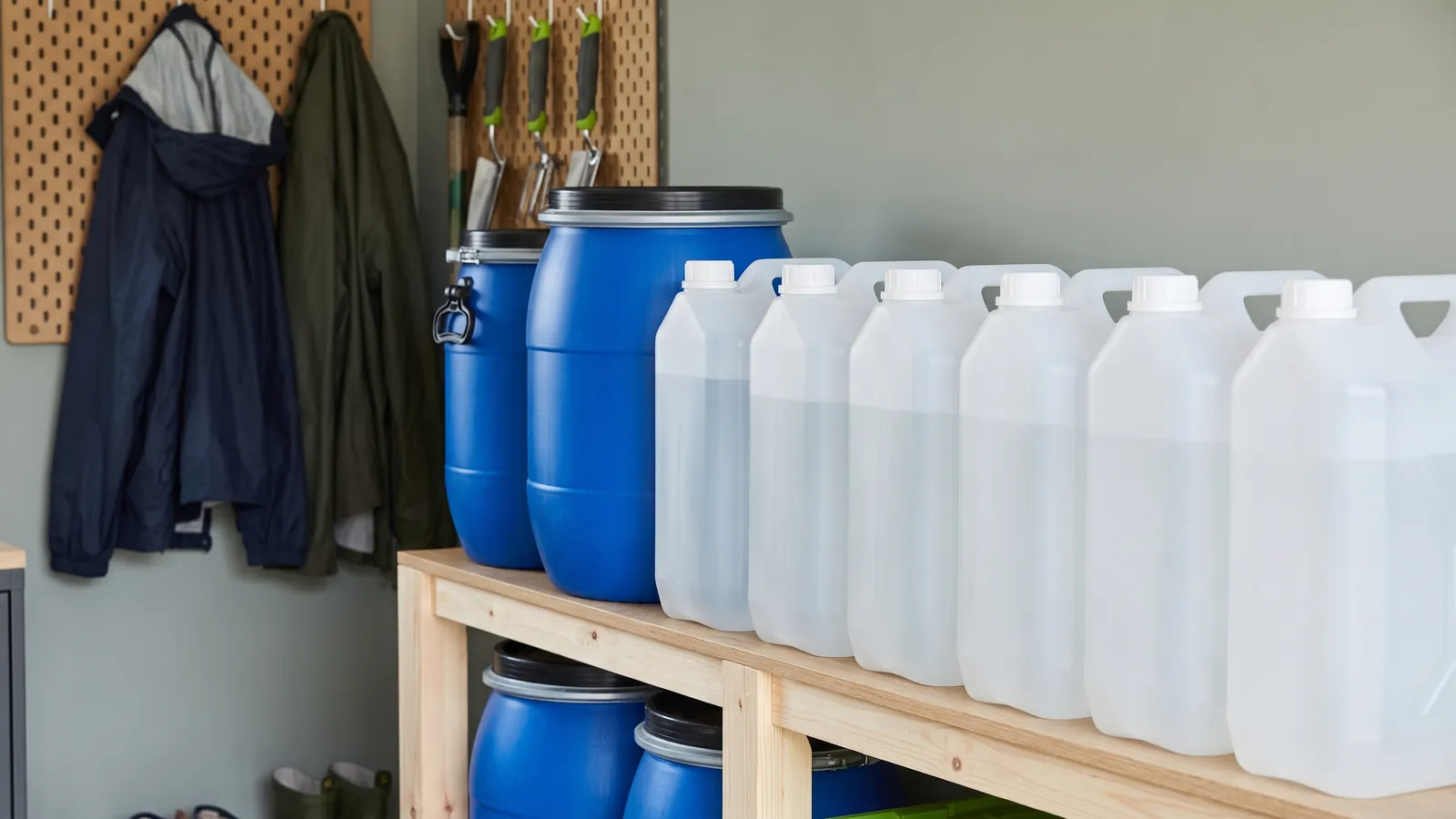
If you buy containers, 'food grade' (HDPE, BPA-free) is non-negotiable, and size against carrying: a full 25L jerry can weighs 25kg. Two or three 10–15L containers are easier to move, fill and pour than one monster. Fill from the cold mains tap, label with the date, and refresh every six months.
Purification tablets are the backup layer, not the plan. They're cheap, tiny and last years — a pack in the kit covers the rare case your stored water runs out and you're purifying from an uncertain source. Follow the dose and contact time on the pack exactly.
Stepping up: past jerry cans, storage becomes a siting decision. A 210L food-grade tank (~£174) is a family's week of water; a WRAS-approved 300L Enduramaxx (~£255) is the certified buy-once reserve; a certified-NEW 1000L IBC is the ceiling — never a reconditioned one, whatever eBay charges, because you cannot rinse away unknown previous contents. All of them weigh a quarter-tonne to a tonne full: solid ground-floor concrete, positioned before filling, rotated twice a year.
Top pick: Enduramaxx 300L Slimline Potable Tank. If you want a fixed water reserve done properly, this is the grown-up option: a UK-manufactured 300-litre tank actually approved for potable storage (WRAS and DWI), with a 10-year warranty and a 600mm round footprint that tucks into a garage corner. That approval is the difference between 'food-grade plastic' and 'certified for drinking water systems'. Full it's around 300kg, so it wants level, load-bearing concrete — a garage or slab, never decking — and stored water still deserves periodic rotation.
| Container | Capacity | Type | Price | |
|---|---|---|---|---|
| Enduramaxx 300L Slimline Potable TankTOP PICK | — | Potable-rated fixed tank | — | See price at Enduramaxx → |
| Aquatabs Water Purification Tablets | 2,000 L | Chlorine (NaDCC) tablets | — | Check price → |
| Aquaroll Premium 40L Water Carrier | — | Wheeled roll-along carrier | — | See price on Amazon → |
| 210L Food-Grade Water Tank with Tap Kit | — | Static food-grade tank (baffled) | — | See price at Directwatertanks → |
| 6 × 25L Stackable Jerry Can Multi-Pack | — | Stackable jerry can set | £55.69as of 20 Sep 2026, 12:29 BST · DetailsProduct prices and availability are accurate as of the date/time indicated and are subject to change. Any price and availability information displayed on Amazon.co.uk at the time of purchase will apply to the purchase of this product. | Check price → |
| 1000L Food-Grade IBC (New) | — | New food-grade IBC | — | See price at Kingfisher → |
| Reliance Aqua-Tainer 26L Water Container | 26 L | Rigid BPA-free polyethylene container with hideaway tap | £57.10as of 20 Sep 2026, 12:29 BST · DetailsProduct prices and availability are accurate as of the date/time indicated and are subject to change. Any price and availability information displayed on Amazon.co.uk at the time of purchase will apply to the purchase of this product. | Check price → |
| WaterBrick 8L Stackable Water Container | 13.2 L | Stackable HDPE brick container | — | See price on Amazon → |
| 25L Hard Water Jerry Can (food grade) | 25 L | Rigid HDPE jerry can, food-grade | £12.34as of 20 Sep 2026, 12:29 BST · DetailsProduct prices and availability are accurate as of the date/time indicated and are subject to change. Any price and availability information displayed on Amazon.co.uk at the time of purchase will apply to the purchase of this product. | Check price → |
| Chlorine Dioxide Water Purification Tablets | 30 L | Chlorine dioxide tablets (1 tablet per 1L) | — | Check price → |
| Collapsible 15L Water Carrier | 15 L | Collapsible food-grade plastic jerrycan with tap | £7.99as of 20 Sep 2026, 12:29 BST · DetailsProduct prices and availability are accurate as of the date/time indicated and are subject to change. Any price and availability information displayed on Amazon.co.uk at the time of purchase will apply to the purchase of this product. | Check price → |
| WaterBOB Emergency Bathtub Water Storage | 379 L | Single-use bathtub water bladder (food-grade LLDPE liner) | £39.99as of 20 Sep 2026, 12:29 BST · DetailsProduct prices and availability are accurate as of the date/time indicated and are subject to change. Any price and availability information displayed on Amazon.co.uk at the time of purchase will apply to the purchase of this product. | Check price → |
ⓘ As an Amazon Associate, PreparedBritain earns from qualifying purchases. We may earn a commission when you buy, or a fee when you request a quote, through our links — it never affects what we recommend. Amazon prices come from Amazon's own product data and show the date and time they were retrieved. Prices at other retailers are checked by us, less often. Prices and stock can change at any time, so always check the retailer's price before you buy.
Who it's for: The buy-once reserve — the only WRAS/DWI potable-rated tank here, UK-made, 10-year warranty.
If you want a fixed water reserve done properly, this is the grown-up option: a UK-manufactured 300-litre tank actually approved for potable storage (WRAS and DWI), with a 10-year warranty and a 600mm round footprint that tucks into a garage corner. That approval is the difference between 'food-grade plastic' and 'certified for drinking water systems'. Full it's around 300kg, so it wants level, load-bearing concrete — a garage or slab, never decking — and stored water still deserves periodic rotation.
- WRAS/DWI potable approval — the real certification, rare at this price
- UK-made, 10-year warranty, one-piece moulding
- 600mm footprint fits a garage corner
- ~300kg full: solid ground-floor concrete only
- 'Slimline' means narrow, not small — it's 1.25m tall
Aquatabs Water Purification Tablets
4.5Who it's for: A cheap, compact backup for disinfecting clear tap or stored water if the mains supply is compromised.
The most widely trusted purification tablet in the world, and a sensible few pounds to keep in any grab bag. It disinfects clear water reliably, but it is not a filter, so treat it as one layer of your water plan rather than the whole answer.
- Certified to NSF/ANSI 60 and used by the WHO, UNICEF and Red Cross; kills bacteria, viruses and Giardia in about 30 minutes.
- Very cheap and compact, with a roughly five-year shelf life; a 100-pack treats around 2,000 litres, so a small tube covers a household for a long emergency.
- Milder chlorine taste than older iodine tablets, and individually sealed so part-used packs stay stable.
- Disinfects but does not filter: it won't remove sediment, chemicals or heavy metals, and won't reliably kill Cryptosporidium.
- Leaves a faint chlorine taste that some people notice.
Don't buy if Your likely water source is cloudy, silty or chemically contaminated. Tablets only work on clear water, so in that case choose or add a proper filter rather than relying on these alone.
Aquaroll Premium 40L Water Carrier
4.5Who it's for: The clever middle ground — 40 litres one person can actually move.
The caravan world solved a problem preppers argue about: how one ordinary person moves 40kg of water. The Aquaroll rolls it — kitchen to car boot to garden tap — on a UK-made, food-grade body with a 10-year warranty. For household resilience it's the most practical single container here, because capacity you can't move is capacity you won't use. Check you're buying this Premium (virgin food-grade plastic) rather than the cheaper recycled-plastic Economy, and treat it as fill-use-empty kit: rotate rather than leaving it static for months.
- Rolls — the only 40L one person moves easily
- UK-made, food-grade, 10-year warranty
- Filler hose and tap connector included
- Built for touring cycles, not months of static storage
- Hard work across grass or gravel when full
210L Food-Grade Water Tank with Tap Kit
4.4Who it's for: The step past jerry cans — a week-plus of household water in one food-grade tank.
Two hundred and ten litres is where water storage stops being containers and becomes a reserve — roughly a week of drinking and basic-hygiene water for a family, in a genuinely food-grade baffled tank with a proper dispensing tap, from a UK specialist rather than a repurposed drum of unknown history. Site it before you fill it: at ~225kg full it never moves again, so decant from the tap and rotate the contents roughly every six months. It isn't WRAS-approved for mains plumbing — fill by hose, don't plumb it in.
- A meaningful family reserve in one purchase
- Food-grade with a baffled interior and real tap kit
- UK tank specialist, not an anonymous drum
- ~225kg full — position first, and only on solid ground
- Not WRAS-approved: hose-fill only, and rotate six-monthly
6 × 25L Stackable Jerry Can Multi-Pack
4.3Who it's for: 150 litres the modular way — six cans you can lift beats one tank you can't.
The alternative philosophy to the big tanks: split 150 litres across six UN-approved, food-grade, interlocking 25-litre cans. Each is 25kg full — heavy but liftable — so water can go where it's needed: two in the car, one in the kitchen, three in the shed. No pump needed, no single point of failure, and the stack footprint is one cupboard corner. The cost is faff: six caps to check and six cans to rotate every six months, and mind the near-identical 20L pack sold alongside this one.
- Every can is liftable — capacity you'll actually use
- UN-approved and stackable; no pump required
- No single point of failure
- Six containers to rotate, not one
- 25kg per can is still a real lift for some
as of 20 Sep 2026, 12:29 BST · Details
Product prices and availability are accurate as of the date/time indicated and are subject to change. Any price and availability information displayed on Amazon.co.uk at the time of purchase will apply to the purchase of this product.1000L Food-Grade IBC (New)
4.2Who it's for: The ceiling of home water storage — and only ever buy one NEW.
A tonne of water in a caged, palletised, certified-new food-grade tank: this is the whole-household reserve, and honestly more than most homes need — two or three smaller tanks are usually the better buy. The reason this exact unit earns its place is the word NEW: reconditioned IBCs on eBay for £100–£180 previously held unknown chemicals, and no amount of rinsing makes that a drinking-water tank. If you want the full 1,000 litres, buy certified-new from a specialist, site it on solid concrete, and accept it will never move again.
- Certified-new, BRCGS food-grade — no mystery previous contents
- Integrated 2-inch valve for controlled decanting
- The genuine maximum a household can sensibly store
- ~1 tonne full: solid concrete, permanent siting
- Overkill for most homes — smaller tanks are usually wiser
- Never substitute a cheap reconditioned IBC for drinking water
Reliance Aqua-Tainer 26L Water Container
4.0Who it's for: Bulk water storage at home, or for camping and caravan trips.
A sturdy, food-safe rigid container that holds a useful 26 litres of water, and a long-standing favourite for storing it. The rectangular shape stacks and stores neatly, though the tap and vent cap are the parts most likely to need eventual replacement.
- BPA-free, food-safe polyethylene certified to UK/EU (LFGB) and FDA standards
- Rectangular design stacks and stores efficiently; reversible hideaway spigot protects it in transit
- Holds 26 litres (7 US gallons) in one rigid, reusable container
- The spigot and vent cap can grow brittle over time and are the usual failure point, though spares are cheap
- Pouring is less convenient than a true jerry-can, and the tap flow is slow
Don't buy if Don't buy if you'll regularly need to carry it full - 26 litres of water weighs about 26kg, which is a lot to lift or move about; a couple of smaller containers may suit better. Also avoid relying on it for long-term storage in direct sunlight, which degrades the plastic.
as of 20 Sep 2026, 12:29 BST · Details
Product prices and availability are accurate as of the date/time indicated and are subject to change. Any price and availability information displayed on Amazon.co.uk at the time of purchase will apply to the purchase of this product.WaterBrick 8L Stackable Water Container
4.0Who it's for: Households wanting modular, stackable long-term water storage that tucks into cupboards, wardrobes and under beds.
A genuinely rugged, food-grade HDPE container whose interlocking design stores water tidily in awkward spaces and doubles for dry food. Worth knowing there is no true 8-litre model: the standard unit holds about 13 litres (3.5 US gallons) and is usually sold in multi-packs, so it is dear per litre and around 13kg when full.
- Interlocking, cross-stackable design uses vertical space far better than round jerrycans
- Food-grade, BPA-free HDPE with a wide screw lid, so it stores dry food as well as water
- Solidly built with a comfortable carry handle and long UV-stable service life
- Expensive per litre compared with a plain 25L jerrycan or a WaterBOB
- Around 13kg when full and usually only sold in pricier imported multi-packs in the UK
Don't buy if You just want the cheapest bulk emergency water: a plain 25L jerrycan or a bath-filling WaterBOB gives far more litres per pound and per cubic foot; the WaterBrick earns its price only if you specifically need the stackable, modular format.
25L Hard Water Jerry Can (food grade)
4.0Who it's for: Cheap, robust bulk water storage kept at home for a stay-at-home emergency.
A plain, food-grade rigid jerry can is one of the most cost-effective ways to store the several litres per person, per day that the government suggests keeping in. It is unglamorous but does the job, and stacks neatly in a garage or under the stairs.
- Food-grade HDPE and usually UN-approved, so safe for drinking water and hard-wearing
- Very inexpensive per litre stored, and stackable to save space
- Rigid walls and a screw cap survive knocks better than collapsible or bag-style containers
- A full 25L can weighs around 25kg, which is awkward and heavy to lift or carry any distance
- Narrow filler necks can make filling and pouring slow without a tap or funnel
Don't buy if You want water you can grab and carry out the door - at 25kg full this is a keep-at-home container, so choose smaller 5-10L cans or a wheeled option if portability matters.
as of 20 Sep 2026, 12:29 BST · Details
Product prices and availability are accurate as of the date/time indicated and are subject to change. Any price and availability information displayed on Amazon.co.uk at the time of purchase will apply to the purchase of this product.Chlorine Dioxide Water Purification Tablets
4.0Who it's for: A compact water-disinfection backup for a grab bag or emergency water store.
A reliable, no-fuss way to make questionable water safe to drink when you can't boil it. Chlorine dioxide handles viruses, bacteria and cysts with little aftertaste, which makes these a sensible line of defence in any household kit.
- Chlorine dioxide kills viruses, bacteria and most cysts, with far less aftertaste than iodine or plain chlorine.
- Small, light and long-lasting (individually foil-sealed, roughly a 3-year shelf life) - ideal for a grab bag.
- One tablet treats a litre, so a 30-pack covers a household through a short outage.
- Not instant - you wait 10-30 minutes, and longer if the water is very cold or cloudy.
- Disinfects but doesn't filter: it won't remove sediment, chemicals or heavy metals, so the water needs to be reasonably clear first.
Don't buy if Don't rely on tablets alone if your likely water source is muddy or debris-laden, or you need to remove chemical contaminants - pre-strain and pair with a filter, or choose a pump/gravity filter instead. And if you can safely boil water, that already does the job for free.
Collapsible 15L Water Carrier
3.5Who it's for: Cheap, packable back-up water storage you can fill ahead of a planned supply interruption.
A sensible, low-cost way to keep spare water capacity in a cupboard until you need it, and 15L is a practical amount for one person's drinking water over a couple of days. Treat it as short-term standby storage rather than a rugged, fill-and-forget container.
- Very inexpensive and folds flat, so you can keep two or three tucked away until a storm warning or works notice gives you time to fill them
- 15L is a well-judged size: roughly a couple of days' drinking water for one, while a full unit at about 15kg is still liftable by most adults
- Built-in tap makes dispensing tidy without tipping the whole container
- The seams and tap are the weak points and can weep or split, especially after repeated folding and unfolding
- Thin walls mean it is easily punctured and not designed for long-term stored water, which is best kept fresh and rotated
Don't buy if You want water you can store filled for months, or a container that shrugs off being knocked about in a garage or car boot; a rigid HDPE jerrycan is the better buy there.
as of 20 Sep 2026, 12:29 BST · Details
Product prices and availability are accurate as of the date/time indicated and are subject to change. Any price and availability information displayed on Amazon.co.uk at the time of purchase will apply to the purchase of this product.WaterBOB Emergency Bathtub Water Storage
3.5Who it's for: Households with a standard bathtub who want a large, cheap water reserve to fill when a supply interruption is forecast.
A clever, low-cost way to bank around 380 litres of clean water in your bath when you get warning of a supply cut, and it packs away to nothing the rest of the time. Its weakness is that it only helps if you have a standard bathtub and enough notice to fill it, and it is effectively single-use once opened.
- Stores roughly 380 litres of water for a modest outlay and folds flat when not in use
- Sealed food-grade liner keeps water far cleaner than an open tub, and a siphon pump is included
- Simple to deploy in any standard bathtub and much cheaper per litre than stockpiling bottled water
- Effectively single-use once the seal is cracked, and stored water is only reliably fresh for a few weeks
- Needs a standard bathtub and advance warning to fill, so it is no help in a sudden, unannounced cut
Don't buy if Skip it if you only have a shower, or if you want a reserve that is always ready to go, in which case a few rigid water containers kept filled will serve an unannounced outage better.
as of 20 Sep 2026, 12:29 BST · Details
Product prices and availability are accurate as of the date/time indicated and are subject to change. Any price and availability information displayed on Amazon.co.uk at the time of purchase will apply to the purchase of this product.The Emergency Water Checklist
One page: how much to store per person, the cheapest ways to store it properly, how to make uncertain water safe, and what changes in a hosepipe ban. Free, no catch.
Download it straight away. We'll also send the occasional briefing when something genuinely matters — severe weather, live incidents, real price drops. Nothing else.
We verify every product's specifications against at least two independent sources, re-check its UK price and stock on a schedule where we can track it automatically, and cross-check safety-relevant claims against official guidance. Where we've bought and used a product ourselves we say so on its review; where we haven't, our verdict is a considered spec-and-evidence comparison, not a hands-on test — and commissions never change a ranking either way. Read our full methodology →
Related kit comparisons
Guides that go with this
How much water your household actually needs, the cheapest way to store it, how to keep it safe, and what to d…
What a boil water notice means, precisely how to make tap water safe, what you can and can't use the tap for, …
Common questions
How long can I keep tap water in a container?
In a clean, sealed, food-grade container kept cool and dark, refresh it every six months or so. UK tap water is high quality but isn't treated for indefinite storage the way sealed bottled water is — label the fill date and rotate.
How much water should I store per person?
The figure behind official guidance is 2.5–3 litres of drinking water per person per day minimum, around 10 litres to also cover cooking and hygiene. Three days for a family of four is roughly 36 litres minimum — about three supermarket multipacks.
Do purification tablets expire?
Yes — typically around five years sealed; check the pack. An expired tablet may simply under-dose, which is the dangerous kind of failure, so replace them when you do your annual kit check.
Does a water container have to be 'food grade'?
Yes. Containers that have held chemicals can never be made safe, and non-food plastics can leach into stored water over months. Buy purpose-made water containers and keep them for water only.
Are bathtub water bladders worth it?
For most homes they're a nice-to-have: a bladder like the WaterBOB holds a huge volume, but only if you get warning before the supply stops — fine for a forecast storm, useless for a burst main. Sealed bottles need no warning.
Can I drink water from my hot water tank or water butt in an emergency?
Water-butt rainwater: no — garden use only. A sealed cold-water storage tank is a possible last resort if treated (boiled or tableted) first, but stored bottled water is safer and simpler. Plan so you never need either.
How do I store a large amount of water at home?
In tiers: stackable 25L jerry cans (liftable, modular) up to about 150L; a static 210–300L food-grade tank for a family reserve — the WRAS/DWI-approved Enduramaxx is the properly certified option; and a certified-new 1000L IBC at the ceiling. Anything above jerry-can size must sit on solid ground-floor concrete and be positioned before filling — a 300L tank weighs about 300kg full. Rotate stored tap water roughly every six months, and never use a reconditioned IBC for drinking water.