How much emergency food should you store? A per-person guide
The maths done for you: turn about 2,000 kcal and 3 litres of water per person per day into concrete food and water shopping lists for 1, 2 and 4 people.
By Tom Calder · Updated 19 September 2026 · Sourced to GOV.UK Prepare & the NHS
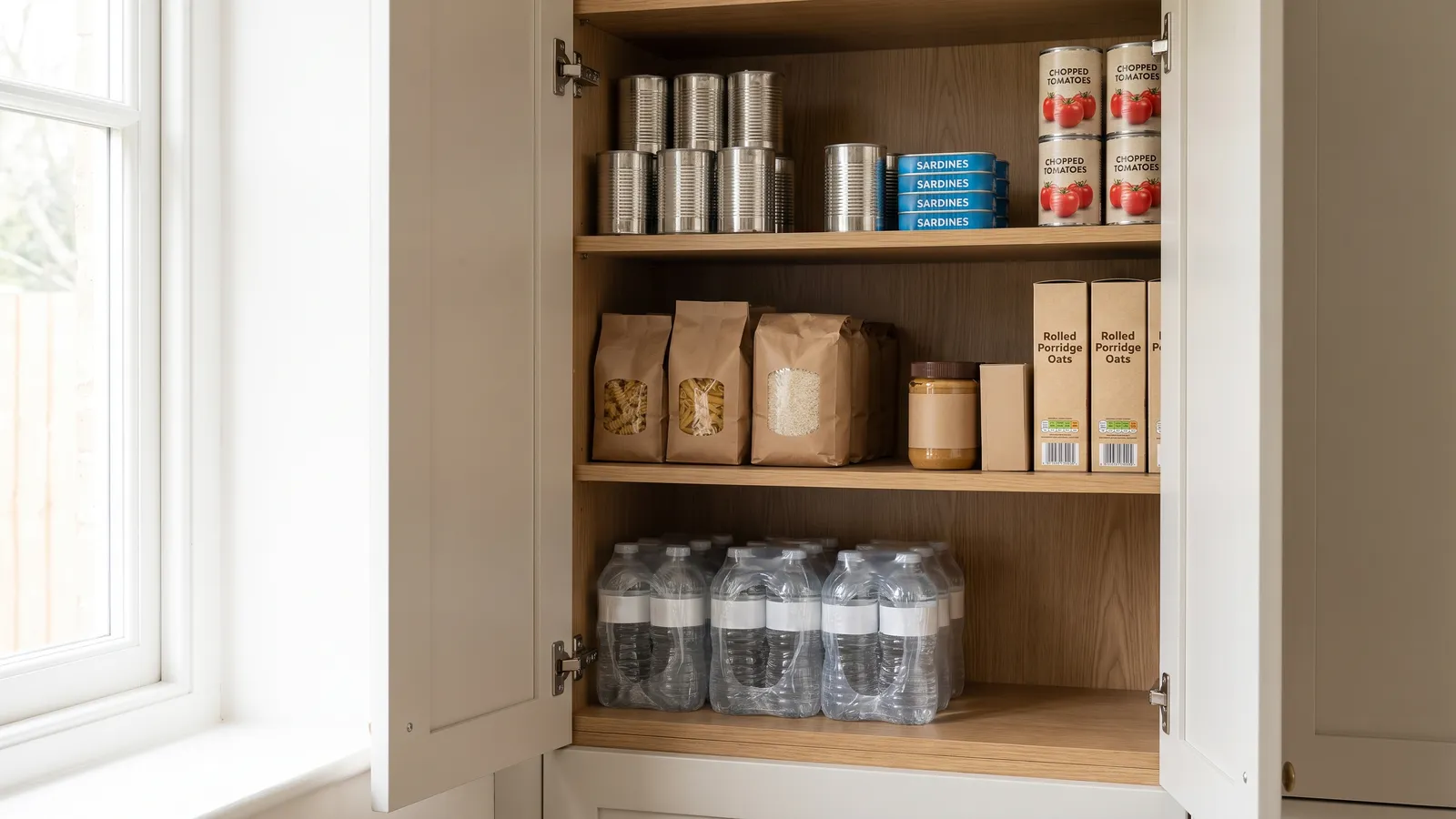
Two numbers do all the work
Emergency-food planning sounds complicated until you reduce it to two figures the government and the NHS already publish. The NHS puts an average adult's needs at around 2,000 kcal a day for women and 2,500 for men, so 2,000 kcal per person per day is a sensible, slightly conservative planning floor. The GOV.UK Prepare campaign, citing the World Health Organisation, puts drinking water at 2.5 to 3 litres per person per day, rising to about 10 litres once you add cooking and basic hygiene. Everything below is just those two numbers multiplied by days and by people.
Hold the calorie figure loosely. A teenager or someone doing heavy physical work needs more; a small child needs less. The point of a round 2,000 is not precision but a floor you can shop against without a spreadsheet.
Start with 72 hours, not a bunker
GOV.UK deliberately does not tell you to build a bunker. Its Prepare campaign centres on short, common disruptions — a power cut or a water outage lasting a few days — rather than a siege. In practice, 72 hours is the sensible first target and, for most households, the last one they will ever need. At 2,000 kcal a day that is 6,000 kcal per person, which is genuinely modest.
For one adult, that is roughly: two tins of baked or mixed beans, two tins of ready-to-eat meat or a canned meal, a tin of fish, a pack of crackers or crispbread, a jar of peanut butter, two tins of fruit, a pack of biscuits or cereal bars, and a litre of UHT milk — plus a manual tin opener and 9 litres of bottled water. Scaling is arithmetic, not judgement: for two people, double every line and store 18 litres of water; for a family of four, quadruple it and store 36 litres. GOV.UK stresses food "that doesn't need cooking", because in a power cut you may have no hob, so bias the 72-hour tier towards things you can eat cold, straight from the tin.
Scaling up: one week and two weeks
If you want more headroom, the next rungs are one week and two weeks — the latter a comfortable upper limit for most households, not a target everyone must hit. Think in per-person weekly baskets of about 14,000 kcal each: around five tins of beans, four tins of meat or ready meals, three tins of fish, 500g of pasta with a jar of sauce, 500g of rice, a 500g bag of porridge oats, a 340g jar of peanut butter, a pack of crackers, four tins of fruit and veg, two litres of UHT milk, and a pack of biscuits or cereal bars.
Then multiply. One week for two people is two of those baskets; two weeks for a family of four is eight of them, plus roughly 168 litres of drinking water. The pasta and rice add cheap calories but need boiling, so any store beyond a few days assumes you can cook — a camping stove or a working gas hob covers it. If you can't cook, weight the basket back towards tins you can open and eat cold.
What actually goes in the trolley — and who's easy to forget
Buy food your household already eats, in long-life form: tinned beans, fish and meat, pasta and sauce, rice, oats, UHT milk, tinned fruit and veg, peanut butter, crackers, biscuits and cereal bars. A few comforts — tea, coffee, a bar of chocolate — matter more than their calories suggest when the power is out. Keep a manual tin opener in the box; an electric one is useless in a cut.
Then the people and animals a bare calorie count misses. Add pet food to the same standard. If there is a baby, ready-to-feed liquid formula needs no water and is the simplest thing to store; powdered formula must be made with water boiled and cooled to no less than 70°C, per NHS guidance. Keep at least a week's buffer of any prescription medicine, and note anything the household can't eat — allergens, coeliac, halal, kosher, vegetarian — so your store is food you will actually open.
Water: the other half of the sum
Food gets the attention, but water is heavier, runs out faster and is easily underestimated. At 3 litres of drinking water per person per day, a 72-hour store is 9 litres each, a week is 21, and two weeks is 42 — so a family of four planning two weeks needs about 168 litres of drinking water alone, and considerably more if you want the 10-litre-a-day comfort level that covers cooking and washing. Supermarket multipack bottled water is sealed, date-stamped and costs pence per litre; buy a few packs more than usual and rotate them through normal drinking before their best-before dates.
A hosepipe ban does not touch your tap supply, so it is never a reason to panic-buy bottles. During an official "boil water" or "do not drink" notice from your water company, follow that notice above all else.
Build it gradually, size it to your house
None of this needs a single big spend or a special "prepper" shop. The cheapest, least wasteful way to build a two-week store is to add two or three long-life items you already eat to each normal shop, and eat the oldest ones first so nothing expires. The cost is spread over weeks, and the food never goes to waste because it is just your cupboard, slightly deeper.
The exact quantities shift with ages, appetites, pets and diets, which is fiddly to do in your head. Our kit builder takes your household and turns these figures into a single, printable shopping list sized to you.
Common questions
How much emergency food do I need per person, per day?
Plan on about 2,000 kcal per person per day — the NHS figure for an average woman, with an average man nearer 2,500. In concrete terms that is roughly two tins of beans, a tin of meat and a tin of fish, some crackers, a little peanut butter, tinned fruit and some milk for one adult for one day.
How many days of food should I store?
GOV.UK Prepare focuses on short disruptions such as a power cut or water outage lasting a few days. In practice, 72 hours is the sensible starting target, and two weeks is a comfortable upper limit for most households — not an official requirement. You do not need more than that.
How much water should I store per person per day?
GOV.UK Prepare uses the World Health Organisation figure of 2.5 to 3 litres of drinking water per person per day, rising to about 10 litres once you include cooking and basic hygiene. So plan on 9 litres of drinking water per person for 72 hours, or 42 litres for two weeks.
Do I need special emergency ration packs or freeze-dried food?
No. Ordinary tinned and dry food you already eat is far cheaper per calorie and rotates through normal meals with no waste. Freeze-dried ration packs suit hiking and long expeditions, not a home cupboard, and they also need water to rehydrate — which is the very thing that may be short.
Roughly what does a two-week food store cost?
Built gradually — a few extra long-life items added to each normal shop — a per-person two-week store is a modest cost spread over several weeks, and effectively free in the long run because you eat and replace it. The expensive mistake is buying it all in one panic trip, or paying a premium for branded 'survival' food.
Should emergency food be able to be eaten without cooking?
For the 72-hour tier, yes — bias towards food you can eat cold, because a power cut may leave you without a hob, and GOV.UK specifically recommends food "that doesn't need cooking". For longer stores, pasta and rice add cheap calories if you have a camping stove or a working gas supply to boil water.
Sources: GOV.UK Prepare — Get prepared for emergencies (food and water) · NHS — Understanding calories · Defra — United Kingdom Food Security Report 2024 · NHS — How to make up baby formula. PreparedBritain is independent and not affiliated with HM Government.
The Emergency Kit Checklist
The GOV.UK Prepare essentials on one printable page — tick them off as you go and keep it with the kit. Free, no catch.
Download it straight away. We'll also send the occasional briefing when something genuinely matters — severe weather, live incidents, real price drops. Nothing else.
Keep reading
All food & growing guides →What to sow and plant this month: the UK vegetable calendar
A month-by-month UK guide to what vegetables to sow and plant — indoors and out — from January to December. Jump to…
Grow your own food: a realistic resilience guide
The calm, honest case for growing some of your own food in the UK — what a garden can and can't do, and the…
Fuel shortages: what to do, and what not to do
The 2021 UK fuel crisis was panic-buying, not a fuel shortage. How forecourts really run, the calm response that…