Best home safes: fire-rated and insurance-rated compared (2026)
Most households buy a safe for one of two quite different jobs: keeping paperwork readable after a fire, or keeping cash and valuables out of a burglar's hands. Very few safes at household prices do both, and the label on the box rarely makes the difference clear. We've compared seven UK-available safes against the manufacturers' own documentation and the certification registers, and price-tracked them across specialist retailers. Where a claim has a named standard and a named certifying body behind it, we say so — and where it's marketing language, we say that too.
By Tom Calder · Updated 20 September 2026 · 7 products, 2 of 7 price-tracked
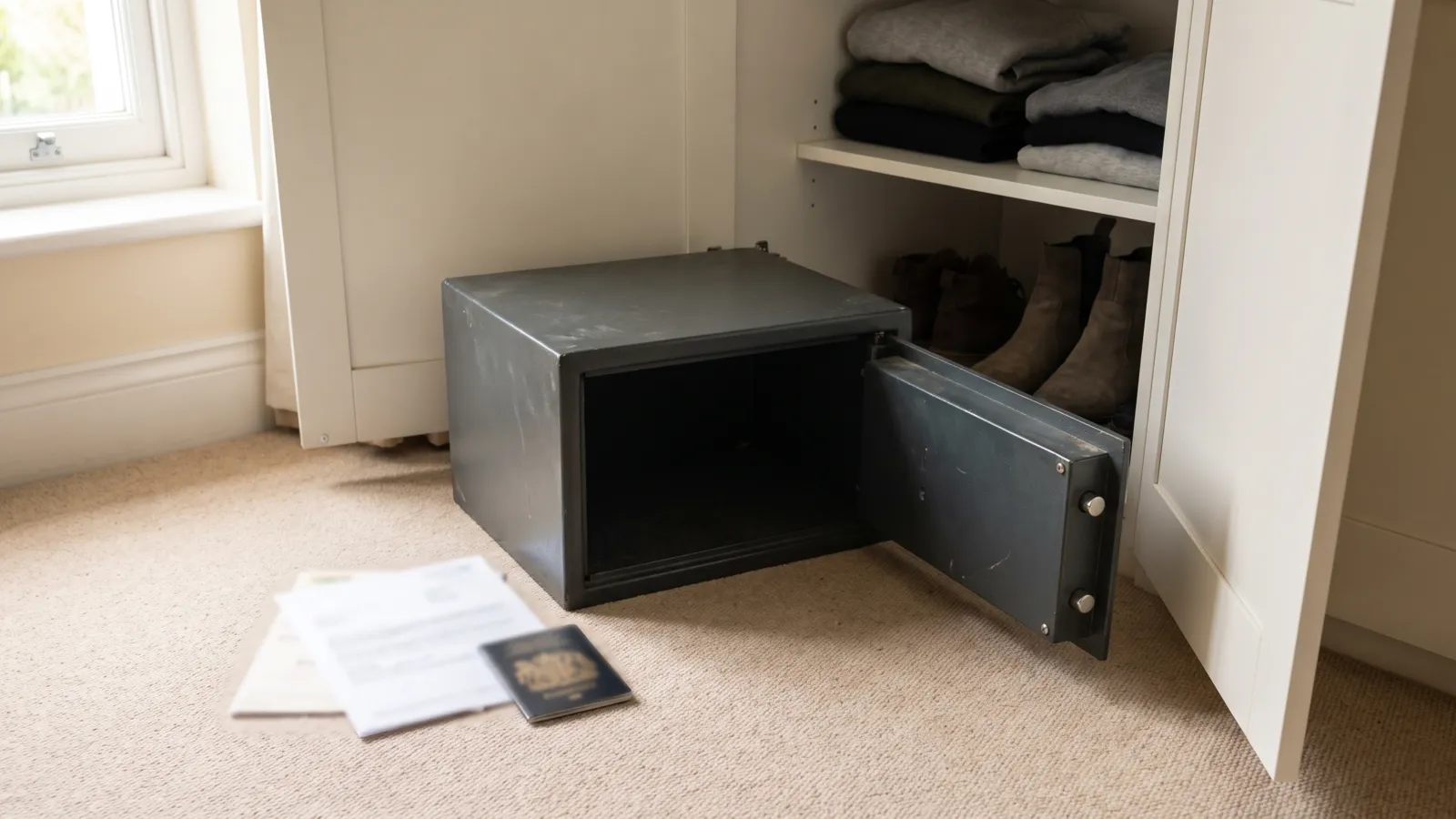
Before you buy
Start by deciding which of the two jobs you're buying for. A fire safe is built around an insulating barrier that keeps the inside cool enough for paper to survive a house fire. A security safe is built around thick steel and heavy bolt work to resist someone attacking it with tools. The two designs pull in opposite directions, and almost nothing at household prices does both well — so it is entirely normal to end up with a certified fire safe for documents and a separate certified security safe for cash and jewellery, rather than one box that half-does both.
Then read the certification line rather than the product name. A real fire rating names a standard and the body behind it: EN 1047-1 and EN 15659 are the European ones, while NT Fire 017 (a Nordtest standard) and UL 72 also count when the certifying body is named, as with RISE/SP in Sweden or Underwriters Laboratories. A real burglary rating names EN 14450 grade S1 or S2, or one of the EN 1143-1 grades, certified through a body such as Sold Secure, AiS or LPCB — and that certification is what generates the cash rating (£4,000, £10,000 and so on) an insurer may ask for. Where a manufacturer prints a cash figure with no standard and no certifying body, as several here do, it is a recommendation rather than a rating. Registers don't always publish certificate numbers either, so if your insurer wants one in writing, ask the manufacturer directly before you buy.
Plan the fitting before you plan the purchase. Weight is the giveaway: the 3.6kg Yale strongbox and the 13kg Phoenix Dione are both easily carried by one person, so their fixing kits are the security, not the steel. Bolting to a solid concrete floor or a masonry wall is what turns a box into a safe, and with certified products it is usually a condition of the certification — Burton states the Home Safe S2's rating is void unless it is fixed down. At the other end of the range, a 57kg Chubbsafes or a 103kg Phoenix Datacombi arrives kerbside and wants a ground floor or a joist you have checked, and professional bolt-down installation, where retailers offer it, runs around £68 to £108.
Finally, size it to what actually goes in, and check the media question. Capacity is not intuitive: 41 litres takes four lever-arch files, 11 litres is about a shoebox, and internal width is what decides whether a laptop lies flat. More importantly, an ordinary paper fire rating allows the interior to reach roughly 177°C — fine for paper, but enough to destroy magnetic and solid-state media. Hard drives, USB sticks and backup tapes need a separate data-media rating, which is exactly why that class of safe costs several times more. On locks, electronic keypads bring multiple user codes, one-time guest codes, time delay and dual-PIN entry; a key lock has nothing to go flat, which is worth something in a document safe you open twice a year.
Top pick: Burton Home Safe S2 1E. The only safe on this page whose security claim we could confirm at primary source: Sold Secure's own register lists the Burton Home Safe S2 under Burton Security Limited, certified to BS EN 14450 Grade S2 after independent attack testing. That certification is what supports the £4,000 cash and £40,000 valuables ratings, and it is backed by AiS approval and a Secured by Design licence. It has no fire protection whatsoever, so treat it as one half of a pair rather than a do-everything box.
| Safe | Type | Certification | Lock | Capacity | Price | |
|---|---|---|---|---|---|---|
| Burton Home Safe S2 1ETOP PICK | Insurance-rated security safe, electronic — no fire rating | EN 14450 S2 (Sold Secure) — £4,000 cash rating. No fire rating. | Electronic keypad, 10 codes, 4× 19mm bolts + hinge dog bolt | 11 L | £283.45Checked 20 Sep · indicative — not price-tracked | Check price → |
| Chubbsafes Executive Fire-Resistant Document Safe 40K | Fire document safe, key lock — no burglary grade | NT Fire 017 class 60 Paper (RISE) + UL 72 Class 350, 1hr | Cylinder key lock, 2 keys, 2 bolts, fixed hinge bolts | 41 L | — | Check price → |
| Phoenix Datacombi DS2501E Size 1 Data & Document Safe | Fire-rated document + data-media safe, floor-standing | NT Fire 017-90 Paper/90DIS (SP) + MTC DIP120-60DM; no burglary | Electronic, dual control, 2 PINs, internal locking drawer | 63 L | £864.62as of 20 Sep 2026, 12:29 BST · DetailsProduct prices and availability are accurate as of the date/time indicated and are subject to change. Any price and availability information displayed on Amazon.co.uk at the time of purchase will apply to the purchase of this product. | Check price → |
| Yale Medium Fire Safe YFM/352/FG2 | Fire document safe, digital lock — no burglary grade | Fire: NT Fire 017-60P (SP), maker-stated. No burglary grade. | Digital touchpad, 3–12 digits, battery override, 2× 16mm bolts | 19 L | £223.99Checked 20 Sep · indicative — not price-tracked | Check price → |
| Yale Large Fire Safe YFM/420/FG2 | Fire document safe, digital lock — no burglary grade | Fire: NT Fire 017-60P (SP), maker-stated. No burglary grade. | Digital touchpad, 48hr lockdown, 2× 16mm bolts, hinge dog bolts | 25.3 L | £239.99Checked 20 Sep · indicative — not price-tracked | Check price → |
| Phoenix Dione SS0311E Electronic Security Safe | Electronic hotel/laptop safe — no fire rating | None — no fire or burglary certification, no certified cash rating | Motorised electronic lock, key override, 2× 20mm bolts | 35 L | — | See price on Amazon → |
| Yale Small Value Safe YSV/200/DB2 | Budget electronic strongbox — no fire rating, no grade | None — no fire, burglary or cash certification of any kind | Digital keypad, auto-lock, override key, 16mm steel bolts | 8.6 L | £39.99as of 20 Sep 2026, 12:29 BST · DetailsProduct prices and availability are accurate as of the date/time indicated and are subject to change. Any price and availability information displayed on Amazon.co.uk at the time of purchase will apply to the purchase of this product. | Check price → |
ⓘ As an Amazon Associate, PreparedBritain earns from qualifying purchases. We may earn a commission when you buy, or a fee when you request a quote, through our links — it never affects what we recommend. Amazon prices come from Amazon's own product data and show the date and time they were retrieved. Prices at other retailers are checked by us, less often. Prices and stock can change at any time, so always check the retailer's price before you buy.
Who it's for: Anyone who needs a cash or valuables rating their home insurer will actually recognise.
The only safe on this page whose security claim we could confirm at primary source: Sold Secure's own register lists the Burton Home Safe S2 under Burton Security Limited, certified to BS EN 14450 Grade S2 after independent attack testing. That certification is what supports the £4,000 cash and £40,000 valuables ratings, and it is backed by AiS approval and a Secured by Design licence. It has no fire protection whatsoever, so treat it as one half of a pair rather than a do-everything box.
- Certified to BS EN 14450 Grade S2 by Sold Secure, and the entry is checkable on Sold Secure's own product register
- £4,000 cash and £40,000 valuables ratings that insurers recognise, plus AiS approval and a Secured by Design licence
- Four 19mm bolts and a hinge-side dog bolt, with optional dual-PIN entry and time delay
- No fire rating of any kind — passports, deeds and paperwork need a separate fire safe
- The certification is void unless it is fixed down: Burton requires it to be bolted to a floor or wall
- 11 litres is genuinely small at 220 x 270 x 190mm inside; the 2E and 3E sizes carry the same S2 certification if you need more room
Don't buy if Skip it if your priority is protecting documents from fire — pair it with, or choose instead, a certified fire safe such as the Chubbsafes Executive 40K.
Who it's for: Households who want fire certification from two named independent bodies, with room for four lever-arch files.
The strongest fire-certification claim in this group, and one we could confirm on Chubbsafes' own manufacturer site: NT Fire 017 resistance class 60 for paper certified by RISE in Sweden, plus UL 72 Class 350 for up to one hour from Underwriters Laboratories. Two named standards, two named bodies. Chubbsafes states no burglary certification and no cash rating for the Executive range, so the '£1,000 cash' figure some UK resellers print is a retailer's insurance guideline with nothing behind it.
- Dual fire certification — NT Fire 017 class 60 for paper by RISE, and UL 72 Class 350 for up to one hour by UL
- 41 litres takes four lever-arch files, with an adjustable shelf and a pull-out tray
- Key lock with two keys means nothing to go flat in a safe you open twice a year
- Three of the five UK stockists we checked were out of stock, one quoting a November 2026 restock
- No burglary certification and no manufacturer cash rating — the £1,000 figure resellers print is not a rating
- 57kg, and professional bolt-down installation is a £68–£108 extra if you'd rather not drill a concrete floor yourself
Don't buy if Skip it if you need to protect hard drives, USB sticks or backup media — paper fire ratings don't cover them, and the Phoenix Datacombi DS2501E does.
Who it's for: Protecting hard drives, backup media and business records from fire, where an ordinary paper safe would not.
The real differentiator here is a separately certified data-media rating rather than vague marketing about being 'safe for electronics': SP in Sweden certified it to NT Fire 017-90 for paper and 017-90DIS for diskettes, tapes and data storage, with a further MTC DIP120-60DM rating covering 60 minutes for DVDs, USB sticks and hard drives. It is also rated for a 9.1m drop impact, for collapse through a burning floor. Phoenix's '£2,500 overnight cash risk' figure, though, is a recommendation with no standard behind it — this is a fire safe, not a burglary-rated one.
- Separately certified data-media protection — NT Fire 017-90DIS plus MTC DIP120-60DM for hard drives and USB sticks
- 90 minutes for paper as well, so documents and digital backups sit in the same unit
- Internal lockable drawer, height-adjustable shelf and three key hooks, with hidden and scrambled code entry as standard
- 103kg and 640 x 500 x 500mm — it wants a ground floor or a checked joist, and arrives kerbside
- The '£2,500 overnight cash risk / £25,000 valuables' figure is a Phoenix recommendation, not a certified cash rating
- Some resellers print a 60-minute data figure lifted from a different standard; Phoenix's own spec is 90 minutes for diskettes and tapes, 60 for digital media
Don't buy if Skip it if you only need paperwork protected — the Chubbsafes Executive 40K or a Yale YFM fire safe does that job for a fraction of the price and the weight.
as of 20 Sep 2026, 12:29 BST · Details
Product prices and availability are accurate as of the date/time indicated and are subject to change. Any price and availability information displayed on Amazon.co.uk at the time of purchase will apply to the purchase of this product.Who it's for: Households wanting an hour of paper fire protection for passports, deeds and policy documents in a cupboard-sized box.
The fire side is credible: Yale states certification to NT Fire 017-60P with SP in Sweden as the certifying body — a real Nordtest standard and a named body, though we could not locate the certificate in a public register, so it stands as manufacturer-stated. The security side is not credible in the same way: the '£1,000 cash / £10,000 valuables' figure Yale prints is its own recommendation with no standard behind it, and the safe appears on neither the Sold Secure nor the Secured by Design register. Buy it as a fire safe that happens to have floor bolts, not as a burglary safe.
- 60 minutes of paper protection to NT Fire 017-60P, a genuine Nordtest standard with SP in Sweden named as certifier
- Code scramble, silent entry, a one-time guest code and lockdown mode are unusual features at this price
- Ships with a pack of two floor fixing bolts, so it can be anchored from day one
- No burglary certification at all — the £1,000 cash figure is Yale's own marketing, not an insurer-recognised rating
- Emergency access is via an external battery contact only; there is no key override if the electronics fail
- The Amazon listing title claims 36 litres — the real capacity is 19 litres according to Yale's own UK page
Don't buy if Skip it if your concern is theft rather than fire — the Burton Home Safe S2 1E costs about the same and carries a Sold Secure EN 14450 S2 certification an insurer will recognise.
Who it's for: The same 60-minute paper fire protection as the medium, in a 25-litre body for households with more paperwork.
The more substantial of the two Yale fire safes — a 76mm steel door, 46mm walls and hardened hinges with rear dog bolts — carrying the same manufacturer-stated NT Fire 017-60P certification via SP in Sweden. One warning worth reading twice: the Amazon listing title carries a 'Secured by Design' claim that does not appear on Yale's own UK product page, and we could not corroborate it on the Sold Secure or Secured by Design registers. Do not treat this as a police-approved security safe; as a fire safe it is sound, but it holds no burglary certification.
- Same NT Fire 017-60P 60-minute paper rating as the medium, in 25.3 litres rather than 19
- 76mm steel door and hardened hinges with rear dog bolts resist the door being levered at the hinge side
- Up to 48-hour lockdown mode and one-time guest codes, plus supplied floor fixing bolts
- The 'Secured by Design' claim in the Amazon title is absent from Yale's own UK page and we could not verify it on any register — ignore it
- £299.99 is RRP with no verified street price on the day, which makes it look poor value beside the £232 medium
- 36kg and kerbside delivery, so you'll need help getting it into position — and no fire rating covers theft
Don't buy if Skip it if 19 litres would do — the medium YFM/352/FG2 carries identical fire certification for around £70 less at real street prices.
Who it's for: Keeping a laptop, tablet and paperwork out of casual reach in a home office or holiday let, once it is bolted down.
Phoenix designed this as a hotel safe, and that shows in the one genuinely useful dimension: 520mm of internal width takes a 17-inch laptop lying flat, which almost nothing else at this price does. What it does not have is certification of any kind — no fire rating, no burglary grade, and a '£1,000 cash' figure Phoenix itself only describes as what the safe is 'recommended for'. At 13kg with a 4mm door and a 1.5mm body, the supplied fixing kit is the security here, not the steel.
- 520mm of internal width swallows a 17-inch laptop flat — rare at any home-safe price
- Motorised high-security electronic lock with two user PINs, a master code and backup override keys
- Back and base come pre-prepared with a DIY fixing kit for brick walls or concrete floors
- No certification whatsoever — no fire rating, no burglary grade, and the £1,000 figure is a Phoenix recommendation, not a rating
- 13kg with a 1.5mm steel body: left unbolted, one person picks it up and carries it out
- Not fire-rated at all, so passports and deeds belong in a fire safe instead
Don't buy if Skip it if the contents need to survive a fire — a Yale YFM fire safe or the Chubbsafes Executive 40K is the right box for documents.
Who it's for: Keeping spare keys, a little cash and medicines out of casual reach in a shared house or holiday let — bolted down.
Priced and built as exactly what it is: a lockable steel box with a keypad and an emergency override key, carrying no fire, burglary or cash certification of any kind. Yale's 'Value' and 'Standard Security' labels are marketing tiers, not tested classifications. It does ship with wall and floor fixings, and at 3.6kg those fixings are the entire security proposition — unbolted, this is a container a thief carries out under one arm and opens later.
- Around £40–£62 buys a keypad-locked steel box with 16mm bolts and a physical emergency override key
- Ships with wall and floor fixings, so it can be anchored properly from the start
- 8.6 litres is enough for keys, cash, medicines and a passport in a small cupboard
- No certification of any kind — no fire rating, no burglary grade, no cash rating, no named standard
- 3.6kg, so unbolted it is a carry-out job: fitting it properly is not optional advice here
- Zero fire protection, so anything irreplaceable inside is lost if the house burns
Don't buy if Skip it if anything going inside is irreplaceable or needs to survive a fire — a certified fire safe such as the Yale YFM/352/FG2 is the right box for documents.
as of 20 Sep 2026, 12:29 BST · Details
Product prices and availability are accurate as of the date/time indicated and are subject to change. Any price and availability information displayed on Amazon.co.uk at the time of purchase will apply to the purchase of this product.Get price-drop alerts on these
Prices for 364 tracked products are refreshed daily — last sweep 20 September 2026. Tell us which and we'll email you when one drops.
We verify every product's specifications against at least two independent sources, re-check its UK price and stock on a schedule where we can track it automatically, and cross-check safety-relevant claims against official guidance. Where we've bought and used a product ourselves we say so on its review; where we haven't, our verdict is a considered spec-and-evidence comparison, not a hands-on test — and commissions never change a ranking either way. Read our full methodology →
Guides that go with this
The fire service's own advice: get out, stay out, call 999 — plus how to plan your escape, what to do if you'r…
A simple, practical household emergency plan — the official GOV.UK Prepare approach: contacts, meeting points,…
Know your risk, get warnings, and what to do before, during and after a flood — the practical checklist, sourc…
Common questions
What's the difference between a fire safe and a security safe?
They are built for different threats. A fire safe uses an insulating barrier to keep its interior cool enough for paper to survive a house fire, but usually has no burglary certification. A security safe uses thick steel and heavy bolt work to resist attack, but typically offers no fire protection at all. Very few household safes are certified for both, which is why many people end up with one of each — a fire safe for documents, a small certified security safe for cash and valuables.
Does my home insurer need my safe to have a cash rating?
It depends on your policy, but if cash or valuables cover is the reason you're buying, the number that matters is the insurer-recognised cash rating — £4,000, £10,000 and so on. That figure comes from independent certification to EN 14450 or EN 1143-1 through a body such as Sold Secure, AiS or LPCB. A manufacturer printing '£1,000 cash / £10,000 valuables' with no standard named behind it is not the same thing. Confirm what your own insurer requires before you buy.
Is 'fireproof' a real standard?
No — it is a marketing word. A genuine fire rating names a standard (EN 1047-1, EN 15659, NT Fire 017 or UL 72), a protection class such as paper or data media, a duration, and the body that certified it. Chubbsafes' Executive range is a good example of a proper claim: NT Fire 017 resistance class 60 for paper, certified by RISE in Sweden, plus UL 72 Class 350 for one hour from Underwriters Laboratories. Two named standards, two named certifying bodies.
Do I really have to bolt a home safe down?
For anything under about 30kg, yes — that is where most of the security comes from. A 3.6kg strongbox or a 13kg laptop safe is simply carried out of the house and opened somewhere else at leisure. Every safe on this page ships with a fixing kit, and with certified models it can be a condition of the rating: Burton states the Home Safe S2's EN 14450 S2 certification is void unless it is bolted to a floor or wall.
Will a fire safe protect a hard drive or USB stick?
Not a standard paper-rated one. Paper fire ratings allow the interior to reach around 177°C, which paper survives and magnetic or solid-state media does not. Protecting drives, USB sticks or backup tapes needs a data-media rating — the Phoenix Datacombi, for example, is separately certified to NT Fire 017-90DIS for diskettes and tapes and to MTC DIP120-60DM for 60 minutes of digital-media protection. Those safes hold a much lower internal temperature and humidity, which is why they cost several times more than a paper safe.
Key lock or electronic keypad?
Electronic keypads win on convenience and on features like multiple user codes, one-time guest codes, time delay and dual-PIN entry. Key locks win on simplicity — there are no batteries to go flat in a document safe you open twice a year, though you do have to keep the keys somewhere sensible. Check the emergency access route too: some electronic safes include a physical override key, while the Yale YFM fire safes offer only an external battery contact if the power fails.
Where in the house should a safe go?
Somewhere it can be bolted to solid material — a concrete floor or a masonry wall — and ideally somewhere not immediately obvious. Weight matters as well: a 57kg or 103kg unit wants a ground floor or a joist you have checked first, and heavier safes are normally delivered kerbside, so work out how it gets from the pavement to the room before you order.