The UK emergency kit list, explained
The Government's Prepare campaign recommends a short list of things every home should keep for an emergency lasting a few days. Here is each one — why it's on the list, how much to keep, and how to choose — with our tested product picks at every budget.
By Tom Calder · Updated 18 July 2026 · Sourced to GOV.UK Prepare
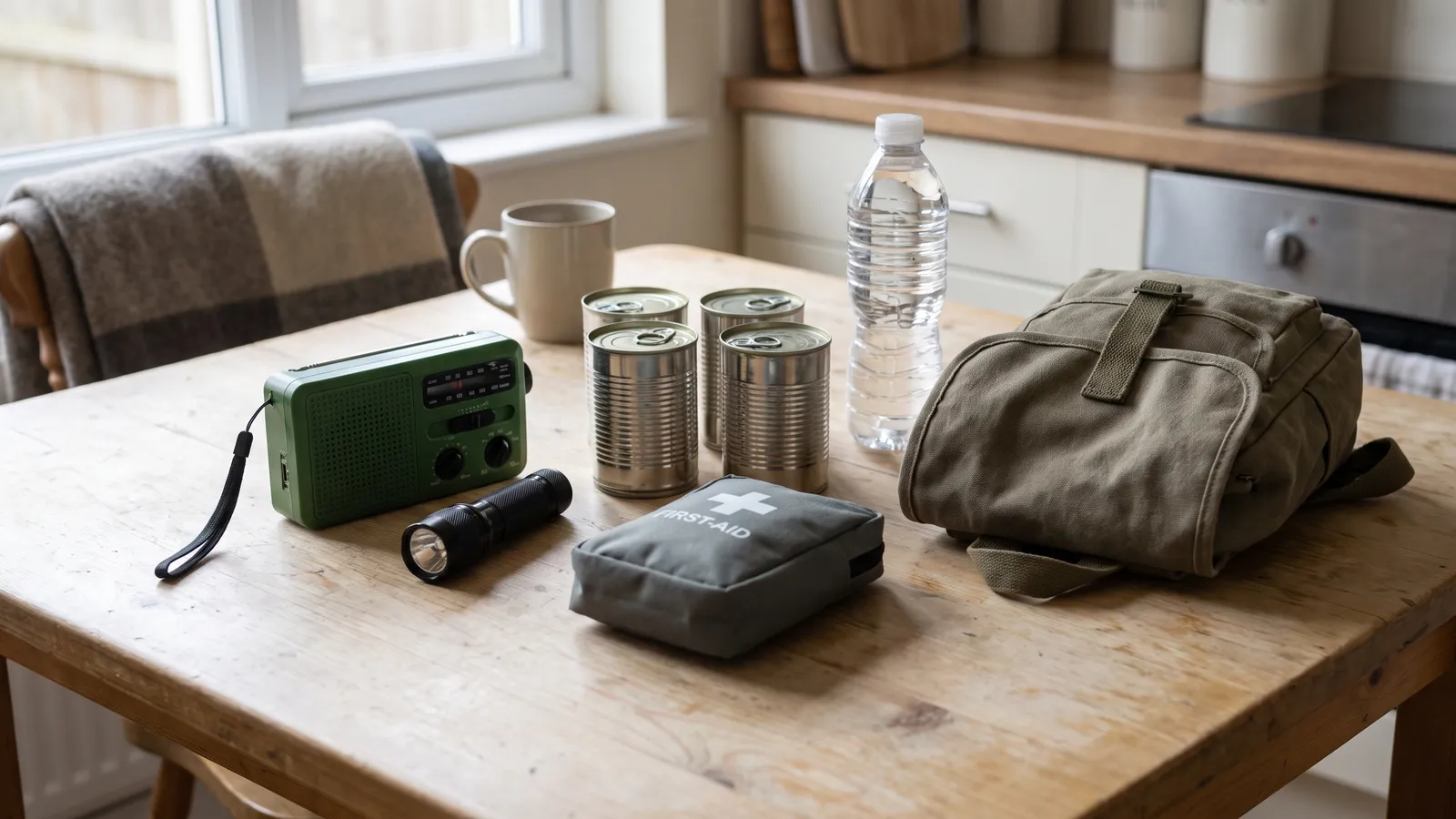
None of this is about doom. An emergency kit is a sensible household habit, like a smoke alarm or a spare tyre: a small, one-off effort that means a storm, a power cut or a burst water main is an inconvenience rather than a crisis. Most of it you may already own — the job is gathering it in one known place and topping up the gaps.
How many days should it cover?
The Prepare campaign deliberately avoids a fixed number, framing supplies around "an emergency lasting a few days". The EU's separate household advice settles on 72 hours. We use three days as a sensible default — it covers the overwhelming majority of UK incidents, from a winter storm to a local power cut, without turning your hallway into a warehouse.
If you live somewhere more exposed — a rural area at the end of a long power line, or a known flood zone — planning for a little longer is reasonable. The simplest way to get your numbers is our two-minute tool.
The nine essentials, in depth
Straight from the Government's list, each explained — and linked to our independent, price-tracked reviews where you want to buy the best version.
1. Bottled water
Mains water can stop with a burst main, contamination, or a pump failure during a power cut. It's the one essential you can't improvise, which is why it tops every official list.
- How to choose
- Sealed supermarket bottled water is the cheapest and safest option — it's treated for storage and date-stamped. Buy a couple of extra multipacks and rotate them through normal use so they never go out of date.
- How much
- The WHO figure the Government cites is 2.5–3 litres of drinking water per person per day as a minimum, or about 10 litres to also cover cooking and hygiene. For a family of four over three days that's roughly 36 litres minimum.
2. Ready-to-eat food
In a power cut the cooker and fridge are out, and shops empty fast when everyone shops at once. A few days of food that needs no cooking removes that worry entirely.
- How to choose
- Tinned meals, UHT milk, cereal bars, dried fruit and nuts — things you'll actually eat and can rotate. Keep a manual tin opener with them. Long-life freeze-dried pouches add years of shelf life if you know you won't rotate a store cupboard.
- How much
- Aim for at least three days of meals per person that need no cooking. Our kit builder sizes it for your household.
3. Torch (not candles)
Government guidance is explicit — a torch is safer than candles, which cause house fires every year, and especially during power cuts.
- How to choose
- A battery or wind-up LED torch for every adult, kept where everyone knows to find it. A head torch frees your hands for jobs; a lantern lights a whole room.
- How much
- One per person, plus spare batteries. Test them twice a year so you're never caught with a flat one.
4. Battery / wind-up radio
When the power's out and mobile networks or broadband go down with it, a battery or wind-up radio is your line to official updates and local news.
- How to choose
- A wind-up or solar radio never needs fresh batteries, and many also charge a phone over USB. Check it picks up FM and DAB.
- How much
- One per household, kept alongside the torches.
5. Power bank
A charged power bank keeps phones alive for calls, torches and official information when there's no mains power — the difference between being cut off and staying in touch.
- How to choose
- A 20,000mAh or larger bank charges most phones several times over. Keep it topped up. For a longer outage, a portable power station will also run a fridge, router and lights.
- How much
- At least one charged bank per household — more if anyone relies on a phone for medical or care reasons.
6. First aid kit
In an emergency, ordinary injuries are harder to treat and help may be slower to arrive. A stocked first aid kit handles the everyday cuts, burns and sprains.
- How to choose
- A ready-made kit with plasters, bandages, sterile dressings, tape, gloves, antiseptic, eyewash, a thermometer and tweezers — the items the Government lists. Add your household's usual medicines and any prescriptions.
- How much
- One household kit, checked once a year for expiry dates, plus a smaller one in the car.
7. Hygiene basics
If the water's off, hand hygiene keeps illness at bay at exactly the moment you can least afford to get ill.
- How to choose
- Alcohol hand sanitiser, wet wipes and a few bin bags. Add any personal items — sanitary products, contact-lens solution, spare toiletries.
- How much
- Enough for a few days for everyone at home.
8. Baby supplies
A baby's needs are the ones you can't improvise or postpone — nappies, feed and sterilising can't wait for the power to come back.
- How to choose
- Ready-to-feed cartons of your usual formula need no water or heating — keep a few, rotated by use-by date. Milton-style cold-water sterilising works with no electricity, which is the NHS-listed method when you can't boil. Add nappies, wipes and any baby medicines to the same box.
- How much
- A few days' worth, rotated before it expires.
9. Pet supplies
Pets depend on you entirely in a disruption, and pet food is rarely something neighbours can lend.
- How to choose
- A few days of the food your pet actually eats, water for them on top of your own, a spare lead or carrier, and note any medicines with their doses.
- How much
- A few days' worth, rotated before it expires.
10. Grab bag
Most emergencies you shelter at home — but occasionally you must leave fast, in a flood or a gas leak. A packed grab bag means you're not hunting for essentials under pressure.
- How to choose
- A rucksack with copies of key documents, some cash, medicines, a phone charger, a torch, water, snacks and a change of clothes. Keep it by the door.
- How much
- One per household, plus personal medicines and document copies for each person.
Sizing water and food for your household
Two of the nine — water and food — depend on how many people (and pets) are at home. The rule of thumb the Government cites for water is 2.5–3 litres of drinking water per person per day, rising to about 10 litres once you include cooking and basic hygiene. For food, plan three no-cook meals per person per day.
That adds up quickly: a family of four planning three days needs roughly 36 litres of drinking water as a minimum, or around 120 litres to be comfortable, plus 36 meals. Rather than do the sums yourself, our kit builder sizes water, food and the rest to your exact household and emails you a printable checklist.
Get your household's list
Tell us who's at home and we'll size everything to official guidance, then send a printable checklist.
The easy things to forget
The nine essentials are the backbone, but the items people most often overlook are small and specific to them:
- Spare batteries. For torches, the radio and any medical equipment — in the sizes those items actually take.
- Prescription medicines. A few days buffer of anything you take daily, plus a written note of doses. Pharmacies can be shut in an incident.
- Some cash. Card machines and ATMs fail in a power cut. A modest amount of small notes covers essentials.
- Copies of key documents. Passports, birth certificates, insurance and prescriptions — paper copies or on a USB stick, kept with the grab bag.
- Glasses, keys and a charger. Spare glasses, spare keys, and a phone charging cable to go with the power bank.
- Warmth. In a winter power cut heating goes too — keep blankets or a foil emergency blanket to hand.
If someone in your home needs extra help
Preparedness matters most for the people who'd struggle most in an outage — older people, young children, and anyone who relies on electricity for medical equipment such as a stairlift, oxygen concentrator or dialysis.
The single most useful step is the free Priority Services Register. Registering at thepsr.co.uk tells your energy supplier and local network operator that your household needs extra support during an interruption — priority updates, and in some cases practical help. It takes a few minutes and costs nothing.
It's also worth knowing which neighbours might need a hand, and agreeing to check on each other. In a power cut, dial 105 free to reach your electricity network operator — see our power cut guide.
Two kits: the home store and the grab bag
It helps to think of two separate things. The home store is the bulk of your supplies — the water, food, torch, radio and first aid kit you'll use while sheltering at home, which is what most emergencies call for.
The grab bag is a smaller, portable subset for the rare case where you have to leave quickly — a flood, a gas leak or an evacuation. It lives by the door with document copies, medicines, cash, a charger and a change of clothes, so you can pick it up and go.
Where to keep it, and how to keep it current
Keep the home store somewhere cool, dark and easy to reach — a cupboard under the stairs or in a utility room — and make sure everyone in the house knows where it is. Keep the grab bag by the front door.
A kit only works if it's current. Once a year, spend ten minutes to: check food and water are in date, replace flat or leaking batteries, test the torch and radio, refresh any medicines, and top up anything you've borrowed from it. Tie it to a date you'll remember — the clocks going back is a good one.
Common questions
How many days should a UK emergency kit cover?
The Government's Prepare campaign frames supplies around 'an emergency lasting a few days' and gives no fixed number. The EU's separate advice is 72 hours. We size to 3 days by default in our kit builder, which covers the large majority of UK incidents like storms and power cuts.
How much water should I store per person?
The WHO figure the Government cites is 2.5–3 litres of drinking water per person per day as a minimum, or about 10 litres per person per day to also cover cooking and hygiene. For a family of four over three days that's roughly 36 litres minimum, or around 120 litres to be comfortable.
What food should be in an emergency kit?
Non-perishable food that needs no cooking: tinned meals, UHT milk, cereal bars, dried fruit and nuts — plus a manual tin opener. Choose things you'll actually eat and rotate before their dates. Long-life freeze-dried pouches are an option if you won't rotate a store cupboard.
Why a torch and not candles?
Government guidance specifically recommends a battery or wind-up torch because candles are a fire risk, and house fires rise during power cuts. Keep a torch for every adult and test them twice a year.
What should go in a grab bag?
Copies of important documents, some cash, medicines, a phone charger, a torch, water, snacks and a change of clothes, in a rucksack kept by the door — so if you have to leave fast (a flood or gas leak) you're not searching for essentials.
How often should I check my emergency kit?
Once a year is enough for most items: check food and water dates, replace flat batteries, test the torch and radio, and top up anything you've used. Put it on the calendar — the clocks changing is an easy reminder.
Is there help for people who rely on electricity for medical equipment?
Yes. The free Priority Services Register (thepsr.co.uk) tells your energy supplier and network operator that you need extra support during an interruption — priority updates and, in some cases, help during an outage. Register anyone in the home who depends on powered medical equipment.
Sources: GOV.UK Prepare campaign ("Get prepared for emergencies"); World Health Organization drinking-water guidance (the 2.5–3 litres/person/day figure cited by Government); the Priority Services Register; Power Cut 105. PreparedBritain is independent and not affiliated with HM Government.
Keep reading
All planning & the national picture guides →Is the UK government telling people to stockpile food and water?
A post claiming Britain is telling households to stockpile for war is going round. Here is what the government…
Igenix air conditioner not cooling: the fixes that actually work
The hose, seal, filter, drainage and settings checks from Igenix's own manuals — including three built-in behaviours…
Aico vs Kidde carbon monoxide alarms: what the difference actually is
Aico and Kidde both certify to BS EN 50291-1:2018 — the real differences are sales channel, how each brand…