How to prepare for a power cut
The free number to save today, what to have ready, food safety, staying warm safely, and the compensation you may be owed — from official UK guidance.
By Tom Calder · Updated 18 July 2026 · Sourced to GOV.UK, Ofgem & the FSA
Save 105 in your phone — today
105 is the free national power cut line. Dial it from any phone and you're connected to your local electricity network operator — the company that actually fixes the wires, which is not the same as the supplier you pay your bill to. It works from mobiles and landlines, and it's the fastest way to report a cut or get an estimated restoration time.
That single step — saving 105 now, while you're reading this — is the highest-value piece of preparation on this page, and it costs nothing. It's also the number to call if you spot damaged power lines; stay well clear and report them.
What to have ready before a power cut
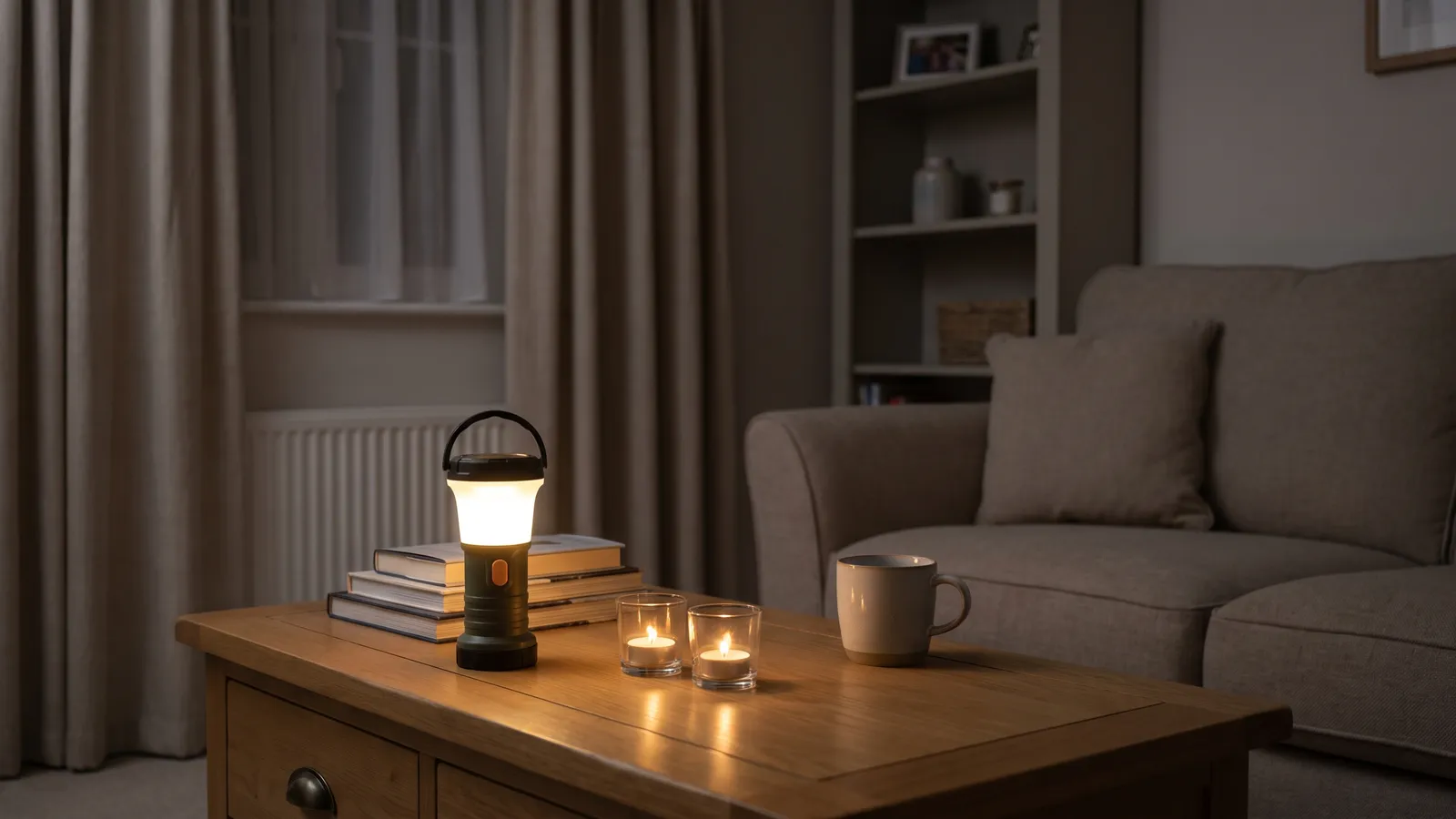
The Government's Prepare campaign keeps this list short and sensible, and most of it you may already own: a torch for every adult (not candles — naked flames cause fires during outages), a charged power bank to keep phones alive, a battery or wind-up radio for updates if the mobile network is down, some food and drink that need no cooking, and warm layers or blankets for a winter cut.
Keep it all together in one place everyone in the house knows about. A power cut at 11pm is not the moment to be hunting for the torch 'somewhere in the garage'. A little cash is worth having too, since card machines and ATMs stop working when the power does.
Keeping phones and essentials powered
For most short cuts, a charged 20,000mAh+ power bank is all you need — it will recharge a phone several times, which covers calls, torches and information. Keep it topped up so it's ready.
For longer outages, or if someone at home relies on powered equipment, a portable power station is the step up: a large, quiet battery that can run a fridge, router, lamps and medical devices for hours, and can be recharged from the mains ahead of forecast disruption or from a solar panel. It is not a generator — there's no fuel and no fumes, so it's safe to use indoors.
Food safety: your fridge and freezer
Keep the fridge and freezer doors shut. The Food Standards Agency's guidance is that an unopened fridge keeps food safe for about four hours, and a full, unopened freezer for around 24 hours (a half-full one, less). The less you open them, the longer the cold holds.
When power returns, check chilled and frozen food before eating it. If the fridge has been off for more than about four hours, or frozen food has fully thawed, follow food-safety guidance rather than tasting to check — when in doubt, throw it out. Food poisoning during an incident is exactly what you don't need.
Staying warm — safely
In a winter power cut the heating goes off too. Close internal doors and gather in one room, wear layers, and use blankets or a foil emergency blanket. A flask of hot water made before the cut, or on a camping stove used outdoors, helps.
One rule matters more than any other here: never use a fuel-burning appliance indoors to heat a room. Camping stoves, BBQs, patio heaters and disposable gas heaters all produce carbon monoxide — invisible, odourless, and capable of killing in an enclosed space. Keep a working carbon monoxide alarm in the home, and if you cook on a camping stove, do it outside in the open air.
During the cut: a quick checklist
Report it by dialling 105, then check whether it's just you (a tripped fuse or a prepayment meter that's run out) or the wider street. Switch off appliances that shouldn't restart unattended — the cooker, an iron, heaters — but leave one light switched on so you know the moment power returns.
Check on neighbours who might need help, especially anyone elderly or dependent on powered equipment. Keep the freezer shut. And if you have solar panels, note that most home systems shut down in a power cut for safety and won't power the house unless you have specific battery-backup kit.
If someone relies on electricity for medical equipment
If anyone in your home depends on mains power for medical reasons — a stairlift, oxygen concentrator, dialysis, or a fridge for medicines — register for the free Priority Services Register at thepsr.co.uk. It tells your energy supplier and network operator to give you priority updates and support during an interruption.
Have a plan for that equipment specifically: a battery backup or power station sized to it, a list of what to do, and a phone number for the equipment's clinical team. Talk to your network operator via the PSR — they plan for exactly this.
How long do power cuts last — and compensation
Most UK power cuts are restored within a few hours. Longer ones usually follow severe weather, when many faults happen at once and crews work through them in priority order; 105 or your network operator's website will give an estimated restoration time.
You may be owed compensation. Under Ofgem's guaranteed standards, network operators must pay set amounts if your supply is off beyond certain periods, with more for prolonged outages (higher thresholds apply during major storms). You usually have to claim it from your network operator — keep a note of when the cut started and ended.
Common questions
Who do I call in a power cut?
Dial 105, free from any phone. It routes you to your local electricity distribution network operator — the company that fixes the network — regardless of who you pay your bill to.
Will my mobile work in a power cut?
Usually at first, but phone-mast backup batteries can run down in a long outage, and home broadband (and wifi calling) goes off with the power. That's why official guidance still lists a battery or wind-up radio, and why a charged power bank matters.
How long is food safe in the fridge and freezer?
The Food Standards Agency says an unopened fridge keeps food safe for around four hours, and a full, unopened freezer for around 24 hours. Keep the doors shut, and if in doubt after a long cut, throw it out rather than taste-testing.
Can I use a camping stove or BBQ to keep warm indoors?
No — never. Fuel-burning appliances release carbon monoxide, which is invisible, odourless and can kill in an enclosed space. Only ever use them outdoors, and keep a working CO alarm at home.
Do solar panels work in a power cut?
Usually not on their own — most home solar systems automatically shut off in an outage for safety, and only keep the house running if you have specific battery-backup equipment installed.
Can I claim compensation for a power cut?
Often, yes. Ofgem's guaranteed standards require network operators to pay set amounts if you're off supply beyond certain periods (with higher thresholds during severe weather). Claim from your network operator and note the start and end times.
Sources: GOV.UK Prepare — power cuts · Power Cut 105 (Energy Networks Association) · Ofgem — Priority Services Register · Ofgem — power cut compensation & guaranteed standards · Food Standards Agency — food and power cuts. PreparedBritain is independent and not affiliated with HM Government.
The Power Cut Action Card
One page for the kitchen drawer: what to do first, what to have ready, how long food keeps, and how to stay warm without risking carbon monoxide. Free, no catch.
Download it straight away. We'll also send the occasional briefing when something genuinely matters — severe weather, live incidents, real price drops. Nothing else.
Keep reading
All power cuts & energy guides →Which radio actually works in a UK power cut?
Long wave closed in June 2026, and half the wind-up radios on sale here advertise an American weather band that…
Can a power cut damage your appliances?
What really happens electrically when the power comes back on, which appliances are genuinely at risk, and how to…
Are candles safe in a power cut?
Candles started 844 accidental house fires in England last year. The honest answer, the fire-service rules if you…