Best portable solar panels for power stations (2026)
A portable solar panel turns a power station from a battery that eventually runs flat into something you can top up from daylight — useful in a long outage, off-grid, or just to keep a power bank charged on a sunny weekend. Here's how they compare, and honest expectations for British weather.
By Tom Calder · Updated 20 September 2026 · 6 products, 5 of 6 price-tracked
Before you buy
Match the panel to the power station's input. A panel only helps if its voltage and connector match your station's solar input (often MC4 or an XT60/DC socket) and the station's charge controller can accept the panel's wattage. Same-brand pairings (a Jackery panel with a Jackery station) are the safe, plug-and-play route; third-party panels can work but check the connector and voltage range first.
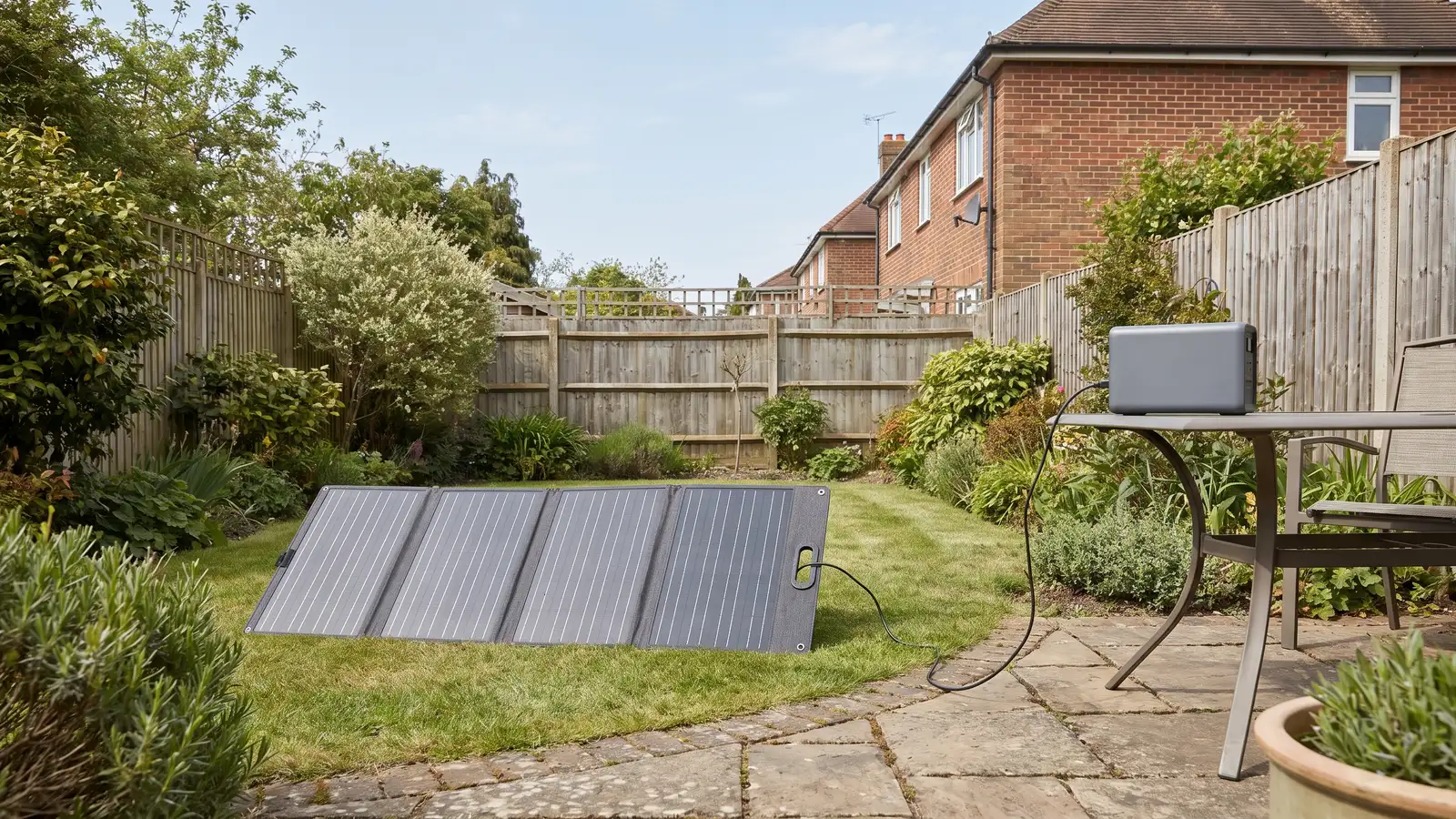
Understand the wattage reality. The rated watts (100W, 120W, 200W) are a lab figure under perfect sun. In the UK you'll realistically see 50–70% of that on a good day and far less under cloud, so a bigger panel isn't overkill — it's what gets you a useful charge in imperfect conditions. For charging phones and power banks directly, a 100W foldable is plenty; to refill a large power station, 200W or two linked panels earns its keep.
Then the practical stuff: foldable panels with a built-in kickstand and handle are far easier to angle at the sun and pack away; a weatherproof (IP) rating matters if you'll leave it out; and USB ports on the panel itself let you charge phones directly without a power station in the loop. Angle it square to the sun and re-aim through the day for a real difference.
Top pick: EcoFlow 110W Portable Solar Panel. A tidy, genuinely portable panel that folds flat, shrugs off British weather (IP68) and plugs straight into EcoFlow power stations. At 110W it is a sensible top-up rather than a fast recharger, so treat it as a companion to a battery you already own.
| Panel | Rated power | Output | Foldable | Weatherproof | Price | |
|---|---|---|---|---|---|---|
| EcoFlow 110W Portable Solar PanelTOP PICK | 110 W | Built-in XT60 DC cable (to EcoFlow power stations) | Yes | IP68 | £149.00as of 20 Sep 2026, 12:29 BST · DetailsProduct prices and availability are accurate as of the date/time indicated and are subject to change. Any price and availability information displayed on Amazon.co.uk at the time of purchase will apply to the purchase of this product. | Check price → |
| Anker SOLIX PS100 Portable Solar Panel | 100 W | XT60i DC solar output (MC4/adapter cables included) | Yes | IP68 | — | Check price → |
| BLUETTI PV120 Portable Solar Panel 120W | 120 W | MC4 connector (3m cable) | Yes — 4-panel fold, built-in kickstand, 5.7 kg | IP65 junction box (splash-resistant; not for prolonged rain) | — | Check price → |
| Jackery SolarSaga 200W Solar Panel | 200 W | USB-A + USB-C on panel, plus DC output to power station | Yes | IP68 (dust & waterproof) | £349.00as of 20 Sep 2026, 12:29 BST · DetailsProduct prices and availability are accurate as of the date/time indicated and are subject to change. Any price and availability information displayed on Amazon.co.uk at the time of purchase will apply to the purchase of this product. | Check price → |
| Choetech 100W Foldable Solar Charger | 100 W | USB-C PD 45W, 2x USB-A (QC 18W + 12W), DC 12-18V out | Yes (folds to approx 50 x 37cm, built-in kickstands) | IPX4 (panels only; junction box/cables not rated) | — | Check price → |
| BioLite SolarPanel 100 | 100 W | USB-C (45W PD) + USB-A | Yes | Water resistant (ETFE-laminated) | £279.90as of 20 Sep 2026, 12:29 BST · DetailsProduct prices and availability are accurate as of the date/time indicated and are subject to change. Any price and availability information displayed on Amazon.co.uk at the time of purchase will apply to the purchase of this product. | Check price → |
ⓘ As an Amazon Associate, PreparedBritain earns from qualifying purchases. We may earn a commission when you buy, or a fee when you request a quote, through our links — it never affects what we recommend. Amazon prices come from Amazon's own product data and show the date and time they were retrieved. Prices at other retailers are checked by us, less often. Prices and stock can change at any time, so always check the retailer's price before you buy.
EcoFlow 110W Portable Solar Panel
4.0Who it's for: Topping up a small or mid-size EcoFlow power station off-grid or during a longer mains outage.
A tidy, genuinely portable panel that folds flat, shrugs off British weather (IP68) and plugs straight into EcoFlow power stations. At 110W it is a sensible top-up rather than a fast recharger, so treat it as a companion to a battery you already own.
- Lightweight (3.3kg) one-piece fold with a built-in adjustable kickstand, so it stows and sets up easily
- IP68 rated against dust and water, sensible for showery UK conditions and leaving out for the day
- Plug-and-play XT60 lead into EcoFlow River and Delta units; bifacial design claws back a little extra output
- 110W is modest; real-world UK output under cloud is lower, so recharging a larger station is slow
- The XT60 pairing is aimed at EcoFlow's own ecosystem rather than universal use
Don't buy if Do not buy this if you need to recharge a large power station quickly or ride out a UK winter on solar alone; step up to a 160-220W panel or run several in series. And on its own it powers nothing, so it only makes sense if you already own (or are buying) a compatible power station.
as of 20 Sep 2026, 12:29 BST · Details
Product prices and availability are accurate as of the date/time indicated and are subject to change. Any price and availability information displayed on Amazon.co.uk at the time of purchase will apply to the purchase of this product.Anker SOLIX PS100 Portable Solar Panel
4.0Who it's for: Topping up a compatible portable power station off-grid or during a longer outage.
A well-made, genuinely portable 100W panel that folds flat, shrugs off rain and pairs neatly with Anker's power stations. It is a sensible resilience add-on rather than a standalone answer to a power cut.
- Light (around 3kg) and foldable with a built-in kickstand, so it is easy to store and angle at the sun
- IP68-rated against dust and water, and built with efficient bifacial N-type cells
- Backed by Anker's 5-year warranty and a wide UK retail presence
- 100W is a headline figure; real UK output under cloud is often well below that, so charging is slow
- Only useful alongside a compatible power station or charge controller (XT60i output) — it cannot power anything on its own
Don't buy if You do not already own, or plan to buy, a portable power station. For plain blackout resilience a charged power bank or station matters first; a panel alone stores nothing, and Britain's overcast skies make solar a slow trickle rather than a quick fix.
BLUETTI PV120 Portable Solar Panel 120W
4.0Who it's for: Topping up a portable power station during a multi-day outage or off-grid stay.
A well-built, efficient folding panel with a standard MC4 output, so it works with most power stations rather than just BLUETTI's own. Sensible for anyone who wants a way to recharge when the mains is off for more than a day.
- Efficient monocrystalline ETFE panel (up to 23.4%) with a sturdy built-in kickstand for angling towards the sun
- Universal MC4 output means it pairs with most portable power stations, not only BLUETTI units
- Genuinely portable at 5.7 kg and widely stocked by UK retailers with proper support
- The IP65 rating covers the junction box only — the panel shouldn't be left out in rain or snow, so it needs bringing in when the weather turns
- 120W is a slow top-up on a grey British day; real-world output often falls well short of the rated figure
Don't buy if You only need to keep phones and a torch going through a short outage — a mains-charged power bank or power station is cheaper and simpler. A solar panel only earns its place for repeated or multi-day off-grid power.
Who it's for: Topping up a Jackery power station off-grid or during a longer power cut.
A well-made, genuinely portable 200W panel that pairs cleanly with Jackery's Explorer power stations. It is a sensible resilience buy for anyone who already owns the matching battery, though the price is firm and UK cloud cover will keep real-world output below the headline figure.
- Efficient TOPCon bifacial cells rated at 200W (boosting higher in bright sun), so it charges a compatible station meaningfully faster than smaller panels
- IP68 dust- and water-resistant, foldable to roughly the size of a large laptop bag at about 8kg, with a carry handle
- Built-in USB-A and USB-C ports let it trickle-charge phones directly, as well as feed a power station
- Premium price per watt compared with generic foldable panels
- Output drops sharply under the UK's typical overcast skies and short winter days, so plan for well under 200W in practice
Don't buy if You don't own (or intend to buy) a compatible power station, or you only need to keep phones and a torch topped up in an outage — a smaller, far cheaper panel or a mains power bank does that job for a fraction of the cost.
as of 20 Sep 2026, 12:29 BST · Details
Product prices and availability are accurate as of the date/time indicated and are subject to change. Any price and availability information displayed on Amazon.co.uk at the time of purchase will apply to the purchase of this product.Choetech 100W Foldable Solar Charger
3.8Who it's for: Keeping phones, power banks and a small power station topped up during a grid outage or off-grid.
A capable mid-size foldable panel with useful USB-C, USB-A and DC outputs and honest ~20-23% efficiency. Sensible for households wanting a way to recharge small essentials when the power is off, provided you don't expect it to rapidly refuel a large power station.
- Multiple outputs (USB-C PD 45W, two USB-A and a 12-18V DC line) let you charge several devices, or a compatible power station, at once
- Folds flat and props itself up on built-in kickstands, so it is quick to deploy in the garden or a window
- Splash-resistant IPX4 panels cope with a passing British shower, and monocrystalline cells give solid real-world efficiency for the size
- The IPX4 rating covers the panels only, not the junction box or cables, so it is not designed to be left out in sustained heavy rain
- Output tops out at 45W over USB-C, so it tops devices up steadily rather than fast-charging a big battery
Don't buy if You own a large power station and want to refill it quickly, a higher-voltage panel matched to that station will do it far faster; and if you only need to keep a phone alive, a 20-28W panel costs a fraction of this.
Who it's for: Recharging a power station through a longer off-grid stint or multi-day power cut.
A well-made 100W panel with a genuinely quick, foolproof setup and a useful 45W USB-C output for charging devices directly. It is premium-priced and fairly heavy for the job, so it only earns its keep if you are pairing it with a sizeable power station rather than topping up a phone.
- Patented alignment stand takes the guesswork out of angling to the sun, packed to power in under a minute
- 45W USB-C plus USB-A means you can charge a laptop or tablet directly without a separate power station
- Efficient monocrystalline cells and durable ETFE lamination hold up well to field use
- Expensive per watt against rivals from Jackery or Anker
- At 4.3kg it is heavier than comparable folding panels, and it is water resistant rather than fully waterproof
Don't buy if You only need to keep phones and a wind-up radio going through a short outage; a £30-60 charged power bank does that far more cheaply, and this panel only makes sense alongside a decent power station over multi-day, off-grid use.
as of 20 Sep 2026, 12:29 BST · Details
Product prices and availability are accurate as of the date/time indicated and are subject to change. Any price and availability information displayed on Amazon.co.uk at the time of purchase will apply to the purchase of this product.The Power Cut Action Card
One page for the kitchen drawer: what to do first, what to have ready, how long food keeps, and how to stay warm without risking carbon monoxide. Free, no catch.
Download it straight away. We'll also send the occasional briefing when something genuinely matters — severe weather, live incidents, real price drops. Nothing else.
We verify every product's specifications against at least two independent sources, re-check its UK price and stock on a schedule where we can track it automatically, and cross-check safety-relevant claims against official guidance. Where we've bought and used a product ourselves we say so on its review; where we haven't, our verdict is a considered spec-and-evidence comparison, not a hands-on test — and commissions never change a ranking either way. Read our full methodology →
Guides that go with this
A calm, sourced look at the 'national blackout' scenario: why it's a low-likelihood risk the grid is engineere…
The free number to save today, what to have ready, food safety, staying warm safely, and the compensation you …
Common questions
Are portable solar panels worth it in the UK?
For genuine off-grid use or extending a multi-day outage, yes — paired with a power station they keep you topped up from daylight. For a typical few-hour power cut, pre-charging your power station and power banks from the mains is simpler and more reliable.
How much power does a 100W solar panel really give?
The 100W rating is under perfect, direct sun. In the UK you'll realistically get around 50–70% of that on a good clear day, and considerably less under cloud — which is why sizing up helps here more than in sunnier climates.
Can any solar panel charge my power station?
Only if the connector and voltage match, and the station's charge controller can handle the panel's wattage. Same-brand pairings are plug-and-play; with third-party panels, check the connector type and the station's accepted voltage range before buying.
Can a solar panel charge my phone directly?
Yes, if the panel has built-in USB ports — many foldable panels do, letting you charge a phone or power bank straight from the sun. Otherwise it charges your phone via a power station or power bank.
What size solar panel do I need?
A 100W foldable panel is plenty for charging phones and power banks. To meaningfully refill a large power station in UK conditions, step up to 200W or link two panels, since real-world output is well below the rated figure.
Do solar panels work on a cloudy day?
Yes, but at greatly reduced output — diffuse light still generates some power, just a fraction of the rating. That reduced real-world yield is exactly why a higher-wattage panel is worth it for British weather.