Best solar phone chargers for UK weather (2026)
A solar phone charger is a small folding panel, sometimes with a battery attached, that turns daylight into a USB charge when there is no socket to be had: a long power cut, a camping trip or a day on the hill. This page compares the small panels sold in the UK on the things that separate them: the wattage the maker claims and what that means under a British sky, the ports they offer, how they cope with rain, and whether they can store what they make for use after dark. We have not tested any of them ourselves; every figure is credited to the maker or its manual.
By Tom Calder · Updated 21 October 2026 · 7 products, all price-tracked
Our picks by type
 Photo: Amazon
BigBlue P25
Carrying a small panel on day trips to top up a phone.
as of 21 Oct 2026, 10:37 BST · Details
Product prices and availability are accurate as of the date/time indicated and are subject to change. Any price and availability information displayed on Amazon.co.uk at the time of purchase will apply to the purchase of this product. Photo: Amazon
BioLite SolarPanel 10+
A panel that stores what it makes, so a phone can be charged after dark.
as of 21 Oct 2026, 10:37 BST · Details
Product prices and availability are accurate as of the date/time indicated and are subject to change. Any price and availability information displayed on Amazon.co.uk at the time of purchase will apply to the purchase of this product.All 7 compared
Photo: AmazonBest panel with batteryA panel that stores what it makes, so a phone can be charged after dark.
as of 21 Oct 2026, 10:37 BST · Details
Product prices and availability are accurate as of the date/time indicated and are subject to change. Any price and availability information displayed on Amazon.co.uk at the time of purchase will apply to the purchase of this product.Our verdict
The SolarPanel 10+ carries a 3,200 mAh battery, so the energy it gathers in daylight is there to use later. BioLite rates it at 10W at peak sun and adds a sundial and kickstand to help aim it. In UK light, refilling the battery from the sun takes a long time, and 3,200 mAh is only part of a charge for many phones. Filling it from the mains beforehand makes it a sensible grab-bag item.
Worth knowing: IPX4 only, so splash resistance rather than waterproofing
Who shouldn't buy it: You want to charge several devices or need meaningful output in poor light.
Photo: AmazonBest folding panelCarrying a small panel on day trips to top up a phone.
as of 21 Oct 2026, 10:37 BST · Details
Product prices and availability are accurate as of the date/time indicated and are subject to change. Any price and availability information displayed on Amazon.co.uk at the time of purchase will apply to the purchase of this product.Our verdict
The P25 folds to roughly 12 x 16 cm and weighs 460 g, with one USB-A and one USB-C output. BigBlue rates the panel at 25W but caps combined USB output at 5V/4A, which is 20W, so plan on the lower figure even in full sun. Its own manual says real output falls with weather, season and heat, so on a typical UK day it is a slow top-up for one phone rather than a quick charge.
Worth knowing: Combined output is capped at 20W against the 25W panel rating
Who shouldn't buy it: You need to charge several devices at speed or want useful output in dull winter light.

Keeping phones and a power bank charged in daylight
Our verdict
A light folding 30W panel with two USB sockets and a DC output, IP67 on Renogy's page. Renogy says it is for low-power devices such as phones and tablets, and that's the honest use: in a long power cut it keeps phones and a power bank going while it's light.
Worth knowing: Phones and tablets only, as Renogy says
Who shouldn't buy it: Don't buy it if you want to recharge a power station: that takes 100W or more.
A small, known-brand panel for charging a phone straight from direct sun.
as of 21 Oct 2026, 10:37 BST · Details
Product prices and availability are accurate as of the date/time indicated and are subject to change. Any price and availability information displayed on Amazon.co.uk at the time of purchase will apply to the purchase of this product.Our verdict
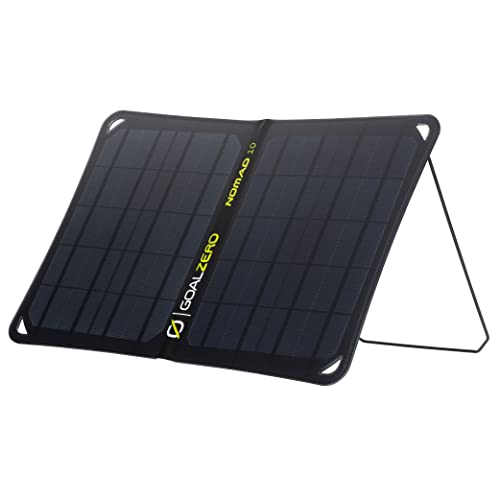
Goal Zero's Nomad 10 is a 10W monocrystalline panel with a built-in USB port, an adjustable kickstand and a dock for its own Flip power banks. The USB port is limited to 7.5W, so even in full sun this is a slow phone charger, and in UK winter light it will be slower still. Goal Zero itself recommends pairing it with a power bank in low light, since it has no battery of its own.
Worth knowing: USB output tops out at 7.5W
Who shouldn't buy it: You want to charge anything in dull weather or need more than one device at once.

A light, low-cost panel for topping up one phone on a bright day.
as of 21 Oct 2026, 10:37 BST · Details
Product prices and availability are accurate as of the date/time indicated and are subject to change. Any price and availability information displayed on Amazon.co.uk at the time of purchase will apply to the purchase of this product.Our verdict
BigBlue's smallest folding panel has a single USB-A output and weighs 360 g, according to its manual. There is no battery, so it only supplies power while the sun is on it. The 14W rating is a full-sun figure; on a dull UK day, and in winter especially, expect a slow trickle that suits a phone top-up rather than a full recharge. Treat it as a fair-weather extra, ideally paired with a power bank.
Worth knowing: One USB-A port only, with no USB-C
Who shouldn't buy it: You want something that works in dull weather or charges a phone and a power bank together.

Someone who wants a very light panel and battery in one for the odd phone top-up.
as of 21 Oct 2026, 10:37 BST · Details
Product prices and availability are accurate as of the date/time indicated and are subject to change. Any price and availability information displayed on Amazon.co.uk at the time of purchase will apply to the purchase of this product.Our verdict
The SolarPanel 5+ is the lighter, slower sibling: a single flat panel of 390 g rated at 5 watts at peak sun. It holds an 8 Wh, 3,200 mAh battery, which is part of a charge for most phones. Filling that from UK sun takes a long time, so charge the battery from the mains beforehand and treat the panel as a slow top-up. It needs direct sunlight to add anything useful.
Worth knowing: Only 5W at peak sun, so it refills the battery very slowly in UK light
Who shouldn't buy it: You expect it to recharge a phone quickly or rely on it through a winter outage.

A mid-size panel that can charge a phone directly or refill a power bank.
Our verdict
The E40 is a folding panel with USB-A, USB-C and DC outputs, so it can feed a phone, a power bank or a tablet. It has no battery, so it only supplies power while lit, and the outputs share whatever the panel is making. The 40W figure is measured at standard test conditions that UK weather rarely matches. FlexSolar's own documents disagree on its weight, so check the box.
Worth knowing: No battery on board
Who shouldn't buy it: You want useful output in dull light or a panel that stores its own power.
ⓘ As an Amazon Associate, PreparedBritain earns from qualifying purchases. We may earn a commission when you buy, or a fee when you request a quote, through our links — it never affects what we recommend. Amazon prices come from Amazon's own product data and show the date and time they were retrieved. Prices at other retailers are checked by us, less often. Prices and stock can change at any time, so always check the retailer's price before you buy.
Before you buy
Start with what the wattage actually means.
Makers rate panels at standard test conditions, which assume strong, direct sun hitting the cells square on at a set temperature. That is a laboratory ceiling, not a British forecast. BigBlue's own manual says output varies with weather, season and location, and Goal Zero recommends pairing its Nomad 10 with a power bank in low light for the same reason. Treat the printed number as a bright June afternoon and plan on a small fraction of it in winter or under cloud. A panel that cannot be aimed at the sun loses more still, so a kickstand or hanging loops earn their keep.
Choose real panel area over gadgetry.
A folding panel of 20 to 40 watts has enough cells to make a useful charge when the sun does come out; the FlexSolar E40 and BigBlue P25 are in that class. Below about 10 watts you are into trickle territory even in good light, and the solar cell glued to a power bank is the slowest of all. Check the output cap as well as the panel rating: the P25 is a 25W panel whose combined USB output BigBlue limits to 5V/4A, and the Nomad 10's USB port tops out at 7.5W, so the lower figure is the one you will see.
Decide whether you want a battery in the loop.
A plain panel only delivers while light is falling on it, so a cloud passing or a phone that has stopped drawing means wasted sun. A panel with a built-in battery, such as the BioLite SolarPanel 10+, stores what it gathers for use after dark, but the battery is small: 3,200mAh is a partial charge for many phones. The better pattern for most households is a separate, larger power bank, filled from the mains before any cut, with the panel as the slow top-up over the following days. Our power banks page covers that half of the pairing.
Match the ports to your phones and cables.
Most modern phones charge over USB-C, yet several small panels still offer only USB-A, including the SolarPowa 14 and the Nomad 10, so you will need an A-to-C cable. The P25 and E40 carry a USB-C output, and the E40 adds USB-A Quick Charge and a 19V DC output for kit with a matching input. Note that all ports on a panel share whatever it is making at that moment, so two phones plugged in split the charge rather than each getting full speed. BioLite's panels are refilled by micro USB, an older connector worth a spare cable.
Read the weatherproofing claim closely, and store the kit sensibly.
IPX4 means splash resistance, and BigBlue's manual for the SolarPowa 14 still says not to expose it to liquids; the P25's IP68 covers the panel but not its junction box, which must not be immersed; Goal Zero calls the Nomad 10 weatherproof without giving an IP rating. None of that excuses leaving a panel out in a downpour with a phone attached. Keep the panel in a grab bag with its cables, charge any built-in battery from the mains every few months, and check the warranty: one year at Goal Zero and BioLite, two years on the P25 and E40.
We verify every product's specifications against at least two independent sources, re-check its UK price and stock on a schedule where we can track it automatically, and cross-check safety-relevant claims against official guidance. Every review is labelled Researched or Used and reviewed by us: where we've bought a product, or been sent it free, and used it ourselves, its review says which; where we haven't, our verdict is a considered spec-and-evidence comparison, not a hands-on test — and commissions never change a ranking either way. Read our full methodology →
Related kit comparisons
Guides that go with this
The free number to save today, what to have ready, food safety, staying warm safely, and the compensation you …
A calm, sourced look at the 'national blackout' scenario: why it's a low-likelihood risk the grid is engineere…
How UK storm warnings work, what Arwen and Éowyn taught households, and the short pre-storm checklist that mat…
The Government's recommended kit — with the best products for each item at every budget.
The surprising answer is usually no — standard grid-tied solar shuts down in a blackout. Here's why, what batt…
Common questions
Do solar phone chargers work in the UK?
Yes, but slowly and mostly in summer. The maker's wattage is measured under standard test conditions of strong, direct sun, which UK weather rarely matches; BigBlue's manual says output varies with weather, season and location. On a bright day a 20 to 40 watt folding panel can put a worthwhile charge into a phone or power bank. Under winter cloud, expect a trickle, and treat the panel as a way of refilling a power bank over several days rather than a quick charge.
How long does a solar charger take to charge a phone?
It depends on the panel, the sun and the phone, and no maker on this page gives a figure for UK conditions. A phone battery typically holds somewhere around 12 to 20 watt-hours, so a panel genuinely delivering 10W in strong sun would need around two hours or more once charging losses are counted, and far longer when real output is a fraction of the rating. The Nomad 10's USB port is capped at 7.5W, so even in full sun it is a slow charger.
Is a solar power bank better than a solar panel?
They do different jobs. A solar power bank stores energy, so a phone can be charged at night, but its small panel refills the battery very slowly: BioLite's SolarPanel 5+ is rated at five watts in peak sun with an 8Wh battery. A folding panel with no battery makes more power but only while the sun is on it. For most households the sensible pairing is a mains-charged power bank plus a 20 to 40 watt folding panel to top it up.
What wattage solar panel do I need for a phone?
For a single phone topped up on a bright day, a 10 to 14 watt panel such as the SolarPowa 14 is the minimum worth carrying. If you also want to refill a power bank, or charge a phone and a tablet, a 25 to 40 watt folding panel such as the BigBlue P25 or FlexSolar E40 gives much more headroom when the light is poor. Check the output cap too: the P25's combined USB output is limited to 20W by BigBlue.
Can I leave a solar charger out in the rain?
Not with a phone attached, and not for long. IPX4 ratings, as on the SolarPowa 14 and BioLite panels, cover splashes only, and BigBlue's manual says not to expose the panel to liquids. The P25's IP68 rating applies to the panel but not its junction box, and FlexSolar rates the E40's junction box IP67. Bring the panel in once it stops being useful, dry the ports before plugging anything in, and keep phones and power banks under cover.
Can a small solar panel charge a power bank or power station?
A power bank, yes, slowly; a power station, only in a limited way. Any USB panel can feed a USB power bank. FlexSolar says the E40's 19V DC output suits equipment with a matching input, including some small power stations, but check your unit's input range and expect a slow refill. Most power stations are better served by a larger panel with the right connector. Our portable solar panels page covers the 100W and larger panels built for that job.
