UK STATUS10 hosepipe bans in force·Reservoirs 56.1%·10 areas in drought·NRR: power outage rated catastrophicChecked 24 Sep 2026
Home › Press and data
For journalists

Press and data

Who to contact, what PreparedBritain is, and figures you can use, with the caveats printed beside them.

Updated 24 September 2026.

Press contact

Tom Rowland
Founder, PreparedBritain

Email hello@preparedbritain.co.uk

We reply the same working day where we can.

Available for interview by phone, video call or pre-recorded, London/UK time.

Bulletins. Regular data bulletins: a fuel bulletin every Monday, from Fuel Finder, the statutory price scheme, and event bulletins when a figure moves, each with every number's base and source. Read them → RSS

Spokesperson and byline. Our spokesperson is Tom Rowland, the founder, speaking under his own name. Articles on the site carry the byline Tom Calder, the site's editorial name. Please attribute quotes to Tom Rowland, founder of PreparedBritain.

About PreparedBritain

Three short paragraphs you can lift as they are.

PreparedBritain is a UK household-preparedness website, launched in July 2026. It publishes plain-English guides to the government's Prepare advice, fact-checks of viral stockpiling and prepping claims, live trackers (fuel prices, hosepipe bans, storms and power cuts, product recalls), reviews of emergency kit (water storage, radios, power banks, food), free printable checklists and a kit builder tool.

Its approach is calm and sourced: every claim links to a primary source such as GOV.UK, the Met Office or the Environment Agency, and its guides tell readers when not to buy.

It is funded by affiliate commission when readers buy through its links, which is disclosed on the site, and by a small shop of printable household planning files. Its founder is Tom Rowland.

Recent data stories

Figures we have published or sent to newsrooms, newest first. Our own traffic is always given as a percentage change, never as a count, and each story carries the caveats we ask you to print with it.

19–23 September 2026

Stockpiling headlines: what people read

After the "government urges citizens to stockpile" headlines, visits to PreparedBritain rose sharply, and most of those visitors read the page that checks the claim. Figures are percentage changes against our late-August average (24 August to 3 September 2026), from our own site analytics.

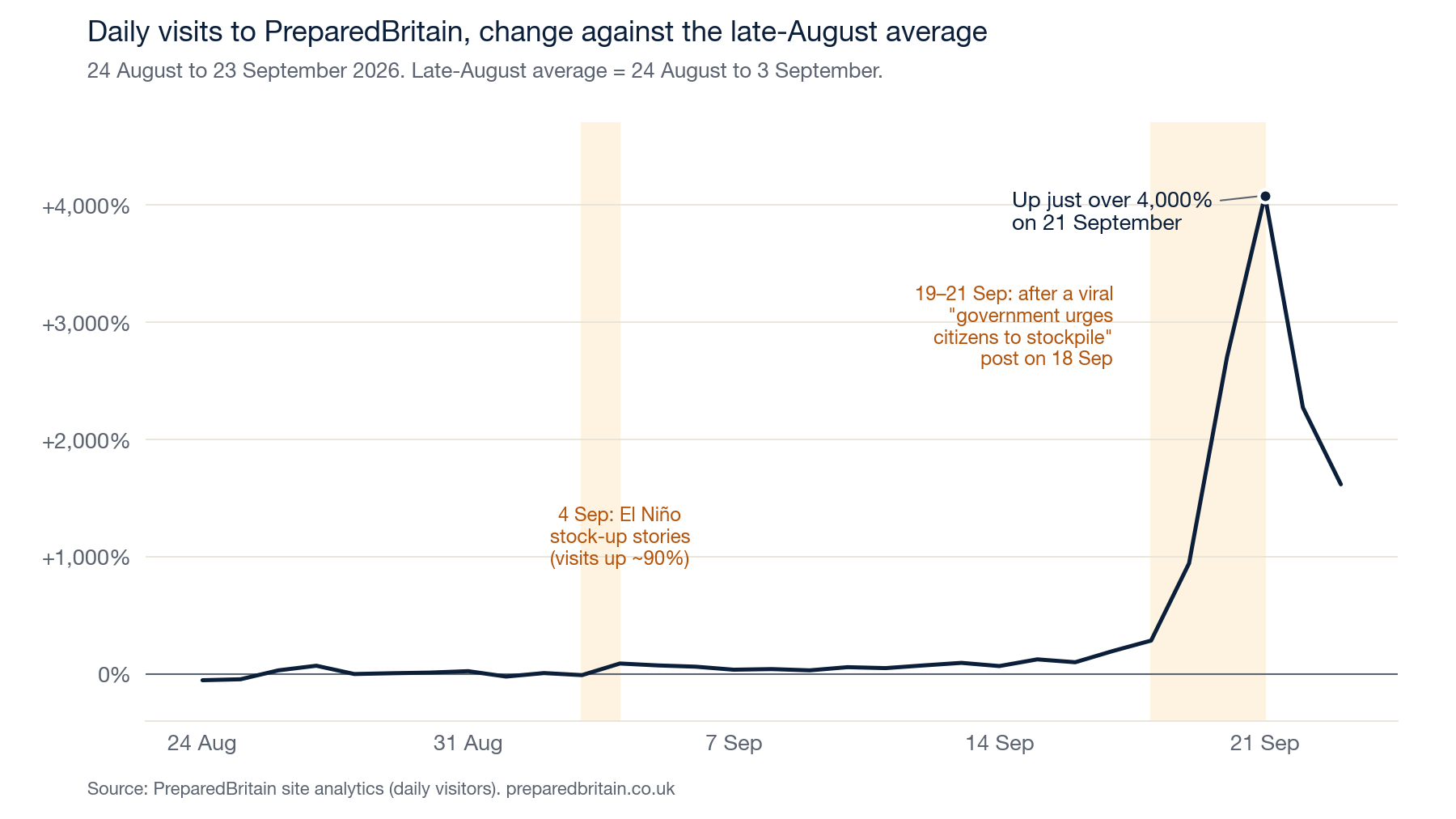
  • Daily visits rose about 90% from 4 September 2026, the day of the El Niño stock-up stories, and averaged 90% above late August from 4 to 18 September.
  • Peak on 21 September 2026: up just over 4,000% (4,077%) against late August. The average from 19 to 23 September was about 2,300% above late August.
  • 73% of visitors from 19 to 23 September read our explainer, published 19 September: "Is the UK government telling people to stockpile food and water?" Read the explainer →
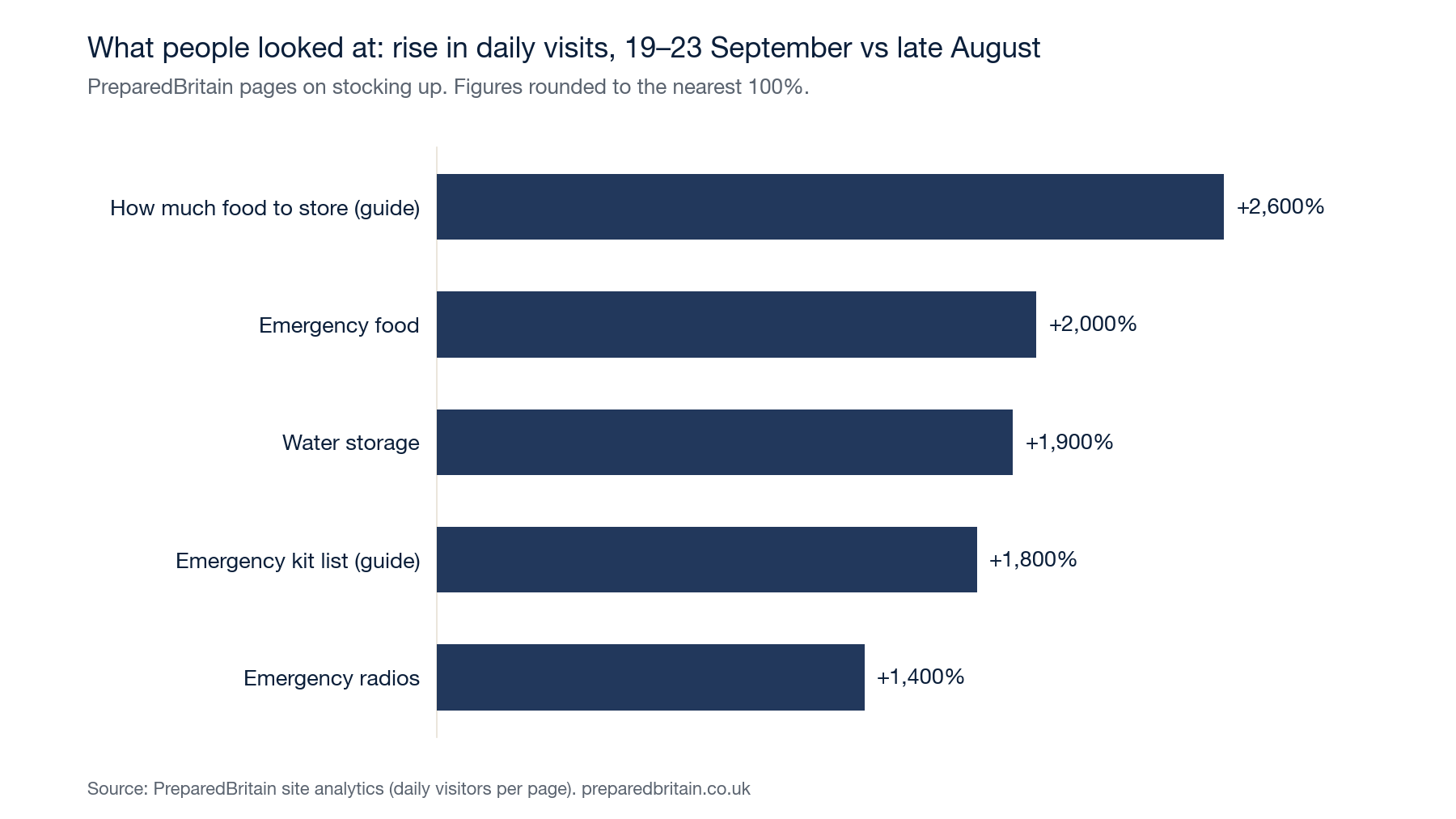
  • Daily visits from 19 to 23 September against late August, by page (rounded as on the chart; unrounded figures in brackets):
  • Clicks from our pages through to retailers rose about 600% (603%) from 19 to 23 September against 4 to 18 September. Radios and water storage were clicked most. These are clicks, not sales: we do not sell kits, and we have no sales data to share.
  • Daily sign-ups for our free emergency checklists rose more than a hundredfold against the first half of September.
  • From 19 to 23 September, 86% of visitors were in the UK and 77% were on a mobile phone (21% desktop, 2% tablet). About 96% arrived from a search engine (Google about 91%, DuckDuckGo 4%, Bing 2%); social media brought under 1%.
Please print these beside the figures
  • PreparedBritain is a young site, launched in July 2026, so some of this growth is our own. The jumps line up with the news days.
  • "Visitors" means daily unique visitors per page, as counted by our own analytics. The percentages are against a small late-August base, which makes them large; the shares (73%, 86%, 77%, 96%) do not depend on the base.
Context
  • The government has not issued a new instruction to stockpile. GOV.UK Prepare advice is unchanged: a few days of bottled water, food that needs no cooking, a torch, a radio, a power bank, a first aid kit and any medicines, to cope with a few days of disruption such as a storm, a flood or a power cut.
  • A national resilience public information campaign, anchored in GOV.UK/Prepare, is being developed by the Cabinet Office and will launch "later this year" (UK Government Resilience Action Plan 2026 Implementation Report, 14 July 2026; written parliamentary answer, 21 September 2026). It has not launched, and the written answer lists no items and asks no one to stockpile.

Charts for this story: Daily visits to PreparedBritain, change against the late-August average · What people looked at: rise in daily visits, 19–23 September vs late August
23 September 2026

Diesel at £2 or more at 23% of the forecourts in the retailer files

Local fuel-price figures for nine areas, from the price files retailers publish under the CMA's voluntary road fuel open-data scheme, read on 23 September 2026.

  • Nationally, diesel averaged 198.2p a litre and petrol 173.6p across the 2,356 forecourts in the retailer files on 23 September 2026.
  • Diesel was £2 or more at 547 of the 2,356 forecourts (23%).
  • Nine area spreadsheets list every forecourt in our data for the area with its price: Greater Manchester; Birmingham, the Black Country and surrounding towns; Merseyside; Tyneside, Wearside, Northumberland and north Durham; Wales; Buckinghamshire; the Basingstoke area; Colchester, Tendring and north Essex; and Carlisle, Penrith and west Cumbria. Download the spreadsheets →
  • Prices change daily. For today's national figures, use the live tracker. UK fuel price tracker →
Please print these beside the figures
  • Source: retailer price files under the CMA's voluntary road fuel open-data scheme, from Asda, Esso, Motor Fuel Group (Morrisons' forecourts and Esso, BP, Jet, Valero, Texaco and Shell-branded sites), SGN Retail and Moto, read on 23 September. Tesco's, Sainsbury's and Shell's own files are no longer updated, so "cheapest" means cheapest of the forecourts in these files. Ten listings with diesel about 50p a litre below the typical price look like errors and are left out. Prices change daily. "A tank" means 55 litres.

The data desk

What each tracker covers, how often it is refreshed, and where the page is.

Licence. Our compiled tables, spreadsheets and charts are free to use with credit to PreparedBritain and a link (Creative Commons Attribution 4.0, as on our data page). The underlying figures stay under their publishers' own terms: the Open Government Licence v3.0 for CMA and Environment Agency data, and the Met Office's own terms of use for its warnings, which need a credit and a link back to metoffice.gov.uk.

UK fuel price tracker

The national average price of petrol and diesel across UK forecourts, from the price files retailers publish under the CMA's voluntary road fuel open-data scheme. On 23 September 2026 the files were Asda's, Esso's, Motor Fuel Group's, SGN Retail's and Moto's.

Refresh: Daily. The page shows the time of its last read.

Forecourt-by-forecourt spreadsheets, 23 September 2026

Every forecourt in our data for each area, with its diesel and petrol price in pence per litre. Prices change daily.

AreaForecourtsDiesel average£2 or moreSpreadsheet
Greater Manchester121197.1p21Download CSV
Birmingham, the Black Country and surrounding towns133198.7p25Download CSV
Merseyside42195.3p5Download CSV
Tyneside, Wearside, Northumberland and north Durham62198.6p18Download CSV
Wales128198.1p27Download CSV
Buckinghamshire21197.9p3Download CSV
The Basingstoke area6200.4p3Download CSV
Colchester, Tendring and north Essex16198.1p5Download CSV
Carlisle, Penrith and west Cumbria13199.4p4Download CSV

Source: retailer price files under the CMA's voluntary road fuel open-data scheme, from Asda, Esso, Motor Fuel Group (Morrisons' forecourts and Esso, BP, Jet, Valero, Texaco and Shell-branded sites), SGN Retail and Moto, read on 23 September. Tesco's, Sainsbury's and Shell's own files are no longer updated, so "cheapest" means cheapest of the forecourts in these files. Ten listings with diesel about 50p a litre below the typical price look like errors and are left out. Prices change daily. "A tank" means 55 litres.

The daily series

The daily figures behind the trackers, one row per day with a CSV each: diesel and petrol pump prices, reservoir stocks and drought areas in England, water companies with a hosepipe ban, flood warnings, Met Office weather warnings, power cuts on three networks and the Niño 3.4 index. Each series states its source, its scope and its caveats.

Refresh: One row per day, recorded only when the source itself published something new.

Live UK power cuts

How many power cuts are active and roughly how many homes are off supply, from the electricity networks' own live feeds, with a page for each of 99 towns and a postcode check.

Refresh: Refreshed from the networks' live feeds through the day. The page shows the time of its last read.

UK hosepipe ban tracker

Every temporary use ban in force, by water company and area, with dates and rules, checked against water company announcements and the Environment Agency's weekly reports.

Refresh: Checked on a schedule against the weekly report and company announcements. The page shows when its data was last checked.

Storms

This season's Met Office storm list, which names have been used and whether a named storm is affecting the UK, with a page for each storm name at /storms/<name>.

Refresh: The storm pages check the Met Office every 10 minutes.

UK weather warnings tracker

Met Office severe weather warnings in force, yellow, amber and red, for wind, rain, snow, ice and heat across the UK.

Refresh: Refreshed on a schedule from the Met Office. The page shows the time of its last read.

UK flood warnings tracker

Environment Agency flood warnings and alerts in force across England: how many, what each level means, and where they are.

Refresh: Refreshed on a schedule from the Environment Agency's real-time flood-monitoring API. The page shows the time of its last read.

Product recalls and safety notices

Product safety notices published by the Office for Product Safety and Standards on GOV.UK, grouped by product type and repeated as published with links to the originals, plus a tracker of notices with an alert date in the last 90 days, newest first.

Refresh: Refreshed on a schedule from GOV.UK.

Emergency kit builder

A tool readers can use: it builds a household's emergency kit in four steps, sized to official UK guidance, with a printable PDF. Variants for a car, a grab bag, a baby, a pet and an older relative are at /tools.

Refresh: Tool, not a dataset.

Charts and logo

Free to use with credit to PreparedBritain and a link. The source line is printed on each chart.

Line chart of daily visits to PreparedBritain from 24 August to 23 September 2026, shown as a percentage change against the 24 August to 3 September average. The line runs near zero until 4 September, sits about 90% higher through mid-September, then climbs steeply from 19 September to a peak of just over 4,000% on 21 September before falling back.
Daily visits to PreparedBritain, change against the late-August average

24 August to 23 September 2026, as a percentage change against the late-August average (24 August to 3 September). The shaded bands mark 4 September (the El Niño stock-up stories) and 19 to 21 September (the days after a viral "government urges citizens to stockpile" post on 18 September). Source: PreparedBritain site analytics, daily visitors.

Download PNG (1800 × 1012) →
Bar chart of the rise in daily visits to five PreparedBritain pages, 19 to 23 September 2026 against late August, rounded to the nearest 100%: how much food to store, up 2,600%; emergency food, up 2,000%; water storage, up 1,900%; emergency kit list, up 1,800%; emergency radios, up 1,400%.
What people looked at: rise in daily visits, 19–23 September vs late August

The rise in daily visits to our pages on stocking up, 19 to 23 September 2026 against the late-August average, rounded to the nearest 100%. Growth rates, not a ranking of the most-read pages. Source: PreparedBritain site analytics, daily visitors per page.

Download PNG (1800 × 1012) →
PreparedBritain logo

The shield mark, for use beside a credit. Please do not alter its colours.

Writing a story and need a figure or chart we do not publish here? Email hello@preparedbritain.co.uk. We reply the same working day where we can.

Follow us on Facebook

A calm heads-up when a storm is named, scam warnings, and the money checkers worth knowing about, in your feed.

Follow on Facebook