Is the UK government telling people to stockpile food and water?
A post claiming Britain is telling households to stockpile for war is going round. Here is what the government actually published, what the BBC actually reported, and the short list the official advice asks for.
By Tom Calder · Updated 19 September 2026 · Sourced to the Cabinet Office, GOV.UK Prepare and the BBC
One: the government's resilience plan, published in July
The Cabinet Office published its UK Government Resilience Action Plan 2026 Implementation Report on 14 July 2026. In it, the government says it is working with devolved and local government, Local Resilience Forums, utilities, businesses and civil society to design and deliver a national resilience public engagement campaign, "anchored in GOV.UK/Prepare, launching later this year".
That campaign has not launched yet. When it does, it will point at the Prepare advice that already exists, which is about coping with a few days of disruption: storms, floods, a power cut, a water supply failure, an IT or cyber incident.
The same report explains why the government is doing it now. Since the previous plan, it says, the UK has seen "new conflict in the Middle East, a growing number of sub-threshold attacks from Russia, the unprecedented growth of new technology, several major cyber attacks, and increasingly severe weather". That is the risk backdrop for the campaign. It is not a forecast of war at home.
Two: the head of the armed forces, on 16 September
Air Chief Marshal Sir Richard Knighton, the Chief of the Defence Staff, said in remarks reported on 16 September that this is the most dangerous period he has known in a 35-year career, and the most dangerous since the Cold War. He argued Britain must be ready for longer, harder conflicts.
That is a serious statement about the state of the armed forces and about defence spending. It is not household guidance, and it is not a claim that fighting is expected on British soil.
Three: the BBC essay, on 17 September
The BBC item behind the viral post is an essay by its special correspondent Allan Little, published on 17 September and titled "War may be coming. Are we psychologically ready?". It asks whether a country that has not fought a war at home in 80 years is mentally prepared for the possibility, and it mentions the government's wish for households to prepare for severe disruption.
It is analysis and opinion about public mood. It is not a news report of a new instruction, and the BBC did not say the government is preparing for war. That framing came from the social post.
What the official advice actually asks for
GOV.UK Prepare asks for a modest cupboard, not a bunker. For water, it works from 2.5 to 3 litres per person per day for drinking, or around 10 litres once you add cooking and basic hygiene. Three days for one person is therefore about 9 litres of drinking water, or 30 litres to live normally.
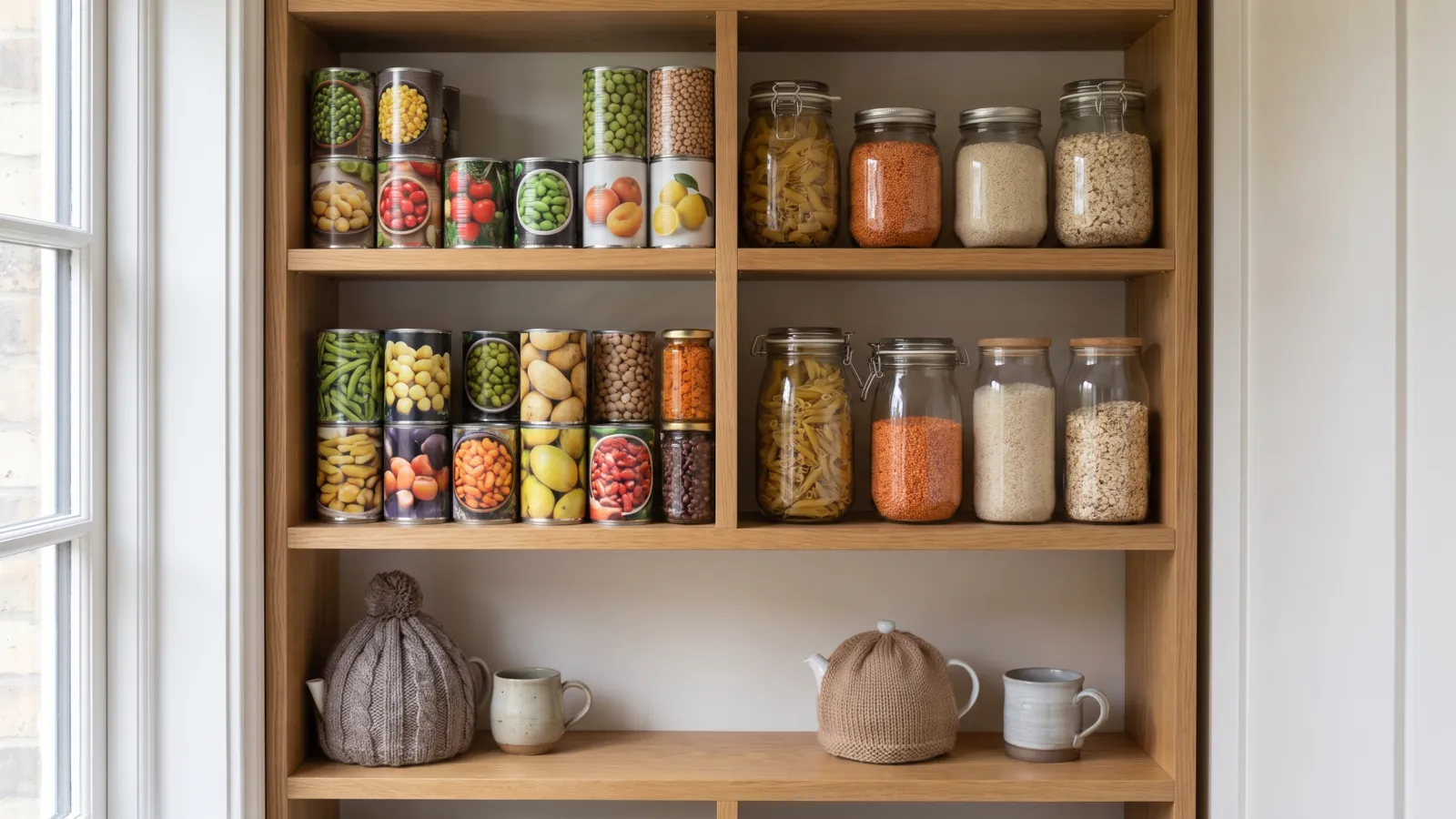
For food, it asks for things that keep and need no cooking, because the same event that cuts your power often takes the hob with it. Tinned fish, beans and fruit, crackers, peanut butter, long-life milk and a few treats do the job.
The rest of the list is a wind-up or battery torch and radio, spare batteries, a charged power bank, a basic first-aid kit, any prescription medicines, copies of important documents and a little cash for when card machines are down.
Almost all of it is ordinary shopping. Add a few items to your normal weekly shop for a month and you are done, for far less than the cost of a single panic-buying trip.
What not to do
Do not panic-buy. Shelves empty because everyone buys at once, not because the country runs out; Defra's UK Food Security Report describes the food supply as broadly stable. Buying a few extra tins each week does the same job without the queue.
Do not buy 25-year ration packs for a three-day problem. Tins you already eat, rotated normally, cost a fraction as much and will not sit untouched in a loft.
Do not build a plan around a generator you have never run. For most households a torch, a power bank, warm layers and water matter far more than a petrol engine, and they carry no carbon-monoxide risk.
Common questions
Has the UK government told people to stockpile food and water?
Not as an emergency instruction. Its Prepare advice has asked households to keep a few days of water, food and basics since 2023, and in July 2026 the Cabinet Office said a national campaign built on that advice would launch later this year. Nothing has been issued telling people to stock up now.
Is Britain preparing for war with Russia?
The government's July 2026 report lists "a growing number of sub-threshold attacks from Russia" among the risks it is planning against, and the head of the armed forces said in September that this is the most dangerous period since the Cold War. Neither says war in Britain is expected, and the household advice covers all disruption: storms, floods, power and water failures, and cyber incidents.
How much water should I keep per person?
GOV.UK Prepare works from 2.5 to 3 litres per person per day for drinking, and about 10 litres a day once cooking and basic hygiene are included. For three days that is roughly 9 litres of drinking water per person, or 30 litres to carry on more or less normally.
How many days should I cover?
The official advice is built around a few days, which covers the great majority of UK disruption. Our own guides work through three days and two weeks, because two weeks is cheap once the shelf exists and covers a longer storm or supply problem.
Did the BBC report that the government is preparing for war?
No. The BBC piece is an essay by Allan Little, published on 17 September 2026, asking whether the public is psychologically ready for the possibility of war. The "prepares for possible war" wording came from a social media post that cited it, not from the BBC's reporting.
Sources: Cabinet Office — UK Government Resilience Action Plan: 2026 Implementation Report (14 July 2026) · GOV.UK Prepare — Get prepared for emergencies · BBC News — Allan Little, "War may be coming. Are we psychologically ready?" (17 September 2026). PreparedBritain is independent and not affiliated with HM Government.
The Emergency Kit Checklist
The GOV.UK Prepare essentials on one printable page — tick them off as you go and keep it with the kit. Free, no catch.
Download it straight away. We'll also send the occasional briefing when something genuinely matters — severe weather, live incidents, real price drops. Nothing else.
Keep reading
All planning & the national picture guides →Igenix air conditioner not cooling: the fixes that actually work
The hose, seal, filter, drainage and settings checks from Igenix's own manuals — including three built-in behaviours…
Aico vs Kidde carbon monoxide alarms: what the difference actually is
Aico and Kidde both certify to BS EN 50291-1:2018 — the real differences are sales channel, how each brand…
Can a log burner give you carbon monoxide poisoning?
Yes — a wood burner can produce dangerous carbon monoxide if the flue is blocked or the wood is wet. Here's how it…