
How can the UK prepare for a cyber-attack? What it has meant at home, and what is worth doing
A minister, a former national security adviser and a former defence secretary have all warned about cyber attacks this week, and the head of MI5 has been quoted saying more advice for the public is coming. Here is what Britain’s real attacks have meant at home, what the National Risk Register plans for, and the few calm things worth doing: the GOV.UK Be Ready basics, a radio first among them, and the NCSC’s six steps for your own accounts.
Households can prepare the way the government’s Be Ready campaign describes: three days of water and food that needs no cooking, a battery or wind-up radio, a torch, a charged power bank, some cash, your medication and the important phone numbers written on paper, plus the NCSC’s basics for your own accounts. October’s warnings came from the AI minister and former officials; the head of MI5 was quoted saying more advice for the public is coming. Be Ready’s own cyber page asks for no supplies, only secure accounts, updated devices and backups: the hand sanitiser, bottled water and tins shoppers bought after its launch are on its general checklist, for any emergency. In the UK, cyber attacks have so far cancelled hospital appointments, paused a retailer’s online orders for 46 days and halted a car maker’s production; no confirmed attack has cut power or water to homes. The National Risk Register plans for worse, but a planning scenario is not a forecast.
By Tom Calder · Updated 12 November 2026 · Sourced to GOV.UK Be Ready, the Cabinet Office, the National Risk Register, the NCSC, the National Audit Office, NHS England, DESNZ, the British Red Cross, Worldpanel by Numerator, De Nederlandsche Bank, Parliament, the BBC, PA and the Daily Express
Earlier changes
4 Nov Added the NCSC Annual Review 2026 (3 November) and its 2028 assessment, and replaced last year’s incident figures with this year’s: 1,831 reports, 337 incidents needing support, 80 nationally significant, in the year to 31 August 2026. Read at ncsc.gov.uk on 4 November 2026.
2 Nov The national campaign this page said was due ‘later this autumn’ launched on 22 October 2026 as Be Ready, replacing GOV.UK Prepare. Updated the household basics to Be Ready’s: three days, 3 litres of drinking water per person per day (we had Prepare’s 2.5 to 3 litres and ‘no number of days’), and cash, which Be Ready now lists (we had said the official advice does not mention cash). Read at GOV.UK Be Ready on 2 November 2026.
What is being said this week
Update, 4 November 2026: the NCSC’s Annual Review, published on 3 November, says AI-powered malware is “highly likely” to have been used in a ransomware attack on UK critical national infrastructure by 2028. What the NCSC actually said, and what the “wipe out food and energy” headlines got wrong.
Four voices are behind this week’s headlines, saying different things. On 12 October 2026 the AI minister, Kanishka Narayan, said it seems “likely, if not inevitable, that our own cyber defences will be breached”. He meant AI-enabled attacks on the country’s systems, not a blackout.
On 17 October the BBC reported that Lord Ricketts, a former national security adviser, had told Radio 4’s Today programme that hybrid attacks are getting “more reckless, more dangerous”. He wants more resilient energy, transport and air traffic control, and ministers to warn the public. That is about infrastructure, not advice to households; whether Britain is preparing for conflict more broadly has its own dated record.
The most shared line is Sir Grant Shapps’s, in the Daily Express on 18 October: “Russia doesn’t need to invade Britain to threaten Britain”, and the next attack “may look like an ordinary Monday morning when everything suddenly stops working”. It is a former Defence Secretary’s warning, not an official forecast; the article cites no report or assessment behind it and does not say where he said it. The same piece also quotes the head of MI5, Sir Ken McCallum, again without saying where: “You should expect to hear more from government in the coming months on how we can all be more resilient.”
What a cyber attack has actually meant at home
Britain’s large cyber attacks have not looked like films. They looked like cancelled appointments, paused orders and some empty shelves.
Hospitals. On 12 May 2017 WannaCry disrupted 81 of England’s 236 NHS trusts: at least 6,912 appointments were cancelled (NHS England estimated about 19,000 in all), five A&E departments diverted patients, and NHS England knew of no patient data being stolen. On 3 June 2024 an attack on the pathology provider Synnovis left south-east London hospitals at about 10% of testing capacity; in the first week 814 planned procedures, 97 of them for cancer, and 861 outpatient appointments were postponed.
Shops. Marks & Spencer disclosed an attack on 22 April 2025, paused online orders on 25 April and took 46 days to restart them. Some food shelves emptied and contactless payment was affected. Customer data was taken, though not usable card details or passwords, and customers were warned to expect fake messages.
Industry. Jaguar Land Rover halted production on 1 September 2025, the day after an attack, and did not begin a phased restart until 8 October, more than five weeks later.
The global IT outage of July 2024 was a faulty CrowdStrike update, not an attack. At home the effect can look the same, and the Risk Register now plans for both.
Could a cyber attack cut your power or water?
Not so far. There is no confirmed case of a cyber attack cutting the power or water supply to British homes. South Staffs Water’s August 2022 attack affected its IT and data, not the supply.
The nearest thing came in July 2026, when a small-scale energy generator went offline for four days after a reported cyber attack. DESNZ, the energy department, said “at no point was there a risk to the wider energy system”; there has been no formal attribution, and no homes were reported to have lost power. Headlines called it a power plant; it was not the grid.
It has happened abroad, in Ukraine in December 2015 and December 2016, during its conflict with Russia: not a precedent for Britain.
So the attacks Britain has had hit organisations, and the disruption reached households through them. The basics below are the ones you would keep for a storm anyway.
NewSee this for your own homeHome Alerts: your postcode's power cuts, warnings and floods, on one screen. Free for your own home. Sign up in a minute.Start free →What the government’s planning assumes
The National Risk Register, published on 14 July 2026, is the public version of the government’s planning, and this edition added new cyber risks: an attack on a water company’s operational technology, in which the company loses visibility and control of its systems and disruption could take “several months” to put right; a cyber attack on data infrastructure such as data centres; and a “digital resilience failure”, added to reflect lessons from the July 2024 CrowdStrike outage.
A reasonable worst case is a planning assumption, not a forecast: the worst plausible version of a risk, used so that emergency services and utilities plan in proportion, not what the Register expects this winter. Our guide to the Register explains how to read it.
The household advice is GOV.UK Be Ready, the national campaign the Cabinet Office launched on 22 October 2026 in place of GOV.UK Prepare. Its checklist is written for any emergency, asks households to be ready for three days and highlights the Priority Services Register; it has its own page on cyber incidents. What the campaign asks.
The Defence Secretary has separately suggested households keep a supply of bottled water indoors and some tinned food they could eat if a power cut stopped them cooking; the government stressed that no big purchases are needed. No official source tells you to stockpile; our stockpiling fact-check has the record.
What to do now: the household basics
None of this is specific to cyber attacks, which is the point: the same few things cover a storm, a flood, a long power cut or a day when the tills stop working.
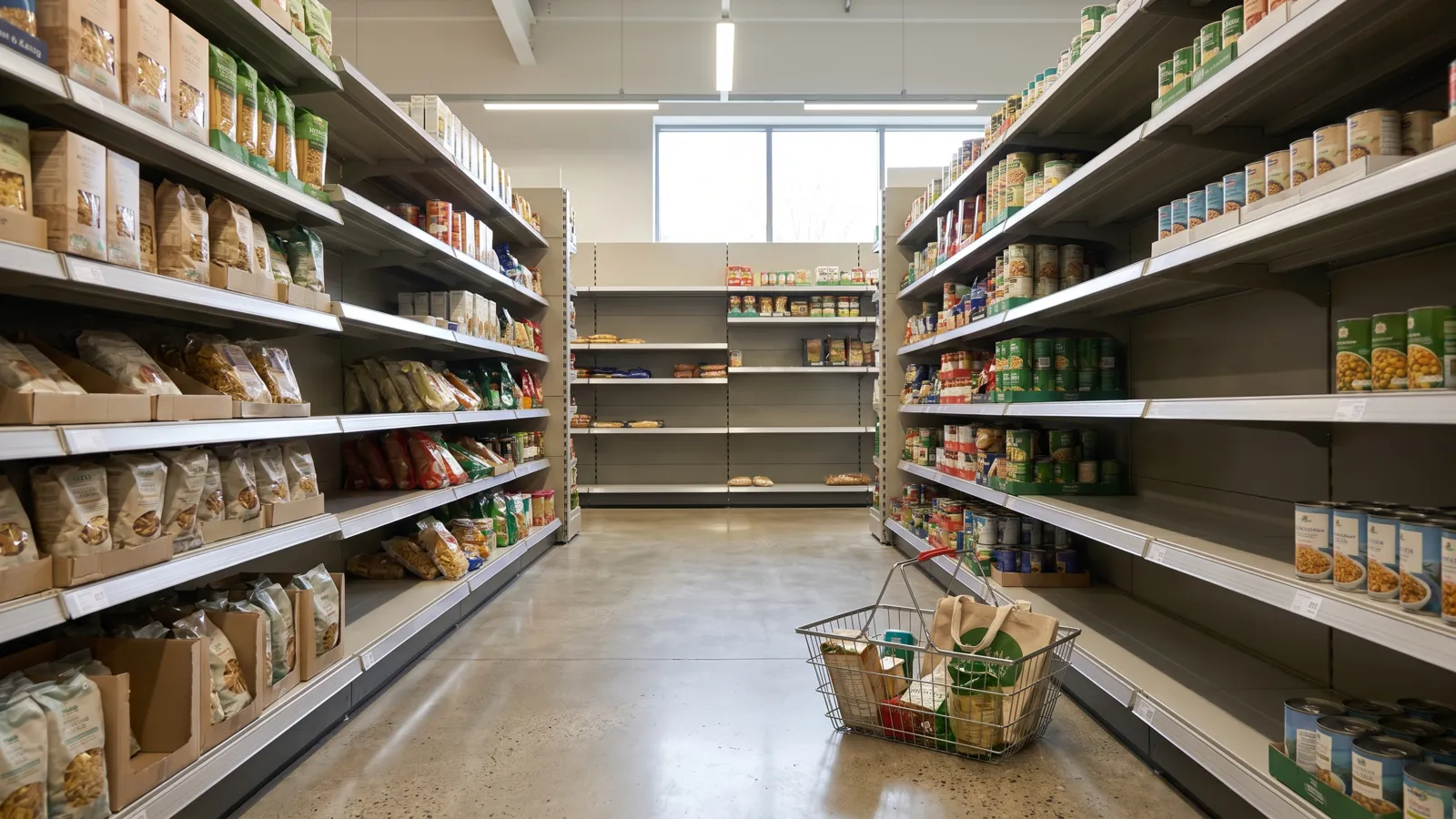
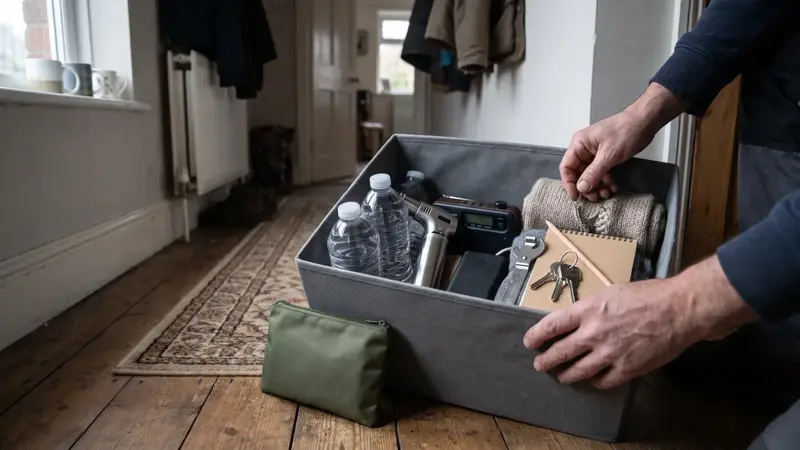
Water and food. GOV.UK Be Ready says bottled water for three days, at 3 litres of drinking water per person per day, plus non-perishable food for three days that needs no fridge or cooking. The British Red Cross and Ready Scotland also work on three days’ supply. Our emergency kit list follows the official list item by item; the kit builder sizes it to your household.
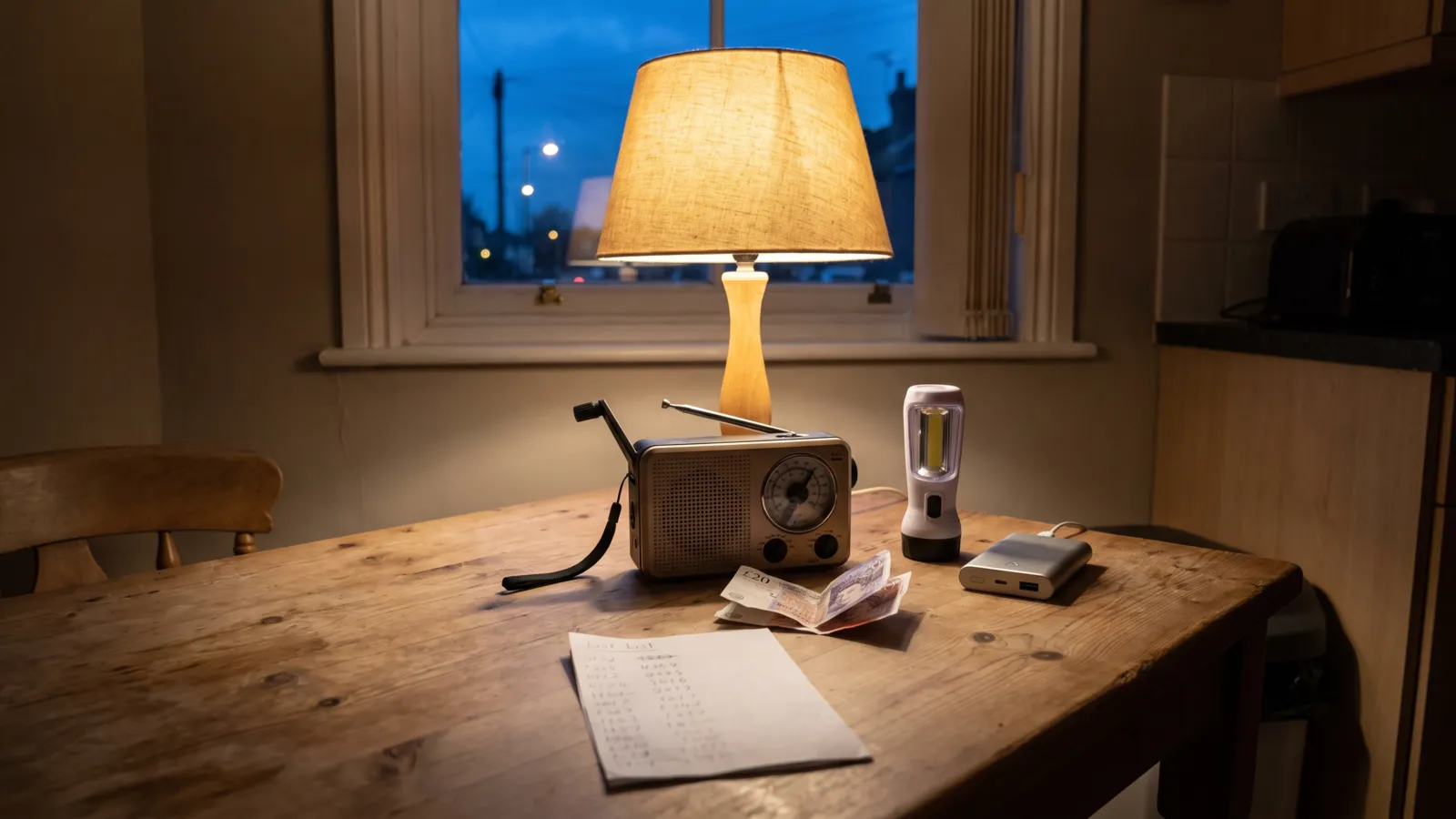
A radio. GOV.UK Be Ready says to keep a battery radio or wind-up radio and spare batteries, to search for stations that are still broadcasting, and to write down the frequencies of the stations you use for news. In a written answer in December 2025 the government said the BBC’s power-outage plan aims to keep key radio channels broadcasting nationally. Which radio to buy, and how to use it in a power cut.
Light, power and numbers. A battery or wind-up torch and a charged power bank. Be Ready warns that mobiles may stop if the local mast is affected, so write important phone numbers on paper, among them 105 for power cuts (England, Scotland and Wales). A household emergency plan puts numbers, shut-offs and a meeting point on one sheet.
Medication and documents. Several days of any medication you rely on, and your documents to hand. If anyone at home relies on powered medical equipment, or is older or disabled, ask your suppliers about the Priority Services Register.
Cash. GOV.UK Be Ready now lists cash, in a mix of coins and notes, and cards, in case electronic payments or cash machines are disrupted; it gives no figure, saying the amount depends on your family’s needs for essentials. For context only, the Netherlands’ national payments forum, chaired by its central bank, advised in May 2025 keeping about €70 per adult and €30 per child for a 72-hour failure of electronic payments, plus more than one way to pay. When the card machine is down explains what a little cash is for.
Your own accounts and devices
In the ten days after Be Ready launched, sales of hand sanitiser rose 83% on the same period last year, bottled water 67% and tinned and jarred goods 37%, Worldpanel by Numerator said on 10 November; some headlines put the buying down to a cyber-attack warning. Those items are on Be Ready’s general checklist for any emergency, alongside a torch and spare batteries and a battery or wind-up FM radio. Its cyber page asks for none of them. Its steps are to secure your accounts, starting with email and using a passkey where available; to install updates and consider replacing any device its maker no longer supports; and to back up important data and practise restoring it. What the sales figures show.
The attacks that reach most households are not on the grid but on accounts: a reused password or a convincing email. The National Cyber Security Centre’s advice has six parts: a strong, separate password for your email; the latest updates on your devices and apps; 2-step verification wherever it is offered; a password manager; backups of what you cannot replace; and passwords made of three random words.
Email first: the NCSC puts it at the top of the list, and it is a ten-minute job.
The scale is real: in the year to 31 August 2026 the NCSC received 1,831 reports and 337 incidents needed its support, 80 of them nationally significant (the year before: 429 incidents, 204 nationally significant). Those were attacks on organisations. Your part is to make sure that when one of them loses your details, the attackers get no further.
The Emergency Kit Checklist
The GOV.UK Prepare essentials on one printable page — tick them off as you go and keep it with the kit. Free, no catch.
Download it straight away. We'll also send the occasional briefing when something genuinely matters — severe weather, live incidents, real price drops. Nothing else.
After an attack: the scams that follow
Every big breach is followed by messages pretending to come from the company. Marks & Spencer warned customers to expect fake messages after its 2025 attack.
The pattern repeats: a text or email about your account, a refund or unusual activity, with a link and a deadline. Go to the company’s website or app yourself, not through the link, and never move money because a message told you to.
Forward scam texts to 7726 and scam emails to report@phishing.gov.uk. If money has gone, call your bank; 159 connects you to it. Report fraud in England, Wales and Northern Ireland to Report Fraud at reportfraud.police.uk or on 0300 123 2040 (it replaced Action Fraud on 4 December 2025); in Scotland, report it to Police Scotland on 101. Our guides to AI-enabled scams and what to do if you have been scammed take it step by step.
What not to do
Don’t buy for a scenario. The official list is a few days of basics; the government has stressed that no big purchases are needed, and the Be Ready campaign asks households to build up supplies gradually, from food they already eat.
Don’t read a planning scenario as a forecast. The Risk Register’s water and data-infrastructure scenarios are the worst plausible cases planners prepare for, not what anyone has said to expect this winter.
Don’t mistake a former minister’s warning for an official one. The “ordinary Monday morning” is Sir Grant Shapps’s image, with no published assessment behind it; the head of MI5’s point was that advice is coming, not that an attack is.
And don’t click the link in the message that follows the breach. That is where a company’s breach becomes your loss.
Common questions
How can the UK prepare for a cyber attack?
At national level the government plans through the National Risk Register, which in July 2026 added cyber-attack scenarios for water companies and data infrastructure, and the NCSC handles incidents (337 in the year to August 2026). Its public campaign, Be Ready, launched on 22 October 2026. At home the answer is the Be Ready basics, which cover any emergency, plus the NCSC’s six steps for your own accounts: separate email password, updates, 2-step verification, a password manager, backups and three random words.
Could a cyber attack cut off my electricity or water?
There is no confirmed case of it in the UK. In July 2026 a small-scale energy generator went offline for four days after a reported attack; DESNZ said “at no point was there a risk to the wider energy system”, and no homes were reported to have lost power. South Staffs Water’s 2022 incident hit its IT, not the supply. The National Risk Register now plans for a cyber attack on a water company’s control systems that could take several months to put right; that is a planning assumption, not a forecast.
What should I keep at home in case of a cyber attack?
The same things the government’s Be Ready checklist lists for any emergency: bottled water for three days at 3 litres of drinking water per person per day (more for cooking and washing), three days of food that needs no fridge or cooking, a battery or wind-up radio, a battery or wind-up torch, a portable power bank, your medication, cash and cards, copies of your documents, and important phone numbers written on paper. The British Red Cross also works on three days’ supply. Be Ready’s own cyber page lists no supplies: its steps are for your accounts, devices and data.
How much cash should I keep at home?
No UK official source gives a figure. The government’s Be Ready checklist lists cash, in a mix of coins and notes, in case electronic payments or cash machines are disrupted, and says the amount depends on your family’s needs for essentials; the British Red Cross lists some “for essentials”. For context, the Dutch national payments forum, chaired by the central bank, advised in May 2025 that households keep about €70 per adult and €30 per child to cover a three-day failure of electronic payments, and have more than one way to pay. Enough for a few days’ essentials, in small notes, is the sensible reading.
Why do I need a radio if I have a phone?
Because the phone may not work. GOV.UK Be Ready’s power-cuts advice says your mobile might stop working if your local mast is affected and to use a battery or wind-up radio for news updates, so keep one with spare batteries and note the frequencies of your news stations on paper. The government said in December 2025 that the BBC’s power-outage plan aims to keep key radio channels broadcasting nationally.
Is the government telling people to stockpile?
No. The government’s Be Ready campaign, launched on 22 October 2026, asks households to be ready for three days, built up gradually during normal shopping, and does not use the word stockpile; the Defence Secretary has suggested keeping bottled water and some tinned food at home, and the government has stressed that no big purchases are needed.
Sources (28)
- Worldpanel by Numerator — British shoppers stock up on essentials, but don’t panic buy, after launch of government’s ‘Be Ready’ campaign10 November 2026: hand sanitiser +83%, bottled water +67%, tinned and jarred goods +37%
- NCSC, Annual Review 2026: Incident management1,831 reports, 337 incidents, 80 nationally significant; read 4 November 2026
- PA via The Irish News — AI breach of UK cyber defences ‘likely, if not inevitable’, minister warns (12 October 2026)
- BBC News via Yahoo News — Ian Aikman, UK must protect against Russian hybrid attacks, says Lord Ricketts (17 October 2026)
- Daily Express via AOL — Michael Knowles, Sir Grant Shapps and Sir Ken McCallum quoted (18 October 2026)
- National Audit Office — Investigation: WannaCry cyber attack and the NHS (2017–18)
- NHS England London — Update on cyber incident: clinical impact in south east London (14 June 2024)
- The Register — M&S restores click and collect following cyber attack (11 August 2025)
- Wikipedia — Jaguar Land Rover cyberattackattack 31 August 2025; production paused 1 September 2025
- TEISS — Jaguar Land Rover resumes production following significant cyberattack (phased restart from 8 October 2025)
- The Guardian via The Irish Times — Iran-linked hackers accused of cyberattack that shut down British power plant23 August 2026, following a Sunday Telegraph report; DESNZ: “at no point was there a risk to the wider energy system”
- GOV.UK — National Risk Register 2026 (14 July 2026)
- Emergency Services Times — Seven new risks added to National Risk Register17 July 2026: cyber attacks on water and data infrastructure, digital resilience failure
- GovInfoSecurity — UK sees data infrastructure, water system cyberattack risks16 July 2026: the Register’s water scenario, “several months”; CrowdStrike lesson
- Cabinet Office — Communities protected as government readies nation for winter weather2 October 2026: campaign “later this autumn”
- Grocery Gazette — Households to stock up on tinned food14 October 2026: the Defence Secretary on bottled water and tinned goods; no big purchases needed
- GOV.UK Be Ready — Be ready for emergencies (3 days; 3 litres of drinking water per person per day; cash in coins and notes; phone numbers on paper), read 2 November 2026
- GOV.UK Be Ready — Power cuts (battery or wind-up radio, mobile masts, 105), read 2 November 2026
- British Red Cross — Prepare an emergency kit (three days’ supply; cash for essentials)
- Ready Scotland — Emergency kit
- Parliament written question 100811, DCMS answer (29 December 2025) via Westminster Brief — BBC power-outage plan for key radio channels
- De Nederlandsche Bank — NFPS advice: prepare for a three-day disruption of electronic payments (20 May 2025)
- NCSC — Top tips for staying secure online
- NCSC — Annual Review 2025, chapter 1: incident management (year to 31 August 2025)
- NCSC — Phishing scams: how to report (7726, report@phishing.gov.uk)
- City of London Police via GOV.UK — Report Fraud: new service replaces Action Fraud (4 December 2025; 0300 123 2040)
- Stop Scams UK — 159, the number to reach your bank
- GOV.UK Be Ready — Cyber (accounts, passkeys, updates, unsupported devices, backups), read 12 November 2026
PreparedBritain is independent and not affiliated with HM Government.
Latest from our live data
All stories → News · 16 NovWhy are we being told to stockpile? What the 'blackouts and empty shelves' alert rests on
 News · 16 NovRed Cross shares 14 ‘essential’ items for 3-day emergency kit: how it compares with Be Ready
 News · 16 NovWill the polar vortex cause power cuts in the UK? What the ‘outdoor item’ stories leave out
For the children this Christmas

Keep reading
All planning & the national picture guides →Diesel prices are easing, except at motorway services, now 17p a litre dearer
Diesel at motorway services averaged 216.0p a litre on 15 October, against 198.6p at every other forecourt. The…
El Niño has set a new record. Here is what the last three giants did to Britain's winters
NOAA's weekly El Niño reading has set a new high for the third week running, and its July–September index value is…
A lab worker in Siberia has died of a suspected plague infection. What does it mean for the UK?
A 28-year-old laboratory worker at a plague research institute in Irkutsk died in the night of 1–2 October,…
