Only 4 in 100 adults have three days of bottled water at home, the government's survey shows
The government's own 2026 preparedness survey of 10,791 UK adults asked people to count the litres of bottled drinking water they keep at home. Set against their household size at 3 litres a person a day, 4% had three days' worth or more and 82% had less than one day. Asked a simpler tick-box question, 37% said they had three days. What else the survey found on food, torches, radios and power banks, what stops people, how it differs by nation and area, and the cheap ways to close the gap.
The Cabinet Office's UK Public Survey of Risk Perception, Resilience and Preparedness 2026, published as official statistics on 19 August, asked 10,791 UK adults how many litres of bottled drinking water they had at home. Divided by their household size at 3 litres a person a day, 4% had three days' worth or more, 10% had about a day and 82% had less than a day; 35% had under a litre in total. When the same people were simply asked to tick whether they had three days of bottled water, 37% said yes, and the survey's authors say the counted question is the one to use. On food, 60% said they had three days of food that needs no cooking, down from 66% in 2025. 54% have a power bank, 53% a battery, solar or wind-up torch and 23% a battery, solar or wind-up FM radio. The biggest barriers were money (29%), not wanting things to go out of date (25%) and not knowing what to do (23%). The figures are self-reported and count bottled water only, not tap water kept in other ways. GOV.UK Prepare quotes the World Health Organisation's minimum of 2.5 to 3 litres a person a day for drinking, and suggests building a kit up over time rather than buying it all at once.
By Tom Calder · Updated 21 October 2026 · Sourced to the Cabinet Office's UK Public Survey of Risk Perception, Resilience and Preparedness 2026 (official statistics, published 19 August 2026): its headline findings, technical report, questionnaire and data tables for the UK, each nation and England's local resilience areas, worked through by us on 21 October 2026, and to GOV.UK Prepare's advice as it read that day
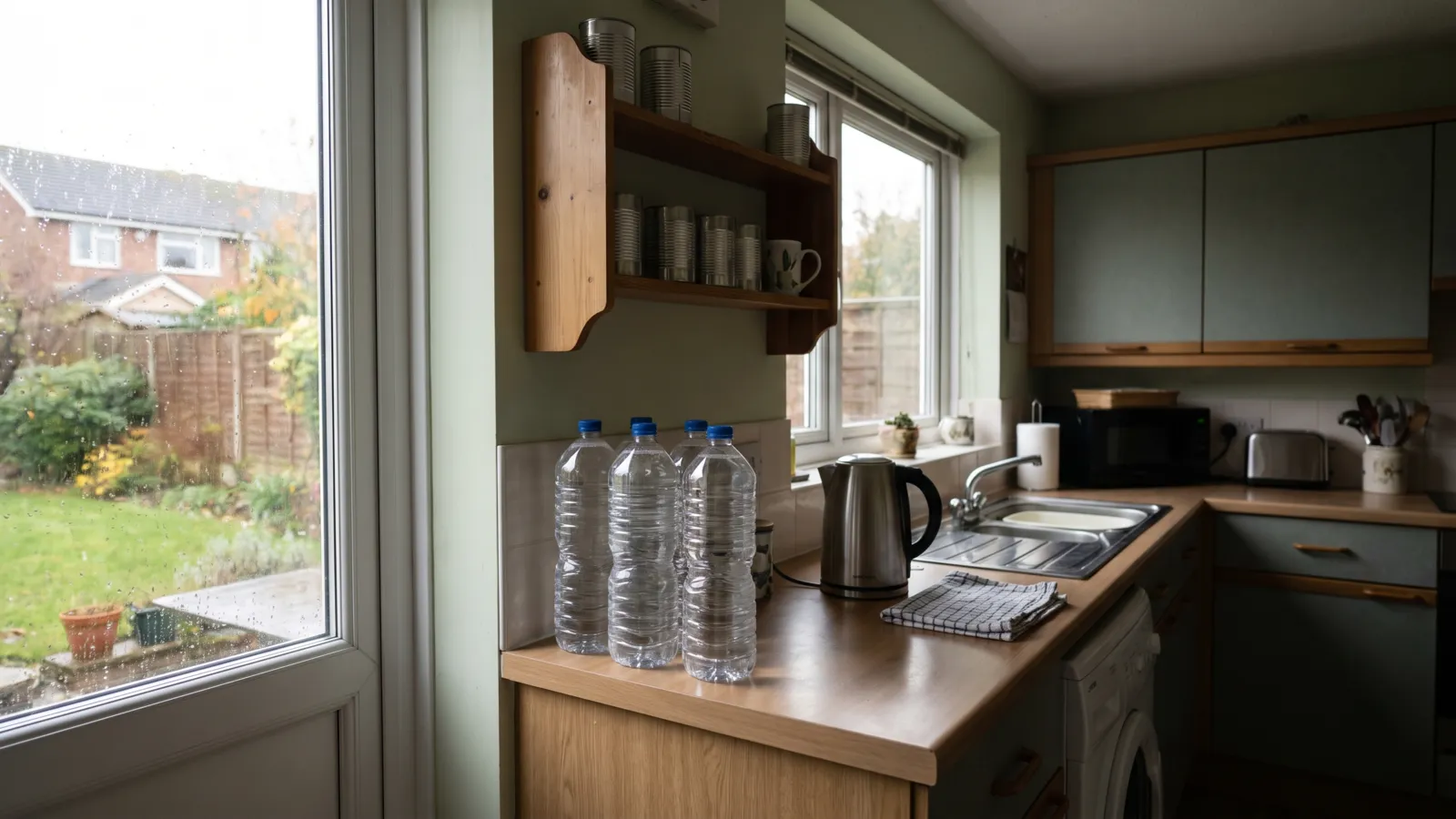
Counted in litres, 4% had three days of bottled water
The UK Public Survey of Risk Perception, Resilience and Preparedness is the government's own measure of how ready people are for emergencies. The Cabinet Office runs it, with Defra funding, to inform its public advice. The 2026 edition, published as official statistics on 19 August, surveyed 10,791 adults across the UK online between 27 February and 11 May 2026, weighted to match the adult population of the UK and of each nation.
This year it asked a precise question: "How many litres of bottled drinking water, if any, do you have at home?" People were asked to answer in litres, checking if they were at home and estimating if not; anyone giving a very large number was asked what form the water was in and to confirm it. The survey team then divided each answer by the number of people in the respondent's household, at 3 litres a person a day.
On that measure, 4% of respondents had enough bottled water for three days or more. 10% had about one day's worth and 82% had less than one day. Fewer than 1 in 100 had a week's worth. In plain litres, 35% had under a litre of bottled drinking water at home, 29% had 1 to 2 litres and 37% had 3 litres or more. For a household of four, three days at 3 litres each is 36 litres.
Earlier in the same survey, people were shown a list and asked to tick the supplies they had. 37% ticked "bottled drinking water for 3 days (at least 9 litres per person in your household)". The survey's authors explain the gap: they say the counted question "allowed respondents to think more carefully about their supplies" and is the one to use when judging how prepared households are for bottled water.
Food, torches, radios and power banks
60% of respondents said they had food that keeps in a cupboard, needs no cooking and would last their household about three days. That is down from 66% in the 2025 survey. A looser question, which did not rule out food that needs cooking, found 85% had three days or more of cupboard food and 25% had a week or more; the survey notes people may have counted dried pasta and rice.
On kit: 54% said they had a power bank to charge a phone, 53% a torch powered by battery, solar or wind-up (down from 55%), and 23% an FM radio powered by battery, solar or wind-up, not counting car or phone radios. 60% had spare batteries for a radio or torch and 60% kept some cash, £10 or more per person. 19% had a camping stove and 8% had water purification tablets.
Asked how long they could meet their household's basic needs in a power cut that also affected gas and water, 25% said a day or less. That has improved from 32% in 2025. 41% said two to three days and 12% said six days or more.
What stops people
The survey asked what might prevent people taking further steps. The top answer was not having enough money to spend extra on preparing, at 29%, up from 27% in 2025. Next came not wanting products to go out of date and be thrown away (25%), not knowing enough about what to do (23%, down from 25%), finding it stressful to think about (19%) and not having space to store supplies (18%, down from 21%). 11% said they had already done a lot to prepare.
13% felt their household was largely or totally prepared for an emergency, the same as in 2025, and half felt slightly or not at all prepared. 14% said they had visited the government's Prepare website; of those, 74% said they had acted on its advice. Awareness of the Emergency Alerts service rose from 63% to 74%. And 28% thought war likely or very likely to affect their local area within two years, up from 19%.
Home Alerts members
The full picture, for your home
Each week, what's happening across Britain set against your own address: your water company, your power network, fuel for your car and the gaps in your kit. Free for your own home. Opening in October; the first 100 on the list get in first.
Join the list →Britain's figures from our live trackers, 21 October.
By nation and by area
The survey publishes separate tables for each nation. Against 4.5% for the UK as a whole, the share with three days or more of bottled water on the counted measure was 4.5% in England, 4.6% in Scotland, 3.3% in Wales and 7.0% in Northern Ireland, from samples of 7,082, 1,578, 1,049 and 1,082 adults. Three days of food needing no cooking: 60.1% in England, 61.4% in Scotland, 63.1% in Wales and 65.6% in Northern Ireland. We have not tested whether these gaps are statistically significant.
For England there are tables for each of the 38 local resilience forum areas, the partnerships of councils and emergency services that plan for local emergencies. These include an extra 936 respondents recruited so each area has a usable sample, but most areas still rest on about 150 people, the area tables are not weighted, and the survey's authors say the area results are indicative only. The area tables give the water measure: three days or more ran from under 2% to 9% across the areas, too small to rank. In every area at least 7 in 10 respondents had less than a day of bottled water.
What GOV.UK Prepare actually advises
The government's Prepare website does not set a fixed amount. On 21 October it said that for bottled water "there is no standard figure" because emergencies vary in length and people use different amounts. It quotes the World Health Organisation's minimum of 2.5 to 3 litres of drinking water a person a day for survival, and says 10 litres a person a day is more comfortable because it also covers basic cooking and hygiene. It adds water for baby formula, medical devices and pets.
For food it suggests non-perishable food that does not need cooking, such as ready-to-eat tinned meat, fruit or vegetables, and a tin opener. And it says: "Rather than buying all the items at once, you could just add to your emergency kit when you are able and build it up over time."
The national campaign the government has promised has not launched yet. A briefing for partner organisations, posted on 1 October, says it will ask households to build up three days' worth of non-perishable food and bottled water over time. Our explainer follows what is known.
Closing the gap without spending much
The survey's own barriers point the way: the commonest are cost, waste and not knowing where to start. Bottles filled from the kitchen tap cost little, and our water storage guide explains how to store tap water safely and rotate it.
For food, a few days of tins you already eat, used and replaced in the normal weekly shop, avoids the waste that a quarter of respondents worry about. How much food to store sets out sensible amounts, and the emergency kit list follows the government's own list item by item.
If you want a number for your own home, the kit builder sizes water and food for your household. If your supply is ever cut off, what to do when the water goes off covers the first hours.
Common questions
How many people in the UK have three days of bottled water?
In the Cabinet Office's 2026 preparedness survey, 4% of UK adults had enough bottled drinking water for their household for three days or more, at 3 litres a person a day, when asked to count the litres they had. 82% had less than a day. When asked a simple tick-box question, 37% said they had three days, but the survey's authors say the counted figure is the one to use.
How much water should I store for an emergency?
GOV.UK Prepare says there is no standard figure. It quotes the World Health Organisation's minimum of 2.5 to 3 litres of drinking water a person a day for survival, and says 10 litres a day is more comfortable because it also covers basic cooking and hygiene. At 3 litres a day, three days is 9 litres per person, or 36 litres for a household of four.
Does tap water stored at home count?
In this survey the question asked only about bottled drinking water, so tap water kept in other containers may not have been counted. For your own planning, tap water kept in bottles costs little; our water storage guide explains how to store it safely and rotate it.
What stops people preparing for emergencies?
In the 2026 survey the most common barriers were not having enough money to spend extra on preparing (29%), not wanting products to go out of date and be thrown away (25%) and not knowing enough about what to do (23%). 18% said they lacked space to store supplies.
Who runs the UK preparedness survey?
The Cabinet Office, with funding from Defra; the UK Health Security Agency helped design it. The 2026 survey, its second, ran online from 27 February to 11 May 2026 and was published as official statistics on 19 August 2026, with data tables for the UK, each nation and England's local resilience forum areas.
Sources (9)
- Cabinet Office — UK Public Survey of Risk Perception, Resilience and Preparedness: 2026 (official statistics, 19 August 2026)
- Cabinet Office — 2026 headline findingsFigures 4.4 to 4.11: items at home, supplies, bottled water, food, barriers
- Cabinet Office — 2026 technical report (method, sample, weighting)
- Cabinet Office — Full 2026 questionnaire (Q25, Q26, Q27, Q30, Q43 wording)
- Cabinet Office — UK 2026 data tables, ODS (Tables 57, 75, 77, 79, 81, 84, 85)
- Cabinet Office — England local resilience forum area 2026 data tables, ODS
- Cabinet Office — England, Scotland, Wales and Northern Ireland 2026 data tables, ODS (linked from the publication page)
- GOV.UK Prepare — Get prepared for emergencies (read 21 October 2026)
- Glamorgan Voluntary Services — National resilience campaign stakeholder briefing (posted 1 October 2026)
PreparedBritain is independent and not affiliated with HM Government.
See our checks first on Google. Add PreparedBritain as a preferred source and Google will show our stories to you more often in Top Stories.

The Emergency Kit Checklist
The GOV.UK Prepare essentials on one printable page — tick them off as you go and keep it with the kit. Free, no catch.
Download it straight away. We'll also send the occasional briefing when something genuinely matters — severe weather, live incidents, real price drops. Nothing else.
Latest from our live data
All stories → News · 21 OctFood inflation held at 1.3%. Wholesale cabbage and cauliflower are up a third. Both are true
 News · 21 OctAldi recall: shoppers warned of hairdryer electric shock or fire risk. How to check yours
 News · 21 OctNo planning permission needed for cross-pavement EV chargers: what changes in England
Keep reading
All planning & the national picture guides →Renogy vs Jackery vs EcoFlow vs BLUETTI solar panels: price per watt, and the plug catch
Nine portable solar panels compared on price per watt, with what a watt is actually worth in a British December…
No planning permission needed for cross-pavement EV chargers: what changes in England
From 21 October 2026, a cable channel under the pavement for charging a car parked on the street no longer needs…
Massive Google outage crashes banking apps: the cash and numbers to keep offline at home
A power fault in one London zone of Google Cloud ran from 07:08 to about 15:00 on Tuesday 20 October and took…