Renogy vs Jackery vs EcoFlow vs BLUETTI solar panels: price per watt, and the plug catch
Nine portable solar panels compared on price per watt, with what a watt is actually worth in a British December (PVGIS and Met Office figures, working shown), weight, weather rating and warranty, and the question that decides it: which plug is on the end of the cable, and whether it goes straight into your power station.
On price per watt Renogy came out cheapest when we checked on 21 October 2026: its E.FLEX 200W and 220W suitcase cost about half as much per watt as BLUETTI’s PV200D, the E.FLEX less still, and well under Jackery’s SolarSaga 200; the cards below carry today’s prices. The catch is the plug: Renogy UK does not name it, so confirm it is MC4 and add your station maker’s adapter cable. BLUETTI’s PV200D includes its XT60 cable, though BLUETTI’s small Elite 10 takes only a 100W-class panel; Jackery’s panels fit only Jackery stations, with a plug that depends on the panel’s version; and EcoFlow’s own Lightweight panels (not yet in our catalogue) carry five years’ cover against a year on the older EcoFlow 110W on Amazon. In a British December the biggest panel here averages about a quarter of a 1kWh station a day in London and a seventh in Glasgow, by PVGIS, so buy for spring to autumn, not for a January storm.
By Tom Calder · Updated 21 October 2026 · Sourced to Renogy, Jackery, EcoFlow, BLUETTI, the European Commission’s PVGIS and the Met Office
Price per watt: how the nine compare
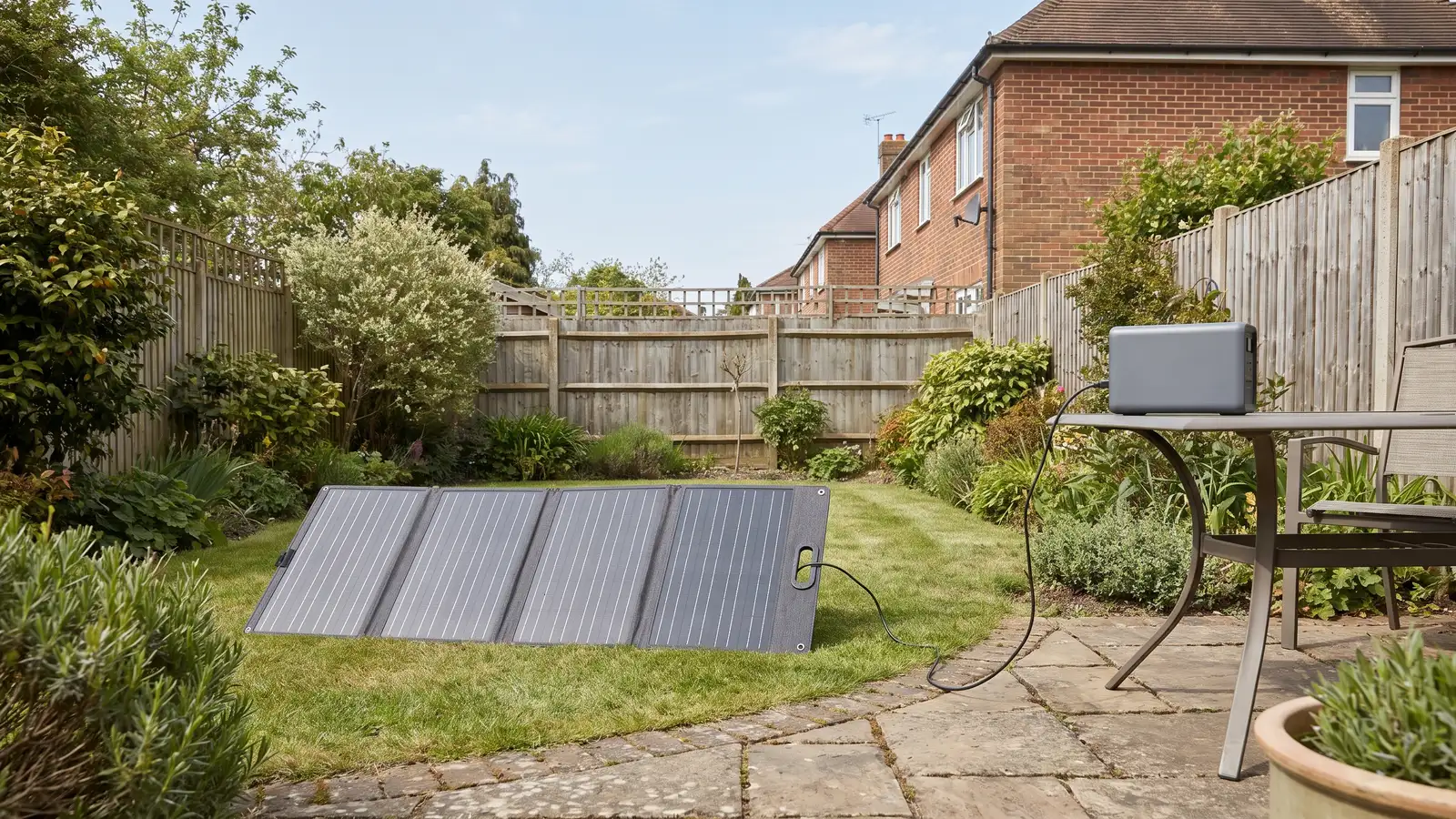
Price per watt is the fairest single number for a solar panel, because a 200W panel in the same light makes roughly twice what a 100W one does, whatever the badge. It is the price divided by the maker’s rated output at standard test conditions (STC, the lab figure every maker prints), and the cards below carry the live prices to divide. At each maker’s own UK store on 21 October 2026, the order ran, cheapest per watt first: Renogy’s E.FLEX 200W; Renogy’s 220W Lightweight Portable Solar Suitcase; Renogy’s 100W suitcase; Jackery’s SolarSaga 100; Jackery’s SolarSaga 200; then BLUETTI’s 100W PV100D and 200W PV200D, all but level. On those prices the Renogy 220W suitcase cost about half as much per watt as the PV200D, the E.FLEX about 15 per cent less again, and the SolarSaga 200 about three-quarters more per watt than the Renogy suitcase. Two panels on our cards, EcoFlow’s earlier 110W and BLUETTI’s PV120, are sold here only through Amazon listings, so we leave them out of the order; their prices are on their cards.
Two honest notes on that list. The EcoFlow panel on our card is the earlier 110W model, with a separate kickstand case, a separate XT60 cable and, by EcoFlow’s own comparison table, a year’s warranty. EcoFlow’s own UK store now sells a 110W Lightweight panel with a built-in cable and a 220W Lightweight, both with five-year warranties; at EcoFlow UK’s prices that day, both sat between Renogy’s 100W suitcase and Jackery’s SolarSaga 200 per watt. Neither is in our catalogue yet, so neither has a card below; if you own an EcoFlow station, look at EcoFlow’s store before buying the Amazon listing. Second, the bifacial ‘up to’ figures some makers quote (Jackery’s 225W, EcoFlow’s 243W and 122W) are their own test numbers, so we rank on the STC rating all four makers publish.
A ranking by price per watt is where to start, not where to stop. The cheapest panel is only the best buy if it plugs into your power station without a chain of adapters, survives being left out in a shower and comes with a warranty you can use. The sections below take those in turn, then say who should buy what. Our portable solar panels page tracks these prices daily.
What a watt is worth in Britain: the winter arithmetic
Rated watts are measured under 1,000 watts of light per square metre at 25°C, which Britain rarely supplies. Rather than guess, we ran the European Commission’s PVGIS calculator, which uses satellite-measured sunlight from 2005 to 2023, for a fixed, unshaded, free-standing array tilted at its best angle with 14 per cent system losses, PVGIS’s defaults. Per kilowatt of panel it gives an average December day of 1.24kWh in London, 0.96kWh in Manchester and 0.66kWh in Glasgow, against 4.00, 3.62 and 3.60kWh in June. December yields about a third of June’s energy in London, a quarter in Manchester and a fifth in Glasgow.
Scaled to these panels, an average December day gives the Renogy 220W suitcase about 270Wh in London, 210Wh in Manchester and 145Wh in Glasgow; a 200W panel about 250, 190 and 130Wh; a 100W panel about 125, 95 and 65Wh. In June the same 220W panel averages about 880Wh in London. Set against a 1kWh power station such as the EcoFlow DELTA 3 Plus or BLUETTI Elite 100 V2, a December day from the biggest panel here refills about a quarter of it in London and a seventh in Glasgow. A fridge-freezer averaging about 21W, the EU’s 2020 average, needs about 500Wh a day before the station’s own draw: the 220W panel covers around half of that on an average London December day, two-fifths in Manchester and under a third in Glasgow, and far less on a dull one.
Those are averages across every kind of December day, and PVGIS models a panel fixed at the ideal angle with nothing shading it. A folding panel you angle towards the sun and move once or twice can do a little better; one propped in a shaded garden, wet, or lying flat does worse, and a run of grey days gives a fraction of the average. The Met Office’s UK series says the same in hours: averaging its monthly figures for 1991–2020, December had 42.7 hours of bright sunshine across the UK against 171.5 in June, about a quarter. Over the last ten Decembers the UK figure ranged from 24.1 hours in 2024, the dullest since 1934, to 48.3 in 2022; December 2025 had 46.5. Plan a panel as a summer and shoulder-season top-up and a slow trickle in winter, not a winter power supply. See will solar panels keep the lights on in a power cut?
The plug: which panel goes straight into which power station
EcoFlow’s stations take solar through an XT60i socket: the DELTA 3 Plus has two, rated 11–60V and 15A each, and the RIVER 3 Plus’s solar input is 11–55V, 13A and 220W at most. EcoFlow’s own panels end in a matching plug and go straight in: the 220W Lightweight lists its connector as XT60, the 110W Lightweight as XT60i-F on a built-in cable, and the earlier 110W on our card came with a separate XT60 cable, by EcoFlow’s own comparison table. A panel with MC4 connectors needs EcoFlow’s Solar to XT60i Charging Cable, which the DELTA 3 Plus manual says is sold separately.
BLUETTI’s current stations use an XT60 solar input: 12–60V and 20A on the Elite 100 V2, 12–60V on the Elite 300, Elite 400 and Apex 300, and 12–28V, 8.2A and 100W at most on the small Elite 10. BLUETTI’s panels end in MC4 connectors, and the difference between its two is what is in the box: the 200W PV200D includes a 1.5-metre MC4-to-XT60 cable, so it is plug-and-go; the 100W PV100D comes with a 3-metre MC4 lead and no adapter, and the Elite 100 V2’s manual lists the MC4-to-XT60 cable as an optional extra. BLUETTI says the panels suit most solar generators with MC4 connectors, and not to mix different panel models. The PV120’s Amazon listing says ‘solar connectors’ and names the BLUETTI stations it suits, without saying whether an XT60 adapter is included.
Jackery’s panels end in Jackery’s own plugs, and which one depends on the version. Its connection guide says the current SolarSaga 200 (model JS-200D) has a DC8020 output that goes straight into the Explorer 1000 v2, 1000 Plus, 2000 v2 and 2000 Plus, among others, while the earlier JS-200A and JS-200C end in DC7909 and need a DC7909-to-DC8020 adapter for those stations. The SolarSaga 100 has come with DC7909 (JS-100A and JS-100C), DC8020 (JS-100F) and, on the 100 Prime, Anderson outputs, and Jackery UK’s SolarSaga 100 page describes an Anderson output with an Anderson-to-8mm cable in one place and a different specification table in another, so check the model number on the panel’s label, and with the seller, before you buy. From a DC8020 panel, the Explorer 240 v2 and 300 Plus need a DC8020-to-USB-C adapter cable that Jackery sells separately, and the older Explorer 240, 500 and 1000 a DC8020-to-DC7909 adapter. Jackery UK’s 100W page lists the Explorer 240 v2, 500 v2, 1000 v2, 2000 v2, 1000 Plus and 2000 Plus as compatible. What Jackery UK does not sell is any adapter between its plugs and MC4 or XT60: a SolarSaga into an EcoFlow or BLUETTI, or a Renogy into a Jackery, means a third-party adapter that no maker here endorses. Treat Jackery panels as Jackery-only, and the reverse.
Renogy is the catch. Its UK pages for the Lightweight Portable Solar Suitcase and the E.FLEX 200W say the panels work with most portable power stations and give full electrical figures, but neither names the plug on the end of the cable. Renogy’s accessory list sells MC4 branch connectors, MC4 extension cables and a ‘solar connector to 5.5 × 2.1mm DC’ adapter, which points to MC4-type connectors, but a hint is not a specification. Before you order, ask Renogy which connector the panel ships with, and budget for your station maker’s MC4 adapter cable: EcoFlow’s Solar to XT60i cable or BLUETTI’s MC4-to-XT60 cable. If you would rather not ask, the same-brand panel is the one that plugs in.
NewSee this for your own homeHome Alerts: your postcode's power cuts, warnings and floods, on one screen. Free for your own home. Opening in October; the first 100 on the list get in first.Join the list →Voltage and current: will the station accept it?
On every station here but one, a single panel of any of these sits inside the input window. The exception is BLUETTI’s small Elite 10, which BLUETTI caps at 28V, 8.2A and 100W of solar, so pair it with a 100W panel such as the PV100D (24.6V, 5.8A) or the Renogy 100W (21.6V, 5.83A). Open-circuit voltages are 23.6V for the Renogy 220W suitcase, 21.6V for the Renogy 100W and the E.FLEX 200W, 23.2V for the SolarSaga 200, 21.6V for the SolarSaga 100, 21.4V for EcoFlow’s 220W Lightweight, 23.5V for its 110W Lightweight and 24.6V for BLUETTI’s PV200D and PV100D, all makers’ STC figures. Short-circuit currents run from 5.8A (BLUETTI’s PV100D) to 12.2A (EcoFlow’s 220W): the Renogy 220W’s 11.5A and the SolarSaga 200’s 11.76A sit under the DELTA 3 Plus’s 15A per port, the Elite 100 V2’s 20A and the RIVER 3 Plus’s 13A, but every 200W-class panel here, from the PV200D’s 10.8A up, is over the Elite 10’s 8.2A.
Two panels in series double the voltage: two Renogy 220W suitcases would be 47.2V open-circuit and two PV200Ds 49.2V, by our arithmetic from the makers’ figures, inside a 60V window but closer to it than a single panel; on the RIVER 3 Plus’s 220W cap a second panel gains nothing. BLUETTI says not to mix panel models, and Jackery’s Solar Panel Series Connector is for two or three of its own panels on v2 and Plus stations, with the same advice to use one model. If you are sizing a station as well as a panel, start with what size power station do I need.
Weight, weather rating and warranty
In the 200W class, EcoFlow’s 220W Lightweight is the lightest at 5.1kg (±0.3kg) on its spec table (the page text says 4.4kg), then Renogy’s E.FLEX 200W at 6.3kg and Renogy’s 220W suitcase at 6.5kg; Jackery’s SolarSaga 200 is 17.5lb (about 7.9kg) and BLUETTI’s PV200D 8.14kg on its leaflet. Folded, the Renogy suitcase is the bulkiest at 588 × 573 × 83mm, because it is a rigid fibreglass case rather than a fabric fold; the others fold to 36–50mm thick. In the 100W class the Renogy 100W suitcase is 4.02kg, Jackery’s SolarSaga 100 4.69kg on its spec table (the same page’s description says 8lb), BLUETTI’s PV100D 4.9kg and the PV120 about 5kg (11.1lb on its listing).
Weather ratings differ more than the prices suggest. IP68 on the SolarSaga 200 (IP67 in other paragraphs of the same Jackery page) and both EcoFlow Lightweight panels, though EcoFlow’s 110W page says the rating covers the panel and not the junction box, and both EcoFlow pages say lightweight panels are not for hanging outdoors for long periods (the 110W page adds vehicles); IP67 on the Renogy suitcases and BLUETTI’s PV200D and PV100D (the PV100D’s page FAQ says IP65, its leaflet IP67); IP65 against splashes on the PV120 listing; and no rating at all on Renogy’s E.FLEX 200W page. Jackery’s SolarSaga 100 is IP68 on paper, but Jackery’s own page says not to leave it in the rain or soak it, which is the sensible rule for all of them: bring a panel in when the weather turns.
Warranties: five years on EcoFlow’s Lightweight panels; three years as standard on the SolarSaga 200, plus a two-year extension that Jackery says applies automatically to a panel bought from its own website, while one bought from a third-party seller, Amazon included, needs a form to claim it, hence ‘(3+2) years’ in its spec table; three years on materials and workmanship for Renogy’s suitcases; 24 months on the SolarSaga 100; two years, prorated, on the E.FLEX; 12 months on BLUETTI’s PV200D and PV100D; one year on the earlier EcoFlow 110W by EcoFlow’s comparison table; and nothing stated on the PV120’s Amazon listing. The SolarSaga 100 has USB-A and USB-C sockets on the panel, and the SolarSaga 200 on its built-in charging cable, for charging a phone directly; the Renogy and BLUETTI panels here do not. Per watt, Renogy’s 220W suitcase paired the second-lowest price with three years’ cover and IP67 when we checked, which is why it leads the picks below despite the unnamed plug.
The Emergency Kit Checklist
The GOV.UK Prepare essentials on one printable page — tick them off as you go and keep it with the kit. Free, no catch.
Download it straight away. We'll also send the occasional briefing when something genuinely matters — severe weather, live incidents, real price drops. Nothing else.
Who should pick which
Best value, with a condition: the Renogy 220W Lightweight Portable Solar Suitcase. It cost about half as much per watt as BLUETTI’s PV200D when we checked, and it is IP67, 6.5kg with built-in kickstands and three years’ cover; its 23.6V and 11.5A suit every station input here except the Elite 10’s. The condition is the plug: confirm the connector with Renogy before ordering and add your station maker’s MC4 adapter cable. The PV200D’s cover is a year.
Cheapest per watt, for fair weather: Renogy’s E.FLEX 200W, about 15 per cent less per watt than the 220W suitcase when we checked, and 6.3kg, but Renogy UK gives it no weather rating and a two-year prorated warranty, and again does not name the plug. Buy it as a panel you set out on dry days and bring in, not one you leave to the weather.
Plug-and-go for a BLUETTI: the PV200D, because the MC4-to-XT60 cable is in the box and BLUETTI’s input figures match its own panel on every BLUETTI station here except the Elite 10. It was the dearest 200W panel here per watt when we checked, so if price matters more than convenience, the Renogy plus BLUETTI’s cable is the alternative. BLUETTI’s PV100D cost about the same per watt and comes without the adapter cable, so for most BLUETTI stations the 200W is the better buy of the two; for an Elite 10, the PV100D plus BLUETTI’s MC4-to-XT60 cable is the BLUETTI pairing that fits its 100W input. See BLUETTI power stations for the units these feed.
For a Jackery: the SolarSaga 200 if your Explorer is a 1000 v2, 2000 v2, 1000 Plus or 2000 Plus, where Jackery’s guide says the current JS-200D version connects directly (check the model number, especially on the Amazon listing), with three years’ cover as standard and two more through Jackery’s extension; the SolarSaga 100 for the smaller Explorers, with 24 months’ cover and USB sockets on the panel, once you have checked which plug it has, since Jackery UK’s page describes an Anderson output. Jackery’s own plugs keep both in Jackery’s ecosystem, which is the point and the limitation; BLUETTI vs Jackery weighs the stations themselves.
For an EcoFlow: not the Amazon 110W on our card, the earlier model with a year’s cover and a separate cable. EcoFlow’s 220W Lightweight has an XT60 plug, 5.1kg, IP68 and five years’ cover, and its 110W Lightweight a built-in XT60i-F cable and five years too; both are sold by EcoFlow UK, and we have not reviewed either yet. Otherwise, the Renogy 220W plus EcoFlow’s Solar to XT60i cable. See EcoFlow power stations.
In the 100W class, on merit: the Renogy 100W suitcase (the cheapest per watt of the 100W-class panels at the makers’ own stores when we checked, 4.02kg, IP67, three years) for any station that takes MC4 through a cable, the Elite 10 included; the SolarSaga 100 for a Jackery; and the PV120 on Amazon (IP65) only if you specifically want BLUETTI’s 120W, since BLUETTI UK did not list it when we checked and sells the PV100D and PV200D instead. If your real need is phones, a torch and a radio, a power bank charged from the mains beats any panel; the kit builder sizes the rest.
How we priced this, and what changes
The order in the first section uses each maker’s own UK store prices on 21 October 2026: Renogy UK, Jackery UK, BLUETTI UK and, for the Lightweight panels, EcoFlow UK. The EcoFlow 110W and PV120 cards are Amazon listings, so they are not in the order; their prices are on the cards. The cards refresh daily and this text does not, so if the cards below put the panels in a different order, the cards are newer: divide a card’s price by the rated watts for the current price per watt. Amazon’s SolarSaga 200 listing still describes the earlier version (24.3 per cent efficiency, a carry bag) while Jackery UK describes the current bifacial one, so check which version a seller is shipping, because the earlier SolarSaga 200 versions end in a DC7909 plug rather than DC8020. This is a researched comparison from the makers’ specifications and PVGIS; none of these panels has been through our hands, and we say so on every card.
Common questions
Is the cheapest solar panel per watt the best buy?
Not automatically. Renogy’s E.FLEX 200W came out cheapest per watt when we checked, but Renogy UK gives it no weather rating, a two-year prorated warranty and no named plug, so it suits dry days and a station that takes MC4 through an adapter cable you buy separately. The Renogy 220W suitcase cost under a fifth more per watt and adds IP67 and three years’ cover, which is why it is our best-value pick. A dearer same-brand panel, such as BLUETTI’s PV200D with its XT60 cable in the box, is the better buy when it saves an adapter and a phone call.
How much does a 200W portable solar panel produce in a UK winter?
On the European Commission’s PVGIS figures for a fixed, unshaded panel at its best angle with 14 per cent losses, a 200W panel averages about 250Wh on a December day in London, 190Wh in Manchester and 130Wh in Glasgow, against about 800Wh in London in June. A dull day gives a fraction of that, and a shaded or flat panel less again. The Met Office’s UK series averages 42.7 hours of bright sunshine in December against 171.5 in June (1991–2020). Treat a panel as a winter trickle, not a winter supply.
Will a Renogy solar panel plug into an EcoFlow, BLUETTI or Jackery power station?
Not without checking. Renogy UK’s pages say the suitcase and E.FLEX panels work with most portable power stations but do not name the plug; Renogy’s accessory range suggests MC4-type connectors. If they are MC4, EcoFlow’s Solar to XT60i Charging Cable (sold separately) feeds a DELTA 3 or RIVER 3, and BLUETTI’s MC4-to-XT60 cable (an optional extra, included only with the PV200D) feeds an Elite or Apex (on the small Elite 10, only from a panel within its 28V, 8.2A and 100W limits). Jackery UK sells no adapter from MC4 to its DC8020 input, so a Renogy into a Jackery means a third-party adapter no maker endorses. Ask Renogy which connector ships before you order.
Can I use a Jackery SolarSaga with a non-Jackery power station?
Jackery does not provide for it. The SolarSaga panels end in Jackery’s own DC8020, DC7909 or Anderson plug, depending on the version, and connect only to Jackery Explorer stations, sometimes through a Jackery adapter. Jackery’s connection guide says the current DC8020 versions go directly into the 1000 v2, 2000 v2, 1000 Plus and 2000 Plus, into the 240 v2, 300 Plus and 100 Plus through a DC8020-to-USB-C adapter cable, sold separately, and into the older 240, 500 and 1000 through a DC8020-to-DC7909 adapter; check the model number on your panel. Jackery UK lists no adapter to XT60 or MC4. If you own an EcoFlow or BLUETTI, buy that brand’s panel or an MC4 panel plus the maker’s cable.
Do I need a solar panel for power cuts at all?
Most households do not. A panel only helps if you already own a power station or large power bank, only in daylight, and in winter only a little: a quarter of a 1kWh station on an average December day in London, a seventh in Glasgow, on PVGIS’s figures. A station or power bank charged from the mains covers the typical short cut on its own. A panel earns its place for long or repeated cuts, a rural supply, a boat or van, or off-grid use, mostly between March and October.
Why rank on rated watts rather than the bifacial figure?
Because the STC rating is the one figure every maker publishes on the same basis: 1,000W of light per square metre at 25°C. The bifacial ‘up to’ numbers (Jackery’s 225W for the SolarSaga 200, EcoFlow’s 243W and 122W for its Lightweight panels) are each maker’s own test under conditions it chooses, so they are not comparable with each other or with panels that do not quote one. Treat any rear-side gain as a bonus, not as watts you paid for.
Sources (22)
- Renogy UK — Lightweight Portable Solar Suitcase220W RSP220LSC-UK and 100W RSP100LSC-UK; IP67; 3-year materials and workmanship warranty; ‘works with most portable power stations’; 220W: Voc 23.6V, Isc 11.5A, 6.5kg, folded 588 × 573 × 83mm; 100W: Voc 21.6V, Isc 5.83A, 4.02kg, folded 523 × 625 × 40mm; no connector named
- Renogy UK — E.FLEX 200W Portable Solar PanelRPP200EF-SE-UK; Voc 21.6V, Isc 11.3A; cell efficiency over 22.6%; 6.3kg; folded 602.5 × 584 × 50mm; 2-year prorated material and workmanship warranty; no IP rating and no connector named
- Jackery UK — SolarSaga 200W Solar Panel200W, ‘up to 225W’ bifacial; 25% efficiency; IP68 in the feature list, IP67 in the ‘Built to Last’ paragraph and FAQ; Voc 23.2V, Isc 11.76A; 17.5 ± 0.5lb; folded 540 × 615 × 40mm; ‘(3+2) Years’: 3 years plus a 2-year extended warranty, automatic when bought from Jackery’s site, by form when bought from a third-party supplier; integrated charging cable with USB-A and USB-C ports; box: panel, DC charging cable, carrying bag, manual; no protective cover bag from 7 Nov 2024; accessories named ‘Adapter DC8020 to USB-C’ and ‘Adapter DC8020 to DC7909’
- Jackery UK — SolarSaga 100W Solar Panelspec table: 100W, 23% cell efficiency, Voc 21.6V, Isc 6A, 10.33lb/4.69kg, folded 610 × 535 × 35mm, 24-month warranty, USB-A 5V 2.4A and USB-C 5V 3A; description says 8lb, up to 25% and IP68, ‘do not place it under the rain’; a second specification block (SP100BK1) gives an Anderson DC 18V output, a 3m Anderson-to-8mm extension cord, 9.1lb and 2 years; compatible with Explorer 240 v2, 500 v2, 1000 v2, 2000 v2, 1000 Plus and 2000 Plus
- Jackery — Solar Generator Connection Guide, July 2025by model: SolarSaga 200 JS-200D has a DC8020 output that connects straight to the Explorer 1000 v2, 1000 Plus, 2000 v2, 2000 Plus and others; JS-200A and JS-200C end in DC7909 and use a DC7909-to-DC8020 adapter for those; SolarSaga 100 JS-100A and JS-100C end in DC7909, JS-100D and JS-100F in DC8020, and the 100 Prime JS-100E in Anderson; DC8020-to-DC7909 adapter for the Explorer 240, 500, 1000 and other older units; ‘The DC8020 to USB-C adapter cable is sold separately’, for the Explorer 100 Plus, 240 v2, 280 Plus and 300 Plus
- Jackery UK — Solar Panel Series Connectorconnects two or three Jackery panels in series for Explorer v2 and Plus stations; use the same model of panel
- EcoFlow UK — 110W Lightweight Portable Solar Panel110W STC, 122W BNPI; 25%; approx. 3.3kg; folded 544 × 413 × 36mm; connector XT60i-F, built-in cable; 5-year warranty; Voc 23.5V, Isc 6.1A; ‘Only the solar panel is IP68 waterproof, not including the junction box’; not recommended for hanging long-term outdoors or on vehicles; comparison table: previous model 4kg, separate kickstand case, separate XT60 cable, 1-year warranty
- EcoFlow UK — 220W Lightweight Portable Solar Panel220W STC, 243W BNPI; 25%; 5.1 ± 0.3kg on the spec table, 4.4kg in the page text; folded 603 × 598 × 36mm; connector XT60; 5-year warranty; Voc 21.4V, Isc 12.2A; IP68; for hanging long periods, use rigid panels
- EcoFlow UK — DELTA 3 Series (DELTA 3 Plus) product page (2 × 500W solar inputs, 11–60V)
- EcoFlow — DELTA 3 Plus user manual, EU editionXT60i solar inputs, 11–60V, 15A, 500W per port, total 1,000W; Solar to XT60i Charging Cable sold separately
- EcoFlow UK — RIVER 3 Plus product page (solar input 11–55V, 13A, 220W)
- BLUETTI UK — 200W Solar Panel, PV200DMC4; 1.5m MC4-to-XT60 cable in the box; ‘Compatible With Most Solar Generators with MC4 Connectors’; 12-month warranty; leaflet: 8.14kg, IP67, Voc 24.6V, Isc 10.8A, folded 585 × 608 × 45mm; do not mix panel models
- BLUETTI UK — 100W Solar Panel, PV100D3m MC4 lead, no adapter cable; 4.9kg; 12-month warranty; IP65 in the page FAQ
- BLUETTI — PV100D user guide leaflet, EN-DEVoc 24.6V, Isc 5.8A, 10.8lb/4.9kg, IP67, 12-month warranty; MC4 cable in the box
- BLUETTI — Elite 100 V2 user manual, EU editionXT60 DC input, 12–60V, 20A; MC4-to-XT60 solar cable listed as an optional accessory
- BLUETTI UK — Elite 300 product page (solar 1,200W, 12–60V, XT60)
- BLUETTI UK — Elite 400 product page (solar 1,000W, 12–60V, XT60)
- BLUETTI UK — Apex 300 product page (solar 2 × 1,200W XT60, 12–60V)
- BLUETTI UK — Elite 10 product pagesolar input ‘100W Max. (12-28 V, 8.2A)’, XT60; FAQ: third-party panels must meet Voc 12–28V, output current 8.2A max, power 100W max
- European Commission Joint Research Centre — PVGIS 5.3, grid-connected PV performancePVGIS-SARAH3 radiation, 2005–2023; 1kWp crystalline silicon, free-standing, optimal slope and azimuth, 14% system loss; monthly output for London 51.507, −0.128; Manchester 53.483, −2.244; Glasgow 55.861, −4.250. Run 21 Oct 2026
- Met Office — HadUK-Grid UK bright sunshine series, monthly totals from 1910last updated 1 Oct 2026; our averages of the monthly figures for 1991–2020: December 42.7 hours, June 171.5 hours; Decembers 2016–2025 ranged from 24.1 hours in 2024, the dullest since 1934, to 48.3 in 2022; December 2025: 46.5 hours
- European Commission — Fridges and freezers: the average refrigerator-freezer sold in 2020 used 181 kWh/a (about 21W averaged over a day)
PreparedBritain is independent and not affiliated with HM Government.
Latest from our live data
All stories → News · 21 OctOnly 4 in 100 adults have three days of bottled water at home, the government's survey shows
 News · 21 OctFood inflation held at 1.3%. Wholesale cabbage and cauliflower are up a third. Both are true
 News · 21 OctAldi recall: shoppers warned of hairdryer electric shock or fire risk. How to check yours
Keep reading
All planning & the national picture guides →No planning permission needed for cross-pavement EV chargers: what changes in England
From 21 October 2026, a cable channel under the pavement for charging a car parked on the street no longer needs…
Massive Google outage crashes banking apps: the cash and numbers to keep offline at home
A power fault in one London zone of Google Cloud ran from 07:08 to about 15:00 on Tuesday 20 October and took…
Storm Austen named: first storm of the season, 70mph gusts possible late Thursday into Friday
The Met Office named Storm Austen at 10:45 on Tuesday 20 October, the first named storm of the 2026/27 season. It…
