Every EcoFlow power station sold in the UK, compared (2026)
EcoFlow sells two families of power station in the UK: the small RIVER units for phones, a router and lights, and the DELTA units that can keep a fridge-freezer running through a cut. The names do not make the choice easy, because a Classic, a Plus and an older model can share a capacity and differ in whether you can add a battery later. This page compares every current EcoFlow model on sale in the UK on 12 October 2026 on capacity, output, weight, solar input, expansion and warranty. Every figure is EcoFlow's own, a UK retailer's spec sheet or an independent reviewer's, and we say which.
By Tom Calder · Updated 21 October 2026 · 11 products, all price-tracked
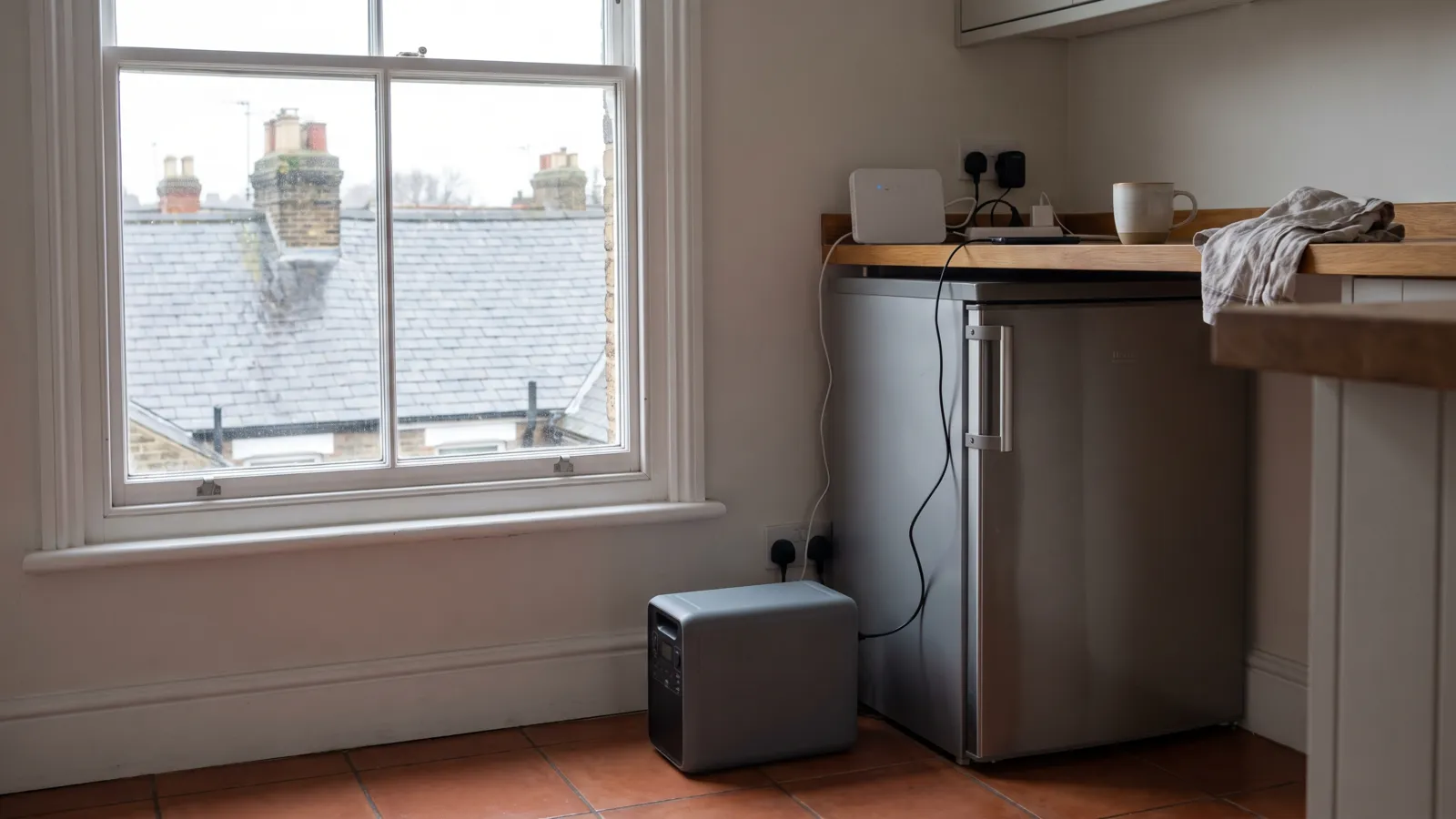
Our picks by size
 Photo: Amazon
EcoFlow DELTA 3 Plus
Households that want the fridge, router and phones covered for a long power cut and may add a second battery later — the expandable 1kWh choice.
as of 21 Oct 2026, 10:37 BST · Details
Product prices and availability are accurate as of the date/time indicated and are subject to change. Any price and availability information displayed on Amazon.co.uk at the time of purchase will apply to the purchase of this product. Photo: EcoFlow
EcoFlow RIVER 3 Plus
Phones, a router, lights and a laptop through an evening's power cut, in a unit small enough to live in a cupboard — with the option to add capacity later.
 Photo: EcoFlow
EcoFlow DELTA 3 Max
Two days of fridge and essentials from one 2kWh unit that is lighter than the DELTA 2 Max.
 Photo: EcoFlow
EcoFlow DELTA Pro 3
Several days of whole-home essentials and heavy kitchen appliances at once, if you can handle a wheeled 51.5kg unit.
All 11 compared
| Power station | Capacity | Output | Weight | Price |
|---|---|---|---|---|
1,024 Wh · 1,800 W · 12.5 kg Households that want the fridge, router and phones covered for a long power cut and may add a second battery later — the expandable 1kWh choice. | 1,024 Wh | 1,800 W | 12.5 kg | £699 at Amazon as of 21 Oct 2026, 10:37 BST · DetailsProduct prices and availability are accurate as of the date/time indicated and are subject to change. Any price and availability information displayed on Amazon.co.uk at the time of purchase will apply to the purchase of this product.In stockCheck price → |
Our verdictOur verdictResearched This is the DELTA 3 Classic with the door left open. Same 1,024Wh LiFePO4 pack, which EcoFlow rates at 4,000 cycles to 80% (it quotes the Classic only as a 10-year life), same 1,800W output, but with an extra-battery port that takes it to 5kWh, dual solar inputs up to 1,000W, 140W USB-C ports and a 56-minute mains recharge. For a home that wants to start with one unit and grow into whole-fridge, whole-day backup, it is the better buy than the Classic; for a home that will never expand, the Classic does the same job for less. EcoFlow's UK store listed it as available to order rather than in stock when we checked; Amazon had it in stock at the same price. Best for Households that want the fridge, router and phones covered for a long power cut and may add a second battery later — the expandable 1kWh choice. Good
Worth knowing
Who shouldn't buy it: You know you'll never add a battery or solar panels — the DELTA 3 Classic is the same power station without the ports you won't use. And if a fridge isn't on your list, a 300Wh unit or a big power bank covers phones, lights and the router for a fraction of the price. Read the full review → | ||||
4,096 Wh · 4,000 W · 51.5 kg Several days of whole-home essentials and heavy kitchen appliances at once, if you can handle a wheeled 51.5kg unit. | 4,096 Wh | 4,000 W | 51.5 kg | £2,799 at EcoFlow Checked 21 OctIn stockCheck price → |
Our verdictOur verdictResearched The DELTA Pro 3 is the top of EcoFlow's portable range: 4,096Wh, 4,000W output rising to 6,000W with X-Boost, 2,600W of solar input and expansion to 12kWh. EcoFlow rates the LiFePO4 pack at 4,000 cycles to 80%. It is a wheeled suitcase-style unit, 51.5kg without extra batteries, built for people who want to run a fridge, freezer and kitchen appliances together. Next to the DELTA 3 Max Plus it offers twice the capacity and a third more output at more than twice the weight; most households will be well served by the smaller unit. Best for Several days of whole-home essentials and heavy kitchen appliances at once, if you can handle a wheeled 51.5kg unit. Good
Worth knowing
Who shouldn't buy it: You only need a fridge, router and phones covered: a 1kWh unit does that for a fraction of the cost and weight. Whole-house backup that needs to switch automatically also needs an electrician and a proper changeover, not just this unit. Read the full review → | ||||
 2,048 Wh · 3,000 W · 22.1 kg A whole household through a day-long power cut — fridge-freezer, boiler controls, router, lights and phones together — with room to grow to 10kWh. | 2,048 Wh | 3,000 W | 22.1 kg | £1,399 at EcoFlow Checked 21 OctPre-orderCheck price → |
Our verdictOur verdictResearched The home-backup pick in EcoFlow's current range. 2,048Wh and a 3,000W output mean it runs a fridge-freezer, the boiler's pump and controls, the router, lights and chargers at the same time, and X-Boost stretches it to 3,900W for simple resistive loads. It recharges from empty in 68 minutes, takes 1,000W of solar, and its extra-battery port expands the system to 10kWh, which is what separates it from the plain DELTA 3 Max. At 22kg it lives where it is plugged in. EcoFlow does not publish a cycle-life figure for this model on its UK page, which is unusual for the brand, so we have not quoted one. Best for A whole household through a day-long power cut — fridge-freezer, boiler controls, router, lights and phones together — with room to grow to 10kWh. Good
Worth knowing
Who shouldn't buy it: Your realistic power cut is a few hours, not a day: a 1kWh unit keeps the fridge cold and the phones charged for that, at half the price and weight. And if you have a heat pump or electric heating you hope to run, no portable unit does that — this covers essentials, not heating. Read the full review → | ||||
2,048 Wh · 2,400 W · 20.3 kg Two days of fridge and essentials from one 2kWh unit that is lighter than the DELTA 2 Max. | 2,048 Wh | 2,400 W | 20.3 kg | £1,199 at EcoFlow Checked 21 OctPre-orderCheck price → |
Our verdictOur verdictResearched The DELTA 3 Max is the fixed-capacity sibling of the DELTA 3 Max Plus: the same 2,048Wh capacity at 20.3kg against the Plus's 22.1kg, but with 2,400W of output where the Plus gives 3,000W, 500W of solar input where the Plus takes 1,000W, and no extra-battery port where the Plus grows to 10kWh. EcoFlow quotes a 3-year warranty plus a 2-year extension. It is the choice for someone who knows 2kWh is the ceiling they need and wants it a little lighter than the DELTA 2 Max; anyone who may add batteries later should pay for the Plus. Best for Two days of fridge and essentials from one 2kWh unit that is lighter than the DELTA 2 Max. Good
Worth knowing
Who shouldn't buy it: You may want to grow past 2kWh or run heavier loads: the DELTA 3 Max Plus expands to 10kWh. If you only need a fridge, a 1kWh unit costs much less. Read the full review → | ||||
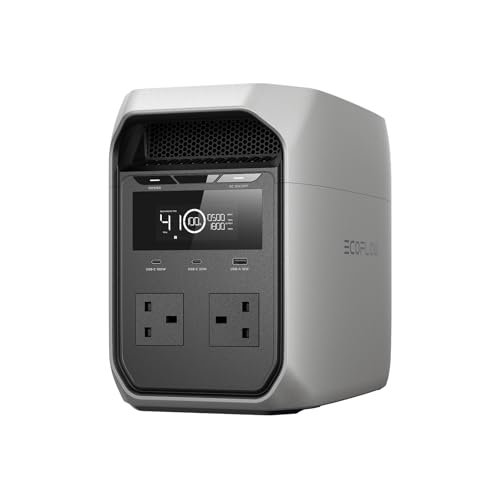 1,024 Wh · 1,800 W · 12.1 kg Keeping a fridge, router, phones and a few lights running through a multi-hour power cut, for households who won't need to expand capacity later. | 1,024 Wh | 1,800 W | 12.1 kg | £499 at Amazon as of 21 Oct 2026, 10:37 BST · DetailsProduct prices and availability are accurate as of the date/time indicated and are subject to change. Any price and availability information displayed on Amazon.co.uk at the time of purchase will apply to the purchase of this product.In stockCheck price → |
Our verdictOur verdictResearched The best-value model in EcoFlow's current 1kWh range, and the lowest-priced of its three: the same 1,800W output and LFP chemistry as the DELTA 2, a slightly faster 45-minute 0-80% mains recharge, and a 10ms UPS switchover. The trade-off is that this 'Classic' model's capacity is fixed: unlike the DELTA 2 there is no extra-battery port, so 1,024Wh is what you get. Best for Keeping a fridge, router, phones and a few lights running through a multi-hour power cut, for households who won't need to expand capacity later. Good
Worth knowing
Who shouldn't buy it: You only need to keep phones, a tablet and a laptop topped up — a much cheaper power bank does that job. And skip this specific 'Classic' model if you think you'll want to add capacity later, since it has no expansion port; the standard DELTA 3 or DELTA 3 Plus do. Read the full review → | ||||
 512 Wh · 500 W · 6.1 kg Keeping the essentials going in a power cut — fridge, broadband router, phones and a few lights. | 512 Wh | 500 W | 6.1 kg | £328.99 at Amazon as of 21 Oct 2026, 10:37 BST · DetailsProduct prices and availability are accurate as of the date/time indicated and are subject to change. Any price and availability information displayed on Amazon.co.uk at the time of purchase will apply to the purchase of this product.In stockCheck price → |
Our verdictOur verdictResearched A well-judged mid-size unit for household backup: the long-life LFP battery, genuinely fast recharge and quiet operation make it a sensible first power station. Just size it to essentials, not the whole house. Best for Keeping the essentials going in a power cut — fridge, broadband router, phones and a few lights. Good
Worth knowing
Who shouldn't buy it: You want to power high-draw appliances (kettle, microwave, heaters) or keep much of the home running — the capacity and 500W output are too small; step up to a Delta-class unit instead. | ||||
286 Wh · 600 W · 4.7 kg Phones, a router, lights and a laptop through an evening's power cut, in a unit small enough to live in a cupboard — with the option to add capacity later. | 286 Wh | 600 W | 4.7 kg | £219 at EcoFlow Checked 21 OctPre-orderCheck price → |
Our verdictOur verdictResearched The sensible entry point to EcoFlow's current range: a 286Wh LiFePO4 pack rated for 3,000 cycles, three mains sockets, a 100W USB-C and a 12V socket, recharged from the wall in an hour. What sets it apart from other small units is the extra-battery system: an EB300 or EB600 clips on underneath with no cables, taking it to 858Wh if you later decide you want the fridge covered too. The under-10ms switchover means a router or desktop rides through the cut without noticing. Its 600W output (1,200W with X-Boost for simple heating loads) rules out kettles and most heaters, which is true of every unit at this size. Best for Phones, a router, lights and a laptop through an evening's power cut, in a unit small enough to live in a cupboard — with the option to add capacity later. Good
Worth knowing
Who shouldn't buy it: You only need to keep phones and a tablet going — a 20,000-25,000mAh power bank does that for a fraction of the price. And if the fridge is the reason you're shopping, start at 1,000Wh (the DELTA 3 Classic or BLUETTI Elite 100 V2) rather than buying this and an extra battery. Read the full review → | ||||
 245 Wh · 300 W · 3.55 kg Phones, router, lights and a laptop through a short power cut, at a size that fits a shelf or a grab bag. | 245 Wh | 300 W | 3.55 kg | £239 at EcoFlow Checked 21 OctPre-orderCheck price → |
Our verdictOur verdictResearched The RIVER 3 is a small 245Wh unit with one 300W mains socket and a 3.55kg body; X-Boost lets it run some heating-element appliances up to 600W. EcoFlow quotes a one-hour mains recharge and 110W of solar input. It keeps a router, phones and LED lights running for many hours, but one socket and 300W rule out a fridge. Compared with the RIVER 3 Plus already on this page, it is the smaller and cheaper choice; the Plus adds capacity and a 600W output. Best for Phones, router, lights and a laptop through a short power cut, at a size that fits a shelf or a grab bag. Good
Worth knowing
Who shouldn't buy it: You want to keep a fridge cold: step up to a 1kWh unit. If you only charge phones, a large power bank is cheaper. Read the full review → | ||||
 768 Wh · 800 W · 7.8 kg Router, lights and a small fridge for a few hours at a time, from a 7.8kg unit. | 768 Wh | 800 W | 7.8 kg | £499 at EcoFlow Checked 21 OctPre-orderCheck price → |
Our verdictOur verdictResearched The RIVER 2 Pro is a 768Wh unit with 800W of output, 1,600W under X-Boost, and 220W of solar input in a 7.8kg body. It is a good fit for a household that wants more than a 250Wh starter unit but not the weight of a 1kWh one. The recurring complaint from reviewers is the fan: EcoFlow's spec sheet gives noise up to 62dB when charging and discharging at high wattage, and testers describe it as intrusive at close range. Next to the 1,024Wh DELTA 3 Classic it has less capacity and no expansion, but it weighs about 4kg less. Best for Router, lights and a small fridge for a few hours at a time, from a 7.8kg unit. Good
Worth knowing
Who shouldn't buy it: Quiet is a priority or you want to cover a fridge for more than half a day: a DELTA 3 Classic or DELTA 3 Plus has more capacity. For phones and a router alone, the RIVER 3 does the job at a lower cost. Read the full review → | ||||
 2,048 Wh · 2,400 W · 23 kg A long power cut with a fridge, freezer, router and a few appliances, if you can live with a 23kg unit. | 2,048 Wh | 2,400 W | 23 kg | £1,199 at EcoFlow Checked 21 OctOut of stockCheck price → |
Our verdictOur verdictResearched The DELTA 2 Max doubles the DELTA 2's capacity to 2,048Wh and lifts output to 2,400W, with EcoFlow quoting 3,100W under X-Boost. It can take two extra batteries for 6kWh, and 1,000W of solar input is more than most 1kWh units manage. UK reviewers rate it as capable but heavy at 23kg, against about 12kg for the DELTA 2. For a home that wants a day or more of fridge and lighting cover it is a strong middle step; the newer DELTA 3 Max is lighter for the same capacity. Best for A long power cut with a fridge, freezer, router and a few appliances, if you can live with a 23kg unit. Good
Worth knowing
Who shouldn't buy it: You will move it often or have steps to climb: the 16.5kg DELTA 3 1500 or a 1kWh unit is easier to handle. If you do not need 2kWh, you are paying for capacity you will not use. Read the full review → | ||||
 1,536 Wh · 1,800 W · 16.5 kg A middle step between 1kWh and 2kWh: enough for a fridge and essentials for a long evening and next day, at 16.5kg. | 1,536 Wh | 1,800 W | 16.5 kg | £949 at EcoFlow Checked 21 OctOut of stockCheck price → |
Our verdictOur verdictResearched The DELTA 3 1500 sits between the DELTA 3 Plus (1,024Wh) and the 2kWh class, with 1,536Wh, the same 1,800W output and a 16.5kg body. EcoFlow lists expansion to 5.5kWh and a 1,500W AC input that fills it in about 90 minutes. A UK retailer lists a 3,000-cycle LiFePO4 pack, so its cycle rating is below the DELTA 3 Plus's 4,000 on EcoFlow's own figures. It suits a household that finds 1kWh tight for a fridge plus a freezer but does not want the weight of a 2kWh unit. Best for A middle step between 1kWh and 2kWh: enough for a fridge and essentials for a long evening and next day, at 16.5kg. Good
Worth knowing
Who shouldn't buy it: You have only a fridge to cover: the 1,024Wh DELTA 3 Classic does that for less. If you want heavy appliances or several days of cover, step up to the DELTA 3 Max Plus. Read the full review → | ||||
ⓘ As an Amazon Associate, PreparedBritain earns from qualifying purchases. We may earn a commission when you buy, or a fee when you request a quote, through our links — it never affects what we recommend. Amazon prices come from Amazon's own product data and show the date and time they were retrieved. Prices at other retailers are checked by us, less often. Prices and stock can change at any time, so always check the retailer's price before you buy.
Before you buy
RIVER models are the small ones
The RIVER 3 (245Wh, one mains socket), the RIVER 3 Plus (286Wh, with a clip-on extra battery that takes it to 858Wh), the RIVER 2 Max (512Wh) and the RIVER 2 Pro (768Wh). DELTA models start at 1kWh: the DELTA 3 Classic and DELTA 3 Plus share 1,024Wh and 1,800W, and the Plus adds the extra-battery port. Above them sit the DELTA 3 1500, three 2kWh units (DELTA 2 Max, DELTA 3 Max, DELTA 3 Max Plus) and the 4kWh DELTA Pro 3. Every current model uses LiFePO4 cells; quoted cycle lives, where given, run from 3,000 to 4,000.
Size it on what you would run.
A router and phones through an evening need well under 300Wh, which any RIVER covers. A fridge-freezer for much of a day wants the 1kWh class, and the surge figure matters as much as capacity because a compressor draws several times its rated power as it starts; the 1kWh DELTA 3 units quote 3,600W surge against 1,800W rated. A fridge plus lights, a laptop and a gas boiler’s controls for a full day suits the 2kWh class. Only a long cut, or several appliances at once, justifies the 51.5kg DELTA Pro 3, which rolls on wheels.
The DELTA 3 Classic and DELTA 3 Max have no extra-battery port, so their capacity is fixed; the DELTA 3 Plus grows to 5kWh, the DELTA 3 1500 to 5.5kWh, the DELTA 2 Max to 6kWh, the DELTA 3 Max Plus to 10kWh and the DELTA Pro 3 to 12kWh. The Plus versions also take more solar: 1,000W on the DELTA 3 Plus and Max Plus against 500W on the Classic and Max. If 1kWh or 2kWh is your ceiling, the fixed model costs less (though the Max Plus also gives 3,000W against the Max's 2,400W); if you might want more later, pay for the port.
UPS switchover, noise and weight decide whether you will be glad of it.
EcoFlow quotes a 10ms switch from mains to battery on the DELTA 3 Classic, DELTA 3 Plus, DELTA 3 Max Plus and RIVER 3 Plus, fast enough for a router or desktop to ride through a cut; the RIVER 2 Max is rated at 30ms. Reviewers of the RIVER 2 Pro and DELTA 3 Plus name fan noise as the main flaw, and a spec sheet published by a UK retailer gives the RIVER 2 Pro up to 62dB under heavy load. Weights run from 3.55kg to 51.5kg, so decide where the unit will live.
Unlike a generator, it gives off no fumes, so it can be used indoors.
Run fully unwound, not overloaded extension leads from it to what you need. Never feed its output into a wall socket or your consumer unit; that needs an electrician and a changeover switch. Charge it in a dry room, on a hard surface, away from escape routes and not while you sleep or are out. Stop using a unit that swells, overheats or smells, as fire services advise, and recharge it after every cut. On the DELTA 3 Classic, Max and Max Plus, the last two warranty years need app registration.
We verify every product's specifications against at least two independent sources, re-check its UK price and stock on a schedule where we can track it automatically, and cross-check safety-relevant claims against official guidance. Every review is labelled Researched or Used and reviewed by us: where we've bought a product, or been sent it free, and used it ourselves, its review says which; where we haven't, our verdict is a considered spec-and-evidence comparison, not a hands-on test — and commissions never change a ranking either way. Read our full methodology →
Related kit comparisons
Guides that go with this
EcoFlow or BLUETTI for a UK home? The three matched pairs compared on capacity, output, cycles, charging, swit…
Two popular 1kWh power stations, plus EcoFlow’s cheaper DELTA 3 Classic, compared on the things that actually …
Plain watt-hour arithmetic for UK homes — fridge-freezer, combi boiler, CPAP, router — three sizing tiers, and…
What a fridge freezer really draws, why a power station’s output rating decides whether the compressor starts,…
The free number to save today, what to have ready, food safety, staying warm safely, and the compensation you …
Jackery or EcoFlow for UK power cuts? The Explorer 1000 v2 and 2000 v2 against the DELTA 3 Plus and DELTA 3 Ma…
Three 2kWh power stations compared on what actually differs: output, solar, charging, expansion, cycle rating,…
Common questions
Which EcoFlow power station should I buy for power cuts?
For most households, a 1kWh DELTA: the DELTA 3 Classic if 1,024Wh will always be enough, or the DELTA 3 Plus if you might add a battery later. For phones, a router and lights only, a RIVER 3 or RIVER 3 Plus does the job at a fraction of the weight. The 2kWh units suit a full day of fridge, lights and boiler controls, and the DELTA Pro 3 is for long cuts or several appliances at once. The pick cards above show our top choice in each size.
What is the difference between the EcoFlow DELTA 3 Classic and DELTA 3 Plus?
On EcoFlow's figures they share 1,024Wh, 1,800W output, 3,600W surge and a 10ms UPS switch. The Plus adds an extra-battery port that takes the system to 5kWh, 1,000W of solar input against 500W, a 12V car socket and 140W USB-C ports, and EcoFlow rates its cells at 4,000 cycles. The Classic has no expansion port and no 12V output. If you will never expand, the Classic does the same day-to-day job for less.
Will an EcoFlow run a fridge-freezer in a power cut?
The DELTA units will. Divide the yearly kWh on your fridge-freezer's energy label by 365 for its daily use; a modern one is often well under 1.5kWh. Allowing for conversion losses, a 1,024Wh DELTA 3 covers most or all of a day for an efficient model, and the 2kWh units a day or more, if the surge rating covers the compressor's start-up. The RIVER 3 and RIVER 3 Plus, at 300W and 600W, are not sized for a fridge-freezer. Our fridge-freezer guide works through the sums.
Can I plug an EcoFlow into my house wiring?
Not on your own. Feeding a home's circuits from a battery needs an electrician to fit a changeover switch, so the battery can never push power into the grid or meet the mains when supply returns. Never use a plug-to-plug lead to feed power back through a wall socket: it can electrocute you or someone working on the line. Charging the unit from a wall socket is fine. In a cut, run fully unwound extension leads from the unit to the fridge, router and lamps you need.
Is EcoFlow's X-Boost figure real output?
It is a lower-voltage mode, not extra power. X-Boost lets a unit run simple heating-element appliances rated above its continuous output, such as a kettle or a hairdryer, by dropping the voltage so the appliance draws less. EcoFlow quotes 2,400W X-Boost on the 1,800W DELTA 3 units and 600W on the 300W RIVER 3. It does not suit motors, compressors or electronics, so size a fridge or a medical device on the rated output and surge figures, never on X-Boost.
How long is the warranty, and is it the same on every model?
EcoFlow's UK product pages give five years on the DELTA 2 Max, DELTA 3 1500, DELTA 3 Plus and RIVER 3 Plus. On the DELTA 3 Classic, DELTA 3 Max and DELTA 3 Max Plus the cover is three years as standard plus two more if you register the unit in EcoFlow's app, so register it the day it arrives. Check the warranty line on the product page for the exact model and variant before you buy, and keep the receipt.
