EcoFlow vs BLUETTI: which power station brand for a UK home?
EcoFlow or BLUETTI for a UK home? The three matched pairs compared on capacity, output, cycles, charging, switchover, expansion, warranty and UK support, with runtimes worked on BLUETTI’s published formulas and shown as ranges.
Neither brand is better for a UK home: at the entry and mid sizes the EcoFlow and BLUETTI units match on capacity and continuous output, all seven use lithium iron phosphate cells, and at the top the DELTA 3 Max Plus has the higher 3,000W rating against 2,600W for the Elite 200 V2. The real differences are expandability, rated cycles and warranty terms: EcoFlow’s RIVER 3 Plus, DELTA 3 Plus and DELTA 3 Max Plus take integrated extra batteries, where the Elite 30 V2 and Elite 100 V2 can at most be topped up from a separate B80 battery and BLUETTI says the Elite 200 V2 is not expandable; BLUETTI rates the Elite 200 V2 for 6,000+ cycles, where EcoFlow gives the DELTA 3 Max Plus only an estimated ten-year life and no cycle figure. Five of the seven carry flat five-year UK warranties; the DELTA 3 Max Plus is three years plus two on app registration, and EcoFlow’s own pages give the DELTA 3 Classic both ways, so register it. Whichever you choose, change its settings before a cut: EcoFlow’s AC timeout can switch off a fridge between compressor cycles, and BLUETTI’s ECO mode can cut light loads such as a router or CPAP.
By Tom Calder · Updated 22 September 2026 · Sourced to EcoFlow, BLUETTI, ResMed, the NHS, the FSA & Ofcom
How the two ranges line up
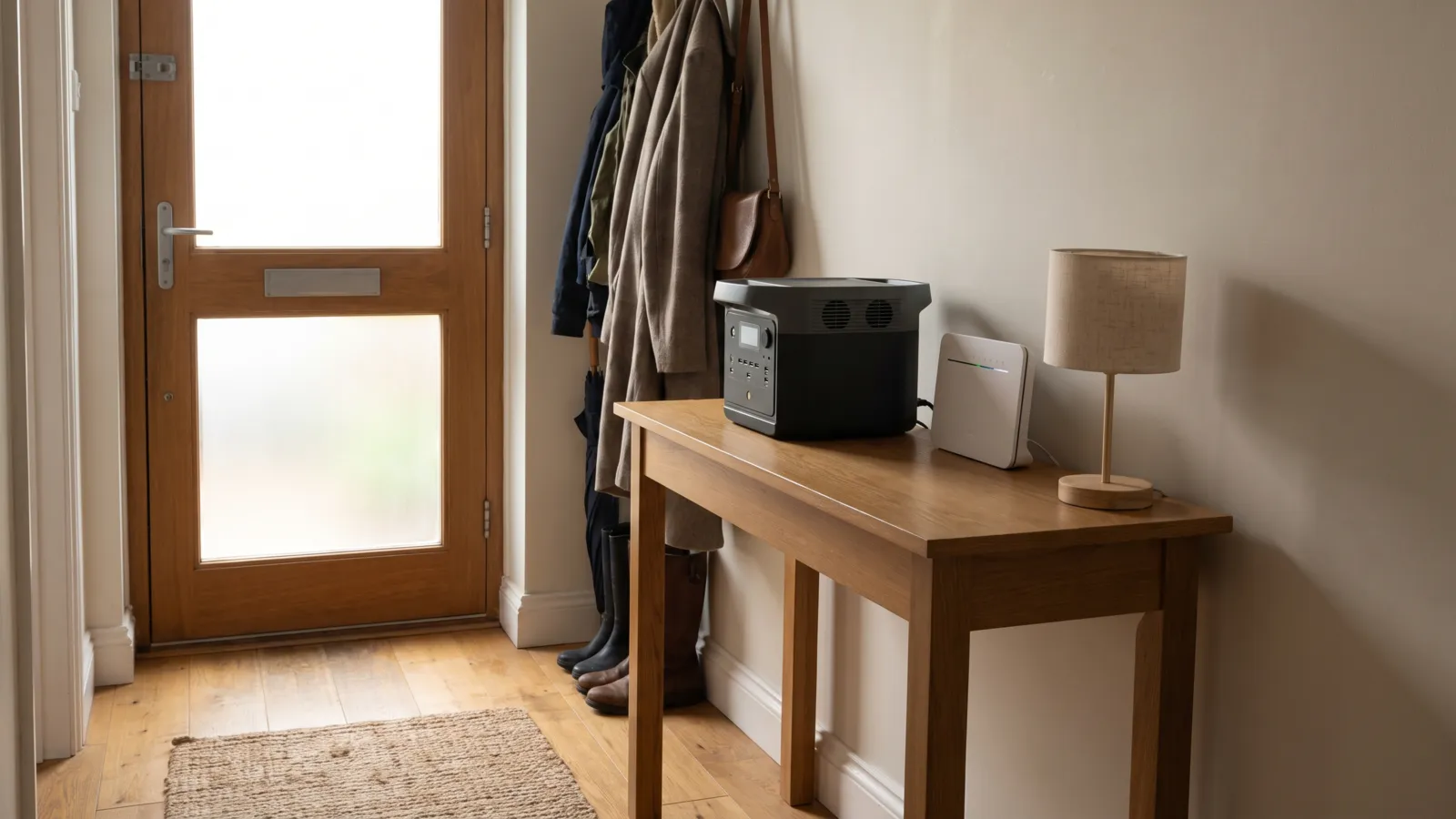
EcoFlow and BLUETTI sell into the same three sizes in the UK, and at each size the headline numbers are close enough that capacity alone won’t decide it. The RIVER 3 Plus (286Wh, 600W) sits against the Elite 30 V2 (288Wh, 600W); the DELTA 3 Classic and DELTA 3 Plus (1,024Wh, 1,800W) against the Elite 100 V2 (1,024Wh, 1,800W); the DELTA 3 Max Plus (2,048Wh, 3,000W) against the Elite 200 V2 (2,073.6Wh, 2,600W). All use lithium iron phosphate cells, and all switch to battery within 15 milliseconds when the mains fails (10 milliseconds or under on every unit but the Elite 200 V2).
What separates them is the smaller print: whether you can add a battery later, how many cycles the pack is rated for, which settings you have to change before a cut, and what each company publishes about its UK operation. If you haven’t settled on a size, start with what size power station do I need. Store stock and pre-order status change often; the cards on this page show live prices and availability.
Entry tier: RIVER 3 Plus vs Elite 30 V2
Near-twins on the headline numbers: 286Wh against 288Wh, 600W continuous, 3,000 rated cycles on the EcoFlow and “over 3,000” on the BLUETTI, under 30dB and 10ms-or-under switchover on both. The Elite 30 V2 is lighter, 4.3kg to 4.7kg. Mains recharging is effectively a tie: the Elite 30 V2 reaches 80% in 45 minutes with BLUETTI’s TurboBoost and full in about 70 from a 380W input, and the RIVER 3 Plus is full in 60 minutes from 360W. The Elite has one mains socket to the RIVER’s three. Solar tops out at 220W on the RIVER 3 Plus and 200W on the Elite 30 V2.
The structural difference is expansion. The RIVER 3 Plus takes an EB300 or EB600 extra battery, up to 858Wh in total; BLUETTI’s own page says the Elite 30 V2 “does not support battery expansion”, though it can be topped up from a separately sold B80 battery in power-bank mode.
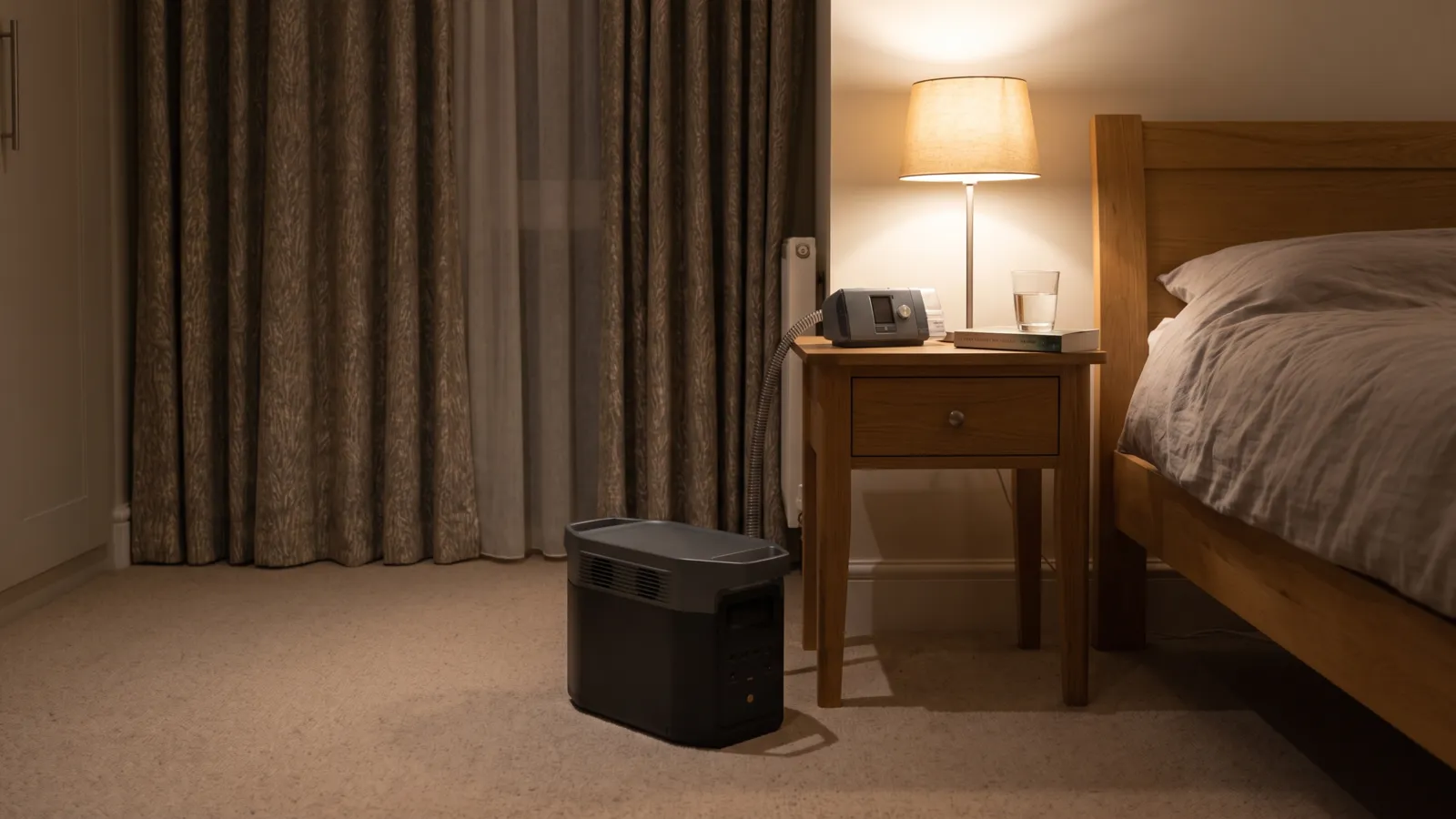
What either will do: a router and full-fibre box together draw about 10–20W on our sizing guide’s figures (EcoFlow’s own runtime guide uses 25W for a modem, router and phone charger in its worked example). On BLUETTI’s formula for the Elite 30 V2 (95% usable, 90% inverter efficiency, 4.5W the unit draws itself on AC), 10–20W is 288Wh × 0.855 ÷ 14.5–24.5W, roughly 10–17 hours through the mains socket. EcoFlow’s runtime guide says to use DC or USB-C for routers to avoid inverter losses, so run the router from the DC outputs where its adaptor allows, with a lead that matches the voltage on the adaptor. ResMed’s tables put its AirMini and AirSense 10 at about 4–20W from 12V with the humidifier off, well within a night on either; ResMed strongly recommends its DC converter, run from the 12V car socket both units have, over an inverter, and running medical equipment in a power cut has the rest.
Choose the RIVER 3 Plus if you might want more storage later without a second box, or need more than one mains plug (a router and fibre box often have separate adaptors). Choose the Elite 30 V2 if lighter weight or its 140W USB-C for a laptop matters more and one mains socket is enough. For phones alone, neither is needed: a power bank does that job.
Mid tier: DELTA 3 Classic and Plus vs Elite 100 V2
All three are 1,024Wh, 1,800W units weighing 11.5–12.5kg, with 10ms-or-under switchover and about 30dB at 600W on all three by their makers’ figures. The Classic and Elite 100 V2 reach 80% from the mains in about 45 minutes; to full, EcoFlow quotes 56 minutes for the Plus and 60 for the Classic, and BLUETTI 70 for the Elite 100 V2. BLUETTI rates the Elite 100 V2 at “over 4,000” cycles and EcoFlow rates the DELTA 3 Plus at 4,000; the Classic’s UK spec table gives a ten-year life but no cycle count, so we don’t either.
The fork is the DELTA 3 Plus. It accepts DELTA 3, DELTA Pro 3, DELTA 2 Max or DELTA 2 extra batteries, up to 5kWh in total, and takes 1,000W of solar, as does the Elite 100 V2, against the Classic’s 500W. EcoFlow’s UK spec table lists the Classic with no extra-battery port, and for planning purposes the Elite 100 V2 is a single box too: BLUETTI says a separately sold B80 battery in power-bank mode can be connected with an aviation-to-XT60 cable, but that recharges it through its DC input rather than adding integrated capacity. The Classic is also the only one of the seven with no 12V car socket, which matters for a CPAP (below).
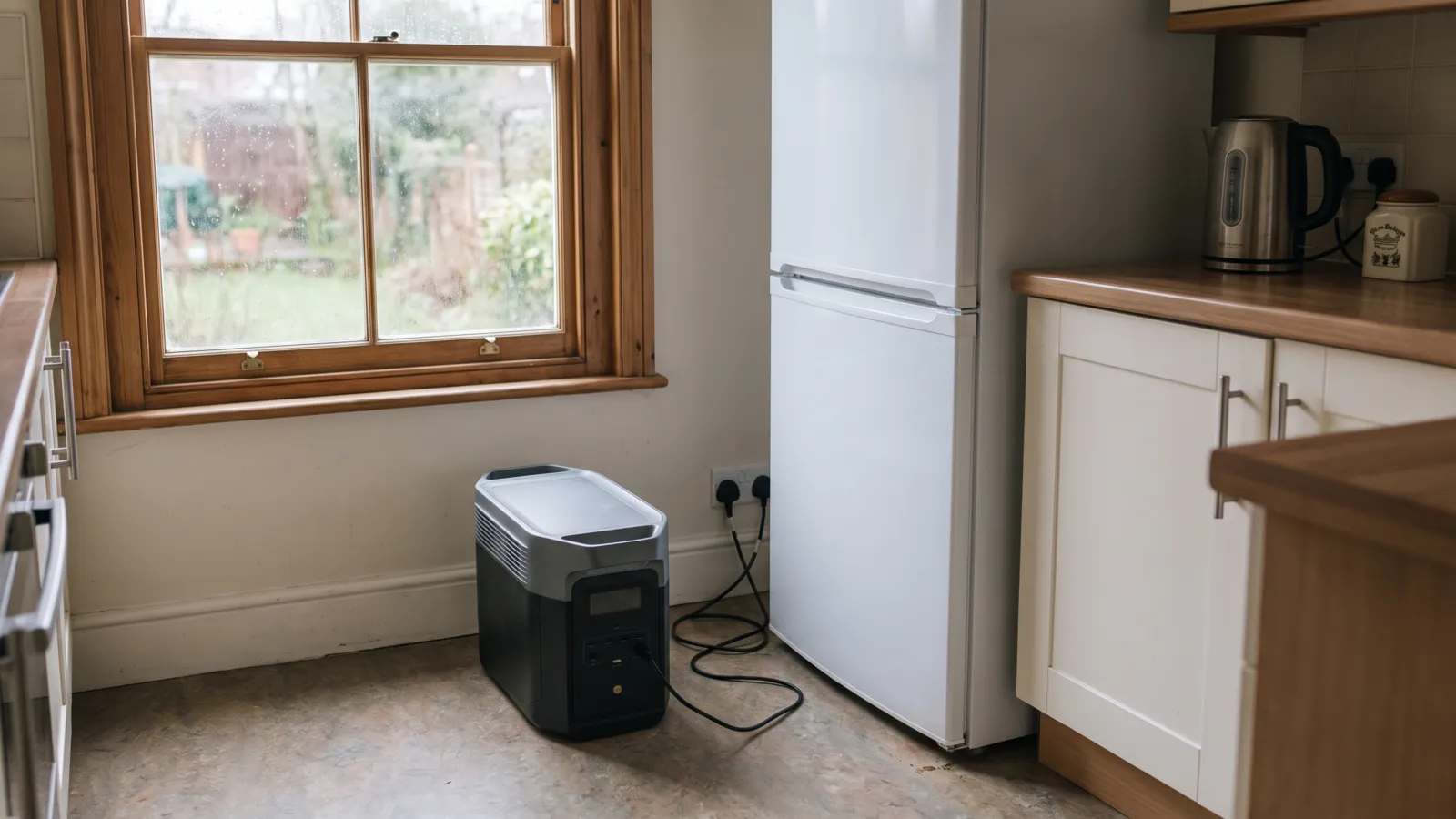
This is the size that keeps a fridge-freezer cold. A fridge-freezer’s compressor cycles, so its average draw is far below its running draw, though BLUETTI warns that motors and compressors may start at two to four times their rated power. Our sizing guide plans on an average of 40–80W; for your own model, divide the kWh/annum on its energy label by 8.76 (350kWh a year averages 40W under the label’s test conditions). BLUETTI publishes a runtime formula for the Elite 100 V2: capacity × 90% usable × 90% inverter efficiency (it says over 90%) ÷ (load + the roughly 10W the unit draws itself). For a 40–80W average that is 1,024Wh × 0.81 ÷ 50–90W, roughly 9–17 hours; a model that averages less lasts longer. The DELTA 3 units hold the same 1,024Wh, but EcoFlow publishes no equivalent formula. Two settings matter more than the brand: EcoFlow’s manuals say to set the AC timeout to “never” in the app for a fridge, especially one holding medicines, and BLUETTI’s Elite 200 V2 manual says to disable ECO mode for fridges, or the unit can switch off between compressor cycles. Read power cut food safety before deciding to power a fridge at all.
Staying on one box? Compare the Classic and the Elite 100 V2 directly. Might add storage later, or charge from panels? The DELTA 3 Plus is built for it; see solar backup for a power cut.
Top tier: DELTA 3 Max Plus vs Elite 200 V2
This is where the brands diverge. The DELTA 3 Max Plus is 2,048Wh with 3,000W continuous, about 22.1kg, charges to 80% in 47 minutes and 100% in 68 from a 2,300W input, and has one extra-battery port: one DELTA Pro 3 extra battery takes it to about 6kWh now. EcoFlow’s 10kWh figure (two DELTA Pro 3 batteries) needs an expansion adapter it says “will be released soon”. The Elite 200 V2 is 2,073.6Wh with 2,600W continuous, 24.2kg, reaches 80% in 1.1 hours with TurboBoost from the same 2,300W input, and BLUETTI says it is not expandable, so plan it as one unit. Both take 1,000W of solar.
Against that, BLUETTI rates the Elite 200 V2 for 6,000+ cycles, where EcoFlow gives the DELTA 3 Max Plus only an estimated ten-year life from its own simulation and no cycle figure (its DELTA 3 Plus is rated at 4,000). BLUETTI also publishes 16dB under low loads with automatic fan control (its manual gives 16–50dB depending on load), against “≤25dB (600W)” for the Max Plus. The two are measured at different loads, so they don’t show which is quieter doing the same job. Switchover is 10ms on the EcoFlow and within 15ms on the BLUETTI. The Elite 200 V2’s warranty is five years; the DELTA 3 Max Plus is three years plus two more on app registration.
The 3,000W rating is the practical difference. Kettles run up to 3kW (EcoFlow’s own DELTA 3 page lists them at 1,200–3,000W), and the Max Plus is the only one of these seven rated at 3,000W, so a 3kW kettle runs within its rating, at the limit, with nothing else on. The Elite 200 V2 runs a kettle rated under 2,600W within its rating, and a 3kW one through Power Lifting once that is switched on, but boils it more slowly.
Home oxygen is a different case. NHS home-oxygen guidance plans on the back-up cylinder your supplier provides, which NHS Highland says lasts roughly 10–20 hours depending on the prescribed rate, and EcoFlow’s manuals say its power stations are “not intended for powering life-sustaining medical equipment” and to check with a device’s maker before using one for any other medical equipment. A concentrator runs continuously at several hundred watts (our medical equipment guide uses 300–600W), so even the largest pair here lasts only hours: at 300W, BLUETTI’s own formula for the Elite 200 V2 gives about 5 hours, and at 600W under 3. Ask your oxygen supplier before running a concentrator from any power station, make sure everyone at home knows how to switch to the cylinder, and join the Priority Services Register (in Northern Ireland, NIE Networks’ Customer Care Register).
Choose the DELTA 3 Max Plus to run several appliances at once, boil a 3kW kettle within its rating, or add a battery later. Choose the Elite 200 V2 if you’ll cycle it often, say daily with solar, and value a published 6,000-cycle rating over the extra headroom; for a few power cuts a year, cycle ratings matter far less than the settings below.
X-Boost and Power Lifting: what the big numbers mean
Both brands print a second, larger wattage: X-Boost on EcoFlow, Power Lifting on BLUETTI, from 1,200W and 1,500W on the entry pair, and 2,400W and 2,700W on the 1kWh units, to 3,900W on both top units. Neither is extra continuous power. BLUETTI’s Elite 200 V2 manual says Power Lifting is “only for pure resistive loads”, such as kettles and heaters, and that “actual output power is still 2,600W”; its Elite 30 V2 page says that model can “momentarily” reach 1,500W on such loads. EcoFlow’s DELTA 3 manuals call X-Boost “more suitable for heating devices” (the RIVER 3 Plus manual adds motor-driven devices and says to test your own), and its manuals say X-Boost doesn’t work while the unit is charging from or passing through the mains. The defaults differ: X-Boost is on out of the box on the RIVER 3 Plus, DELTA 3 Classic and DELTA 3 Max Plus but off on the DELTA 3 Plus, and is switched in the EcoFlow app; Power Lifting is off by default on the Elite 200 V2. Either lets a kettle or heater rated above the continuous output run at reduced power; neither lets the unit sustain more than its rating.
So compare the continuous figure. Whether a fridge or other motor will start depends on the surge rating, not the boost mode: EcoFlow quotes 3,600W surge on the DELTA 3 Classic and Plus and 6,000W on the DELTA 3 Max Plus, BLUETTI quotes 3,600W on the Elite 100 V2, and BLUETTI’s manual warns that motors and compressors may start at two to four times their rated power. Use the boost figure only to judge whether a heater or kettle will run, slowly. Check the appliance’s input on its rating plate, not its output: a microwave draws more from the socket than the cooking power printed on the front, so an 800W microwave will not run on a 600W unit.
The Power Cut Action Card
One page for the kitchen drawer: what to do first, what to have ready, how long food keeps, and how to stay warm without risking carbon monoxide. Free, no catch.
Download it straight away. We'll also send the occasional briefing when something genuinely matters — severe weather, live incidents, real price drops. Nothing else.
Switchover, apps and the light-load trap
Every unit here can sit between the wall and your router, or a CPAP if its maker approves running it from an inverter, passing mains through until it fails, then switching to battery: 10ms or under on the four EcoFlow units and on the Elite 30 V2 and Elite 100 V2, within 15ms on the Elite 200 V2, with the Elite 30 V2’s bypass limited to 980W. If your CPAP has a heated humidifier, check with its maker before running it from any power station’s AC socket: ResMed’s battery guide says its heated humidifiers, other than a few named older models, must not be used with inverters, and strongly recommends its DC converter instead. The trap with all of them is the light load. BLUETTI’s Elite 200 V2 manual says ECO mode is on by default and to disable it for devices under 60W and for fridges; a router or CPAP is exactly that kind of load. EcoFlow’s manuals say the AC output switches off after it has been idle for a set time, which can catch a fridge between compressor cycles, so set the AC timeout to “never” in the app.
The apps are optional for everyday use, but some power-cut settings live in them, so set them up before you need them. EcoFlow’s connects by Bluetooth or Wi-Fi and is where the AC timeout and X-Boost are set; BLUETTI’s Elite 200 V2 manual puts UPS modes, the maximum grid input current and separate AC and DC ECO control in its app, though the buttons on the unit switch ECO and Power Lifting. Registering through the EcoFlow app is also what earns the DELTA 3 Max Plus (and, per its product page, the DELTA 3 Classic) its extra two years of warranty. A digital landline stops working in a power cut unless it has a battery back-up. Ofcom says that if you depend on your landline and have no working mobile or reliable signal, your provider must offer you a free back-up solution, such as a battery unit, lasting at least an hour; read power cut preparation before winter.
UK warranty and support: what each brand publishes
Five of the seven carry a flat five years: the RIVER 3 Plus, DELTA 3 Plus and the three Elite V2 units. The DELTA 3 Max Plus is three years plus two on app registration. EcoFlow’s UK warranty table lists the DELTA 3 Classic at five years, but its own UK product page says three plus two on app registration, so register it to be sure of the full five.
Both brands publish a UK company. BLUETTI’s UK imprint names POWEROAK ENERGY UK CO., LTD at a business park in Chesterfield, with a UK freephone number; it offers phone and 24/7 chat support. EcoFlow’s UK store names ECOFLOW INNOVATION UK LTD with a registered company number, a London address and a UK customer support line on weekdays, and its terms of sale for the UK store are with that company under English law. EcoFlow’s UK warranty page says EcoFlow covers warranty shipping for units bought from its UK site; bought through a retailer, you may have to pay return shipping, so check with the seller. None of that is evidence about service quality either way. Waiting for a sale? Black Friday power stations tracks the genuine drops.
Common questions
Is EcoFlow or BLUETTI the better brand for a UK home?
Neither, on the current UK ranges. At each size the pairs match on capacity and cell chemistry, and below the top tier on continuous output. Pick on the differences that apply to you: EcoFlow’s RIVER 3 Plus, DELTA 3 Plus and DELTA 3 Max Plus can take extra batteries, and the Max Plus is rated at 3,000W against 2,600W; BLUETTI publishes a 6,000+ cycle rating for the Elite 200 V2, where EcoFlow gives the Max Plus only a ten-year life estimate; and both publish a UK company, address and support phone line.
Will an EcoFlow or BLUETTI power station run a fridge freezer?
The 1,024Wh units (DELTA 3 Classic, DELTA 3 Plus, Elite 100 V2) and above will. A fridge-freezer’s compressor cycles, so its average draw is well below its running draw: our sizing guide plans on 40–80W, and the kWh/annum on its energy label divided by 8.76 gives your own model’s figure. On BLUETTI’s runtime formula for the Elite 100 V2, which counts the unit’s own draw, 40–80W gives roughly 9–17 hours. Set EcoFlow’s AC timeout to “never” in the app, or turn off BLUETTI’s ECO mode, or the unit may switch off between compressor cycles. The 286–288Wh entry units manage roughly 3–5 hours on BLUETTI’s Elite 30 V2 formula, about as long as the Food Standards Agency says a closed fridge stays cold on its own, so they aren’t worth buying for a fridge.
Which is best for a CPAP machine overnight?
Any of them except the DELTA 3 Classic, once your CPAP’s maker or your sleep service has agreed. ResMed’s own tables put its AirMini and AirSense 10 at roughly 4–20W from 12V with the humidifier off, and ResMed strongly recommends its DC converter over an inverter; that needs a 12V car-socket output, which the DELTA 3 Classic does not have. ResMed also says most of its heated humidifiers must not be used with an inverter, and a power station’s mains socket is one, so check with your sleep service before running a humidified CPAP from it, or before running without humidification in a long cut. EcoFlow’s manuals likewise say to check with a medical device’s maker before powering it. Disable ECO or auto-off settings so the unit doesn’t switch off under a light load.
How long are the UK warranties?
Five years on the RIVER 3 Plus and DELTA 3 Plus (EcoFlow UK’s warranty table) and on the Elite 30 V2, Elite 100 V2 and Elite 200 V2 (BLUETTI UK’s product pages). The DELTA 3 Max Plus is three years as standard, plus two more if you register it in the EcoFlow app. EcoFlow’s warranty table lists the DELTA 3 Classic at five years, but its UK product page says three plus two on app registration, so register that one too.
Can I add a battery later?
On the EcoFlow RIVER 3 Plus (to 858Wh), DELTA 3 Plus (up to 5kWh) and DELTA 3 Max Plus (to about 6kWh with one DELTA Pro 3 extra battery; 10kWh once EcoFlow releases its expansion adapter), yes. The DELTA 3 Classic has no extra-battery port. The Elite 30 V2 and Elite 100 V2 can be topped up from a B80 battery in power-bank mode through their DC input, which is not integrated expansion; BLUETTI says the Elite 200 V2 is not expandable and has no power-bank mode.
Do I need the app?
For everyday use, no: both brands charge and discharge without their apps, and on the Elite 200 V2 the AC button switches BLUETTI’s ECO modes off (its manual puts UPS modes and separate AC and DC ECO control in the app). Set the EcoFlow app up before a cut, though: EcoFlow’s manuals say to set the AC timeout to “never” there for a fridge, and X-Boost is switched in it (on by default on the RIVER 3 Plus, DELTA 3 Classic and DELTA 3 Max Plus, off on the DELTA 3 Plus). The app is also how you get EcoFlow’s two-year warranty extension on the DELTA 3 Max Plus and, per its product page, the DELTA 3 Classic.
Sources: EcoFlow UK — Warranty policy (per-model terms; shipping cover for UK-site purchases) · EcoFlow UK — Contact us (ECOFLOW INNOVATION UK LTD, company number, London address, UK support line) · EcoFlow UK — Terms of service (UK store contracts with ECOFLOW INNOVATION UK LTD under English law) · EcoFlow UK — RIVER 3 Plus (spec table: 360W AC input, 0–100% in 60 min; three AC outlets; 12V car output; <10ms UPS; <30dB; 3,000 cycles; EB300/EB600 to 858Wh) · EcoFlow UK — DELTA 3 Classic (spec table: 3+2 warranty, ten-year life with no cycle count, 3,600W surge, 2,400W X-Boost, no extra-battery port, no 12V output, noise at 600W and 200W) · EcoFlow UK — DELTA 3 Plus (DELTA 3 Series page: 1–5kWh expansion, 4,000 cycles, 3,600W surge, noise at 600W, kettle wattage range, 5-year warranty) · EcoFlow UK — DELTA 3 Max Plus (10-year life estimate; expansion adapter ‘will be released soon’) · EcoFlow UK — DELTA 3 Max Plus specifications (3,000W output, 6,000W surge, 3,900W X-Boost, one extra-battery port, ≤25dB at 600W) · EcoFlow — DELTA 3 Plus user manual (AC timeout ‘never’, X-Boost off by default and unavailable while charging, medical equipment limit) · EcoFlow — DELTA 3 Classic user manual (X-Boost on by default; AC timeout; medical equipment limit) · EcoFlow — DELTA 3 Max Plus user manual (X-Boost on by default; AC timeout; medical equipment limit) · EcoFlow — RIVER 3 Plus user manual (X-Boost on by default, heating and motor-driven devices; AC timeout; medical equipment limit) · EcoFlow — How to test power station runtime (DC or USB-C for routers to avoid inverter losses; 25W modem, router and phone example) · BLUETTI UK — Elite 30 V2 (FAQ: 380W AC input, 70 min to full, runtime formula with 4.5W self-draw, B80 power-bank charging; specs: one AC outlet, 12V car outlet, 140W USB-C) · BLUETTI UK — Elite 100 V2 (specs: 3,600W surge, 2,700W power lifting, 12V car socket; FAQ: runtime formula with 10W self-draw, B80 via aviation-to-XT60 cable, 5-year warranty; 30dB at 600W) · BLUETTI UK — Elite 200 V2 (UK charging figures; 16dB under low loads; not expandable, no power-bank mode; UPS within 15ms; runtime formula; 5-year warranty) · BLUETTI — Elite 200 V2 user manual (US edition; UK input figures differ — cited only for Power Lifting, ECO mode, app settings, compressor start-up and the 16–50dB noise range) · BLUETTI UK — Imprint (UK company, Chesterfield address, freephone, 24/7 chat) · Companies House — POWEROAK ENERGY UK CO., LTD (13269849) · ResMed — Battery guide (CPAP draw at 12V DC; DC converter recommended; heated humidifiers not to be used with inverters) · NHS Highland — Contingency planning for power outages: home oxygen · Food Standards Agency — Food safety in a power cut · Ofcom — Your landline is going digital: what you need to know (making phone calls in a power cut) · NIE Networks — Customer Care Register (Northern Ireland). PreparedBritain is independent and not affiliated with HM Government.
Keep reading
All power cuts & energy guides →Will a power station run a fridge freezer, and for how long?
What a fridge freezer really draws, why a power station’s output rating decides whether the compressor starts, 1kWh…
Which power station will run a CPAP machine through a power cut?
The blower alone is a small load; the humidifier and heated tube decide the size. What an NHS sleep service says…
Can a power station run a gas boiler in a power cut?
A gas combi boiler needs only about 35–123W of electricity on its makers’ figures, well within any 1kWh-class unit…