What is a 'Black Sky event'? The UK warning, and the one thing every home should have
An expert quoted by LADbible says a ‘black sky event’ means ‘weeks or months’ of disruption, and LADbible calls a wind-up radio a must-have; the BBC has described its own FM plan. Not a new warning: the National Risk Register says a nationwide power loss has never happened here and is low likelihood. How power would come back, and the Be Ready basics.
A Black Sky event is an informal civil-contingency name for a long, wide loss of power and the services that depend on it. It is not an official term, and nothing new has happened: the BBC article behind this week’s coverage reports the government saying there is no specific threat to the grid, and the National Risk Register says a nationwide loss of power has never happened here and its likelihood is low. The plan is a staged restoration: NESO’s standard, which it must meet from 31 December 2026, targets 60% of each region’s demand back within 24 hours and all of Great Britain within five days. The household advice is the same as for any power cut, and it is already the Be Ready list: a battery or wind-up FM radio, a torch, a charged power bank, cash, and three days of water and food. No emergency, no new advice.
By Tom Calder · Updated 7 November 2026 · Sourced to the Cabinet Office's National Risk Register (2026 edition, with the 2025 edition for comparison), NESO's Electricity System Restoration Standard, GOV.UK Be Ready and its checklist, Ofgem's report on the 9 August 2019 power cut, ENTSO-E's final report on the 2025 Iberian blackout, NHS carbon monoxide advice, and the BBC and LADbible articles, all read on 7 November 2026
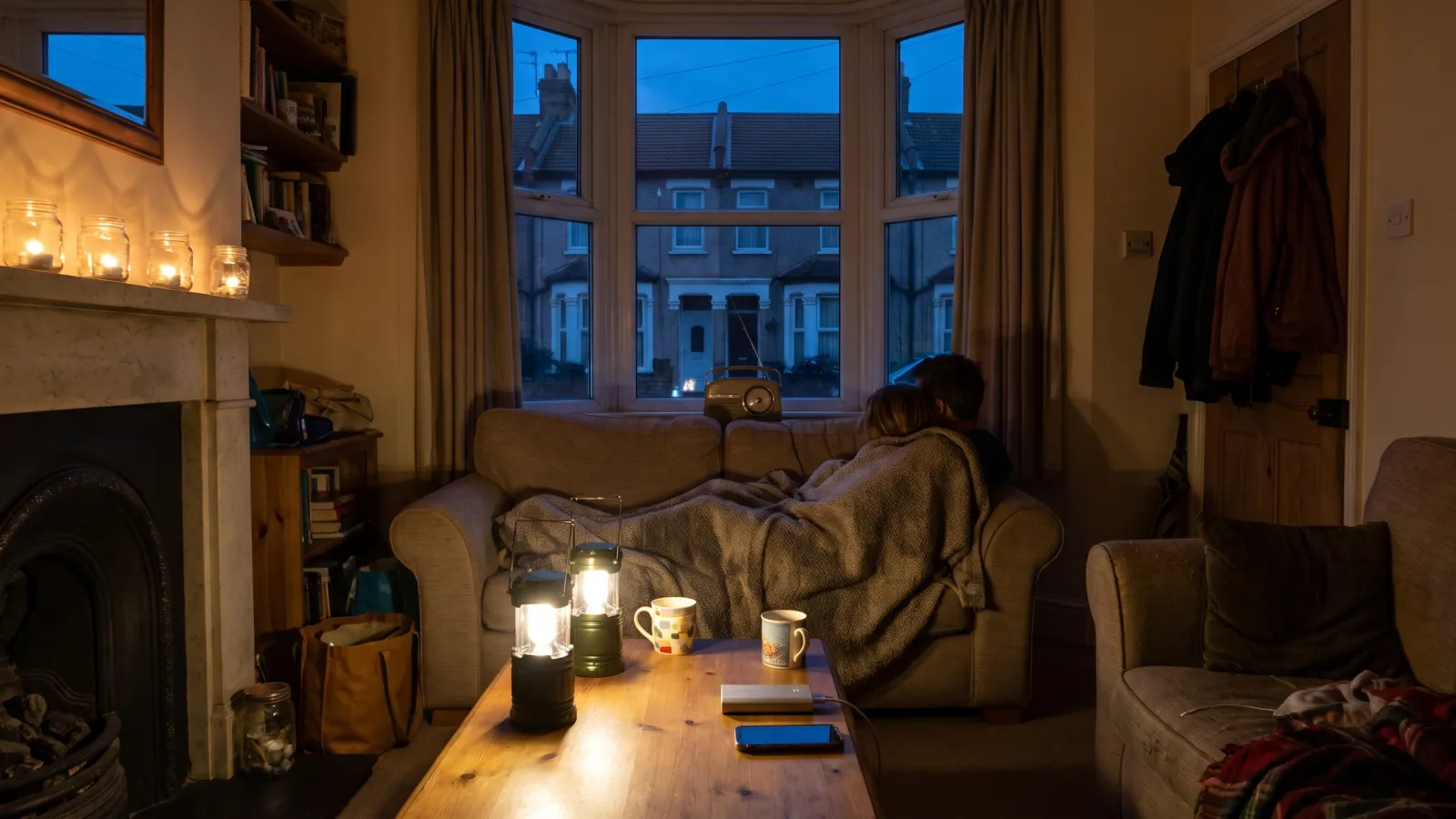
What a Black Sky event actually is
"Black Sky" is not an official UK term and has no statutory definition; the National Risk Register 2026 does not use it. Civil-contingency planners and the BBC use it for a long, wide loss of power that takes connected services with it. The one-word "BlackSky" is a page-title artefact, not the name of a government plan for the internet.
The official version is the "National power outage" scenario in the latest National Risk Register (2026): a failure of the National Electricity Transmission System. It says "Great Britain has never experienced a nationwide loss of power and the likelihood is low". Its reasonable worst case is a total failure in winter with "secondary impacts across critical utilities networks (including mobile and internet telecommunications, water, sewage, fuel and gas)". A recent resilience summit, the BBC reports, discussed withstanding one for "a minimum of 72 hours": Be Ready’s three days.
Has it ever happened?
Not across Great Britain. The Register says so, and the Cabinet Office told the BBC there has "never been a complete outage in the grid’s 75-year history".
The nearest was 9 August 2019, when more than a million customers lost supply after a lightning strike was followed by the loss of two large generators. Automatic protection cut about 4% of national demand and all supplies were back within 45 minutes, Ofgem’s report shows. The big outages people remember are regional and weather-driven: Storm Darragh in winter 2024–25 left more than 2 million homes without power, and Lancaster’s 2015 flood cut 61,500 people off.
Abroad, the closest example is the Iberian blackout of 28 April 2025 in mainland Spain and Portugal, with brief disruption in a small area of south-west France. ENTSO-E’s final report on 20 March 2026 found "a combination of many interacting factors, including oscillations, gaps in voltage and reactive power control".
Home Alerts members
The full picture, for your home
Each week, what's happening across Britain set against your own address: your water company, your power network, fuel for your car and the gaps in your kit. Free for your own home. Sign up in a minute.
Start free →Britain's figures from our live trackers, 7 November.
How power would come back
NESO, the National Energy System Operator, has an Electricity System Restoration Standard in its licence, set by the government in 2021 and written into its licence by Ofgem that August: 60% of each region’s demand restored within 24 hours of a total shutdown and 100% of Great Britain’s within five days, with full compliance required by 31 December 2026. These are targets from the end of this year, not a measure of what the system could do today.
The Register’s 2026 edition gives the planning picture for its worst case: some consumers gradually reconnected within a few hours, about 60% of demand back within two days, all customers by days five and six with controlled cuts at peak times, and full, stable power beyond seven days. The BBC quotes an unnamed insider saying NESO’s latest advice is "two to three days"; that is a conversation, not a NESO publication. White’s "weeks or months" is longer than this, though the Register’s cyber-attack scenario says full restoration "could take at least 7 days" and critical services "may take several months".
Why everyone is saying ‘get a radio’
It comes from Lancaster: "The two communication systems that survived were copper wire landline telephones and FM radio." The BBC describes its own plan: an emergency radio studio, secure lines that do not depend on the internet, three days of fuel, water and food, pre-arranged government scripts, and FM transmitters with diesel for three days. "Why FM? Because it works almost everywhere, even in a blackout or a crippling cyber-attack."
None of this is new for households. The Be Ready checklist already lists an "FM radio (battery/wind-up)" beside the torch and power bank, so LADbible’s must-have is the government’s own list. We have compared wind-up radios and battery radios. Sillito found his torch batteries had leaked and his wind-up radio missing. Check yours.
What to do now
Follow the Be Ready checklist: "being ready for 3 days helps you manage while support reaches those most in need". Bottled water at "3 litres per person per day for drinking"; non-perishable food for three days; a torch and spare batteries; an FM radio; a charged power bank; cash in coins and notes, and cards; copies of documents; and important phone numbers and medication doses written down. Add blankets and first aid, and check it every six months. The checklist, item by item goes through them.
Write 105, the free power-cut number in England, Scotland and Wales (03457 643643 in Northern Ireland), on paper. If anyone at home has extra needs (powered medical equipment, state pension age, a child under five and more), join the free Priority Services Register for advance warning of planned cuts and priority support. In a national outage no home's supply can be prioritised, the Register says, but responders would use the PSR to target help. Our national power outage guide has the fuller picture.
What not to do
Don’t panic-buy. Nothing in either article or from the government asks households to stock more than the Be Ready three days, built up gradually.
Don’t leave candles burning; Be Ready’s power-cut advice is that a torch is safer. Never run a generator, camping stove or barbecue indoors or in a garage: the NHS lists all three as carbon monoxide risks.
Watch for scams that borrow the headline: treat any text, email or doorstep call about "the black sky event" that wants a payment or a login as a scam until checked another way. And don’t read one commentator’s "weeks or months" as the plan: the Register’s figure is full, stable power beyond seven days, and NESO’s target is five.
Common questions
What is a black sky event?
An informal name, used in civil contingencies and by the BBC, for a long and wide loss of electricity that takes connected services such as water, mobile networks and the internet with it. It is not an official UK term. The nearest official scenario is the National Risk Register's failure of the National Electricity Transmission System, which the Register describes as never having happened in Great Britain and low likelihood.
Is a black sky event going to happen in the UK?
Nobody official says so. The BBC reports that "the government says there is no specific threat to the grid", and the National Risk Register says Great Britain has never had a nationwide loss of power and the likelihood is low. The coverage this week is about plans and preparedness, not a forecast.
How long would a black sky event last?
For the power itself, the planning figures are days, not months. NESO's restoration standard, which it must meet from 31 December 2026, targets 60% of each region's demand back within 24 hours and all of Great Britain within five days. The National Risk Register 2026's reasonable worst case has about 60% of demand back within two days, all customers by days five and six, and full, stable power beyond seven days. "Weeks or months" is one commentator's definition, quoted by LADbible, though the Register says critical services could take months to recover after a cyber attack.
What should I have at home for a black sky event?
The same as for any power cut, which is the Be Ready checklist: bottled water at 3 litres a person a day for three days, three days of non-perishable food, a torch and spare batteries, a battery or wind-up FM radio, a charged power bank, cash in coins and notes, copies of documents, a written list of important numbers and medication, blankets and a first aid kit. Write down 105 for power cuts, and join the Priority Services Register if anyone at home has extra needs, such as powered medical equipment or a child under five.
What happens to the internet and phones in a black sky event?
The National Risk Register's worst case includes secondary impacts on mobile and internet telecommunications. In Lancaster in 2015 the BBC says the two systems that kept working were copper landlines and FM radio. The government is spending £70m on high-altitude platforms to give at least a week of emergency mobile and internet cover, but that is still in development. Hence the radio.
Sources (15)
- Cabinet Office, National Risk Register 2025 (16 January 2025; previous edition, superseded by the 2026 edition, which repeats both quotes), pp. 90–91: Failure of the National Electricity Transmission System ('never experienced a nationwide loss of power and the likelihood is low'; secondary impacts on telecoms, water, sewage, fuel and gas), read 7 November 2026
- Cabinet Office, National Risk Register 2026 (14 July 2026): National power outage, pp. 117–118 ('never experienced a nationwide loss of power and the likelihood is low'; secondary impacts on telecoms, water, sewage, fuel and gas; recovery: about 60% of demand within 2 days, all customers by days 5 and 6, full stable power beyond 7 days; no domestic supply can be prioritised); Storm Darragh, p. 119; Cyber attack: electricity infrastructure, p. 56 (full restoration 'at least 7 days', critical services 'may take several months'), read 7 November 2026
- NESO, Electricity System Restoration Standard (60% of regional demand within 24 hours, 100% of GB demand within 5 days, full compliance by 31 December 2026), read 7 November 2026
- GOV.UK Be Ready, home page ('Being ready for 3 days helps you manage while support reaches those in need'), read 7 November 2026
- GOV.UK Be Ready, Be Ready Checklist (English PDF: water at 3 litres per person per day, FM radio battery/wind-up, torch, power bank, cash, documents, numbers and medication), read 7 November 2026
- GOV.UK Be Ready, Power cuts ('Torches are safer than candles', battery or wind-up radio, 105 in England, Scotland and Wales and 03457 643643 in Northern Ireland, Priority Services Register eligibility), read 7 November 2026
- Priority Services Register (linked from Be Ready), read 7 November 2026
- Ofgem, 9 August 2019 power outage report (3 January 2020), read 7 November 2026
- Energy Emergencies Executive Committee (E3C), GB power disruption on 9 August 2019: final report, read 7 November 2026
- BBC News, What happens if all the lights go out? This is the plan for a 'Black Sky' event, by David Sillito (7 November 2026), read 7 November 2026
- LADbible, UK ‘black sky event’ warning as expert explains item every household should have, by James Holt (7 November 2026), read 7 November 2026
- PreparedBritain, What happens in a national power outage, and how to prepare
- ENTSO-E, Final Report on the Grid Incident in Spain and Portugal on 28 April 2025 (20 March 2026): total blackout in continental Spain and Portugal, brief disruption in a small area of south-west France; 'a combination of many interacting factors, including oscillations, gaps in voltage and reactive power control', read 7 November 2026
- NHS, Carbon monoxide poisoning (portable generators; do not use a barbecue or camping stove indoors; engines in enclosed spaces such as a garage), read 7 November 2026
- DESNZ (then BEIS), Introducing a new Electricity System Restoration Standard: policy statement (2021), read 7 November 2026
PreparedBritain is independent and not affiliated with HM Government.
See our checks first on Google. Add PreparedBritain as a preferred source and Google will show our stories to you more often in Top Stories.

The Emergency Kit Checklist
The GOV.UK Prepare essentials on one printable page — tick them off as you go and keep it with the kit. Free, no catch.
Download it straight away. We'll also send the occasional briefing when something genuinely matters — severe weather, live incidents, real price drops. Nothing else.
Latest from our live data
All stories → News · 4 NovCould a cyber attack wipe out the UK's food supply and energy in two years? What the NCSC actually said
 News · 3 NovVampire devices: the '£200' is 13 gadgets added up; turning a home off standby saves about £45
 News · 2 NovCold Weather Payment opens: £25 a freezing week; last winter 40 of 71 stations triggered none
Keep reading
All planning & the national picture guides →Could a cyber attack wipe out the UK's food supply and energy in two years? What the NCSC actually said
The Sun says a cyber attack 'could wipe out UK's food supply & energy in 2yrs'. The NCSC's Annual Review says…
Is pepper spray legal in the UK? The law, self-defence and the legal alternatives
Pepper spray and CS spray are prohibited weapons across the UK. What the law says and the sentence it carries, what…
What should be in a survival kit? A UK household list
In the UK a survival kit is mostly a home kit: what GOV.UK Be Ready says to keep for 3 days, the grab bag, a…