Keeping warm in a power cut, safely (2026)
When a winter power cut takes the heating with it, staying warm is about trapping your own body heat, not making more — because the ways of 'making more' indoors (gas heaters, stoves) are exactly what kill people with carbon monoxide. Here's the safe kit that keeps a household warm through a cold outage.
By Tom Calder · Updated 11 August 2026 · 7 products, prices indicative
Before you buy
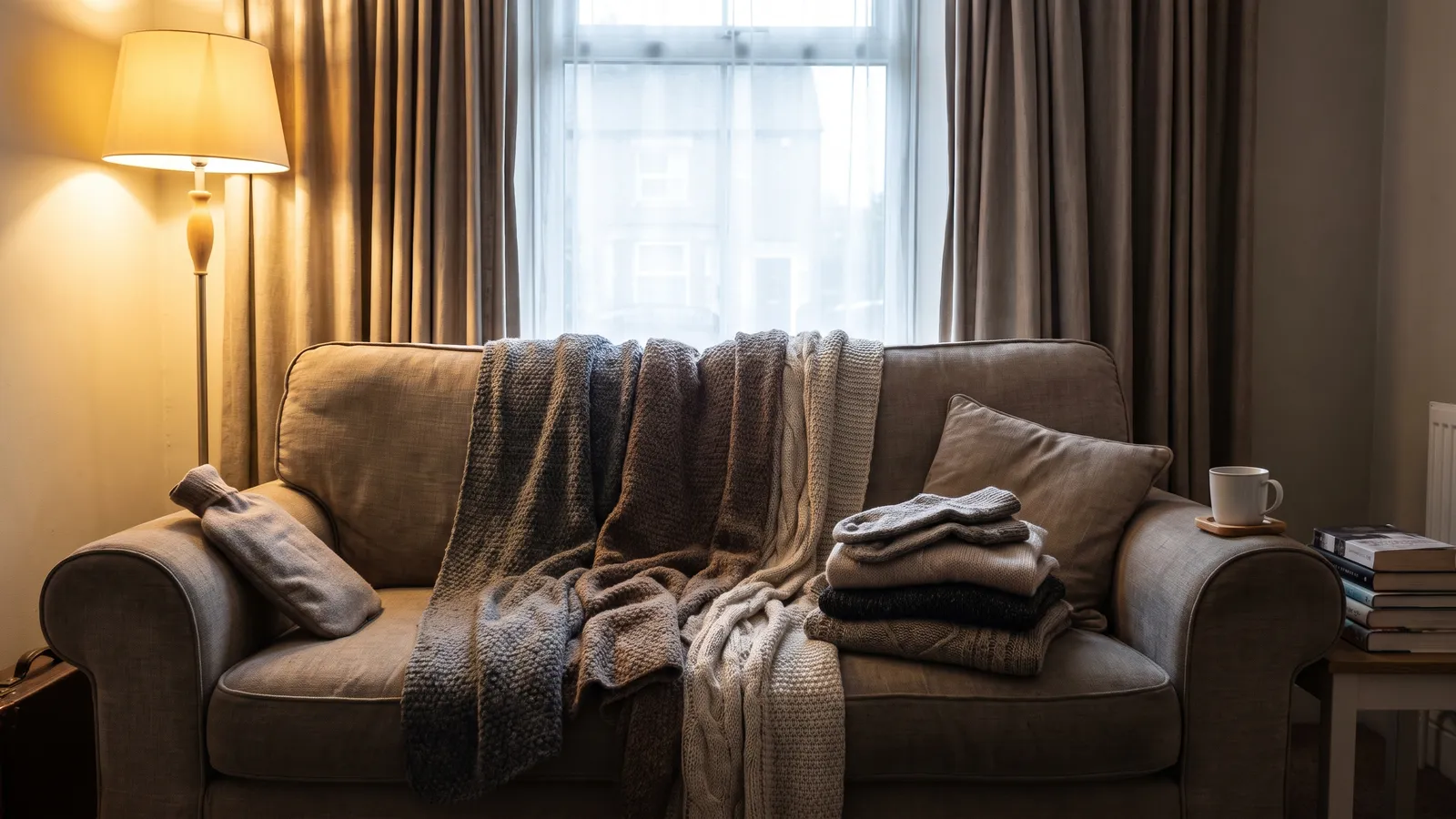
The safe strategy is layers, insulation and one warm room. Close doors to the room you're using, block draughts, and put on thermal base layers, wool jumpers and a hat — a lot of heat leaves through your head. Wool and down blankets trap warmth without power; a hot water bottle (filled before the cut, or from water heated on a camping stove used strictly outdoors) is the classic, safe, targeted heat source.
Powered options only help if you own a power station: an electric heated throw draws little enough (around 100W) to run for hours off a battery station, unlike a fan or convector heater that would flatten it in minutes. Rechargeable hand warmers are a small comfort for the coldest hours. Everything here is about efficient, safe warmth — not brute heat.
For sleeping and the worst cold, a proper sleeping bag or a reflective emergency bivvy (the SOL type) genuinely holds body heat, and gathering the household to sleep in one room pools warmth. Check on the vulnerable often: babies and older people lose heat fastest.
Top pick: Hot Water Bottle with Knitted Cover. A quietly excellent bit of resilience kit: for around a tenner you get hours of warmth with no electricity, and the knitted cover protects skin and holds heat longer. Just make sure you also have a way to boil water if the power is down.
| Item | Type | Needs power | Price | |
|---|---|---|---|---|
| Hot Water Bottle with Knitted CoverTOP PICK | Rubber hot water bottle with knitted cover (2L) | No | — | Check price → |
| Dreamland Heated Throw Blanket | Electric heated overblanket / throw (mains-powered) | Yes - mains 230V, detachable controller | — | See price on Amazon → |
| Pure New Wool Blanket | 100% pure new wool, woven blanket | No | — | See price on Amazon → |
| Thermal Base Layer Set (top & bottoms) | Synthetic (polyester/elastane) top & bottoms | No | — | See price on Amazon → |
| Blizzard / SOL Emergency Bivvy Bag | Reflective emergency bivvy (survival bag) | No | — | See price on Amazon → |
| Rechargeable Electric Hand Warmers (2-pack) | Reusable electric (rechargeable Li-ion, USB-C) | Yes - USB-C rechargeable battery, no fuel or disposables | — | See price on Amazon → |
| Down-Filled Throw Blanket | Down/feather-filled throw | No | — | See price on Amazon → |
ⓘ As an Amazon Associate, PreparedBritain earns from qualifying purchases. We may earn a commission when you buy, or a fee when you request a quote, through our links — it never affects what we recommend. Amazon prices come from Amazon's own product data and show the date and time they were retrieved. Prices at other retailers are checked by us, less often. Prices and stock can change at any time, so always check the retailer's price before you buy.
Hot Water Bottle with Knitted Cover
4.5Who it's for: Cheap, power-free warmth when the heating's off or the power's out.
A quietly excellent bit of resilience kit: for around a tenner you get hours of warmth with no electricity, and the knitted cover protects skin and holds heat longer. Just make sure you also have a way to boil water if the power is down.
- Needs no electricity and nothing to charge — fill from any kettle, camping stove or pan of hot water
- Very cheap and long-lasting warmth; holds heat for several hours to warm a bed or take the chill off during a power cut
- The knitted cover reduces the risk of skin burns and helps retain heat
- Only useful if you have a way to heat water — in an all-electric home a power cut leaves you stuck without a stove or gas hob
- Rubber perishes: replace every couple of years (check for cracks) and never fill with fully boiling water
Don't buy if You have no off-grid way to boil water — an all-electric kitchen with no camping stove means a hot water bottle can't help during a prolonged power cut, so pair it with a means to heat water first.
Dreamland Heated Throw Blanket
4.5Who it's for: Cutting heating bills by warming the person, not the whole room, during normal winter evenings.
A well-made, reputable British-brand throw that heats in a few minutes, runs for around a penny an hour and is machine-washable. A sensible comfort-and-cost buy for everyday warmth, but treat it as an energy-saver rather than emergency kit.
- Very cheap to run (roughly 1p per hour) and warms up in about five minutes
- Machine-washable and tumble-dry safe once the controller is detached, with a 2-year guarantee
- Multiple heat settings, auto-shutoff timer and overheat protection from a 50-year-old UK brand
- Needs a mains socket, so it is useless in a power cut
- Faux-fur and plush finishes can shed or flatten over time, and cheaper colours go in and out of stock
Don't buy if Don't buy this as blackout or power-cut insurance - it does nothing without mains electricity. For resilience during outages, a non-powered wool or synthetic blanket (or a good sleeping bag) is the item to keep.
Pure New Wool Blanket
4.5Who it's for: Dependable home warmth during a winter power cut when the heating is off.
A good pure new wool blanket is one of the most reliable ways to stay warm if the heating fails, holding its insulating power even when slightly damp and needing no power at all. It is heavier and pricier than a foil blanket, but a British-made one lasts decades and earns its place in the airing cupboard.
- Keeps you warm even when damp, is naturally breathable and is slow to ignite, so it is more forgiving than synthetics if you are heating a room by other means.
- Genuinely durable, lasting decades with basic care, so it doubles as everyday bedding rather than kit that only appears in a crisis.
- No batteries, power or setup, and works the instant you need it.
- Bulky and heavy, so it belongs at home rather than in a grab bag or car kit.
- Quality British wool is not cheap, and coarser weaves can feel scratchy for sensitive skin unless you choose a softer lambswool or merino.
Don't buy if Don't buy this for packable warmth in a grab bag or car — a compact foil or synthetic emergency blanket is far lighter, cheaper and better suited to that. Wool is for staying put and staying warm at home.
Thermal Base Layer Set (top & bottoms)
4.0Who it's for: Cheaply adding real warmth during a winter power cut or in an unheated home
A thermal top-and-bottom set is one of the cheapest, most reliable ways to stay warm when the heating is off, since it needs no power, fuel or batteries. Generic synthetic sets do the job well for occasional use; just check sizing and don't expect the comfort or odour resistance of merino.
- Adds genuine warmth for very little money and packs down small in a grab bag or drawer
- Works with no power, fuel or batteries, so it keeps you warm when the heating cannot
- Layering traps body heat efficiently, which is cheaper than heating a whole room during a cold snap
- Quality and sizing vary widely between generic brands; the cheapest sets can feel thin and pill quickly
- Synthetic fabric can feel clammy and hold odour if worn for days without washing
Don't buy if You already own decent thermals or merino kit, in which case a second budget set adds little; and if you expect to wear it for days on end without washing, it is worth paying more for a merino set that resists odour and feels warmer for its weight.
Blizzard / SOL Emergency Bivvy Bag
4.0Who it's for: A cheap warmth backstop to keep in a grab bag or car for one person.
A light, inexpensive reflective bag that traps most of your body heat and packs down to nothing, which makes it a sensible always-there emergency layer. It is a single-use-minded backstop rather than proper shelter, so treat it as insurance and not a sleeping bag.
- Reflects about 90% of body heat and blocks wind and rain via taped seams
- Very light and compact (around 108g) so it lives in a bag or glovebox unnoticed
- Low cost and includes a rescue whistle and tinder-cord drawstring
- Non-breathable, so condensation builds up inside on longer use
- Thin material is not durable and won't survive repeated real-world use
Don't buy if Don't buy if you want a reusable, breathable shelter for regular camping or repeated overnights - pay more for a breathable reusable version (e.g. SOL Escape) or a heavier-duty Blizzard bag instead.
Rechargeable Electric Hand Warmers (2-pack)
3.5Who it's for: Commuters, spectators and anyone with cold-sensitive hands who wants reusable warmth without disposable sachets.
A practical, low-cost comfort item that reheats hands on cold days and doubles as a small power bank, though generic units vary in build quality and honest runtime. Reasonable value if you keep expectations sensible and buy from a seller with a clear returns policy.
- Reusable and rechargeable over USB-C, so no ongoing cost or single-use waste versus disposable warmers
- A 2-pack gives one warmer per hand or a spare to charge, with 3-4 heat settings on most models
- Many double as a modest power bank, adding a little emergency phone top-up in a kit
- Generic branding means quoted battery life and mAh figures are often optimistic; real runtime on high heat can be a few hours, not the headline number
- Lithium-ion cells are a fire risk if damaged or cheaply made, and are not a substitute for proper heating in a genuine cold emergency
Don't buy if Don't buy if you need dependable warmth in a power cut or off-grid cold spell - a rechargeable unit is only as good as its last charge, so a well-insulated layer, blankets and a hot drink matter more. Also skip if you specifically want a phone charger, where a dedicated power bank is better value.
Down-Filled Throw Blanket
3.5Who it's for: Quiet, no-power warmth on the sofa or bed during a cold snap or heating outage.
A genuine down or feather throw is warm, light and needs no electricity, which makes it a sensible comfort layer if the heating fails. It is more a nice-to-have than a survival essential, and a wool or synthetic-fill throw does much the same job for less fuss.
- Warm and lightweight with no power needed, so it keeps working through an outage
- Packs down small and lofts up quickly, useful for staying warm while conserving heating
- Natural down insulates well for its weight and breathes better than most synthetics
- Down loses much of its warmth if it gets damp, and it is slow to dry
- Costs more than an equivalent fleece or wool throw for broadly similar everyday use
Don't buy if You need something you can machine-wash easily, that shrugs off damp, or that suits a down allergy. In those cases a wool or synthetic-fill throw is the calmer choice.
The Power Cut Action Card
One page for the kitchen drawer: what to do first, what to have ready, how long food keeps, and how to stay warm without risking carbon monoxide. Free, no catch.
Download it straight away. We'll also send the occasional briefing when something genuinely matters — severe weather, live incidents, real price drops. Nothing else.
We verify every product's specifications against at least two independent sources, re-check its UK price and stock on a schedule where we can track it automatically, and cross-check safety-relevant claims against official guidance. Where we've bought and used a product ourselves we say so on its review; where we haven't, our verdict is a considered spec-and-evidence comparison, not a hands-on test — and commissions never change a ranking either way. Read our full methodology →
Guides that go with this
How to stay warm at home without turning the heating on — warm the person, then the zone, then the room, with …
The free number to save today, what to have ready, food safety, staying warm safely, and the compensation you …
How UK storm warnings work, what Arwen and Éowyn taught households, and the short pre-storm checklist that mat…
What the UKHSA Cold-Health Alert colours mean, who's most at risk in cold weather, and the practical, sourced …
Common questions
How do I keep warm in a power cut without heating?
Layer up (thermals, wool, a hat), gather in one draught-proofed room, and use blankets, a hot water bottle and body heat. A reflective emergency bivvy or a good sleeping bag holds warmth for sleeping. It's about trapping heat, not making it.
Is it safe to use a gas or camping heater indoors in a power cut?
No — never. Fuel-burning heaters and stoves produce carbon monoxide, which is invisible, odourless and can kill in an enclosed space. Keep a working CO alarm, and only ever burn fuel outdoors in the open air.
What's the warmest blanket without power?
Wool and down blankets trap the most body heat with no power; a reflective emergency bivvy/blanket adds a windproof, heat-reflecting layer for the coldest conditions. Layer a couple together for a cold night.
Will a power bank or power station run a heater?
A big electric heater, no — it draws far too much. But a low-wattage heated throw (~100W) will run for hours off a portable power station, which is the sensible powered option if you own one. See our power stations reviews.
How do I keep a baby or older person warm in an outage?
They lose heat fastest, so prioritise them: extra layers and blankets, a warm hat, keep them in the warmest room, and check on them frequently. For anyone reliant on powered medical warmth, plan a battery backup and register on the Priority Services Register.
Are rechargeable hand warmers worth it?
As a small comfort for cold hands, yes — they're cheap and reusable. They won't warm a room, so treat them as a nice-to-have alongside the blankets and layers that do the real work.