Is pepper spray legal in the UK? The law, self-defence and the legal alternatives
Pepper spray and CS spray are prohibited weapons across the UK. What the law says and the sentence it carries, what ‘reasonable force’ means in self-defence, why carrying anything as a weapon is an offence, and the legal options: personal safety alarms, phone SOS features, Ask for Angela and more.
No. Pepper spray and CS spray are prohibited weapons in the UK. In England, Wales and Scotland, section 5(1)(b) of the Firearms Act 1968 bans any weapon “designed or adapted for the discharge of any noxious liquid, gas or other thing”, and the Home Office says that includes personal protection sprays using CS, Mace or OC pepper. Northern Ireland’s Firearms Order 2004 has the same ban. Having one in your possession, even at home, is an offence without official authority, and the maximum sentence is 10 years in prison. The law does let you use reasonable force to defend yourself, but carrying anything as a weapon in a public place is a separate offence. The legal option the police point to is a personal attack alarm. The national Ask the Police service says it cannot confirm that sprays sold as legal, such as “non toxic sprays”, are lawful until a test case is brought before the court. Your phone’s Emergency SOS, what3words and Ask for Angela help too.
By Tom Calder · Updated 4 November 2026 · Sourced to legislation.gov.uk, GOV.UK, the Home Office, the national Ask the Police service, police forces, the IOPC and the Suzy Lamplugh Trust. This is a plain-English summary of the law, not legal advice.
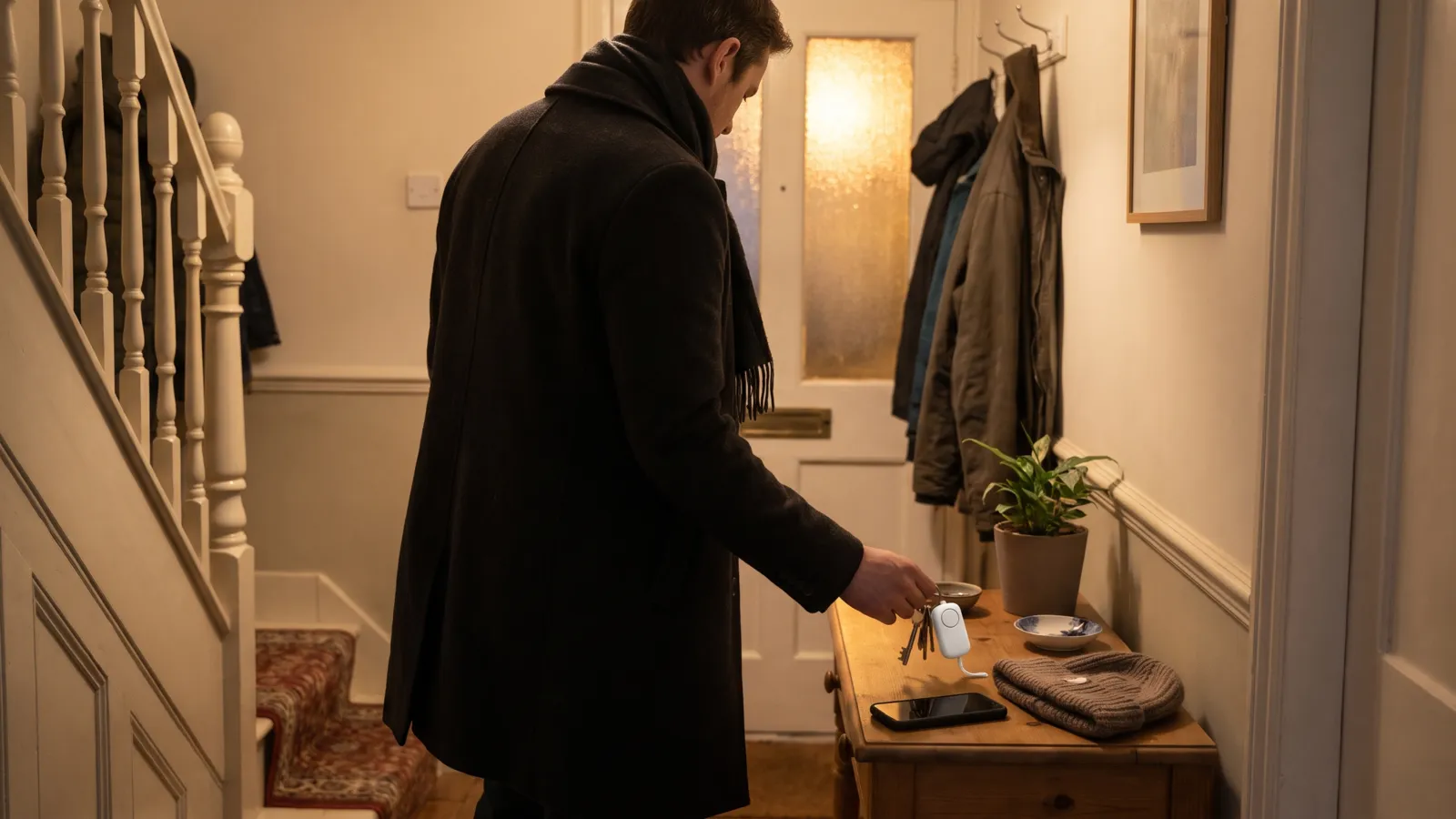
Is pepper spray legal in the UK? No, and nor is CS spray
In England, Wales and Scotland the law is section 5 of the Firearms Act 1968. A person commits an offence if, “without authority”, they have in their possession, or purchase or acquire, any of the weapons the section lists, and section 5(1)(b) lists “any weapon of whatever description designed or adapted for the discharge of any noxious liquid, gas or other thing”. The Home Office’s guide to firearms law for the police says this covers not only flamethrowers and poison gas projectors “but also personal protection sprays using CS, Mace or OC pepper”. OC (oleoresin capsicum) is the pepper in pepper spray.
Three things follow. It doesn’t matter that a spray is small or sold for self-defence: the law covers a weapon “of whatever description”. The offence is possessing, buying or acquiring one, so keeping a spray at home is an offence too, not only carrying it. And the Act makes no exception for self-defence. The same Home Office guide notes that the courts have held stun guns to be prohibited under the same paragraph.
Northern Ireland has its own law with the same effect. Article 45(1)(f) of the Firearms (Northern Ireland) Order 2004 prohibits “any weapon of whatever description designed or adapted for the discharge of electricity or any noxious liquid, gas or other thing”, without the authority of the Secretary of State.
The sentence is serious. Possessing a prohibited weapon designed to discharge a noxious liquid can be tried in a lower court or on indictment. In England and Wales a magistrates’ court can impose up to 12 months in prison, a fine or both; in Scotland a sheriff court can impose up to 6 months. On indictment the maximum is 10 years, a fine or both (Schedule 6 to the 1968 Act; section 282 of the Criminal Justice Act 2003). In Northern Ireland the maximum is 1 year on summary conviction and 10 years on indictment (Schedule 5 to the 2004 Order). Buying one online or abroad changes nothing about the offence here, and the national Ask the Police service warns that products bought from abroad have “a greater chance of being illegal”.
Self-defence and ‘reasonable force’: what the law says
You are allowed to defend yourself. GOV.UK says you can use reasonable force to protect yourself or others when a crime is happening in your home, that you can do so in the heat of the moment, and that there is no fixed definition of reasonable force because it depends on the circumstances. The joint CPS and police statement for householders adds that if you are in your own home and in fear for yourself or others, you don’t have to wait to be attacked.
The rules are set out in section 76 of the Criminal Justice and Immigration Act 2008, which applies in England, Wales and Northern Ireland. Whether the force was reasonable is decided “by reference to the circumstances as D believed them to be”, so a genuine but mistaken belief can count, unless the mistake came from drink or drugs taken voluntarily. In most cases, force is not reasonable if it was “disproportionate” in those circumstances. In England and Wales only, a ‘householder case’ (broadly, defending yourself in your home against someone you believe is an intruder) uses a different line: force that was “grossly disproportionate”. Also in England and Wales, the chance to retreat is “a factor to be taken into account, rather than as giving rise to a duty to retreat”.
The law also accepts that people under threat can’t measure their response precisely. Section 76 says a person “may not be able to weigh to a nicety the exact measure of any necessary action”, and that having done only what you “honestly and instinctively thought was necessary” is “strong evidence” that the action was reasonable. Section 76 does not extend to Scotland, so the tests there differ.
What reasonable force does not cover is going out prepared to use a weapon. That is the next point.
Why carrying anything as a weapon in public is an offence
Section 1 of the Prevention of Crime Act 1953 (England and Wales) makes it an offence to have “any offensive weapon” with you in a public place “without lawful authority or reasonable excuse”, and puts the burden of proving the excuse on you. An offensive weapon means any article “made or adapted for use for causing injury to the person”, or one “intended by the person having it with him for such use”. The maximum sentence on indictment is 4 years. Scotland’s version is section 47 of the Criminal Law (Consolidation) (Scotland) Act 1995, with a maximum of 5 years, and Northern Ireland’s is Article 22 of the Public Order (Northern Ireland) Order 1987, worded the same way.
The second half of that definition is the one that catches people out. An everyday item, such as keys, a can of hairspray or a torch, is not a weapon in itself, but carrying it intending to use it to hurt someone can turn it into an offensive weapon in law. Carrying something for self-defence ‘just in case’ is not a reasonable excuse either: the Crown Prosecution Service’s guidance on knife and weapons offences says that carrying an offensive weapon in public “merely because of the possibility of a constant or enduring threat (even where genuine) does not amount to self-defence or a reasonable excuse”. Only exceptionally, when an imminent and specific attack is expected, might it be reasonable.
This is separate from the self-defence rules above. Using whatever is to hand in the moment you are attacked is judged by the reasonable-force test. Setting out with something to use as a weapon is an offence in itself. Blades have their own rules, which our guide to knives and the law covers.
NewSee this for your own homeHome Alerts: your postcode's power cuts, warnings and floods, on one screen. Free for your own home. Sign up in a minute.Start free →Personal safety alarms: the legal option police point to
The national Ask the Police service, answering the question “Are there any legal self-defence products that I can buy?”, says the only fully legal self-defence product at the moment is a personal attack alarm (it calls it a “rape alarm”), adding that they are not expensive. Avon and Somerset Police say an alarm is “designed to shock and distract an attacker, giving you vital seconds to get away”.
How you use one matters more than which one you buy. The Suzy Lamplugh Trust’s advice is to set the alarm off “holding it as close to the attackers face as possible”, then drop it and get away, shouting a clear instruction such as calling for the police; “don’t wait to check that your alarm has had the desired effect; just go.” It adds that an alarm “should be just one part of your personal safety plan”.
Our own suggestion: keep it where you can reach it in a second, such as a coat pocket, rather than at the bottom of a bag, and check the battery as the maker’s instructions say. Remember what a siren alarm can’t do: it makes noise, and it calls nobody. For an older relative who lives alone, the useful device is usually one that calls someone when pressed; our personal and careline alarms comparison covers both kinds, from siren alarms to SOS pendants.
Criminal identifier and marker sprays: the legal status is unclear
Some sprays are sold as legal alternatives: they squirt a coloured dye or foam meant to mark an attacker rather than hurt them. We could not find any police or official source confirming that they are lawful, and the national Ask the Police service says plainly that it can’t: products that claim to be legal, “e.g. non toxic sprays”, cannot be confirmed as legal or endorsed “until a test case is brought before the court”.
The same answer says that if you are stopped with one “there is always a possibility that you will be arrested and detained until the product, its contents and legality can be verified”. It describes products that squirt a relatively safe, brightly coloured dye, and says a properly designed one used as intended should not cause an injury, but if an injury does occur “this may be assault”. And it repeats the rule above: you must not have a product “made or adapted to cause a person injury”.
So our honest position is that we can’t tell you a marker spray is legal, because no official source does. An alarm does the same job of drawing attention, with no question mark over it.
Your phone: Emergency SOS, what3words and the silent 999 call
Most phones have an emergency shortcut, and setting it up takes a minute. On an iPhone, Apple says you can press and hold the side button and either volume button until the sliders appear and the countdown ends, or turn on ‘Call with 5 Presses’ in Settings > Emergency SOS and press the side button five times quickly. After the call, the iPhone texts your emergency contacts with your location unless you cancel. On Android 12 and later, Google says pressing the power button five times or more starts Emergency SOS, which can call for help, share your location with your emergency contacts and record video; it has to be set up first, and Google says it doesn’t work in aeroplane mode or with Battery Saver on. Add your emergency contacts before you need them.
If you can’t say where you are, what3words can help. The national Ask the Police service explains that it gives a three-word address to every 3-metre grid square on a map, that the free app works offline, and that you read your three words to the 999 call handler so help can come to the exact spot.
If you call 999 and can’t speak, the Independent Office for Police Conduct’s advice is: listen to the operator, cough or tap your phone if you can, and if prompted press 55 to show it’s a genuine emergency and be put through to the police. Staying silent and not pressing 55 will lead to the call being ended.
Ask for Angela, StreetSafe and getting home safely
Ask for Angela is a phrase you can use with staff to get discreet help without having to explain. The scheme started in Lincolnshire in 2016; it began in licensed venues such as pubs and bars and has spread to places such as fire stations, places of education and public transport. Staff take their lead from you, and can help you leave or stay safely, find your friends, or contact the emergency services. Look for its posters.
StreetSafe, on the police.uk website, lets you tell the police anonymously about public places where you have felt unsafe, for example because of anti-social behaviour or a lack of street lighting. The reports inform policing and local authority safety work. It is not for reporting crimes: report those to the police, and if you are in immediate danger, call 999.
For the walk home, the simplest ‘walk-me-home’ service is already on your phone. Police advice includes sharing your live location with a trusted friend or family member before you go out, and the Suzy Lamplugh Trust suggests a tracking app a trusted friend can follow. Plan how you will get home before you go, including the last train or bus, and check whether your university, workplace or venue runs a walk-home or safe-taxi scheme.
Personal safety tips for women, older people and everyone else
The everyday advice from the police and the Suzy Lamplugh Trust is the same for everyone. Tell someone where you are going and for how long. Keep your phone charged and on you. Use well-lit, busy streets and routes you know, and stay in a group where you can. If you think you are being followed, trust your instincts: cross the road, check who is behind you, and head somewhere busy, such as a shop. Report incidents, even near misses.
If someone tries to take your bag or phone, Avon and Somerset Police advise you to “consider letting them have it rather than risk getting hurt”. If you are attacked, they say, shout for help as loudly as you can or shout for someone to contact the police, try to get to a safe place and call the police.
For older people the same basics apply, with one more: a way to call for help at home that doesn’t depend on reaching the phone. Our personal and careline alarms comparison explains what each kind of alarm does and who answers when the button is pressed.
Common questions
Is pepper spray legal in the UK?
No. In England, Wales and Scotland, section 5(1)(b) of the Firearms Act 1968 prohibits any weapon designed or adapted to discharge a noxious liquid, gas or other thing, and the Home Office says that includes personal protection sprays using CS, Mace or OC pepper. Northern Ireland prohibits them under Article 45 of the Firearms (Northern Ireland) Order 2004. Possessing, buying or acquiring one without official authority is an offence.
What is the sentence for carrying pepper spray in the UK?
Possessing a prohibited weapon designed to discharge a noxious liquid carries a maximum of 10 years in prison, a fine or both on indictment, across the UK. In a magistrates’ court the maximum is 12 months in England and Wales; in a sheriff court in Scotland, 6 months; in Northern Ireland, 1 year on summary conviction.
Is it legal to keep pepper spray at home for protection?
No. The offence is having one in your possession, or buying or acquiring one, not just carrying it in public, so a spray kept at home is still an offence without official authority.
Can I bring pepper spray back from holiday?
No. Even if it was legal where you bought it, possessing it in the UK is an offence. The national Ask the Police service warns that self-defence products bought from abroad have a greater chance of being illegal.
Are personal safety alarms legal in the UK?
Yes. The national Ask the Police service says a personal attack alarm is the only fully legal self-defence product at the moment. Hold it close to an attacker’s face, set it off, drop it and get away, the Suzy Lamplugh Trust advises.
Are criminal identifier or marker sprays legal in the UK?
Their legal status is unclear, and no official source confirms them as legal. The national Ask the Police service says it can’t confirm that non-toxic sprays are legal until a test case is brought before the court, that you could be arrested and detained while a product is checked, and that if a dye spray does injure someone this may be assault.
Can I use reasonable force to defend myself?
Yes. In England, Wales and Northern Ireland, section 76 of the Criminal Justice and Immigration Act 2008 says force is judged against the circumstances as you believed them to be, and force must not be disproportionate. In England and Wales, force against someone you believe is an intruder in your home fails only if it is grossly disproportionate, and there is no duty to retreat. Section 76 does not apply in Scotland.
Can I carry keys, hairspray or a torch for self-defence?
Not as a weapon. An offensive weapon in law includes any article you intend to use to injure someone, so carrying an everyday item for that purpose can be an offence. The Crown Prosecution Service says carrying an offensive weapon in public merely because of the possibility of a constant or enduring threat, even a genuine one, is not self-defence or a reasonable excuse.
Is a stun gun or taser legal in the UK?
No. The Home Office’s guide to firearms law says the courts have held that stun guns are prohibited weapons under the same section 5(1)(b), and Northern Ireland’s Order prohibits weapons designed to discharge electricity.
Sources (23)
- legislation.gov.uk: Firearms Act 1968, section 5 (weapons subject to general prohibition; 5(1)(b) noxious liquid, gas or other thing), read 4 November 2026
- legislation.gov.uk: Firearms Act 1968, Schedule 6 (prosecution and punishment of offences), read 4 November 2026
- legislation.gov.uk: Criminal Justice Act 2003, section 282 (short sentences: either-way offences tried summarily in England and Wales), read 4 November 2026
- legislation.gov.uk: Sentencing Act 2020, section 224 (general limit in a magistrates’ court: 12 months for either-way offences), read 4 November 2026
- legislation.gov.uk: Firearms (Northern Ireland) Order 2004, article 45 (weapons subject to general prohibition), read 4 November 2026
- legislation.gov.uk: Firearms (Northern Ireland) Order 2004, Schedule 5 (punishment of offences), read 4 November 2026
- Home Office — Guide on firearms licensing law, chapter 3 (CS, Mace and OC pepper sprays and stun guns as section 5(1)(b) prohibited weapons; updated 18 September 2026), GOV.UK
- GOV.UK — Using reasonable force against intruders, read 4 November 2026
- Crown Prosecution Service and National Police Chiefs’ Council — Householders and the use of force against intruders (joint statement, 2018)
- legislation.gov.uk: Criminal Justice and Immigration Act 2008, section 76 (reasonable force for purposes of self-defence etc.), read 4 November 2026
- legislation.gov.uk: Prevention of Crime Act 1953, section 1 (offensive weapons in a public place; England and Wales), read 4 November 2026
- legislation.gov.uk: Criminal Law (Consolidation) (Scotland) Act 1995, section 47 (offensive weapons in a public place), read 4 November 2026
- legislation.gov.uk: Public Order (Northern Ireland) Order 1987, article 22 (carrying an offensive weapon in a public place), read 4 November 2026
- Crown Prosecution Service — Knife and other weapons offences, prosecution guidancea constant or enduring threat is not a reasonable excuse
- Ask the Police — Q589: Are there any legal self-defence products that I can buy? (no date shown), read 4 November 2026
- Ask the Police — Q1103: What is the what3words system? (no date shown), read 4 November 2026
- Avon and Somerset Police — Staying safe in public places (personal attack alarms, sharing your live location, what to do if attacked), read 4 November 2026
- Suzy Lamplugh Trust — Personal safety out and about (planning, personal alarms, if you think you are being followed), read 4 November 2026
- Independent Office for Police Conduct — Make Yourself Heard: the Silent Solution (press 55), read 4 November 2026
- Apple Support — Make an emergency call or text on iPhone or Apple Watch (Emergency SOS), read 4 November 2026
- Google Android Help — Get help in an emergency using your Android phone (Emergency SOS, Android 12 and later), read 4 November 2026
- Ask for Angela — FAQs (what the scheme is, where it runs, what staff do), read 4 November 2026
- Avon and Somerset Police — Report feeling unsafe in public spaces (StreetSafe), read 4 November 2026
PreparedBritain is independent and not affiliated with HM Government.
The Emergency Kit Checklist
The GOV.UK Prepare essentials on one printable page — tick them off as you go and keep it with the kit. Free, no catch.
Download it straight away. We'll also send the occasional briefing when something genuinely matters — severe weather, live incidents, real price drops. Nothing else.
Latest from our live data
All stories → News · 3 NovVampire devices: the '£200' is 13 gadgets added up; turning a home off standby saves about £45
 News · 2 NovCold Weather Payment opens: £25 a freezing week; last winter 40 of 71 stations triggered none
 News · 31 OctEarliest polar vortex breakdown on record forecast for November: what it means for the UK
Keep reading
All planning & the national picture guides →What should be in a survival kit? A UK household list
In the UK a survival kit is mostly a home kit: what GOV.UK Be Ready says to keep for 3 days, the grab bag, a…
Survival knives and the law in the UK: what you can legally carry
What UK law says about survival knives, axes and multi-tools: the 3-inch folding pocketknife rule, what counts as a…
Earliest polar vortex breakdown on record forecast for November: what it means for the UK
A polar vortex breakdown is forecast for early November, the earliest on record if it happens. We checked all 32…
