Survival knives and the law in the UK: what you can legally carry
What UK law says about survival knives, axes and multi-tools: the 3-inch folding pocketknife rule, what counts as a good reason, the knives banned even at home, buying and delivery rules, and the car and camping kit.
In public, the only blade you can carry without a reason is a folding pocketknife whose cutting edge is 3 inches (7.62 cm) or less and which doesn’t lock. A typical survival knife, a fixed blade or a lock knife, and a survival axe or hatchet, all need a good reason or lawful authority (a reasonable excuse in Scotland), and a court decides whether yours was good enough. The law names work, religious reasons and national costume; it doesn’t name camping or bushcraft, and the Crown Prosecution Service’s guidance for England and Wales says a knife under a car seat counts as one you have with you. Some knives are banned even at home: in England and Wales that includes zombie-style knives and machetes (since 24 September 2024) and ninja swords (since 1 August 2025). Most knives, and axes, can’t be sold to under-18s. A household kit needs none of this: a small non-locking folding knife or a multi-tool kept at home does the jobs. If you are unsure about your own situation, seek legal advice.
By Tom Calder · Updated 4 November 2026 · Sourced to legislation.gov.uk, GOV.UK, the Crown Prosecution Service and nidirect. This is a plain-English summary of the law, not legal advice.
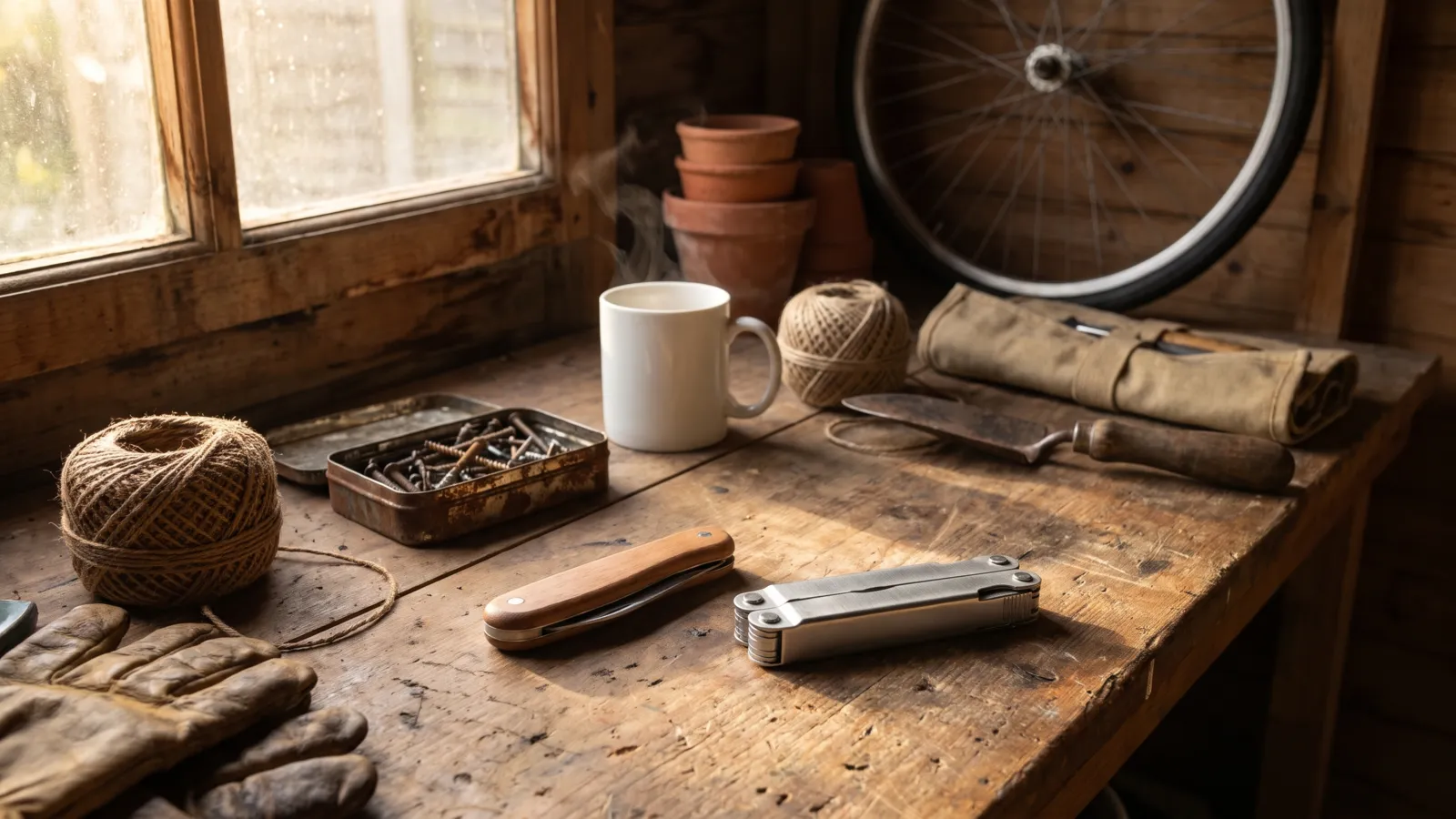
Carrying a knife in public: the 3-inch folding pocketknife rule
The law in England and Wales is section 139 of the Criminal Justice Act 1988, and Northern Ireland has its own version of the same section with the same wording. It makes it an offence to have “any article which has a blade or is sharply pointed” with you in a public place, “except a folding pocketknife”, and the exception stops applying “if the cutting edge of its blade exceeds 3 inches”. A public place is any place the public can get into, whether they pay or not, and the Crown Prosecution Service (CPS) adds that this includes any highway. The offence doesn’t need any intent to hurt anyone: the CPS says it does not have to be carried with any offensive intent. (The CPS prosecutes in England and Wales; Scotland and Northern Ireland have their own prosecutors and courts, so treat its guidance as an indication there, not a rule.)
The folding exception does not cover a lock knife. GOV.UK describes the exempt pocketknife as one that has a cutting edge no longer than 3 inches and is not a lock knife, meaning it does “not have a button, spring or catch that you have to use to fold the knife”. The CPS puts it the same way: a lock knife isn’t a folding pocketknife “because it is not immediately foldable at all times”. Most knives sold as survival knives are fixed blades or lock knives, so they fall outside the exception whatever their length.
Scotland’s law is section 49 of the Criminal Law (Consolidation) (Scotland) Act 1995. It covers the same articles and exempts a folding pocketknife if the cutting edge of its blade “does not exceed three inches (7.62 centimetres)”. The maximum penalty on indictment is 4 years in prison in England, Wales and Northern Ireland, and 5 years in Scotland; GOV.UK adds that an adult convicted of carrying a knife or weapon illegally more than once will get a prison sentence; that rule (section 315 of the Sentencing Code) applies in England and Wales, to anyone aged 16 or over with a previous relevant conviction.
What counts as a good reason (a reasonable excuse in Scotland)
It is a defence to prove that you had “good reason or lawful authority” for having the knife in a public place. The Act gives three examples: having it “for use at work”, “for religious reasons”, or “as part of any national costume”. GOV.UK gives the kirpan some Sikhs carry as a religious example, and says “a court will decide if you’ve got a good reason”. In Scotland the defence is to show “a reasonable excuse or lawful authority”, with the same three examples. Lawful authority is narrow: the CPS describes it as people who carry a weapon as a matter of duty, such as a soldier or a police officer.
The CPS guidance shows how narrowly courts read this. The excuse “is construed narrowly” and must be objectively reasonable, and once the offence is proved, it is for you to prove the excuse on the balance of probabilities. Work use “does not automatically provide a reasonable excuse”: there has to be an immediate connection between having the blade and the work, and in one case a plumber or electrician’s defence was weakened because the article was found in his car glovebox on a Saturday, when he wasn’t working. Forgetfulness alone, the CPS says, cannot be a reasonable excuse.
Self-defence is not a good reason. The CPS says carrying a weapon in public merely because of “a constant or enduring threat (even where genuine) does not amount to self-defence or a reasonable excuse”. Don’t buy, choose or describe any blade as being for protection. A spray is no legal alternative: pepper and CS sprays are prohibited weapons, as our guide to pepper spray and the law explains, along with the options that are legal.
Neither the Act nor the CPS guidance names camping, bushcraft, fishing or hiking. Whether taking a knife or axe to one of those is a good reason depends on the facts, and only a court can decide it. GOV.UK’s advice, if you want to know what counts as a good reason, is to contact your local police or get legal advice. Our advice is the same: if your plans depend on carrying a blade in public, seek legal advice first.
Survival axes, hatchets, bushcraft knives and multi-tools
Section 139 isn’t limited to knives. It covers “any article which has a blade or is sharply pointed”, and the CPS says even a butter knife with no cutting edge and no point is a bladed article. So treat a survival axe, a hatchet, a machete or a bushcraft knife exactly like a fixed-blade knife: fine to own and use at home or on private land with the owner’s permission, but needing a good reason (a reasonable excuse in Scotland) to have with you in public. The under-18 sales ban covers “any axe” too.
A multi-tool follows the same test as a knife, applied to every blade and point on it, including saws and awls: each must fold, not lock, and have a cutting edge of 3 inches or less. If a blade locks, as the blades on most full-size multi-tools do, the tool is outside the pocketknife exception however short the blade is. Even a non-locking one isn’t certain to count, because no source we found says a multi-tool is a folding pocketknife, so if you need to carry one in public, seek legal advice. Our multi-tools comparison says which models lock.
NewSee this for your own homeHome Alerts: your postcode's power cuts, warnings and floods, on one screen. Free for your own home. Sign up in a minute.Start free →Schools and colleges
In England, Wales and Northern Ireland, section 139A of the 1988 Act makes it a separate offence to have a bladed or pointed article, or an offensive weapon, on school premises (and, in England and Wales since 6 April 2022, further education premises). The defences are good reason or lawful authority, with use at work, educational purposes, religious reasons and national costume given as examples, and the maximum is 4 years on indictment. Scotland’s equivalent, section 49A of the 1995 Act, covers school premises, with a reasonable excuse defence and a maximum of 5 years.
Knives banned outright, even at home
Some knives and weapons can’t be owned at all. GOV.UK says that for the weapons on its banned list it is illegal to possess them, bring them into the UK, sell or hire them out, or lend or give them to someone. In England and Wales, having one of these weapons in private, at home for instance, has been an offence since 14 July 2021; in Scotland since 27 March 2023. Antiques over 100 years old are exempt, except flick knives and gravity knives.
The ones a survival-knife buyer is most likely to meet, with the date each ban began in England and Wales, are: the zombie knife, a blade with a cutting edge, a serrated edge and images or words suggesting it is to be used for violence (18 August 2016); the cyclone or spiral knife (14 July 2021); the zombie-style knife or machete (24 September 2024), which is any bladed article with a plain cutting edge, a sharp pointed end and a blade over 8 inches long that also has a serrated cutting edge (other than up to 2 inches next to the handle), more than one hole in the blade, spikes, or more than two sharp points (some kinds of point don’t count); and the ninja sword (1 August 2025), a sword with a blade of 14 to 24 inches, two straight cutting edges, a blunt spine and a tanto or reversed tanto point. The ninja sword definition was adjusted from 16 July 2026. A sword with a curved blade of 50 centimetres or over has been banned since 6 April 2008, with defences for swords made before 1954 or by traditional hand methods.
The flick knife ban matters for anything sold as a quick-opening knife. The Restriction of Offensive Weapons Act 1959 covers a knife whose blade opens automatically from the closed position, or from a partially opened position, to the fully opened position by manual pressure applied to a button, spring or other device in or attached to the knife. So an assisted-opening knife, which a spring pushes open once you start it, can count. Gravity knives are banned too, as are butterfly knives, push daggers, disguised knives, stealth knives that metal detectors can’t find, belt buckle knives and swordsticks, among others on GOV.UK’s list.
Scotland and Northern Ireland have their own lists. On legislation.gov.uk, Scotland’s list has the zombie knife (since 23 June 2022) and the cyclone knife (since 28 June 2022), but the zombie-style knife and ninja sword entries were made for England and Wales. In Northern Ireland, nidirect describes a complete ban on the sale of listed weapons, including flick, gravity, butterfly, disguised and stealth knives, push daggers, swordsticks and samurai swords; the zombie, zombie-style, cyclone and ninja sword entries on the England and Wales list don’t apply there. If a big knife looks anything like the descriptions above, don’t buy it, and if you already own one and aren’t sure, ask your local police or seek legal advice.
Buying a knife: age 18, online orders and delivery
It is illegal to sell a knife, knife blade, razor blade or axe to anyone under 18 (section 141A of the 1988 Act in England, Wales and Scotland; article 54 of the Criminal Justice (Northern Ireland) Order 1996). GOV.UK says the small non-locking folding pocketknife is the exception, and that in Scotland 16 and 17 year olds can be sold cutlery and kitchen knives. In Northern Ireland, nidirect says it is illegal for anyone, including a shop, to sell a knife of any kind, including cutlery and kitchen knives, to anyone under 18.
Buying online, expect checks. Since 6 April 2022 in England and Wales, a remote seller accused of selling to an under-18 has to show, as a minimum, that it ran an age-checking system, marked the package as containing a bladed article to be delivered only into the hands of someone aged 18 or over, took all reasonable precautions that it would be, and didn’t send it to a locker. Under the Offensive Weapons Act 2019 (in force in England and Wales from 6 April 2022 and in Scotland from 28 June 2022), a remote seller can’t deliver a bladed product to a home address unless it has procedures likely to make sure it is handed to someone aged 18 or over, and can’t send it to a locker. In practice: proof of age at checkout, an adult signing for the parcel, and no lockers.
More is coming. The Crime and Policing Act 2026, which received Royal Assent on 29 April 2026, would require online knife sellers in England and Wales to check a copy of the buyer’s photo ID and a photograph of them (or use checks set out in regulations), require the parcel to be handed to the buyer, raise the maximum sentence for selling knives to under-18s and for selling or possessing banned weapons to 2 years (England, Wales and Scotland), and create a new offence in England and Wales, carrying up to 7 years, of having a blade or offensive weapon with intent to use unlawful violence. When we checked legislation.gov.uk on 4 November 2026, those sections were not yet in force; we’ll update this guide when they are.
Keeping a knife at home, in a camping kit or in the car
At home, you can keep any knife that isn’t on the banned list: section 139 is about public places. The CPS says that where access is restricted to a household, its family and friends and tradespeople who come to do repairs, the place is likely to be private rather than public.
The car is where people get caught out. A public road is a public place, and the CPS says having a knife with you covers one that is “nearby, under the defendant’s control, or immediately accessible (e.g. under a car seat, or in a bag next to them)”. So a lock knife, fixed blade or hatchet in the glovebox, door pocket or a grab bag on the back seat needs a good reason, just as if it were in your pocket. Keep only a non-locking folding knife with a cutting edge of 3 inches or less, or nothing, in the car kit.
Taking a knife or axe camping or to a bushcraft course is the judgement call. Neither the law nor the CPS guidance lists it as a good reason, and none of it is decided until a court does. The sensible way to show your purpose is to pack the blade away, in the boot or a closed bag rather than within reach, take it straight there and straight home, and not carry it around town in between; but there is no rule that packing it away makes carrying it lawful, and the CPS’s glovebox example shows that the connection to the activity has to be close in time. If you are unsure, seek legal advice before you go.
What a household emergency kit actually needs
Not a survival knife. The government’s Be Ready checklist doesn’t include a knife at all, and the jobs a blade does in a power cut or a flood, opening packets, cutting cord or tape, are covered by a small non-locking folding knife or a multi-tool kept at home with the rest of your kit. Our emergency kit list goes item by item, and the multi-tools comparison covers the tools themselves, with which ones lock.
Common questions
Is it legal to carry a survival knife in the UK?
Not without a good reason or lawful authority (a reasonable excuse in Scotland). The only blade you can carry in public without a reason is a folding pocketknife with a cutting edge of 3 inches (7.62 cm) or less that doesn’t lock. Survival knives are usually fixed blades or lock knives, so they are outside that exception. The law names work, religious reasons and national costume as examples, and a court decides whether a reason is good enough.
Is a lock knife legal in the UK?
It is legal to own one, but not to carry one in public without a good reason, whatever the blade length. GOV.UK says the folding pocketknife exception only covers knives that don’t have a button, spring or catch you have to use to fold them, and the Crown Prosecution Service says a lock knife isn’t a folding pocketknife because it is not immediately foldable at all times.
Can I keep a knife or multi-tool in my car?
Only a non-locking folding one with a cutting edge of 3 inches or less, unless you have a good reason. A public road is a public place, and the Crown Prosecution Service says a knife that is nearby, under your control or immediately accessible, such as one under a car seat, counts as one you have with you. Its guidance also gives a case where an article found in a tradesman’s glovebox on a Saturday, when he wasn’t working, weakened his work defence.
Is camping or bushcraft a good reason to carry a knife or axe?
It may be, but the law doesn’t say so and no one can promise it. Neither section 139 nor the Crown Prosecution Service guidance names camping or bushcraft; a court decides on the facts. Packing the blade away and going straight there and back helps show your purpose, but doesn’t make carrying it lawful; if you are unsure, seek legal advice.
Are zombie knives and machetes banned in the UK?
In England and Wales, zombie knives have been banned since 18 August 2016, and zombie-style knives and machetes since 24 September 2024: a plain cutting edge, a sharp point and a blade over 8 inches, plus serrations (beyond 2 inches next to the handle), more than one hole, spikes or more than two sharp points. Ninja swords followed on 1 August 2025. You can’t own them even at home. Scotland banned zombie knives from 23 June 2022; its list on legislation.gov.uk doesn’t include the zombie-style or ninja sword entries. Northern Ireland has its own list, which doesn’t include them either.
Can a 16 or 17 year old buy a knife or an axe?
No, except a small non-locking folding pocketknife, according to GOV.UK. It is illegal to sell a knife, knife blade, razor blade or axe to anyone under 18. In Scotland, 16 and 17 year olds can be sold cutlery and kitchen knives. In Northern Ireland, nidirect says no knife of any kind, including cutlery and kitchen knives, can be sold to under-18s.
Is a Swiss Army knife legal to carry in the UK?
A classic one usually is, if its blade doesn’t lock and its cutting edge is 3 inches or less: that is the folding pocketknife exception. Some larger Swiss Army and multi-tool models have locking blades, and those need a good reason in public. Check the model, not the brand.
Can I carry a knife for self-defence?
No. The Crown Prosecution Service says carrying a weapon because of a constant or enduring threat, even a genuine one, does not amount to self-defence or a reasonable excuse. Having any article in a public place with the intention of using it to injure someone, even defensively, makes it an offensive weapon, which is a separate offence under the Prevention of Crime Act 1953.
Sources (15)
- legislation.gov.uk: Criminal Justice Act 1988, section 139having an article with a blade or point in a public place; England and Wales, and Northern Ireland versions
- legislation.gov.uk: Criminal Justice Act 1988, section 139A (school and further education premises)
- legislation.gov.uk: Criminal Law (Consolidation) (Scotland) Act 1995, section 49 (public places)
- legislation.gov.uk: Criminal Law (Consolidation) (Scotland) Act 1995, section 49A (school premises)
- legislation.gov.uk: Criminal Justice Act 1988 (Offensive Weapons) Order 1988, Schedulebanned weapons, with dates, England and Wales
- legislation.gov.uk: Criminal Justice Act 1988 (Offensive Weapons) (Scotland) Order 2005, Schedule
- legislation.gov.uk: Criminal Justice Act 1988, section 141offensive weapons, including possession in private
- legislation.gov.uk: Restriction of Offensive Weapons Act 1959, section 1 (flick knives and gravity knives)
- legislation.gov.uk: Criminal Justice Act 1988, sections 141A and 141B (sales to under-18s; remote sales)
- legislation.gov.uk: Criminal Justice (Northern Ireland) Order 1996, article 54 (sales to under-18s)
- legislation.gov.uk: Offensive Weapons Act 2019, sections 38 and 40 (delivery of bladed products)
- legislation.gov.uk: Crime and Policing Act 2026, Part 2offensive weapons; not yet in force at 4 November 2026
- GOV.UK: Selling, buying and carrying knives and weapons
- Crown Prosecution Service: Knife and other weapons offences, prosecution guidance (updated 28 May 2026)
- nidirect: Knife crime and other offensive weapons (Northern Ireland)
PreparedBritain is independent and not affiliated with HM Government.
The Emergency Kit Checklist
The GOV.UK Prepare essentials on one printable page — tick them off as you go and keep it with the kit. Free, no catch.
Download it straight away. We'll also send the occasional briefing when something genuinely matters — severe weather, live incidents, real price drops. Nothing else.
Latest from our live data
All stories → News · 3 NovVampire devices: the '£200' is 13 gadgets added up; turning a home off standby saves about £45
 News · 2 NovCold Weather Payment opens: £25 a freezing week; last winter 40 of 71 stations triggered none
 News · 31 OctEarliest polar vortex breakdown on record forecast for November: what it means for the UK
Keep reading
All planning & the national picture guides →Earliest polar vortex breakdown on record forecast for November: what it means for the UK
A polar vortex breakdown is forecast for early November, the earliest on record if it happens. We checked all 32…
The 7 pet essentials are a retailer's list: the government checklist asks for food and water
Headlines say pet owners have been told to stock up on seven essentials amid a government 72-hour warning. The list…
The 'one thing' to know without a phone is your route home: Be Ready advice, not a new warning
Headlines say the government has warned people to know one thing without a phone in a blackout. It is a line from…
