Car emergency kit checklist: what to keep in your car this winter, and all year
The Highway Code's rule 228 kit, what National Highways, the RAC, the AA and the Met Office add to it, and the rules around the awkward items: fuel cans, warning triangles, power banks and knives. Plus the motorway breakdown steps from rule 277 and what to do if you are stuck in snow.
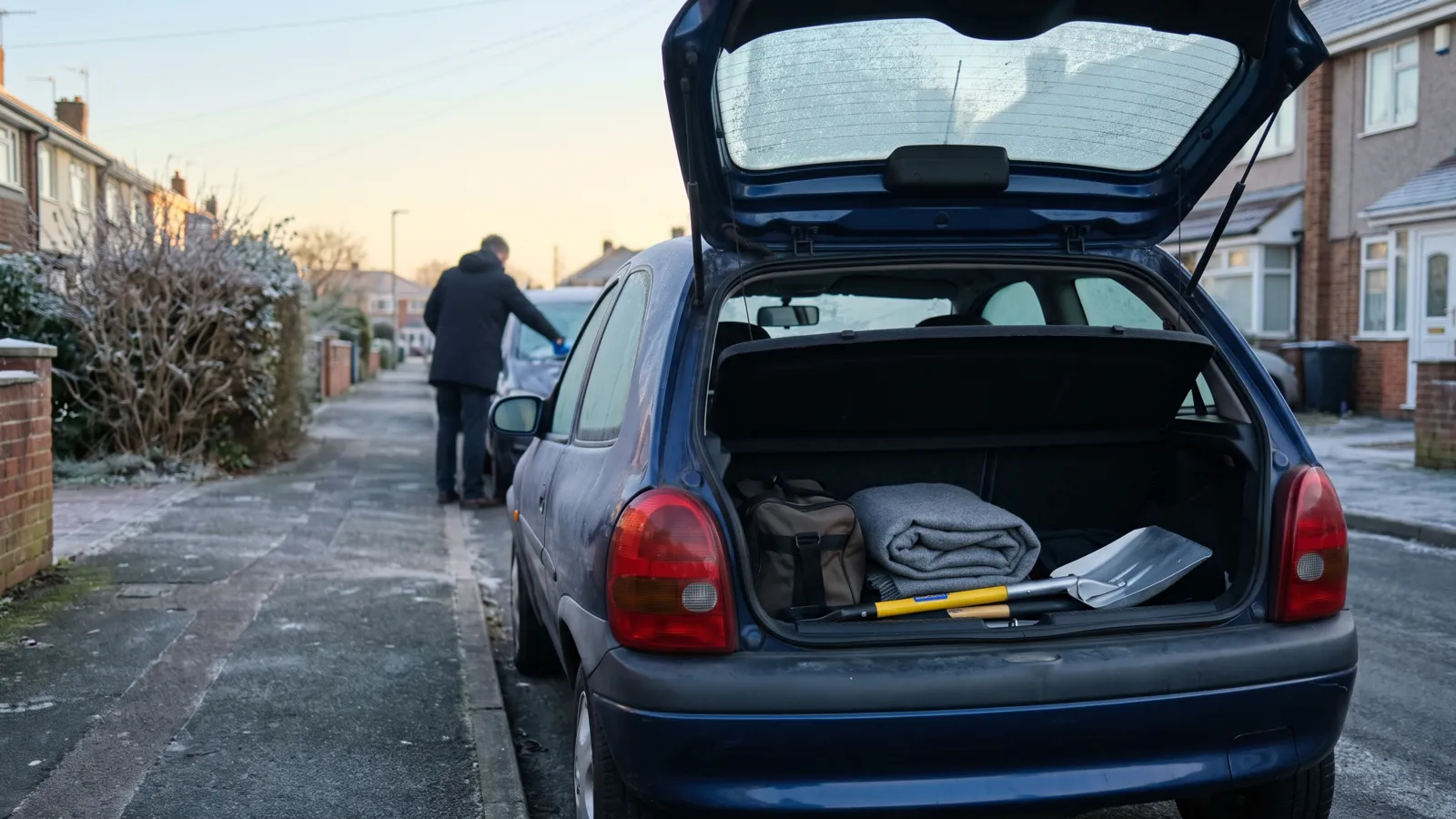
The Highway Code (rule 228) says to take an emergency kit of de-icer and ice scraper, torch, warm clothing and boots, first aid kit, jump leads and a shovel, plus a warm drink and emergency food, in case you get stuck or your vehicle breaks down. National Highways, the RAC and the AA add water, blankets, a charged phone with an in-car charger or power bank, a hi-vis jacket, sunglasses for the low winter sun, screenwash and a road atlas. All year, the AA lists a spare tyre or repair kit, a tyre pressure gauge, jump leads, a first aid kit, a torch, snacks and warm layers. The kit is a recommendation; what the law requires before you set off in snow is clear windows, clean lights and legible number plates (rule 229). Leave out candles, matches and knives. Most winter journeys are fine; this is the kit that makes a long wait comfortable and safe.
By Tom Calder · Updated 16 October 2026 · Sourced to the Highway Code, National Highways, the RAC, the AA, the Met Office, the HSE, legislation.gov.uk and the CPS
The checklist
Winter essentials: the Highway Code's rule 228 list is the core: de-icer and an ice scraper, a torch, warm clothing and boots, a first aid kit, jump leads and a shovel, plus a warm drink and emergency food “in case you get stuck or your vehicle breaks down”. National Highways adds water, blankets, a fully charged mobile with a car charger, and sunglasses for the low winter sun; the RAC adds a hi-vis jacket, a wind-up torch, screenwash, a road atlas, an empty fuel can and the locking wheel nut key; the AA adds waterproofs. The Met Office's kit page, written by the RAC, suggests hot drinks in a flask.
All year: the AA's year-round list is a spare tyre with jack and wrench, or a repair kit, a tyre pressure gauge, jump leads or a portable jump starter, a first aid kit, a warning triangle, a hi-vis vest, a wind-up torch, a phone charger or power bank, non-perishable snacks, a road atlas and a few warm layers. Our car emergency kits page compares the ready-made bags; the car kit builder sizes a list to who travels with you.
For a long journey: National Highways adds any medication you need, a charged phone, food and water, and a Hidden Disabilities Sunflower if you use one. The RAC's driving-in-snow page adds spare screenwash and a square of carpet for under the drive wheels if you get stuck.
A recommended kit, and three legal duties
Rule 228 says to take the kit; it does not say you must. The MUSTs are about seeing and being seen. Rule 229: you MUST be able to see, so clear all snow and ice from all your windows, and you MUST ensure that lights are clean and number plates are clearly visible and legible. Rule 228 opens with the forecast and “DO NOT drive in these conditions unless your journey is essential”. Our guides on defrosting your car and the law and driving in snow and ice cover rules 228 to 231.
Phones, power banks and jump starters
A charged phone with an in-car charger or battery pack is on every list; the Met Office adds that a phone light won't really give you visibility, so pack a proper torch. The AA says a portable jump starter is a simple alternative to jump leads if no other driver is around.
One rule for any lithium battery: do not store it in the car all year. Electrical Safety First says not to leave a power pack in a parked car where it could get cold in winter or hot in summer, and the Nottinghamshire and West Yorkshire fire services say to keep batteries out of hot vehicles and away from extreme temperatures. None gives a figure. A power bank or jump starter travels with you for the journey and comes indoors between trips.
NewSee this for your own homeHome Alerts: your postcode's power cuts, warnings and floods, on one screen. Free for your own home. Opening in October; the first 100 on the list get in first.Join the list →Fuel cans: the law, and the usual advice
The RAC and the Met Office list an empty fuel can; the RAC notes that running out of fuel remains a common reason motorists become stranded. Empty is the usual advice. If you do carry petrol, the Petroleum (Consolidation) Regulations 2014 (England, Wales and Scotland) allow no more than 30 litres in no more than two suitable portable containers in a vehicle: plastic up to 10 litres, metal up to 20 litres. A suitable container is in good repair, secure from leaking, and marked PETROL and HIGHLY FLAMMABLE. The HSE's summary adds that the petrol in your own fuel tank does not count.
Warning triangles: never on a motorway
Carry one if you like: the RAC and the Met Office kit page suggest two, and the RAC notes they are a legal requirement in many European countries. On an ordinary road, Highway Code rule 276 says to place it at least 45 metres (147 feet) behind your vehicle on the same side of the road, and never to stand between your vehicle and oncoming traffic. On a motorway the rule is absolute: never use them on motorways (rule 276), and rule 277 and National Highways both say do not place a warning triangle on the carriageway.
If you break down on a motorway: go left, get safe, get help
Rule 275: on motorways and other high-speed roads, the safest place to stop is a service area; hard shoulders provide less protection because they are so close to high-speed traffic. National Highways adds: do not stop in a live lane unless absolutely necessary.
If you cannot, rule 277 gives three steps. Go left: stop as far to the left as possible, with your wheels turned to the left; on a motorway without a hard shoulder, emergency areas are marked by blue signs with an orange SOS telephone symbol (rule 270). Get safe: exit your vehicle by the side furthest from traffic, if it is safe and possible to do so, put on hi-vis if it is within easy reach, and do not return to your vehicle even if it's raining, cold or dark. Get help: use the free emergency telephone (National Highways also gives 0300 123 5000), then a breakdown recovery service, and always face the traffic when you speak.
If you cannot get to the left or get out safely, stay in your vehicle, keep your seat belts and hazard warning lights on, and call 999 immediately and ask for the police. In an emergency area, rule 278 says you MUST use the emergency telephone provided and follow the operator's advice for exiting.
If you are stuck in snow
The Met Office, in travel advice produced with National Highways, says: if you get stuck, stay with your car and tie something brightly coloured to your aerial. That is where UK national guidance stops: we found no Highway Code, National Highways, Met Office or fire service page on running the engine for warmth.
The closest UK public-body advice is Ceredigion County Council's: run the engine and heater for about 10 minutes every hour, open a window slightly to avoid carbon monoxide poisoning, and periodically clear snow from the exhaust pipe. The US National Weather Service says the same. Carbon monoxide has no colour or smell; our guide to carbon monoxide poisoning symptoms covers the warning signs.
What to leave out: candles, matches and knives
Candles and matches are on the Met Office's list for being cut off at home, not in any car kit, and an open flame in a car is a fire and carbon monoxide risk. Not in the car.
Knives and bladed multi-tools stay out too. In England and Wales, section 139 of the Criminal Justice Act 1988 makes it an offence to have a bladed or sharply pointed article with you in a public place without good reason or lawful authority; the only exception is a folding pocketknife with a cutting edge of 3 inches or less, and the Crown Prosecution Service confirms a lock knife does not count as one. A blade in the car counts as one you have with you if it is nearby, under your control or immediately accessible, under a seat for instance, and a public road is a public place. So a lock knife, a fixed blade or any folding blade over 3 inches in the glovebox or boot needs a good reason, which a court decides. Scotland's wording is “reasonable excuse”. A car kit does not need one.
Before a long winter journey
Check the forecast and warnings first; our weather warnings tracker shows the live Met Office picture. The AA's winter checks: tyre tread at or above the legal 1.6mm, pressures, battery, lights, wipers, screenwash at a suitable winter concentration. National Highways asks for a roadworthy car with enough fuel, and main roads where you can.
The AA's steer is a calm one: rather than carrying everything but the kitchen sink, focus on a few useful essentials, and if conditions could make driving dangerous, consider whether your journey is really necessary. Most winter journeys are fine; this is the kit that makes a long wait comfortable and safe. Our winter driving kit page compares the scrapers, de-icers and shovels.
Common questions
What should I keep in my car for emergencies?
The Highway Code's rule 228 list is the core: de-icer and an ice scraper, a torch, warm clothing and boots, a first aid kit, jump leads and a shovel, plus a warm drink and emergency food. For all year, the AA adds a spare tyre or a repair kit, a tyre pressure gauge, a hi-vis vest, a warning triangle, a phone charger or power bank, snacks, a road atlas and a few warm layers; National Highways says to keep warm clothes, a hi-vis jacket and a torch in the car if you can. Every one of those sources lists a charged phone.
What do I need in my car in winter?
Rule 228's kit above, and on top of it what National Highways, the RAC and the AA add: water, blankets, a fully charged phone with an in-car charger or power bank, a hi-vis jacket, sunglasses for the low winter sun, screenwash, a road atlas and an empty fuel can. Before a long journey, National Highways adds any medication you need and food and water. Rule 229 is the legal part: clear all snow and ice from all your windows, and make sure lights are clean and number plates are legible before you set off.
Do I need a warning triangle?
No UK source we read says you must carry one, and none says you may not; the RAC notes they are a legal requirement in many European countries. If you carry one, Highway Code rule 276 says to place it at least 45 metres (147 feet) behind your vehicle on the same side of the road, and never to use one on a motorway. Rule 277 and National Highways both say do not place a warning triangle on the carriageway of a motorway.
Can I carry petrol in my car?
Yes, within limits. The Petroleum (Consolidation) Regulations 2014, as summarised by the HSE, allow up to 30 litres in no more than two suitable containers in a vehicle: plastic containers up to 10 litres and metal containers up to 20 litres, each marked PETROL and HIGHLY FLAMMABLE, in good repair and secure from leaking. The petrol in the car's own tank does not count. The RAC and the Met Office list an empty fuel can in the kit, which is the usual advice.
What should I do if I break down on a motorway?
Highway Code rule 277: go left, get safe, get help. Stop as far to the left as possible with your wheels turned to the left, or in an emergency area (blue signs with an orange SOS telephone symbol). Exit by the side furthest from traffic if it is safe to do so, put on hi-vis if it is within easy reach, and do not return to your vehicle even if it's raining, cold or dark. Use the free emergency telephone or call National Highways on 0300 123 5000, then your breakdown provider. If you cannot get out safely, stay in the vehicle with seat belts and hazard lights on and call 999 for the police. Never put a warning triangle on the carriageway.
Can I keep a knife or multi-tool in my car kit?
Leave it out. In England and Wales, Criminal Justice Act 1988 section 139 makes it an offence to have a bladed or sharply pointed article with you in a public place without good reason, with an exception only for a non-locking folding pocketknife with a cutting edge of 3 inches or less; the Crown Prosecution Service confirms a lock knife is outside that exception. A blade in the car counts as one you have with you if it is nearby or immediately accessible, and a public road is a public place, so a locking multi-tool in the glovebox needs a good reason, which a court decides. GOV.UK puts the maximum penalty for an adult at 4 years in prison, an unlimited fine or both. Scotland's wording is “reasonable excuse”. Nothing in a car kit needs a blade.
Sources (25)
- GOV.UK — The Highway Code: driving in adverse weather conditions, rules 226 to 237 (updated 22 October 2025)
- GOV.UK — The Highway Code: breakdowns and incidents, rules 274 to 287 (updated 22 October 2025)
- GOV.UK — The Highway Code: motorways, rules 253 to 273 (updated 22 October 2025)
- National Highways — Travelling in snow and ice (no date shown)
- National Highways — Driving on motorways: what to keep in the car and what to do if you break down (no date shown)
- RAC — Winter breakdown kit checklist (25 February 2026)
- RAC — Driving in snow (6 January 2026)
- The AA — Winter driving checklist (updated 5 October 2026)
- The AA — Car essentials: what to keep in your car (updated 20 August 2025)
- Met Office — Prepare a winter kit for your car, written with the RAC (no date shown)
- Met Office — Travelling in heavy snow and ice, with National Highways (no date shown)
- Met Office — 5 tips for staying safe in snow (no date shown)
- legislation.gov.uk — Criminal Justice Act 1988, section 139: having article with blade or point in public place (revised, in force 15 October 2026)
- GOV.UK — Selling, buying and carrying knives (no date shown)
- Crown Prosecution Service — Knife and other weapons offences (updated 28 May 2026)
- legislation.gov.uk — Petroleum (Consolidation) Regulations 2014, Schedule 2: petrol kept in a motor vehicle (in force 1 October 2014)
- legislation.gov.uk — Petroleum (Consolidation) Regulations 2014, Schedule 3: portable container sizes and marking (in force 1 October 2014)
- HSE — Storing petrol: private individuals, clubs and associations (updated 7 July 2026)
- HSE — Carriage of dangerous goods FAQs: can private individuals carry petrol? (updated 18 June 2026)
- Electrical Safety First — Power banks (no date shown)
- Nottinghamshire Fire and Rescue Service — Electrical safety (no date shown)
- West Yorkshire Fire and Rescue Service — Battery safety (no date shown)
- Ceredigion County Council — Severe weather advice: snow and ice (no date shown)
- US National Weather Service — Winter safety: during a storm (no date shown)
- US CDC — Clear snow from tailpipes (last reviewed 26 August 2026)
PreparedBritain is independent and not affiliated with HM Government.
The Emergency Kit Checklist
The GOV.UK Prepare essentials on one printable page — tick them off as you go and keep it with the kit. Free, no catch.
Download it straight away. We'll also send the occasional briefing when something genuinely matters — severe weather, live incidents, real price drops. Nothing else.
Latest from our live data
All stories →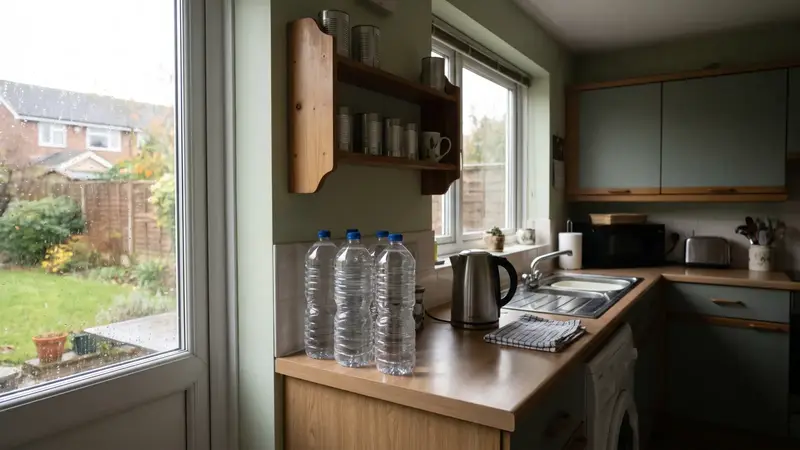 News · 21 OctOnly 4 in 100 adults have three days of bottled water at home, the government's survey shows
 News · 21 OctFood inflation held at 1.3%. Wholesale cabbage and cauliflower are up a third. Both are true
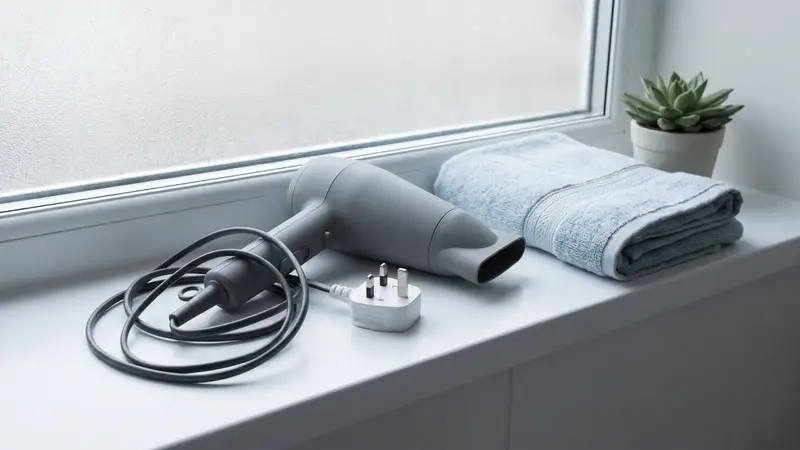 News · 21 OctAldi recall: shoppers warned of hairdryer electric shock or fire risk. How to check yours
Keep reading
All weather, storms & flooding guides →Repair or replace your boiler? An honest way to decide
An engineer has quoted for a repair. How age, parts, repeat breakdowns, safety labels and the size of the quote…
Is a polar vortex coming for the UK this winter? What the forecasts say
Headlines say a polar vortex is set to hit Britain this winter and that British Gas has told households to stockpile…
Storm damage: who pays for a fallen tree, a blown-down fence or lost roof tiles?
What counts as a storm for home insurance, how the ombudsman settles disputes, who pays for fallen trees, fences and…
