Is it illegal to leave your car running to defrost it? The law, fines and insurance
What the Highway Code and the regulations say about running the engine to defrost your car, idling fines, insurance if it is stolen, and clearing it legally.
If you walk away from it on a road, yes: Highway Code rule 123 says you MUST NOT leave a parked vehicle unattended with the engine running. On a private drive it depends on whether the public has access to it, but the theft and insurance risks are the same. Staying with the car while you clear the glass is different, and official guidance from the Welsh Government and Newcastle City Council treats de-icing the windows before a journey as a reason to run the engine. Police can issue a £50 fixed penalty for breaking the regulations behind the rule, councils in England and Scotland £20 for needless idling, and Welsh councils £75 to £150 from 30 September 2026. If the car is stolen with the keys in it, your insurer may refuse the claim.
By Tom Calder · Updated 24 September 2026 · Sourced to the Highway Code, legislation.gov.uk, the Welsh Government, the Financial Ombudsman Service, councils, police, the NHS, the RAC and the AA
What the law says about a running engine
The rule is Highway Code rule 123, and it is a MUST: “You MUST NOT leave a parked vehicle unattended with the engine running or leave a vehicle engine running unnecessarily while that vehicle is stationary on a public road.” It adds that if you are likely to be stationary for more than a couple of minutes you should apply the parking brake and switch off, and that running the engine is permissible in traffic or for diagnosing faults. Defrosting is not mentioned either way.
Two regulations sit behind it. Regulation 107 of the Road Vehicles (Construction and Use) Regulations 1986 says no one may leave a motor vehicle on a road “which is not attended by a person licensed to drive it unless the engine is stopped” and the parking brake set. Regulation 98 requires the driver of a stationary vehicle to stop the engine, and any other machinery on it, “so far as may be necessary for the prevention of noise or of exhaust emissions”. The Code, which applies in England, Scotland and Wales, marks legal requirements with MUST and says disobeying one is a criminal offence. Northern Ireland’s own Highway Code has the same rule 123, backed by its own regulations, so the fines on this page are for Great Britain.
Walking away while it defrosts
Leaving the car unattended has no minimum time in either rule 123 or regulation 107, and the regulation’s only exceptions cover vehicles being used for fire and rescue, police or ambulance purposes, and vehicles parked safely whose engine is needed to drive machinery forming part of, or mounted on, them. Defrosting is not listed. Starting the car on the street and going back indoors while the windscreen clears is exactly what rule 123 prohibits. The Code’s own security advice is to remove the key and lock the car “even if you only leave it for a few minutes”.
On your own drive the legal position is less clear-cut. Regulation 107 applies “on a road”, and the Road Traffic Act 1988 defines a road in England and Wales as “any highway and any other road to which the public has access”, with a similar definition for Scotland. The Highway Code says that can take in “many roadways and driveways on private land”, but a private drive the public has no access to is generally not a road, and whether yours counts depends on the facts. The theft and insurance points below apply wherever the car is parked.
Sitting with it while the glass clears
Staying with the car changes the question to whether the engine is running “unnecessarily”. Rule 123 does not define the word, and regulation 98 does not mention defrosting. The official guidance we found that does mention it treats running the engine to clear the glass before a journey as a legitimate reason. The Welsh Government lists “de-icing and de-misting windows for safety before making a journey” among the occasions you may need to idle, and Newcastle City Council gives defrosting a windscreen for a few minutes as an example of when drivers will not be penalised. That is guidance, not an exemption written into the law.
Warming up for comfort is treated differently: the Welsh Government lists “operating heating/cooling systems for comfort” as an unacceptable reason. In practice, run the engine while you scrape and brush, then set off once every window is clear, rather than sitting in a warm, parked car. And the person with the car has to be a driver: regulation 107 only counts it as attended by someone “licensed to drive it”.
Idling fines: who issues them and how much
In England, the Road Traffic (Vehicle Emissions) (Fixed Penalty) (England) Regulations 2002 let councils authorise officers to tell the driver of a vehicle stationary on a road to switch off, and to issue a fixed penalty for needless idling. The penalty is £20, rising to £40 if it is not paid in time. Refusing an officer’s request to switch off is a separate offence, with a fine of up to £1,000 if it goes to court.
Enforcement depends on your council. Those that do it, such as Newcastle and Kensington and Chelsea, describe asking drivers to switch off first, with the £20 penalty for those who refuse. Scotland’s regulations also set £20, rising to £40 if unpaid. In Wales the £20 penalty is replaced from 30 September 2026: councils set their own amount, or a scale, between £75 and £150, and must have published it on their website before an offence is committed.
The police can act too, because breaking regulation 98 or 107 is an offence under section 42 of the Road Traffic Act 1988. It can be dealt with by a £50 fixed penalty, with no penalty points, or by a fine of up to £1,000 for a car if it goes to court.
If the car is stolen: the insurance question
Motor policies can exclude theft when the keys were left in or around the car, or when it was left unattended, and the Financial Ombudsman Service lists both among the reasons insurers turn down theft claims. When a complaint reaches it, the Ombudsman checks that the exclusion was clearly highlighted when the policy was sold, and considers how close the driver was to the car and whether they could reasonably have stopped the theft.
In one published case, a driver left his car on the drive with the keys in the ignition and the engine running to de-ice it, and it was stolen while he was upstairs. The Ombudsman found the insurer had acted fairly in refusing the claim: the car was out of sight, and the “keys in car” exclusion had been clearly highlighted. Staffordshire Police say thieves look out for vehicles left running on frosty mornings, and on one morning in January 2026 two vehicles left to defrost were taken from driveways in Stoke-on-Trent. Check your policy for a keys-in-car or unattended-vehicle exclusion before the first frost.
Clearing the car: what rule 229 requires
Rule 229 lists what has to be clear before you set off: “you MUST be able to see, so clear all snow and ice from all your windows” and “you MUST ensure that lights are clean and number plates are clearly visible and legible”. It adds that mirrors should be clear and windows demisted thoroughly. The law behind the first line, regulation 30 of the Construction and Use Regulations, requires all glass to be kept so that it “does not obscure the vision of the driver” while the car is driven on a road.
The number plate law is strict. Under section 43 of the Vehicle Excise and Registration Act 1994, a plate that is “in any way” obscured, or not easily distinguishable, is an offence with a fine of up to £1,000, unless you can show you took all reasonably practicable steps to keep it clear. A letterbox scraped in the windscreen does not meet rule 229, and the RAC’s advice is never to drive with only a small viewing hole cleared. Once the car is clear, our guide to driving in snow and ice covers the Highway Code’s rules for the road itself.
Snow on the roof
Rule 229 also says to “remove all snow that might fall off into the path of other road users”. That line is advice rather than a MUST, but the Highway Code says its advisory rules can be used in evidence in court to establish liability. As the RAC points out, snow left on the roof can fall onto your own windscreen while you drive or fly into the path of another car.
The quick way to defrost, and what not to do
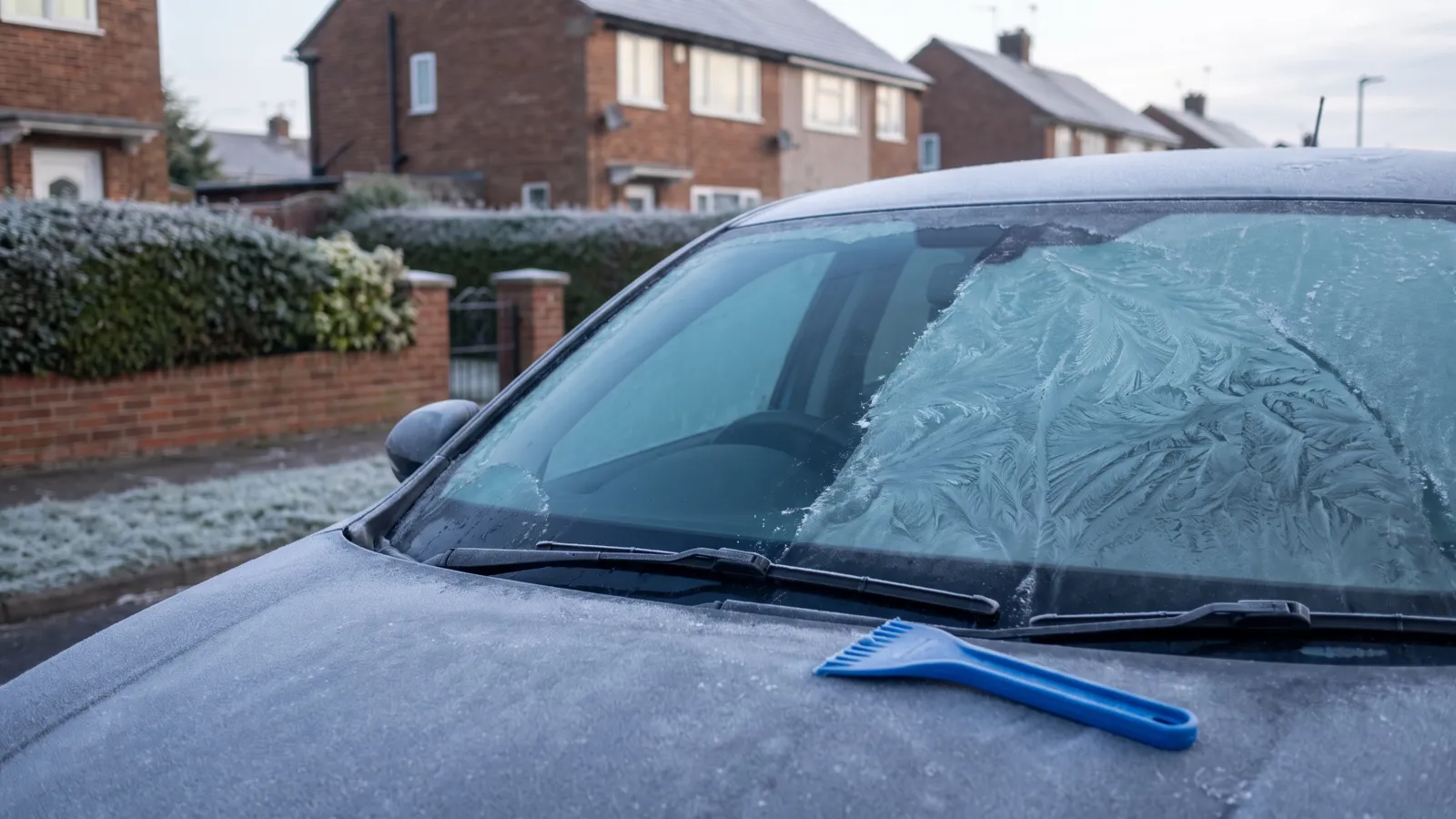
The AA’s routine keeps you beside the car throughout. Make sure the wipers are switched off before you start the engine: if they are frozen to the glass, the wiper motor can be damaged or the rubber torn. Start the engine, send warm air to the windscreen, switch on the rear screen heater and any heated mirrors, and turn on the air conditioning, which dries the air and stops the glass misting. Then use the time: brush off the snow, spray de-icer and scrape, and do not drive until all the glass is clear. If you need to go back indoors, switch off and lock the car.
Never pour hot or boiling water on the glass. The RAC says boiling water will likely crack it, an effect known as thermal shock, and the AA advises against even lukewarm water, which can still crack the glass, especially if it is already chipped, and can refreeze on the wipers. Never run the engine inside a garage to warm the car either: the NHS says turning on a vehicle engine in an enclosed space such as a garage can cause a build-up of carbon monoxide.
Two habits make frosty mornings quicker. A sheet of cardboard across the windscreen overnight, which the AA suggests, stops it icing up, and the Highway Code’s rule 228 puts de-icer and an ice scraper first in the kit it recommends for winter journeys. Our car kit builder sizes a winter car kit for whoever travels with you, and our winter driving kit page compares the options.
Common questions
Is it illegal to leave your car running to defrost it?
If you leave it unattended on a road, yes: Highway Code rule 123 says you MUST NOT leave a parked vehicle unattended with the engine running, backed by regulations 98 and 107 of the Construction and Use Regulations. Staying with the car while you clear the glass is different. Rule 123 targets engines left running unnecessarily, and the Welsh Government and Newcastle City Council both treat de-icing the windows before a journey as a legitimate reason.
Can I leave my car running on my driveway to defrost it?
The law is less clear-cut there. Regulation 107 applies on a road, which the Road Traffic Act 1988 defines in England and Wales as “any highway and any other road to which the public has access”, so it depends on whether the public has access to your drive: a private drive the public cannot use is generally not a road. Whatever the legal position, Staffordshire Police say thieves look out for vehicles left running on frosty mornings, and insurers can refuse a claim when the keys were left in the car. Stay with it, or switch off and lock it.
How much is the fine for leaving your engine running?
Councils in England and Scotland can issue a £20 fixed penalty for needless idling, rising to £40 if unpaid, and in England refusing an authorised officer’s request to switch off is a separate offence with a fine of up to £1,000 in court. In Wales, from 30 September 2026, councils set their own penalty of between £75 and £150 in place of the £20 one. Police can also deal with an engine left running as an offence under section 42 of the Road Traffic Act 1988: a £50 fixed penalty with no penalty points, or a fine of up to £1,000 for a car in court.
Can you be fined for driving with a frosted windscreen?
Yes. Rule 229 says you MUST be able to see, so clear all snow and ice from all your windows. The law behind it, regulation 30 of the Construction and Use Regulations, requires glass that does not obscure the driver’s vision, and breaking it is an offence under section 42 of the Road Traffic Act 1988, with a fine of up to £1,000 for a car in court. Number plates MUST be clearly visible too: an obscured plate is an offence under section 43 of the Vehicle Excise and Registration Act 1994, also with a fine of up to £1,000.
Will my insurance pay out if my car is stolen while it defrosts?
It may not. Policies can exclude theft when the keys were left in or around the car or it was left unattended, and the Financial Ombudsman Service found an insurer acted fairly in refusing a claim for a car stolen from a driveway while it de-iced with the keys in the ignition. Check your policy wording for a keys-in-car or unattended-vehicle exclusion. The AA says this kind of theft even has a name: “frosting”.
Can I pour hot water on a frozen windscreen?
No. The RAC says boiling water will likely crack the glass through thermal shock, and the AA advises against even lukewarm water, which can still crack the glass, especially if it is chipped, and can refreeze on the wipers. Use the car’s heater and air conditioning, with de-icer and a scraper on the outside, and stay with the car while the engine runs.
Sources (30)
- The Highway Code — General rules, techniques and advice for all drivers and riders (rules 103 to 158), gov.ukrule 123: the driver and the environment
- The Highway Code — Driving in adverse weather conditions (rules 226 to 237), gov.ukrules 228 and 229: winter kit, clearing windows, lights, plates and roof snow
- The Highway Code — Introduction, gov.ukwhat MUST and should mean; the Code applies in England, Scotland and Wales
- The Highway Code — Annex 4: The road user and the law, gov.ukthe statutory definition of a road, and why it can take in many private roadways, driveways and car parks
- The Highway Code — Annex 6: Vehicle maintenance, safety and security, gov.ukremove the key and lock the car even for a few minutes
- The Highway Code for Northern Ireland — Rules and advice for drivers and riders (103 to 158), nidirectrule 123, backed by Northern Ireland’s own regulations
- Road Vehicles (Construction and Use) Regulations 1986, regulation 98: stopping of engine when stationary, legislation.gov.uk
- Road Vehicles (Construction and Use) Regulations 1986, regulation 107: leaving motor vehicles unattended, legislation.gov.uk
- Road Vehicles (Construction and Use) Regulations 1986, regulation 30: view to the front, legislation.gov.uk
- Road Traffic Act 1988, section 192: the definition of a “road” (any highway and any other road to which the public has access), legislation.gov.uk
- Road Traffic Act 1988, section 42: breach of construction and use requirements, legislation.gov.uk
- Road Traffic Offenders Act 1988, Schedule 2, legislation.gov.uksection 42: a level 3 fine for a car, no endorsement
- Road Traffic Offenders Act 1988, Schedule 3, legislation.gov.uk (section 42 is a fixed penalty offence)
- The Fixed Penalty Order 2000, Schedule 1, legislation.gov.ukitem 41: £50 for other fixed penalty offences
- Road Traffic (Vehicle Emissions) (Fixed Penalty) (England) Regulations 2002, legislation.gov.ukregulations 6, 8, 12, 13 and 17: council officers, the £20 penalty rising to £40, and the offence of refusing to switch off
- Road Traffic (Vehicle Emissions) (Fixed Penalty) (Scotland) Regulations 2003, legislation.gov.ukregulation 8: £20 for a stationary idling offence; regulation 18: rising to £40 if unpaid
- Road Traffic (Vehicle Emissions) (Fixed Penalty) (Wales) (Amendment) Regulations 2026, legislation.gov.ukpenalties of £75 to £150, set and published by each council before an offence, in force 30 September 2026
- Welsh Government — Tackling stationary engine idling (updated 17 March 2026)
- Newcastle City Council — Vehicle engine idling
- Royal Borough of Kensington and Chelsea — Idling engines: don’t be idle (updated 13 July 2026)
- Vehicle Excise and Registration Act 1994, section 43: obscured registration mark, legislation.gov.uk
- Sentencing Act 2020, section 122: the standard scale of fines, legislation.gov.uklevel 3 is £1,000 for offences since 1 October 1992
- Criminal Procedure (Scotland) Act 1995, section 225: the standard scale in Scotland, legislation.gov.uk (level 3 is £1,000)
- Financial Ombudsman Service — Vehicle theft: how it handles complaints about rejected claims
- Financial Ombudsman Service — Case study: a consumer leaves his car running and unattended
- Staffordshire Police — Reminder to never leave vehicles unattended following thefts (7 January 2026)
- NHS — Carbon monoxide poisoning
- RAC — How to de-ice your car (27 January 2026)
- RAC — Is it illegal to drive with snow on your car?13 February 2026; cited for why roof snow matters, not the law
- The AA — The best way to defrost a windscreen
PreparedBritain is independent and not affiliated with HM Government.
The Emergency Kit Checklist
The GOV.UK Prepare essentials on one printable page — tick them off as you go and keep it with the kit. Free, no catch.
Download it straight away. We'll also send the occasional briefing when something genuinely matters — severe weather, live incidents, real price drops. Nothing else.
Keep reading
All weather, storms & flooding guides →Can you be sued for clearing snow and ice outside your house?
GOV.UK says you’re unlikely to be sued if you clear snow and ice carefully. The council’s legal duty, how to clear a…
Is a ‘snow bomb’ heading for the UK? How to read winter weather headlines
Every winter brings maps of Britain turned blue and an “exact date” snow will hit. The maps are automated…
What this record El Niño means for a UK winter (and what it doesn't)
The Met Office says this El Niño is now the strongest on record. For Britain that means a wetter, stormier autumn…