Driving in snow and ice: the Highway Code rules, technique and when not to travel
Highway Code rules 228–231 explained: clearing snow and ice legally, tyres, gentle-input technique, black ice, and when the right call is not to drive.
By Tom Calder · Updated 12 August 2026 · Sourced to gov.uk & the Met Office
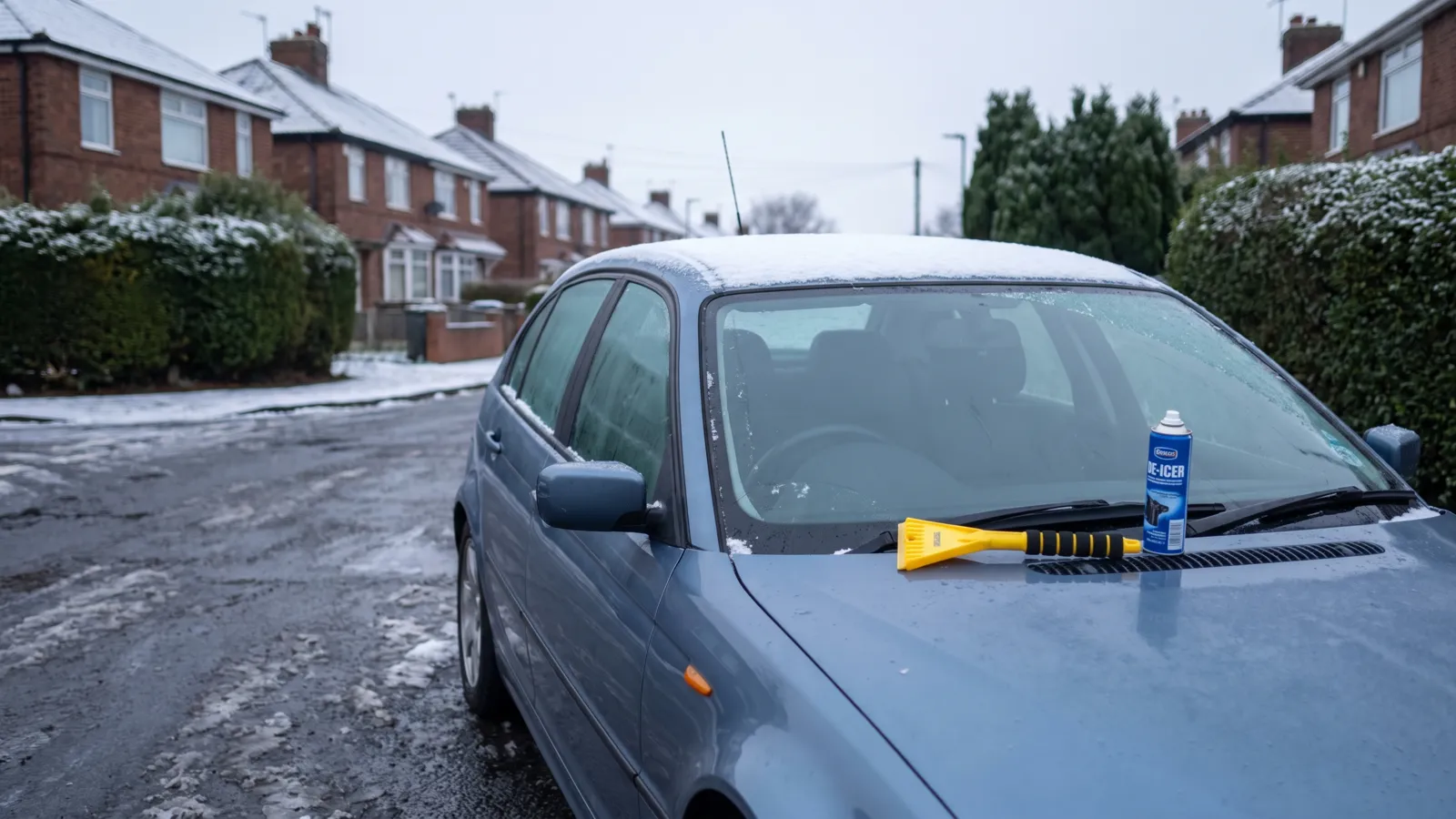
What the Highway Code actually says
The Highway Code deals with snow and ice in four rules, 228 to 231, and the first of them settles the biggest question before you reach for the keys. Rule 228 says to check the forecast for warnings of icy or snowy weather and — in the Code's own capitals — "DO NOT drive in these conditions unless your journey is essential". Everything the Code then says about technique assumes you have already decided the journey genuinely needs to happen.
The wording matters. Where a rule says MUST or MUST NOT, it describes a legal requirement backed by a named regulation, and breaking it is an offence. Where it says "should", it is advice — though advice that can still be cited in evidence in court to help establish liability, careless driving included. Rules 228–231 contain both kinds, and this guide flags which is which.
Before you set off: clearing the car is a legal duty
Rule 229 sets out the pre-departure checks, and two of them are law. You MUST be able to see, so clear all snow and ice from all your windows — not a letterbox-sized patch on the driver's side. That traces to regulation 30 of the Road Vehicles (Construction and Use) Regulations 1986, which requires a full view of the road ahead. You MUST also ensure your lights are clean and your number plates are clearly visible and legible.
The roof is the question everyone asks. There is no offence called "driving with snow on your roof", but Rule 229 tells you to remove any snow that might fall into the path of other road users — and if a slab slides over your windscreen or onto the car behind, you can be dealt with for driving without due care or for using a vehicle in a dangerous condition. A soft brush clears a roof in under a minute.
Demist the inside thoroughly, clear your mirrors, and budget ten unhurried minutes with a scraper and de-icer rather than pulling away half-blind. A winter driving kit that lives in the car from November makes this routine rather than a scramble.
Tyres and pressures: the legal floor is not a winter target
Cars MUST have at least 1.6mm of tread across the central three-quarters of the tyre, around its whole circumference, and tyres MUST be correctly inflated to the manufacturer's specification — both requirements sit in Annex 6 of the Highway Code, under the Construction and Use Regulations. Grip on snow falls away as tread wears long before the legal limit, so tyres near 2mm going into winter are better replaced ahead of the season than after it.
Ignore the persistent tip about letting air out for extra grip. It does not improve traction on ice, it worsens braking and stability, and it takes you outside the manufacturer's specification the law requires. Check pressures when the tyres are cold — monthly, and before any long winter journey; a small plug-in inflator makes this a two-minute job. Winter tyres are not required by UK law: their softer compounds are designed for temperatures below about 7°C, and they earn their cost on rural, hilly or untreated roads far more than on short, gritted urban runs.
On the road: high gear, gentle inputs, ten times the room
Rule 231 is close to a checklist: drive at a slow speed in as high a gear as possible, and accelerate and brake very gently. A high gear keeps the torque reaching the wheels low, which is exactly what you want when grip is scarce. The Code stops short of naming a gear for moving off, but the technique driving instructors and breakdown organisations teach is to pull away in second, easing the clutch to avoid wheelspin. Automatics with a winter or snow mode should use it.
Leave enormous room. Rule 230 warns that stopping distances can be ten times greater than on dry roads, and Rule 126 says the gap to the vehicle in front — at least two seconds on high-speed roads — should be at least doubled in the wet and can need to be up to ten times greater on ice: twenty seconds, not two. Treat bends as no-braking zones: brake progressively on the straight before the bend, then steer smoothly round it with no sudden inputs.
Black ice announces itself by silence. Rule 231 notes that on ice, tyres make virtually no noise — if the road goes quiet and the steering suddenly feels light and unresponsive, you are on it. Do not brake; ease off the accelerator and keep the steering as straight as you can until grip returns. Rule 230 fills in the rest: be prepared for conditions to change over relatively short distances, take care when overtaking vehicles spreading salt or de-icer, and do not overtake a snowplough unless the lane you intend to use has been cleared — ploughs throw snow out to either side.
Snow socks and chains: a fair test
Neither is required by UK law, and neither is the cure-all the marketing implies. Chains give real traction, but only on a compacted snow layer; on cleared or gritted tarmac they need to come off, because they damage both road and tyre. Most UK roads you would actually use are treated within hours, so the realistic chain user is someone on upland rural roads that stay snow-covered — not a commuter.
Snow socks — fabric covers for the driven wheels — are the pragmatic middle option. They genuinely help you pull away and hold grip on packed snow, fit in minutes without tools, and cost a fraction of a winter tyre set. Their limits: they wear fast on bare tarmac and manufacturers typically cap speeds at around 30mph, so they are a get-out-of-a-side-street tool, not a travel-through-a-warning tool. If you park on a hill or visit rural relatives in winter, they earn a place in the boot alongside a proper car emergency kit — but they do not change the arithmetic of an amber or red warning.
The decision framework: when not to travel
Match the decision to the Met Office warning, not to how the road looks from your window. Under a yellow warning, most journeys can go ahead with extra time, a planned route and a check that no further snowfall is forecast along it — the final item on Rule 229's checklist. Under amber, the Met Office advice is to think about changing your plans, and the Highway Code's "essential journeys only" test starts to bite: ask whether the journey has to happen today at all.
A red warning means dangerous weather is expected, it is very likely there will be a risk to life, and the Met Office advice is to avoid travelling where possible. If a journey genuinely cannot move, carry Rule 228's kit — de-icer and scraper, torch, warm clothing and boots, first aid kit, jump leads and a shovel, plus a warm drink and food — keep your phone charged, and tell someone your route and arrival time. Check the live picture on our weather warnings tracker before you commit, and if a thaw has left standing water on the route, read our guide to driving in floods first.
Common questions
Is it illegal to drive with snow on your car roof?
There is no specific offence of driving with snow on the roof, but Highway Code Rule 229 tells you to remove any snow that might fall into the path of other road users. If it slides over your windscreen or onto another vehicle, you can be dealt with for driving without due care and attention or for using a vehicle in a dangerous condition. Clear it before you set off.
Is it illegal to drive with only a small patch of windscreen cleared?
Effectively, yes. Rule 229 says you MUST be able to see, so clear all snow and ice from all your windows — the underlying law, regulation 30 of the Road Vehicles (Construction and Use) Regulations 1986, requires a full view of the road ahead. Driving with a "porthole" can bring a fine and, where it amounts to careless driving, penalty points.
Can I leave my car running unattended to defrost it?
Not on a public road: Highway Code Rule 123 says you MUST NOT leave a parked vehicle unattended with the engine running (Construction and Use Regulations 98 and 107). On a private driveway the regulation does not apply, but an unattended running car is a theft target and many insurers refuse claims where the keys were left in the vehicle. Stay with the car while it defrosts.
Do I need winter tyres in the UK?
No — there is no UK legal requirement for winter tyres, socks or chains. The legal duties are at least 1.6mm of tread and correct inflation to the manufacturer's specification. Winter and all-season tyres are designed for temperatures below about 7°C and are most worthwhile if you regularly drive rural, hilly or untreated roads; for short journeys on gritted urban routes the case is much weaker.
What gear should I pull away in on snow or ice?
Second gear where possible, easing the clutch gently to limit wheelspin — the technique driving instructors and breakdown organisations recommend; the Highway Code itself does not name a gear for pulling away. Once moving, Rule 231 says to drive at a slow speed in as high a gear as possible, accelerating and braking very gently. In an automatic, use the winter or snow mode if the car has one.
Should I let some air out of my tyres for extra grip?
No. It does not improve grip on ice, it worsens braking and stability, and tyres MUST legally be inflated to the vehicle manufacturer's specification (Highway Code Annex 6). Check pressures when the tyres are cold and keep them at the recommended figure all winter.
Sources: The Highway Code — Driving in adverse weather conditions (rules 226 to 237), gov.uk · The Highway Code — Annex 6: Vehicle maintenance, safety and security, gov.uk · The Highway Code — General rules, techniques and advice for all drivers and riders (rules 103 to 158), gov.uk · Met Office — Weather warnings guide (National Severe Weather Warning Service). PreparedBritain is independent and not affiliated with HM Government.
The Emergency Kit Checklist
The GOV.UK Prepare essentials on one printable page — tick them off as you go and keep it with the kit. Free, no catch.
Download it straight away. We'll also send the occasional briefing when something genuinely matters — severe weather, live incidents, real price drops. Nothing else.
Keep reading
All weather, storms & flooding guides →After a flood: the first 48 hours, drying out and the insurance claim
What to do after a flood in the UK: safety checks before re-entry, contaminated-water hygiene, drying out properly,…
Boiler stopped in the cold? Thawing a frozen condensate pipe safely
How to tell a frozen condensate pipe from a real boiler fault, thaw it safely with warm water, reset the boiler, and…
Flood alerts vs flood warnings: what each level means and what to do
What flood alerts, flood warnings and severe flood warnings mean, how much time each typically gives you, and the…