After a flood: the first 48 hours, drying out and the insurance claim
What to do after a flood in the UK: safety checks before re-entry, contaminated-water hygiene, drying out properly, and how to run the insurance claim.
By Tom Calder · Updated 12 August 2026 · Sourced to gov.uk, UKHSA, the FSA & Flood Re
Before you set foot back inside
Do not go back into a flooded property until the emergency services confirm it is safe — that is the government's first instruction, and it exists because the dangers after a flood are mostly invisible. Floodwater undermines floors and walls, shifts heavy furniture, and can leave structural damage that only shows when you put weight on it. Check whether warnings are still in force for your area before you travel back, and if anything about the building looks wrong — cracked walls, doors that no longer close, a sagging ceiling — stay out and report it to your local council.
The non-negotiables are water, gas and electricity. Government guidance is not to turn any of them back on until your utility company or a qualified engineer has checked they are safe. If the water reached sockets, appliances or the consumer unit, do not touch the switches — a flooded electrical installation can stay dangerous long after it looks dry. The same applies to gas: have the boiler and appliances checked by a Gas Safe registered engineer before they are used again, and if you smell gas at any point, leave and call the National Gas Emergency line on 0800 111 999 (in Northern Ireland, 0800 002 001). Floodline (0345 988 1188) can advise on everything else, around the clock.
Evidence first: the hour that decides the claim
Ring your insurer's emergency claims line before you move a single item — most insurers run them 24 hours a day, and buildings and contents policies usually include alternative accommodation cover if you cannot stay in the home, so ask about that in the first call. Then document everything. Photograph and video every room before any clean-up starts, making sure the line the water reached is visible on the walls — government guidance says explicitly to photograph the damage and the flood water line before you begin clearing up. It is also worth marking the peak level in each room in pencil before it fades, so the loss adjuster can still see it weeks later.
Throw nothing away until the insurer has agreed to it. Photograph damaged items where they sit, keep a running list with approximate ages and values, and keep a cutting of any carpet you eventually remove so the adjuster can verify the quality. Keep every receipt from day one — accommodation, meals, cleaning materials, dehumidifier hire — because reasonable costs are usually recoverable. If your policy documents were lost in the water, don't worry: insurers can find your policy from your name and postcode. For next time, papers such as policies, deeds and passports are exactly what a waterproof document bag is for.
The first 48 hours: hygiene, and what to bin
Treat all floodwater as contaminated. Government public-health advice is blunt on this: it can carry sewage, chemicals and other contaminants, so wear waterproof gloves and wellingtons for any contact, cover cuts with waterproof plasters, wash your hands thoroughly and often, and keep children and pets away from floodwater and flooded rooms until cleaning is done. Wash clothing and textiles that have touched floodwater separately, at 60°C.
Food is the simplest decision you will make all week: do not eat anything floodwater has touched. The Food Standards Agency allows one exception — food in water-resistant packaging such as undamaged, sealed tins, which can be kept once the outside is washed clean before storing or opening. If the power went off, government advice is to bin fridge food after four hours without electricity and freezer food after 24 — our power-cut food-safety guide covers the detail — and a fridge or freezer that itself took on floodwater should stay off until it has been checked as safe. Before drinking from the tap, check your water company's website for any advice in force for your area; a boil water notice means exactly what it says.
Clean and disinfect hard surfaces with hot water and detergent, followed by a standard household disinfectant. There is no need for specialist chemicals in most homes — ordinary products, used thoroughly, are what official guidance points to.
Drying out: months, not weeks
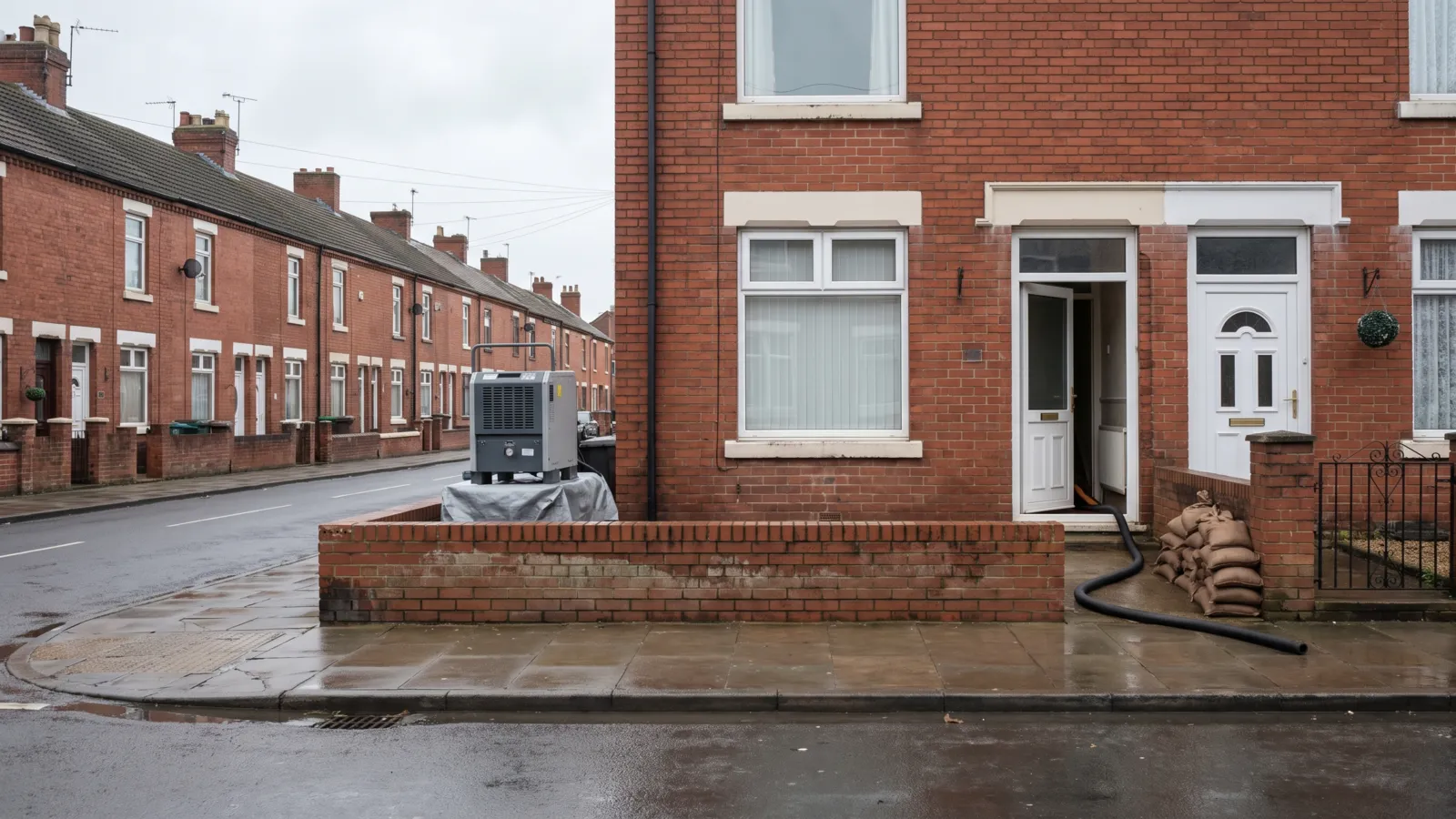
A flooded home dries on the timescale of masonry, not carpets — typically weeks, often months for solid-walled or older properties. The routine is unglamorous: keep air moving through the house whenever weather allows, run heating low and steady rather than blasting it, and run dehumidifiers continuously in the worst-affected rooms, emptying or draining them daily. Your insurer will normally install professional drying equipment; domestic dehumidifiers still earn their keep in the long tail afterwards, and for keeping condensation down once you're living in a part-dried house.
Damp walls grow mould, and mould is a genuine health issue rather than a cosmetic one — government guidance links it to coughs, wheeze and airway infections, with children, older people, pregnant women and anyone with respiratory conditions or weakened immunity most at risk. This is why saturated plaster usually comes off up to above the tide mark, and why reinstatement — replastering, rewiring, redecorating — should not begin until the drying contractor certifies the property dry. Redecorating over damp walls is the classic false economy of flood recovery: the finish fails, and the mould returns behind it.
The claim: adjusters, interim payments and disputes
For anything beyond minor damage, your insurer will appoint a loss adjuster to assess the claim and agree the scope of repairs. Be clear about the relationship: the adjuster is appointed and paid by the insurer. They should act fairly, but they are not your representative. You can hire your own loss assessor to argue your side — they typically charge a percentage of the settlement — but for most straightforward claims, meticulous evidence and written records do the same job for free. Confirm every agreement from meetings and phone calls by email, and ask for an interim payment early if you need to replace essentials before the claim settles.
If the claim stalls or the offer looks wrong, complain formally to the insurer first; if you are still unhappy after its final response, or after eight weeks with no final response, you can take the complaint to the Financial Ombudsman Service at no cost — within six months of the final response. If you have no insurance at all, contact your local council — government guidance points flooded households to councils for emergency housing help, and hardship grants are sometimes activated after major flooding.
Flood Re, Build Back Better and repairing smarter
If your home has flooded, your renewal quote is the next worry — and this is what Flood Re exists for. It is a joint initiative between the insurance industry and the government that caps the flood element of home insurance for higher-risk properties, and most homes built before 1 January 2009 are eligible through ordinary insurers. You do not apply to it directly; you simply shop around at renewal, because participating insurers use it behind the scenes.
Better still, repair smarter than you were built. Under Flood Re's Build Back Better scheme, participating insurers — a list that includes most of the biggest household names, so ask yours — can pay up to £10,000 on top of your flood claim for resilience measures: flood doors and barriers, non-return valves on drains, raised sockets and meters, hard flooring in place of carpet downstairs, waterproof membranes and plaster. Raise it before repairs are scoped, not after. Then check your longer-term exposure and defences, so the next flood does a fraction of the damage.
Common questions
How long does a flooded house take to dry out?
Usually weeks, and often several months for older or solid-walled properties — masonry holds a remarkable amount of water. Professional drying equipment installed by the insurer speeds it up, but reinstatement (replastering and redecorating) should not start until the drying contractor certifies the property dry. Rushing this stage is the most common cause of mould problems a year later.
Can I throw away ruined carpets before the loss adjuster visits?
Not without agreeing it with your insurer first — the claims line will tell you what evidence they need before anything goes. Photograph damage where it sits before you clear up. If contaminated items must go for hygiene reasons, photograph them thoroughly in place and keep a cutting of carpets or fabrics so the adjuster can verify the quality you are claiming for.
Who pays for somewhere to live while my home is repaired?
Buildings and contents policies usually include alternative accommodation cover (sometimes called loss of use) while the home is uninhabitable. Ask about it in your first call to the claims line, check the limit — often a percentage of the sum insured or a fixed amount — and keep every receipt. If you are uninsured, your local council can help with emergency housing.
What is Flood Re and is my home eligible?
Flood Re is a joint initiative between the insurance industry and the government that caps the flood element of home insurance premiums for higher-risk homes. Homes built before 1 January 2009 are generally eligible; homes built on or after that date are not, by design, to avoid encouraging building on floodplains. You never deal with Flood Re directly — just shop around at renewal, as participating insurers apply it behind the scenes.
Is it safe to turn the electricity back on myself after a flood?
No. Government guidance is not to turn your water, gas or electricity back on until your utility company or a qualified engineer has checked they are safe. Water and silt inside sockets and cabling can leave the system dangerous even after it looks dry. The same rule applies to gas appliances: Gas Safe registered engineer first, boiler second.
What can I claim under Build Back Better?
If your insurer is signed up to Flood Re's Build Back Better scheme, you can claim up to £10,000 on top of the flood repair costs for resilience measures — flood doors, barriers, non-return valves, raised sockets and meters, waterproof membranes and hard flooring. It applies as part of a flood claim, so raise it with your insurer before the repair scope is agreed.
Sources: GOV.UK — What to do after a flood · UKHSA — Flooding and health: advice for the public · Food Standards Agency — Food safety after a flood: consumer advice · UKHSA/OHID — Health risks of damp and mould in the home · Flood Re — Build Back Better · Flood Re — Eligibility criteria · FCA — How to complain (Financial Ombudsman route). PreparedBritain is independent and not affiliated with HM Government.
The Emergency Kit Checklist
The GOV.UK Prepare essentials on one printable page — tick them off as you go and keep it with the kit. Free, no catch.
Download it straight away. We'll also send the occasional briefing when something genuinely matters — severe weather, live incidents, real price drops. Nothing else.
Keep reading
All weather, storms & flooding guides →Boiler stopped in the cold? Thawing a frozen condensate pipe safely
How to tell a frozen condensate pipe from a real boiler fault, thaw it safely with warm water, reset the boiler, and…
Flood alerts vs flood warnings: what each level means and what to do
What flood alerts, flood warnings and severe flood warnings mean, how much time each typically gives you, and the…
How to drive through flood water — and when you must not
How to drive through flood water safely if you have no choice — the real depth limits (30cm of moving water can…