Best flood protection for UK homes (2026)
If you're in a flood-risk area, a little kept in the garage buys crucial time when water's rising. Here's what genuinely helps hold water back — and what to check against your own flood risk first.
By Tom Calder · Updated 20 September 2026 · 6 products, 3 of 6 price-tracked
Before you buy
Set expectations first: no consumer product flood-proofs a house. What barriers, covers and sandless sandbags buy is time and reduced damage in the common case — shallow, short-lived water — and that's genuinely worth having. Check your actual risk on the Environment Agency's postcode tool before you spend a pound; the right budget for a low-risk home is nearly zero.
Water finds the easy routes: doors, airbricks, and back up through drains. A sensible starter set covers the first two — door barriers or sandless sandbags for thresholds, push-on covers for airbricks — and remembers that most defences top out around 30–60cm; beyond that, water comes through walls and floors and the game becomes moving things up, not holding water back.
Don't count on the council's sandbags: policies vary and many councils prioritise protecting roads and infrastructure, not individual homes, in a live event. And pair the kit with the paperwork — check your insurance covers flood, and if you're in a high-risk area, ask about Flood Re-backed policies, which exist precisely to keep cover affordable.
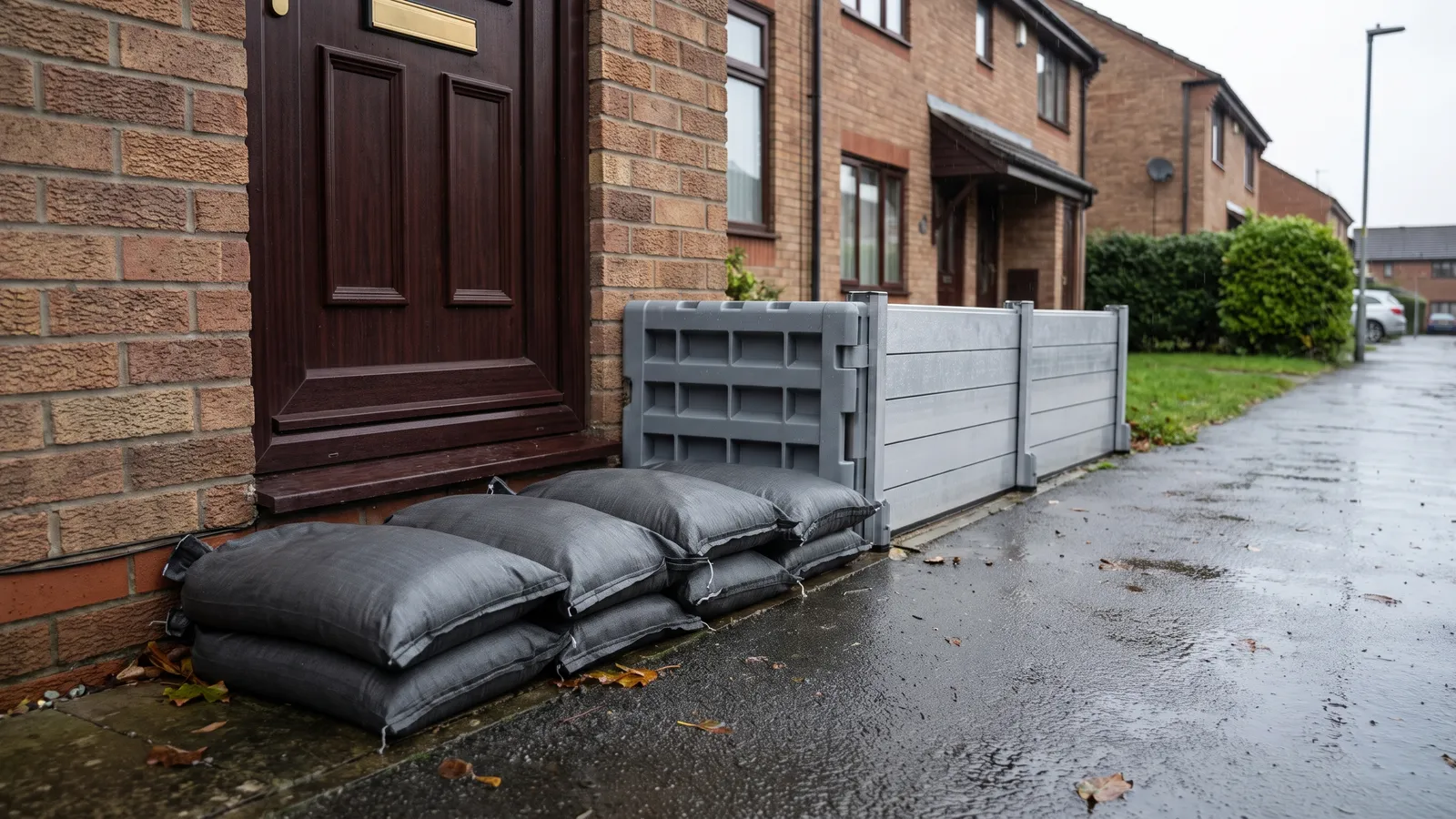
The four types of barrier, and which one fits your house. Door barriers (£150–£500) are the ones people mean by 'flood gates for houses' — a demountable panel that seals a doorway, usually into a frame fitted permanently to the wall. They're the most effective consumer option for a specific opening, and the most expensive. Water-activated and self-inflating barriers (£30–£80 each) swell when wet and lay across a threshold or along a wall — cheap, storable and quick, but low, and only as good as the flat surface underneath. Traditional or sandless sandbags (£1–£6 each) are the flexible option for awkward shapes and are genuinely useful for diverting shallow water, though they seep and were never designed to be watertight. Airbrick covers and non-return valves (£10–£40) close the openings people forget: water comes up through airbricks and back up drains just as readily as it comes under a door.
Two things worth knowing before you spend. First, buy tested kit — the BSI Kitemark scheme covers flood protection products, and an independently certified barrier is worth considerably more than an untested own-brand one at the same price. Second, if you've actually been flooded, ask your council about Property Flood Resilience grants: after major flooding events the government has repeatedly activated a repair grant of up to £5,000 per property, administered by local councils. It's activated per-event rather than always open, so check gov.uk and your council's site after a flood rather than assuming it's available. The National Flood Forum, an independent charity, gives free advice on what's genuinely worth fitting to your particular property.
Top pick: Floodgate Adjustable Door Flood Barrier. A serious, UK-made door barrier that expands to seal a doorway in minutes and holds water to around 60cm without any permanent modification. It is a genuine step up from sandbags for a defined flood risk, but it is a considered purchase rather than a grab-bag item, and it only works on inward-opening doors with a sound frame to seal against.
| Product | Type | Protects up to | Price | |
|---|---|---|---|---|
| Floodgate Adjustable Door Flood BarrierTOP PICK | Adjustable telescopic door barrier (inward-opening doors) | 60 cm | £529.99as of 20 Sep 2026, 12:29 BST · DetailsProduct prices and availability are accurate as of the date/time indicated and are subject to change. Any price and availability information displayed on Amazon.co.uk at the time of purchase will apply to the purchase of this product. | Check price → |
| FloodSax Sandless Sandbags | Sandless self-inflating water-absorbing flood bag (single-use) | 60 cm | — | Check price → |
| Self-Inflating Water-Activated Flood Barrier | Self-inflating water-activated absorbent (gel/crystal) barrier | 9 cm | — | Check price → |
| Submersible Clean/Dirty Water Pump | Mains submersible clean/dirty combination pump (handles particles ~30-35mm) | — | — | Check price → |
| Flood Air Brick Covers (pack) | Removable clip/screw-on cover with waterproof seal | 60 cm | — | See price on Amazon → |
| Hessian Sandbags (pack, unfilled) | Hessian / jute (biodegradable, supplied unfilled) | 30 cm | £12.75as of 20 Sep 2026, 12:29 BST · DetailsProduct prices and availability are accurate as of the date/time indicated and are subject to change. Any price and availability information displayed on Amazon.co.uk at the time of purchase will apply to the purchase of this product. | Check price → |
ⓘ As an Amazon Associate, PreparedBritain earns from qualifying purchases. We may earn a commission when you buy, or a fee when you request a quote, through our links — it never affects what we recommend. Amazon prices come from Amazon's own product data and show the date and time they were retrieved. Prices at other retailers are checked by us, less often. Prices and stock can change at any time, so always check the retailer's price before you buy.
Who it's for: Homeowners in a known flood-risk area with an inward-opening door who want a reusable barrier rather than sandbags.
A serious, UK-made door barrier that expands to seal a doorway in minutes and holds water to around 60cm without any permanent modification. It is a genuine step up from sandbags for a defined flood risk, but it is a considered purchase rather than a grab-bag item, and it only works on inward-opening doors with a sound frame to seal against.
- Reusable and quick to deploy in minutes with no tools, sandbags or permanent building work
- UK-made steel-and-neoprene construction that expands to fit a range of door widths and forms a watertight seal to roughly 60cm
- Widely used by councils and flood-risk households, so it is a known, well-supported product rather than a novelty
- Expensive compared with sandbags or FloodSax, at roughly £450-£490 depending on size
- Only suits inward-opening doors and needs a flat, sound frame and reveal to seal against; it does nothing for water entering via airbricks or walls
Don't buy if Your door opens outward, your property tends to flood through airbricks and walls rather than the doorway, or you are not in a genuine flood-risk area, in which case a cheaper FloodSax/sandbag approach or a whole-property flood plan is the more proportionate spend.
as of 20 Sep 2026, 12:29 BST · Details
Product prices and availability are accurate as of the date/time indicated and are subject to change. Any price and availability information displayed on Amazon.co.uk at the time of purchase will apply to the purchase of this product.FloodSax Sandless Sandbags
3.5Who it's for: Renters, flats and anyone without space to store sand, for shallow doorway flooding and indoor leaks.
A genuinely practical alternative to traditional sandbags: they store flat by the door and expand into a 20-litre barrier once soaked. They handle shallow, slow-moving water and indoor leaks well, but they are single-use and no substitute for a proper barrier against deep or fast flooding.
- Store flat like a pillowcase and weigh under half a kilo dry, so a pack fits in a cupboard with no sand to source or shovel
- Double as absorbent pads indoors for leaks and spills under boilers, radiators and pipes
- Lighter and far cleaner to deploy than filled sandbags, and largely biodegradable for disposal after use
- Single-use and must be soaked in water to activate, so they are no good as an instant dry-side barrier or a reusable defence
- Each row only holds back around 20cm of water; you need to stack several rows (a full box for a 2m doorway) for meaningful height
Don't buy if Don't buy if you face deep or fast-flowing floodwater or want something reusable year after year, a fixed door barrier or reusable flood guard suits that better; FloodSax are for shallow, slow nuisance water and one-off events.
Self-Inflating Water-Activated Flood Barrier
3.5Who it's for: Households facing shallow, slow-rising flooding who want a compact, sand-free defence they can store flat by the door.
A sensible, low-fuss alternative to sandbags for shallow doorway, garage and run-off flooding: they store flat, weigh little dry and swell into a working barrier within a few minutes of contact with water. Just be realistic about the height they reach and the fact they are single-use.
- Store flat and light (roughly 150g dry) then swell to a firm barrier in about 3-5 minutes with any water - far easier to keep to hand than a pile of sandbags
- No sand and no mess; a single small pack replaces a load of traditional sandbags and is quick to deploy
- Good for shallow doorway or garage flooding and for diverting surface run-off
- Single-use: once swollen they cannot be dried and reused, and a single tube only reaches about 9cm, so deeper or faster water overtops them
- They rely on being stacked and held in position, and do not seal perfectly to uneven ground on their own
Don't buy if Don't buy these if you face fast-moving or deep floodwater (more than ankle height) or want a barrier you can reuse year after year - a reusable water-filled barrier, or a proper property-flood-resilience survey, is the better spend.
Submersible Clean/Dirty Water Pump
3.5Who it's for: Clearing standing floodwater from a cellar, garage or utility room after water has already come in.
A sensible, low-cost tool for pumping standing water out once the worst has passed, coping with the silty water a real flood leaves behind. Just remember it clears water rather than stopping it, and it needs mains electricity to run.
- The clean/dirty combination design copes with muddy, gritty floodwater (solids up to roughly 30-35mm) and empties a room far faster than bailing by hand.
- A built-in float switch turns it on and off with the water level, so you don't have to stand over it.
- Widely stocked at Screwfix, Toolstation and Draper for around £50-90 with simple hose fittings, making it affordable insurance if you're in a known flood-risk area.
- It's mains-powered, so it's no help during the power cuts that often come with flooding unless you have a generator.
- On the dirty setting it won't clear the final few millimetres, so you'll still need a mop or wet vacuum to finish the job.
Don't buy if Don't buy this expecting it to keep water out of your home. It only helps after floodwater is already inside, and it relies on mains power a flood may have knocked out. If your priority is keeping water out, spend on flood barriers or sandbags first; if power-cut resilience matters, look at a petrol-driven or battery pump instead.
Flood Air Brick Covers (pack)
3.5Who it's for: Homes in flood-risk areas with air bricks sitting below likely flood level.
A cheap, sensible layer of defence if your air bricks sit low enough to let floodwater in, and the better ones are independently tested (BS 851188/PAS 1188) to around 600mm depth. They only close off one route in, though, so treat them as one part of a wider flood plan rather than the whole answer.
- Inexpensive and quick to deploy when a flood warning comes in
- Reusable year after year, and clip-on types need no drilling
- Quality packs are standards-tested (BS 851188:2019 / PAS 1188-1) to roughly 600mm of water
- Only protect the air bricks, not doors, walls or drains, so water can still enter elsewhere
- Must be fitted correctly with a ~20mm seal margin around each brick, and you need one per air brick
Don't buy if Your likely flood route is through doorways or rising groundwater rather than the air bricks, or you'd be tempted to leave permanent covers on all year, which blocks underfloor ventilation and invites damp. In those cases a proper door barrier or an automatic self-closing air brick is the better spend.
Hessian Sandbags (pack, unfilled)
3.0Who it's for: A cheap, biodegradable stopgap to slow shallow floodwater and steer it away from doors and airbricks.
The traditional, low-cost option and easy to source, but they slow water rather than seal it out, and you still need sand plus the time and muscle to fill and stack them. Sensible to keep a few as a backup, but not a substitute for a proper reusable barrier if your property genuinely floods.
- Inexpensive and widely stocked, so easy to buy ahead or in a hurry
- Natural jute breaks down over time, with no plastic to dispose of
- Versatile beyond flooding, useful for ballast, erosion and general site work
- Supplied empty, so you need sand or aggregate plus the effort to fill and stack them
- Never fully watertight and go heavy, soggy and awkward once used, often single-use after contaminated floodwater
Don't buy if Don't rely on these alone if your home floods regularly or fast, or if you have no sand to hand. A self-inflating alternative like FloodSax or a reusable flood barrier deploys faster and seals better.
as of 20 Sep 2026, 12:29 BST · Details
Product prices and availability are accurate as of the date/time indicated and are subject to change. Any price and availability information displayed on Amazon.co.uk at the time of purchase will apply to the purchase of this product.Get price-drop alerts on these
Prices for 364 tracked products are refreshed daily — last sweep 20 September 2026. Tell us which and we'll email you when one drops.
We verify every product's specifications against at least two independent sources, re-check its UK price and stock on a schedule where we can track it automatically, and cross-check safety-relevant claims against official guidance. Where we've bought and used a product ourselves we say so on its review; where we haven't, our verdict is a considered spec-and-evidence comparison, not a hands-on test — and commissions never change a ranking either way. Read our full methodology →
Guides that go with this
Know your risk, get warnings, and what to do before, during and after a flood — the practical checklist, sourc…
A simple, practical household emergency plan — the official GOV.UK Prepare approach: contacts, meeting points,…
Where to get sandbags in the UK, how to fill and stack them correctly, and why the Environment Agency says flo…
How to drive through flood water safely if you have no choice — the real depth limits (30cm of moving water ca…
Common questions
Do sandless sandbags actually work?
Yes, within their design: the polymer filling absorbs water in minutes and swells into a firm barrier that stacks like the real thing, without storing a tonne of sand. They're one-use once activated, and like all sandbags they slow and divert shallow water rather than sealing it out.
How high can home flood barriers protect?
Most door barriers and sandbag walls are effective to roughly 30–60cm. Above that, water penetrates airbricks, walls and floors regardless — which is why deeper flood risk is answered by moving valuables up and leaving, not by taller barriers.
Will the council give me sandbags in a flood?
Don't rely on it. Policies vary enormously; many councils don't guarantee sandbags for individual homes during an event and prioritise infrastructure. Check your council's published policy — and if you're at risk, hold your own supply.
What are airbrick covers and do I need them?
Push-on or screw-on covers that seal the ventilation bricks near ground level — one of the first routes floodwater takes into a house. If your flood risk is real, they're among the cheapest, most effective items here. Remove them once the risk passes so the house can breathe.
What's a submersible pump for?
Clearing water after the event — a flooded cellar, garden or under-floor void — not fighting a rising flood, which will beat any domestic pump. Get one with a float switch, and never handle mains electrics while standing in water.
What is Flood Re?
A government-backed reinsurance scheme that lets insurers pass on the flood element of eligible home policies, keeping premiums and excesses down for high-risk households. Your insurer applies it automatically — if you've had eye-watering flood quotes, ask specifically about Flood Re-backed policies.
What's the best flood barrier for a house?
For a specific doorway, a demountable door barrier is the most effective consumer option — expect £150–£500, usually with a frame fitted permanently to the wall so the panel can go up in minutes. For longer or awkward runs, water-activated barriers and sandless sandbags are cheaper and more flexible but lower and less watertight. Most flooded homes need a combination: a barrier on the door, covers on the airbricks, and a non-return valve on the drains.
Do inflatable and water-activated flood barriers work?
Within limits, yes. They swell on contact with water and can hold back shallow flooding across a threshold or wall, and they store flat which is their real advantage. But they're low, they rely on a reasonably flat surface to seal against, and they won't handle fast-moving or deep water. Treat them as a way to buy time and reduce damage, not as a flood-proof solution.
How much do flood gates for houses cost?
A demountable door barrier typically runs £150–£500 depending on width and certification, and that's usually per opening — a house with a front door, back door and patio doors needs one each. Professionally installed systems with permanently fitted frames cost more. Water-activated barriers and sandbags are far cheaper per unit but protect far less.
Can you actually flood-proof a house?
Not completely, and be wary of anyone claiming otherwise. What's achievable is 'property flood resilience': barriers, airbrick covers and non-return valves that keep shallow water out for longer, plus internal changes (raised sockets, tiled floors, moving valuables upstairs) that mean a flood costs you far less to recover from. For serious or fast-moving flooding, the plan is to leave safely, not to hold the water back.
Is there a grant for home flood protection?
Sometimes. After major flooding events the government has repeatedly activated a Property Flood Resilience Repair Grant of up to £5,000 per affected property, paid through local councils. It's activated per-event rather than permanently open, so check gov.uk and your own council's website after a flood. The National Flood Forum also gives free independent advice on what's worth fitting.