How to make a household emergency plan
A simple, practical household emergency plan — the official GOV.UK Prepare approach: contacts, meeting points, utilities, kit and the people who need extra help.
By Tom Calder · Updated 20 July 2026 · Sourced to GOV.UK Prepare & the British Red Cross
Why a plan beats panic
The single most useful thing you can do for emergencies isn't buying kit — it's spending twenty minutes agreeing a plan while everyone's calm. Prepare, the UK Government's official emergency-preparedness campaign (launched by the Deputy Prime Minister in May 2024), is built around exactly this: a household that has talked through what to do copes far better than one improvising in the moment.
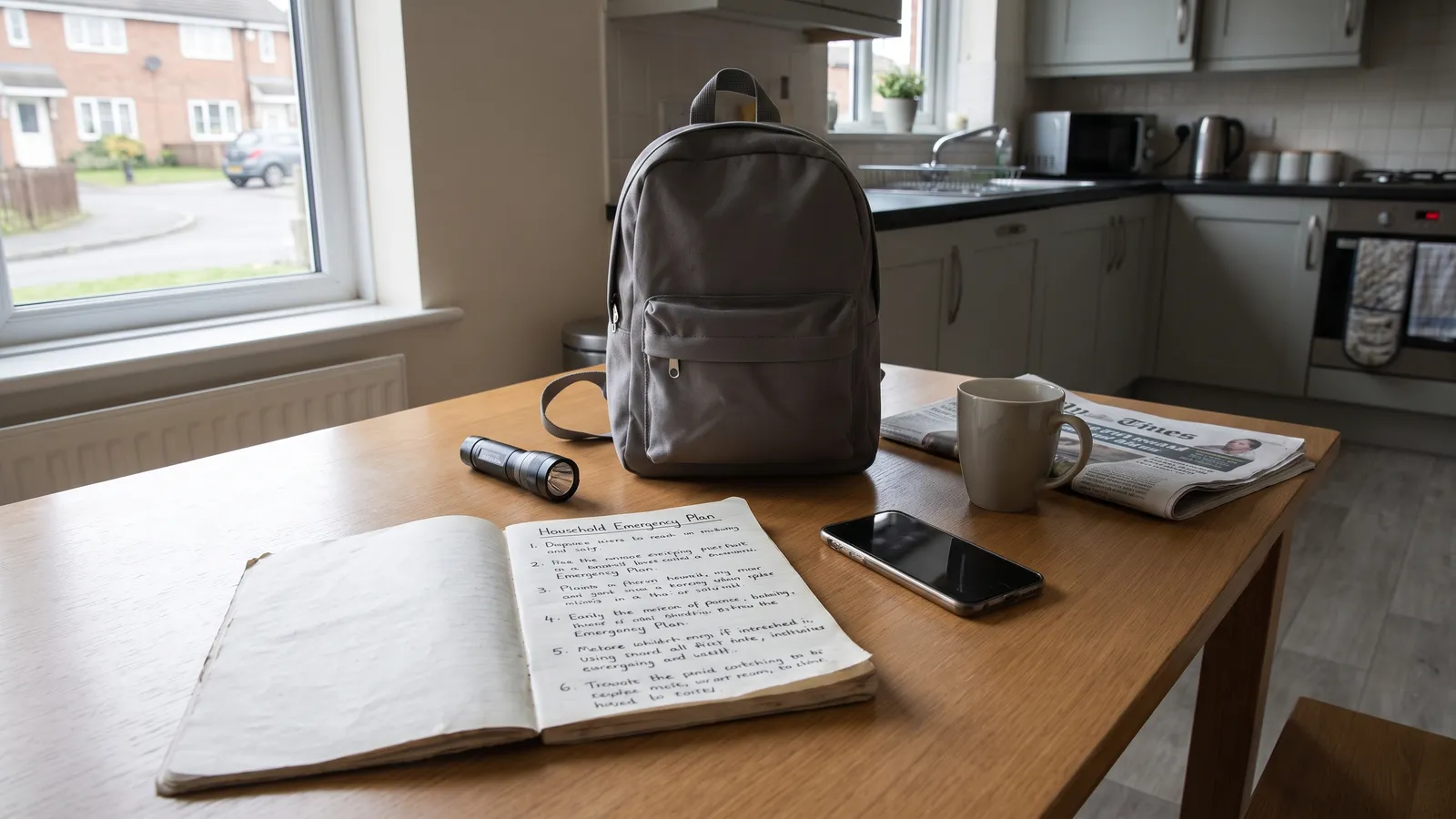
A plan doesn't need to be elaborate. It's a short, shared understanding of how you'd contact each other, where you'd meet, how to make the house safe, and who needs extra help — written down so it works even when phones don't.
The core of the plan: contacts and a meeting point
The British Red Cross boils good planning down to five steps: know the risks, make a plan, look out for others, prepare your home, and get supplies ready. Two elements do most of the work. First, agree a meeting place away from the home and clear of hazards, in case you can't get back inside or can't reach each other. Second, choose someone outside your immediate area as a contact everyone can check in with — local phone networks often jam in an emergency, but an out-of-area relative can relay messages.
Write the key numbers on paper, not just in a phone that might be dead: your out-of-area contact, family mobiles, and the emergency numbers below. A plan that lives only on a charged smartphone isn't a plan.
The numbers to write down
Four free numbers cover most household emergencies. 999 for any immediate danger to life or fire. 105 for a power cut — free from any phone in England, Scotland and Wales, it connects you to your local electricity network operator (in Northern Ireland it's 03457 643643). 0800 111 999 for the National Gas Emergency Service if you smell gas — free, 24 hours. And Floodline on 0345 988 1188 for flooding advice and to sign up for free flood warnings.
Put these on the fridge and in your grab bag. In a real incident you don't want to be searching for them.
Make the house safe: know your shut-offs
Part of the plan is knowing, in advance, how to turn off your gas, electricity and water — because being able to isolate a supply quickly can turn a burst pipe or a gas scare into a manageable event. Find your stopcock, your consumer unit (fuse box) and your gas meter control now, and show everyone in the household, so nobody's hunting for them in the dark.
Prepare also recommends keeping your important documents — passports, birth certificates, insurance policies — together with your written plan, so they're quick to grab if you're ever asked to leave.
The people and pets who need extra thought
A good plan accounts for who needs support. Keep a written list of everyone's regular medication. Plan for vulnerable or disabled household members — and sign anyone who relies on powered medical equipment, or is otherwise vulnerable, onto the free Priority Services Register with your energy and water companies for extra help during a supply cut. Teach children what to do and how to call for help. And don't forget pets: food, a carrier, and up-to-date ID.
It's the quiet, boring detail — a spare inhaler, a torch by the bed, a neighbour who'll check on an elderly relative — that makes the difference on the night.
Get the supplies ready
The Prepare campaign's recommended kit is modest and sensible: a battery or wind-up torch (safer than candles) with spare batteries; a battery or wind-up radio for updates; a portable power bank; a backup battery for any medical equipment; a basic first aid kit; hand sanitiser and wet wipes; non-perishable food that needs no cooking (and a tin opener); baby supplies if needed; and at least 2.5–3 litres of drinking water per person per day.
You almost certainly own most of it already — the point of the plan is gathering it in one known place, not spending a fortune.
Common questions
What is a household emergency plan?
A short, shared plan for how your household would cope in an emergency — who to contact, where to meet, how to turn off gas, water and electricity, what's in your kit, and who needs extra help. GOV.UK's Prepare campaign provides a free printable template.
What should be in the plan?
Emergency contact numbers (including an out-of-area contact), a meeting point away from the home, how to shut off your utilities, a list of medications, arrangements for vulnerable members and pets, and where your kit and key documents are kept.
What phone numbers should every household know?
999 for danger to life or fire; 105 for a power cut; 0800 111 999 for the National Gas Emergency Service if you smell gas; and Floodline on 0345 988 1188. Write them on paper in case your phone is dead.
How much water should I store per person?
GOV.UK Prepare recommends at least 2.5–3 litres of drinking water per person per day. For a short emergency, a few days' worth per person is a sensible target.
Do I need to spend money to be prepared?
Barely. Most of a good plan is free — a conversation, a written contact list, knowing your shut-off valves, and gathering torches, a radio and water you already own into one place.
How do I include vulnerable family members in the plan?
Keep a list of their medications, plan for their specific needs, and sign anyone reliant on powered medical equipment or otherwise vulnerable onto the free Priority Services Register with your energy and water companies.
Sources: GOV.UK Prepare — Get prepared for emergencies · British Red Cross — Five tips to plan for emergencies · GOV.UK — Get flood warnings by text, phone or email. PreparedBritain is independent and not affiliated with HM Government.
The Emergency Kit Checklist
The GOV.UK Prepare essentials on one printable page — tick them off as you go and keep it with the kit. Free, no catch.
Download it straight away. We'll also send the occasional briefing when something genuinely matters — severe weather, live incidents, real price drops. Nothing else.
Keep reading
All planning & the national picture guides →Solar storms, the aurora and the grid: a calm UK guide
What a geomagnetic storm actually does, the G1–G5 scale, the record May 2024 aurora, and why a severe solar storm is…
Your landline is going digital: the PSTN switch-off explained
The UK's old copper phone network is being switched off by January 2027. What the digital switchover means, why your…
The National Risk Register 2026, explained for households
What the UK government's 2026 risk assessment says — and the calm, practical steps every household can take.