When the mobile network goes down: how to stay in contact in the UK
In a long power cut the local mast can go quiet. What still works, how long masts last on Ofcom's own figures, and the licence-free radios, satellite options and paper list that fill the gap.
In a power cut, a mobile phone keeps working only as long as the nearest mast has power. Ofcom's 2025 figures put at least one hour of battery backup at around 20% of UK mast sites, and at least six hours at about 5%, so in a long cut expect patchy or no signal. Emergency calls to 999 or 112 roam onto any network that is still up, so always try. A landline that runs through your router stops in a power cut unless it has battery backup; Ofcom expects providers to offer a free way to reach 999 for at least an hour to people who depend on their landline. For news, keep a battery or wind-up FM radio. To talk to your own household nearby, licence-free PMR446 walkie-talkies need no network at all. Some phones can text by satellite outdoors, but none of this replaces a plan written on paper: who to call, where to meet and the numbers you need.
By Tom Calder · Updated 4 November 2026 · Sourced to Ofcom, GOV.UK Be Ready, GOV.UK Emergency Alerts, Relay UK, O2, Apple, the RSGB and the BBC
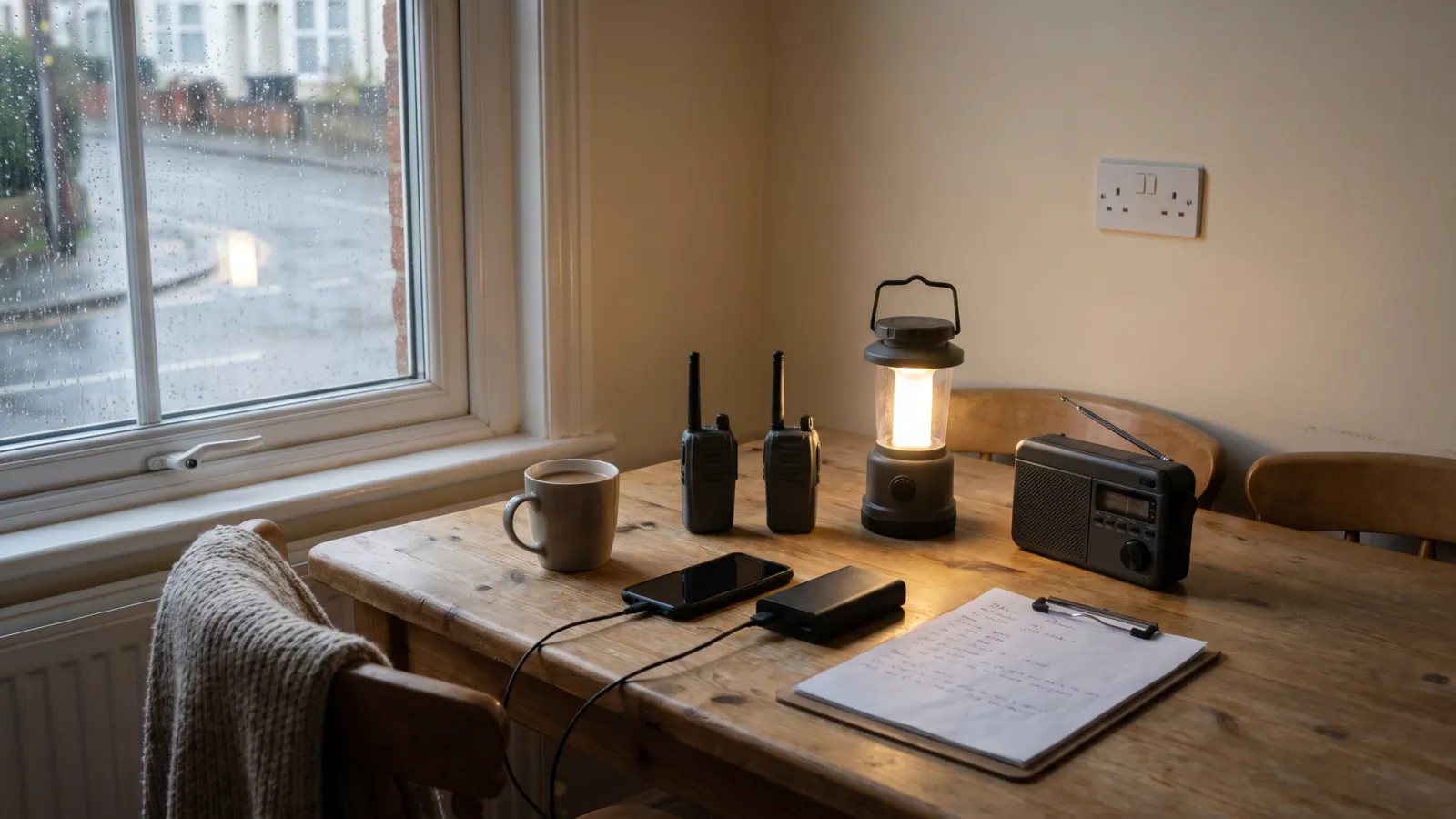
Why the mobile network can go quiet
Mobile phones need a working mast nearby, and masts run on mains electricity. When a storm or fault cuts the power to a wide area, each mast runs on whatever backup it has, and then stops. GOV.UK Be Ready puts it plainly: your mobile phone might stop working if your local mast is in the area of the power cut, although the network may keep working for a while where there is backup power, and you might pick up signal from a nearby area that still has power.
Ofcom gives Storm Arwen in 2021 as an example: widespread power cuts, followed by the loss of mobile service in the same areas. Most power cuts are short. The Ofgem figures Ofcom quotes say around 90% are over within three hours. The longer ones are where it pays to have a few other ways to stay in touch.
How long do mobile masts last in a power cut?
There is no single answer, because it differs from site to site. Ofcom's technical report of February 2025 is the best published picture. It found that around 20% of UK mast sites have battery backup for at least one hour, and far fewer, about 5%, for at least six hours.
Because phones will use any network for an emergency call, Ofcom estimated that in a power cut of up to about an hour, around two thirds of people would still be able to call 999. The longer the cut, the fewer people can.
Since then, Ofcom has updated its resilience guidance for phone companies. The version published on 16 June 2026 expects the mobile networks to take robust, risk-based measures to keep services running in power cuts, including thinking about communities that are especially exposed. It does not set a fixed number of hours for masts. For the big core network sites, the figure is at least five days. So plan on the basis that your local mast may stop within an hour, and that only a minority will keep going for longer.
999 and 112 still try every network
In the UK you can call 999 or 112. If your own network has no signal, try anyway: Be Ready says emergency calls automatically roam onto any mobile network that is available, so a phone on one network can get through on another network's mast. If you cannot get through on a mobile, try a landline, and the other way round, because one may work when the other does not.
emergencySMS lets people who are deaf, hard of hearing or speech-impaired text 999. You have to register first, before you need it: text the word register to 999, reply yes when asked, and wait for the text saying you are registered. Relay UK says it is slower than a voice call, that you should not assume your message has arrived until you get a reply, and that you need to register again if your number changes.
To report the power cut itself, call 105 in England, Scotland and Wales, or 03457 643643 in Northern Ireland. Write those numbers down now, because you may not be able to look them up later.
NewSee this for your own homeHome Alerts: your postcode's power cuts, warnings and floods, on one screen. Free for your own home. Sign up in a minute.Start free →Landlines after the digital switchover
The old copper phone network is being switched off, and GOV.UK expects most homes to have moved to digital landlines by January 2027. A digital landline plugs into your router, and digital lines cannot carry power from the exchange the way the old ones did. So in a power cut the phone stops along with the router, unless it has a battery backup.
Ofcom's guidance gives you a safety net. It expects your phone provider to have a way for you to reach the emergency services for at least one hour in a power cut at your home, offered free if you depend on your landline, for example because you have no mobile or no mobile signal. This is often a battery backup unit. Ofcom notes that some providers' battery units last several hours. If you use a telecare alarm, check with its provider how it behaves in a power cut, because GOV.UK warns that telecare on a digital line may not work without power.
If you are still on an analogue line, a basic corded phone may keep working in a local power cut, as long as the exchange has power.
Emergency Alerts, and why a radio still matters
Emergency Alerts are the government's warnings to mobile phones about a serious danger near you. GOV.UK says they work on all 4G and 5G networks in the UK and need no mobile data or wifi. They do not reach phones that are switched off or only on 2G or 3G, and may not reach phones in airplane mode. Alerts are sent through mobile masts, so an alert sent after your local mast has gone quiet will not reach you.
That is why Be Ready asks every household to keep a battery or wind-up radio with spare batteries. Updates may be broadcast by radio during a power cut, and a radio needs no mast and no mains. Be Ready suggests trying FM and digital (DAB) stations, and writing down on paper the frequencies of the local and national stations you use for news. The BBC has said its local and nations radio stations have a special role in a crisis, and that they plan carefully to stay on air.
Crank radios for emergencies are worth having, and a set that also takes ordinary batteries means you are not relying on the handle alone. Long wave is no help any more, because the BBC switched off Radio 4 long wave in June 2026; our radio guide explains what to buy instead.
Off-grid communication devices: licence-free walkie-talkies
To keep in touch with your own household close by, for example between houses on the same street, or with someone checking on a neighbour, a set of PMR446 walkie-talkies needs no mast, no network and no bill. Ofcom says you do not need a licence for PMR446: anyone can use handheld radios on 446.0 to 446.2 MHz at up to 0.5 watts.
Be realistic about range. The boxes on the sets we track say 4 km, 8 km, even 10 km. Ofcom describes PMR446 as being for short distances, such as within office buildings, factories and building sites, so treat the box figure as a best case and try your pair from the places you would actually use them before you rely on them.
PMR446 channels are shared with everyone else nearby, so you may hear other people, and they can hear you. Ofcom's advice is to move to another channel if yours is busy. The sets we track have 8 or 16 channels; agree a channel and privacy code with your household in advance and write them on your contact list. Keep the radios legal: Ofcom says they are only licence-free if they are used as built, as handheld sets with their own fixed aerial, not with a bigger aerial or as a base station. A walkie-talkie cannot call 999.
Emergency radio frequencies: what you can use without a licence
None of these radios connects you to 999: in an emergency, call 999 or 112 from a phone. These are the radio services a household might come across, and what Ofcom allows:
PMR446 walkie-talkies: 446.0 to 446.2 MHz, up to 0.5 watts, handheld only. No licence needed.
CB (Citizens' Band) radio: 27 MHz. No licence needed since 8 December 2006, as long as the equipment meets Ofcom's technical rules. Ofcom calls it a short-range service. CB shares its band with the Ministry of Defence, so you have to accept interference.
Amateur (ham) radio: you need an Ofcom amateur licence to transmit, and for the entry-level Foundation licence you first pass a short exam run by the Radio Society of Great Britain. A walkie-talkie is only licence-free if it is a PMR446 or CB set used within Ofcom's rules, so check the listing says PMR446 before you buy one.
Broadcast radio for news: FM and DAB. You only listen, so no licence is needed. Long wave no longer carries BBC Radio 4.
Satellite messaging on your phone
Some phones can now reach a satellite when there is no mast in range. In the UK, two options cover most ordinary phones:
Emergency SOS via satellite on iPhone: Apple says it works in the UK on iPhone 14 or later (iOS 16.2 or later). It lets you text 999 when you have no mobile or wifi signal. You need to be outside with a clear view of the sky and horizon. Apple says it is free for two years after you activate the phone.
O2 Satellite: O2 is the one UK network we found selling satellite connection for everyday phones, at £3 a month on pay monthly contracts or included in its Ultimate plan, on a list of recent Samsung, Apple, Google and HONOR models. Your phone switches to it automatically when there is no O2 signal and you are in satellite coverage. It carries texts and a few apps, including WhatsApp and Google Maps (WhatsApp calls may work, slowly), but not standard voice calls or 999 calls, and O2 says it should not be relied on to contact the emergency services. You can text 999 through it only if you have registered with emergencySMS. Your phone will not receive Emergency Alerts while it is on O2 Satellite. We found no live satellite service for everyday phones from EE, Vodafone or Three when we checked on 4 November 2026.
Neither Apple nor O2 says anything about whether these services work when masts lose power, so treat them as a useful extra outdoors, not your plan. For walking or sailing away from coverage, a dedicated satellite messenger or a personal locator beacon is a separate decision, with a subscription for most messengers.
Storm communications: keep the phone charged
Whatever else you have, the phone is still the first thing you will reach for, and in a power cut its battery runs down with no way to recharge it. Keep a charged power bank: Be Ready's emergency kit checklist includes one, to charge phones. Be Ready also suggests not using the phone as a torch, because that drains the battery more quickly.
When a storm is on the way, charge phones and power banks the evening before. If the power goes, agree in advance who will let whom know they are fine, so the battery goes on the calls that matter.
Your emergency contact list, on paper
A phone that is flat or has no signal cannot show you its contacts. Be Ready's checklist asks you to write down important phone numbers on paper and store them somewhere easy to find in a power cut. A good list fits on one sheet:
Your household: everyone's mobile number, and where you will meet if you cannot get home or get in touch.
Someone outside the area: a relative or friend everyone can text to say they are safe, if local lines are busy.
Neighbours: especially anyone who lives alone or may need help.
Services: 105 for power cuts (03457 643643 in Northern Ireland), your water company, your GP and pharmacy, your landline and mobile providers, and 111 for urgent medical advice.
School, work and care: numbers for schools, employers, carers, and any telecare or alarm provider.
Radio: the FM frequencies of your BBC local station and any other station you use for news, and the channel and privacy code your household uses on its walkie-talkies.
Put a copy in the emergency kit, one by the phone and one in each bag or car. Be Ready also has a free printable household emergency plan on its Be ready for emergencies page. Our guide to making a household emergency plan walks through the rest: the meeting point, the shut-offs and the people who need extra thought.
Common questions
How long do mobile masts work in a power cut?
It varies by site. Ofcom's February 2025 report found that around 20% of UK mast sites have at least one hour of battery backup, and about 5% have at least six hours. Some will keep going longer, others stop quickly, so expect signal to get patchier the longer a cut lasts.
Can I call 999 with no signal from my network?
Often, yes. Be Ready says emergency calls automatically roam onto any available mobile network, so if another network's mast is working nearby your call can go through. Always try 999 or 112, and try a landline too if you have one.
Will my landline work in a power cut?
Not if it is a digital line through your router, unless it has battery backup. Ofcom expects providers to offer a way to reach the emergency services for at least an hour in a power cut, free to people who depend on their landline. Ask your provider. An old analogue line with a corded phone may keep working as long as the exchange has power.
Do I need a licence for walkie-talkies or CB radio in the UK?
No for PMR446 walkie-talkies, used as sold. No for CB radio either: Ofcom has not required a licence for CB since December 2006, as long as the equipment meets its technical rules. Amateur (ham) radio does need an Ofcom licence, and so does transmitting on any other two-way radio that is not PMR446 or CB.
Can my phone text by satellite in the UK?
On some phones. iPhone 14 and later can text 999 by satellite outdoors when there is no signal. O2 Satellite adds texts and some apps on recent phones for £3 a month, but not standard or 999 calls, and 999 texts only if you have registered with emergencySMS. Neither Apple nor O2 says whether these work when masts lose power.
What should be on an emergency contact list?
Everyone in your household, someone outside your area everyone can check in with, neighbours who may need help, 105 for power cuts, your GP, schools and carers, your phone providers, and the FM frequency of your BBC local radio station. Keep it on paper, with your emergency kit.
Sources (15)
- Ofcom — Mobile RAN power resilience: Technical Report and CFI Update (around 20% of mast sites have at least 1 hour of backup, about 5% at least 6 hours; two thirds could make emergency calls in a cut of up to an hour; Storm Arwen), published 10 February 2025
- Ofcom — Network and Service Resilience Guidance for Communications Providers, section 4.2 (mobile site power backup expectations; 1 hour minimum emergency access on landlines, free to those who depend on them; Ofgem outage durations), published 16 June 2026
- GOV.UK Be Ready — Power cuts (mobile masts, roaming emergency calls, landlines, battery or wind-up radio, 105), read 4 November 2026
- GOV.UK Be Ready — Be ready for emergencies (checklist: charged power bank, battery or wind-up FM radio, important phone numbers written on paper; printable household emergency plan), read 4 November 2026
- GOV.UK — UK transition from analogue to digital landlinesdigital lines and power cuts, battery back-up units, telecare, corded phones
- GOV.UK — How emergency alerts work (4G and 5G, no data needed, phones that won't get alerts), read 4 November 2026
- Relay UK — Contact 999 using Relay UK (emergencySMS registration and limits), read 4 November 2026
- Ofcom — Business Radio Guidance, sections 1.3.2 and 9 (PMR446 licence-exempt, 446.0 to 446.2 MHz, 0.5 W, handheld with integral antenna), published 5 December 2025
- Ofcom — Licence-exempt devicesPMR446 for short distances; CB a short-range service in the 27 MHz band
- Ofcom — Citizens' Band (CB) radio licensing update (licence-exempt since 8 December 2006)
- Radio Society of Great Britain — Foundation licencethe exam before an Ofcom amateur licence
- O2 — How to get, connect to and use O2 Satellite (texts and apps, no voice or 999 calls, emergencySMS, no Emergency Alerts, compatible phones, price), read 4 November 2026
- Apple Support — Use Emergency SOS via satellite on your iPhone (UK, iPhone 14 or later, free for two years), read 4 November 2026
- BBC — Connecting in a crisis (local and nations radio's role and resilience planning), published 11 October 2011
- Radio Society of Great Britain — BBC long wave shutdown
PreparedBritain is independent and not affiliated with HM Government.
The Power Cut Action Card
One page for the kitchen drawer: what to do first, what to have ready, how long food keeps, and how to stay warm without risking carbon monoxide. Free, no catch.
Download it straight away. We'll also send the occasional briefing when something genuinely matters — severe weather, live incidents, real price drops. Nothing else.
Latest from our live data
All stories → News · 3 NovVampire devices: the '£200' is 13 gadgets added up; turning a home off standby saves about £45
 News · 2 NovCold Weather Payment opens: £25 a freezing week; last winter 40 of 71 stations triggered none
 News · 31 OctEarliest polar vortex breakdown on record forecast for November: what it means for the UK
Keep reading
All power cuts & energy guides →Off-peak electricity times in the UK: Economy 7, Economy 10 and smart tariffs
There is no off-peak on a standard single-rate tariff: a unit costs the same at 3am as at 6pm. Off-peak times only…
How to read your electricity and gas meter: smart, digital, dial and Economy 7
Which numbers to write down from every common British meter: smart meters and their in-home displays, digital and…
Is the UK’s gas and electricity supply OK this winter? What NESO, National Gas, Ofgem and the government actually say
The three organisations that plan Britain’s winter energy supply all published their outlooks in October 2026. NESO…
