Which radio actually works in a UK power cut?
Long wave closed in June 2026, and half the wind-up radios on sale here advertise an American weather band that receives nothing in Britain. What to look for instead.
By Tom Calder · Updated 19 September 2026 · Sourced to GOV.UK Prepare and the BBC long wave closure
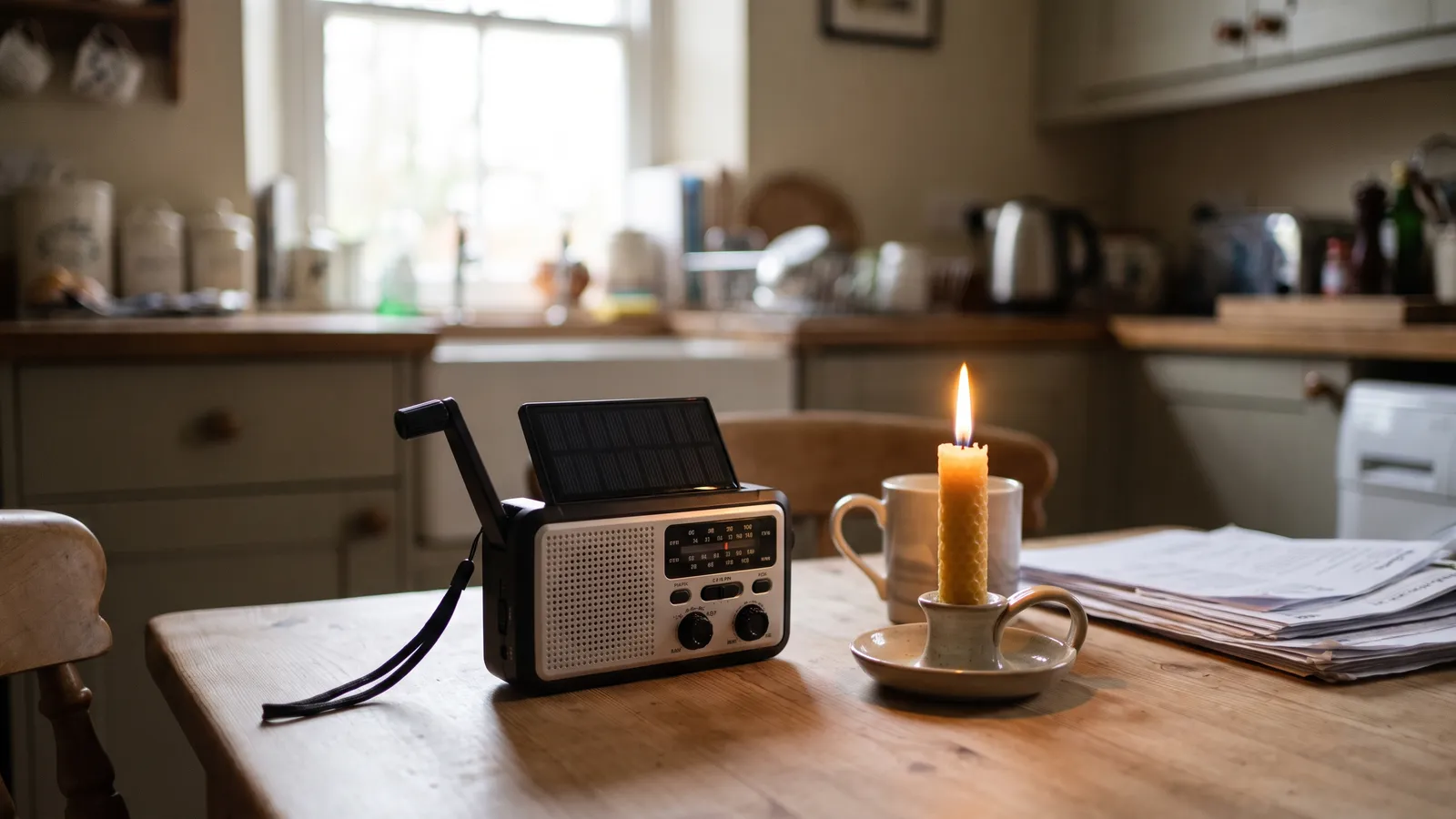
Long wave is gone, so start there
If your emergency plan involves an old long wave radio, it stopped working for that job this summer. The BBC closed Radio 4 on 198 kHz long wave in the early hours of 27 June 2026, and the transmitters at Droitwich, Westerglen and Burghead were shut down with it. The reason was mundane: nobody makes the valves for the Droitwich transmitter any more.
Long wave mattered for emergencies because it carried hundreds of miles from a single site, which is why it was the traditional fallback. That is over. Anything you buy now needs to work on FM, and preferably DAB as well.
FM is the one that matters
FM carries the BBC's national stations and, more importantly in a local emergency, BBC local radio, which is the station that carries practical local information when something goes wrong in your area.
DAB works too and sounds better, but it uses more battery for the same listening time, and a cheap set will flatten its cells faster. A radio that does FM only is perfectly good for this job. FM plus DAB is nicer, not essential.
GOV.UK Prepare asks for a battery or wind-up radio in a household kit for exactly this reason: it keeps working when the power, the broadband and the mobile network do not.
The American weather band trap
Many wind-up radios sold here are American designs, and their listings advertise NOAA weather channels as a headline feature. NOAA is the US weather service. Those channels broadcast on frequencies used in North America, and in the UK they receive nothing at all.
It is not a fault, and it does not make the radio bad, but it is not a reason to pay more. Judge a radio on FM reception, how it takes power, and whether the crank feels like it will survive being used in the dark.
How these radios actually take power
Winding is a backup, not a power supply. On a typical hand-crank set a minute of steady cranking buys a few minutes of listening at low volume, which is fine for catching an update and miserable as a way to pass an evening.
The little solar panels are slower still. They trickle-charge over hours of real daylight, which is useful if a cut lasts days and useless on the first evening.
So the honest answer is batteries. A radio that also takes ordinary AA cells lets you keep a packet in the drawer: alkalines hold their charge for years, while a radio's internal cell quietly goes flat between emergencies. Wind the handle when the batteries run out, not instead of having them.
Your phone is not a substitute
Emergency Alerts reach mobile phones and are genuinely useful, but a phone needs charge and a working mast, and both are in short supply during a long or wide power cut. A radio needs neither.
The sensible setup is both: alerts on the phone for the warning, a radio for the hours afterwards, and a power bank so the phone survives to make calls.
Common questions
Can I still get Radio 4 on long wave in an emergency?
No. The BBC switched off Radio 4 on 198 kHz long wave on 27 June 2026 and closed the Droitwich, Westerglen and Burghead transmitters. A long wave radio will no longer pick up BBC programming in the UK.
FM or DAB for an emergency radio?
FM is the priority, because it carries BBC national and local stations and uses less battery. DAB is a fine addition if the radio has both, but do not pay much extra for DAB alone.
Do I need the NOAA weather channels?
No. NOAA is the American weather service and its channels are not broadcast in the UK. On a radio sold here those bands are silent, so treat them as marketing rather than a feature.
How much listening does winding give?
Roughly a few minutes of low-volume listening for a minute of steady cranking, depending on the radio. It is enough to catch an update on the hour, not to keep the radio running all evening.
Are the solar panels on these radios useful?
Only slowly. They trickle-charge across hours of real daylight, which helps in a multi-day outage and does nothing on the first evening. Spare AA batteries are the reliable answer.
Sources: GOV.UK Prepare — Get prepared for emergencies · Radio Society of Great Britain — BBC long wave shutdown · The Register — End of an era as the BBC switches off Radio 4 long wave (June 2026) · GOV.UK — Emergency Alerts. PreparedBritain is independent and not affiliated with HM Government.
The Power Cut Action Card
One page for the kitchen drawer: what to do first, what to have ready, how long food keeps, and how to stay warm without risking carbon monoxide. Free, no catch.
Download it straight away. We'll also send the occasional briefing when something genuinely matters — severe weather, live incidents, real price drops. Nothing else.
Keep reading
All power cuts & energy guides →Can a power cut damage your appliances?
What really happens electrically when the power comes back on, which appliances are genuinely at risk, and how to…
Are candles safe in a power cut?
Candles started 844 accidental house fires in England last year. The honest answer, the fire-service rules if you…
How to run a generator safely: carbon monoxide, positioning, refuelling and fuel storage
UK generator safety, fully sourced: carbon monoxide rules, 6-metre positioning, refuelling, legal petrol storage…