How to run a generator safely: carbon monoxide, positioning, refuelling and fuel storage
UK generator safety, fully sourced: carbon monoxide rules, 6-metre positioning, refuelling, legal petrol storage limits and why you must never plug into a wall socket.
By Tom Calder · Updated 12 August 2026 · Sourced to gov.uk, the HSE and legislation.gov.uk
The rule that outranks all the others: never run it indoors
A petrol or diesel generator produces carbon monoxide (CO) in its exhaust — a gas you cannot see, smell or taste, and which can kill in minutes in an enclosed space. The UK Chief Medical Officers' public-health advice for power cuts is unambiguous: do not use petrol or diesel generators, or any similar fuel-driven equipment, indoors. In practice 'indoors' means more than your living room. Treat the garage (even with the door fully open), the shed, a conservatory, a lean-to, a covered porch, a caravan awning and a gazebo pushed up against the house wall the same way.
Partial ventilation does not make an enclosed space safe. CO builds up faster than an open door or window can clear it, and because it is odourless you get no warning before symptoms start. If anyone feels headachy, dizzy or sick while a generator is running nearby, get them into fresh air immediately and seek medical advice — our guide to carbon monoxide poisoning symptoms covers what to look for and when to call 999.
Six metres out, exhaust pointing away
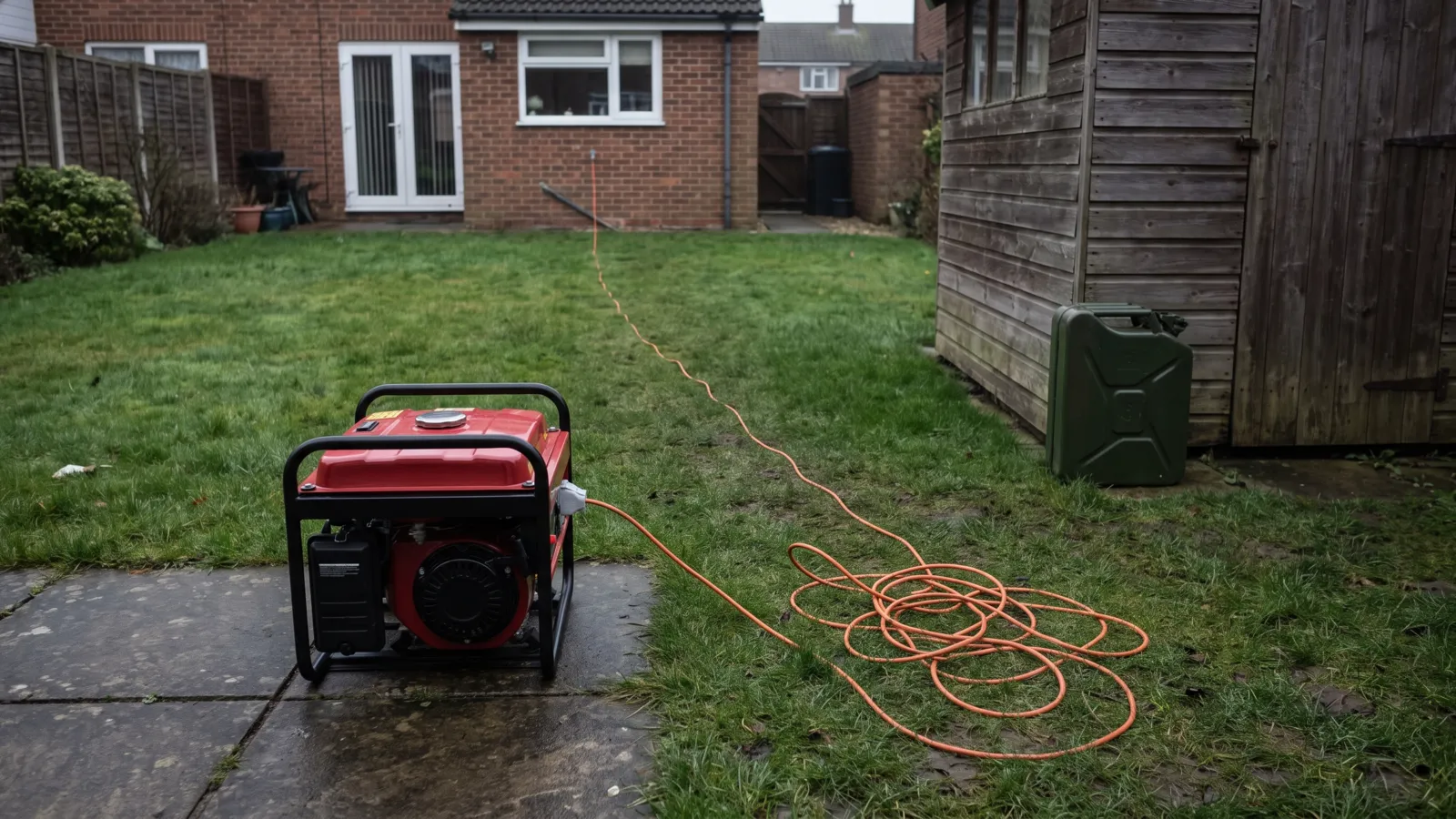
Government guidance for households using a generator in a power cut is specific: place it outdoors, at least 6 metres (20 feet) from the building, with the exhaust facing away from windows and doors. Apply the same logic to everything air can pass through — trickle vents, airbricks, extractor outlets and your neighbours' openings as well as your own. Six metres is a minimum, not a target; further is better if your garden allows it.
Set the generator on firm, level ground and run power to the house through an outdoor-rated extension lead, fully unwound — a tightly coiled lead can overheat under load. If it is raining, protect the generator with a purpose-built cover or canopy that leaves its ventilation clear. Never solve a rain problem by moving the generator into a shed or garage: that reintroduces the exact hazard the 6-metre rule exists to remove.
Pair it with a carbon monoxide alarm
Government guidance on carbon monoxide alarms — now a legal requirement for rented homes in England — is to fit one in every room used as living accommodation that has a fixed fuel-burning appliance, and that benchmark is worth applying to any home. A generator running in the garden makes the rooms facing it worth protecting too, because exhaust can drift back in through an open window or vent. Fit alarms certified to BS EN 50291, and choose models with sealed long-life batteries, or mains models with battery back-up: a mains-only alarm is no use in the very power cut that has you running a generator.
Test the alarm's button before storm season and whenever the generator comes out of storage. An alarm is a backstop, not a licence to relax the positioning rules — if it sounds, get everyone outside and do not restart the generator until you know why.
Refuel only when it's off and cool
Petrol spilled or splashed onto a hot exhaust can ignite. Switch the generator off and give the engine time to cool before you open the fuel cap — treat this as non-negotiable, however inconvenient mid-power-cut. Refuel outdoors, away from any flame or anyone smoking, using the container's spout or a funnel, and stop below the filler neck: petrol expands as it warms, and an over-filled tank vents vapour.
Wipe up any spill and let the vapour disperse before restarting. While the generator is running, keep the fuel can well away from it — never leave spare petrol standing next to a hot engine.
How much petrol you can legally store at home
Home petrol storage is governed by the Petroleum (Consolidation) Regulations 2014. You may keep up to 30 litres at home without telling anyone, provided it is in suitable containers: plastic containers of up to 10 litres, metal containers of up to 20 litres, or a single demountable fuel tank of up to 30 litres. Containers must be marked 'PETROL' and 'HIGHLY FLAMMABLE' — the approved cans sold at petrol stations and DIY chains already are.
The regulations also say where it can live: never in living accommodation, and — if the storage place is not in the open air — somewhere with a direct exit to the open air and ventilation to that exit. In practice that means a garage or garden shed, away from anything that could ignite it. To keep between 30 and 275 litres you must notify your local Petroleum Enforcement Authority in writing, renewing the notice each January; above 275 litres you must apply to the authority for a licence. For a household generator none of that should be necessary — 5 to 10 litres in one approved can covers occasional use, and fresher fuel is better fuel.
Never plug it into a wall socket
'Backfeeding' — running a lead from the generator into a wall socket to power the house — is the most dangerous mistake a generator owner can make. It energises your home's wiring and, through it, the local network: that can electrocute engineers working to restore your supply, and when the mains comes back it meets your generator with no protection in between. The law reflects the danger: under the Electricity Safety, Quality and Continuity Regulations 2002, anyone running a generator as a switched alternative to the mains must ensure it cannot operate in parallel with the distributor's network — something a lead into a wall socket can never guarantee.
If you want a generator to feed your home's circuits, the only proper route is a transfer switch installed by a qualified electrician, which physically isolates your installation from the grid before the generator connects. Until you have one, run appliances directly from the generator on outdoor-rated extension leads — nothing else. And before you buy at all, read the honest note below: for most households a battery power station is the better answer.
Common questions
Can I run a generator in my garage if I leave the door open?
No. Carbon monoxide builds up in any enclosed or partly enclosed space faster than an open door can clear it, and government advice is explicit that generators must not be used indoors — garages included. Run it outdoors, at least 6 metres from the building, with the exhaust facing away from windows and doors.
How much petrol can I legally keep at home?
Up to 30 litres without notifying anyone, under the Petroleum (Consolidation) Regulations 2014 — in plastic containers of up to 10 litres, metal containers of up to 20 litres, or a single demountable fuel tank of up to 30 litres. Between 30 and 275 litres you must notify your local Petroleum Enforcement Authority in writing; above 275 litres you need a licence from the authority. Petrol must never be kept in living accommodation.
Can I plug a generator into a wall socket to power my house?
Never. Backfeeding energises your home's wiring and the local network, which can electrocute engineers restoring the supply, and it bypasses your home's protective devices. The Electricity Safety, Quality and Continuity Regulations 2002 require that a generator used as a switched alternative to the mains cannot operate in parallel with the network. The only safe route into house circuits is a transfer switch fitted by a qualified electrician; otherwise plug appliances directly into the generator.
Do I still need a carbon monoxide alarm if the generator stays outside?
Yes. Exhaust can drift back into the house through open windows, trickle vents and airbricks, especially in still weather. Fit alarms certified to BS EN 50291 in the rooms nearest the generator, and choose battery-powered models with sealed long-life batteries — a mains-only alarm won't work during the power cut you bought the generator for.
Can I use a generator in the rain?
Only with a purpose-built generator cover or canopy that keeps the unit dry while leaving its ventilation clear — a wet generator is an electric shock risk. Never move it into a shed, garage or porch to escape the weather: that swaps a shock risk for a carbon monoxide one. Keep lead connections off wet ground and use outdoor-rated extension leads.
Sources: UK Chief Medical Officers — public health advice during a national power outage: generator placement (GOV.UK) · The Petroleum (Consolidation) Regulations 2014, Schedule 2 — storage at domestic premises (legislation.gov.uk) · HSE — If you store petrol at home: quantities, notification and licensing · HSE — Portable petrol storage containers: guidance under the PCR 2014 · Smoke and Carbon Monoxide Alarm (Amendment) Regulations 2022 — guidance for landlords and tenants (GOV.UK) · The Electricity Safety, Quality and Continuity Regulations 2002, regulation 21 — switched alternative sources of energy (legislation.gov.uk). PreparedBritain is independent and not affiliated with HM Government.
The Power Cut Action Card
One page for the kitchen drawer: what to do first, what to have ready, how long food keeps, and how to stay warm without risking carbon monoxide. Free, no catch.
Download it straight away. We'll also send the occasional briefing when something genuinely matters — severe weather, live incidents, real price drops. Nothing else.
Keep reading
All power cuts & energy guides →Power cut with a baby: feeding, sterilising and keeping them warm safely
How to feed, sterilise and keep a baby safely warm in a power cut — NHS formula rules, cold-water sterilising and…
Insulin and fridge medicines in a power cut or heatwave: what's safe and what to do
NHS-sourced temperature windows for insulin and fridge medicines in a power cut or heatwave, correct cool-bag…
What size portable power station do you actually need? A UK sizing guide
Plain watt-hour arithmetic for UK homes — fridge-freezer, combi boiler, CPAP, router — three sizing tiers, and when…