Insulin and fridge medicines in a power cut or heatwave: what's safe and what to do
NHS-sourced temperature windows for insulin and fridge medicines in a power cut or heatwave, correct cool-bag practice, and when to ask the pharmacist.
By Tom Calder · Updated 12 August 2026 · Sourced to the NHS, Ofgem, the FSA & manufacturer leaflets
Start with the reassuring fact
The fridge in "fridge medicines" is mostly there to protect unopened stock. NHS guidance on insulin is clear: keep disposable pens, cartridges and vials in the fridge until you start using them — but the pen you are actually injecting from lives at room temperature, for up to four weeks (28 days). If your in-use insulin is already sitting in a drawer or bag, a power cut changes nothing for it. Write the date on the pen when it first comes out of the fridge, as the NHS suggests, and you always know where you stand.
The genuine threats sit at the extremes. Heat above the leaflet's ceiling — 25°C for some brands, 30°C for others — can stop insulin working properly. Freezing destroys it outright: the NHS says insulin that has frozen must be thrown away, and the safest way to do that is to hand it to a pharmacy rather than putting it in the bin. Everything in this guide follows from those two limits.
Temperature windows for common fridge medicines
In-use insulin: room temperature for up to 28 days under NHS guidance, with the exact ceiling set by your brand's patient information leaflet — most major pens state below 30°C, some below 25°C, and a few long-acting brands allow six or even eight weeks in use. Unopened insulin: in the main body of the fridge at 2–8°C, away from the cooling element and the back wall — pens pushed against the coldest surfaces can accidentally freeze.
Semaglutide (Ozempic): the manufacturer's leaflet allows an in-use pen six weeks below 30°C or in the fridge — and, like insulin, it must never be used after freezing. Adalimumab: Humira's leaflet permits a single pen up to 25°C for a maximum of 14 days, protected from light — after which it must be used or discarded, even if it went back into the fridge. Biosimilar brands set their own out-of-fridge windows, some longer, so check the leaflet for yours.
The surprise on the list: adrenaline auto-injectors such as EpiPen should not be in the fridge at all — their leaflets say do not store above 25°C and do not refrigerate or freeze. Reconstituted liquid antibiotics and some eye drops genuinely do need the cold and have short lives, and the details vary by product. For anything not covered here, the leaflet in the box is the authority, and your pharmacist outranks this guide every time.
In a power cut: keep, cool, or call
Keep: for a cut of up to about four hours, do nothing except leave the fridge door shut. The Food Standards Agency says a fridge should stay cold for up to four hours in a power cut — so the worst move is repeatedly opening the door to check. Your in-use insulin pen was never in the fridge anyway.
Cool: if the outage looks set to run longer — check your network operator's live estimate — move unopened fridge stock into a cool bag with freezer blocks, packed as described below. In cool weather an unheated room or porch that stays below 25°C does the job with no kit at all — but never anywhere that could dip below freezing, because a frozen pen is ruined and a slightly warm one usually is not. If unopened stock spends more than a few hours at room temperature, write the date on the box and treat its in-use countdown as started, then mention it to the pharmacist at your next refill.
Call: if you are unsure whether anything got too warm or froze, do not bin it and do not inject it — put it aside, marked, and ask a pharmacist. Out of hours, NHS 111 can advise and help arrange an emergency replacement supply. Medicines are expensive and often in tight supply; a two-minute phone call beats guessing in either direction.
Cool-bag practice: one rule matters
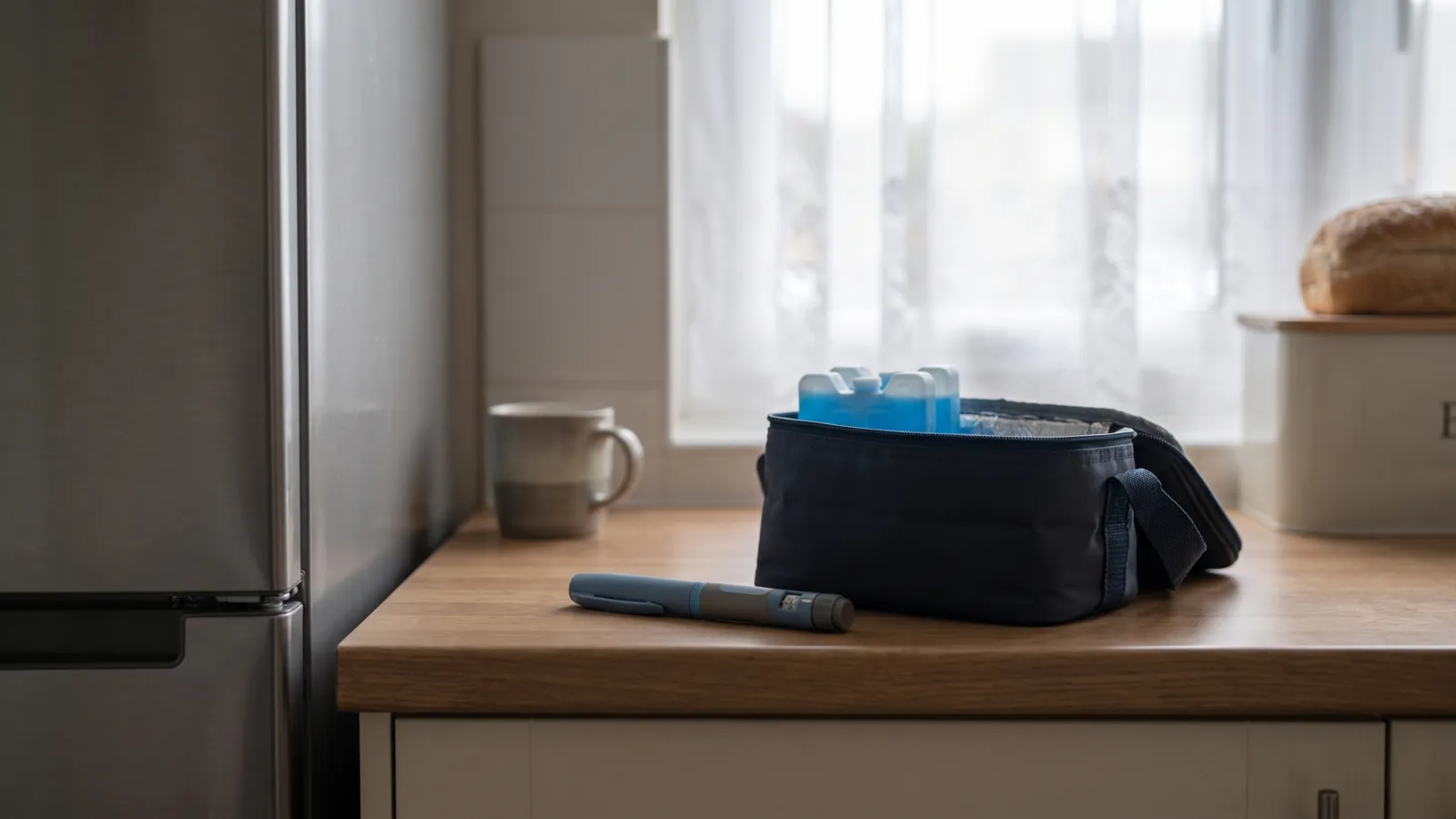
The rule is that medicine must never touch the ice. NHS travel guidance for insulin says exactly this: a cool bag is fine, but keep the insulin away from the ice block so it cannot freeze — because a frozen pen is a ruined pen. Wrap the medicine in a tea towel, sit it in the middle of the bag, and put the freezer blocks around the outside of the wrapping, never in direct contact.
No cool bag? A sealed food container inside a larger box with wrapped ice blocks works on the same principle. If you own a fridge thermometer, drop it in: you are aiming for the leaflet's window, typically 2–8°C for unopened stock, and simply below 25°C is acceptable for most in-use pens.
Heatwaves: the risk is the room, not the fridge
In hot weather the fridge keeps working; the danger is everything stored outside it. During amber and red heat-health alerts, indoor rooms can sit above 30°C for days — beyond most leaflets' in-use ceiling. Move pens and tablets to the coolest room in the house, away from windowsills, radiators and the bathroom cabinet (steamy and warm), and use the wrapped-cool-bag method for trips out.
Cars deserve a specific warning: a parked car's interior can far exceed any medicine's storage limit within an hour. Take medicines with you rather than leaving them in the glovebox, and on long journeys treat them like the NHS says to treat travelling insulin — insulated, shaded, and never against ice.
If your household depends on fridge medicines
Join the Priority Services Register. It is free, and reliance on refrigerated medicines or powered medical equipment is exactly the kind of need it exists for. Register with both your energy supplier and your network operator: you get advance notice of planned outages, priority updates during faults, and extra support in a prolonged cut. In any outage, call 105 — the free national number that connects you to your local network operator.
Compensation exists, but know its shape. Under Ofgem's rules you can claim £95 if an unplanned cut lasts over 12 hours (over 24 hours where a fault hits more than 5,000 premises), plus £45 for each further 12 hours, capped at £390 in those larger incidents. Payments are usually automatic, but it is worth contacting your operator to confirm. These are fixed payments for the interruption itself, not an itemised refund for spoiled medicine — for replacement supplies, your pharmacist and GP are the route, and NHS 111 out of hours.
The boundary this guide will not cross: never throw medicine away, and never carry on using medicine you suspect has been too warm or frozen, without a pharmacist's check. Storage guidance in leaflets is deliberately conservative, pharmacists deal with exactly this question after every storm, and their advice on your specific product overrides anything written here.
Common questions
How long can insulin stay out of the fridge?
Once opened and in use, the NHS says insulin can be kept at room temperature for up to 4 weeks (28 days) — after that it may not work properly and should go to a pharmacy for disposal. Unopened insulin belongs in the fridge at 2–8°C. Some brands' leaflets allow longer in use (six or eight weeks for certain long-acting insulins), so check the leaflet for your specific product.
My insulin froze against an ice pack — can I still use it?
No. NHS guidance is that insulin which has frozen must be thrown away — take it to a pharmacy for disposal rather than binning it at home, and contact your pharmacist or GP promptly for a replacement supply. This is why cool-bag packing matters: the medicine should never touch the ice block directly.
Is my medicine still safe after a four-hour power cut?
Almost certainly, if the fridge door stayed shut — the Food Standards Agency says a fridge should stay cold for up to 4 hours in a power cut. If the cut ran longer, or the door was opened repeatedly, check a fridge thermometer if you have one and ask your pharmacist before using or discarding anything. Your in-use insulin pen, stored at room temperature anyway, is unaffected.
Does Ozempic need a fridge during a heatwave?
An in-use Ozempic pen can be kept for six weeks below 30°C or in the fridge, according to the manufacturer's patient information leaflet. In a heatwave the practical risk is rooms and cars exceeding 30°C — keep the pen in the coolest room or a cool bag (not touching ice), and never use any pen that has been frozen. Unopened pens stay in the fridge at 2–8°C.
Can I claim compensation if a power cut spoiled my medicines?
Ofgem's guaranteed standards pay fixed amounts for the interruption itself — £95 for an unplanned cut over 12 hours (24 hours for faults affecting more than 5,000 premises), plus £45 per additional 12 hours, capped at £390 in those larger incidents — rather than itemised refunds for losses. Payments are usually automatic, but contact your network operator on 105 to check one is coming, and ask your pharmacist about replacing the medicine itself.
How do I get extra support in power cuts if I rely on fridge medicines?
Sign up to the Priority Services Register — it is free, and needing refrigerated medicines or mains-powered medical equipment qualifies you. Register with both your electricity supplier and your network operator to get advance notice of planned works, priority information during faults, and additional support in prolonged outages.
Sources: NHS — Storing and travelling with rapid-acting insulin · NHS — Storing and travelling with long-acting insulin · Ofgem — Compensation for a power cut or supply problem · Ofgem — Join your supplier's Priority Services Register · Food Standards Agency — Food safety in a power cut · emc — Ozempic patient information leaflet (manufacturer storage instructions) · emc — Humira 40 mg pre-filled pen patient information leaflet · emc — EpiPen 0.3 mg auto-injector patient information leaflet. PreparedBritain is independent and not affiliated with HM Government.
The Power Cut Action Card
One page for the kitchen drawer: what to do first, what to have ready, how long food keeps, and how to stay warm without risking carbon monoxide. Free, no catch.
Download it straight away. We'll also send the occasional briefing when something genuinely matters — severe weather, live incidents, real price drops. Nothing else.
Keep reading
All power cuts & energy guides →What size portable power station do you actually need? A UK sizing guide
Plain watt-hour arithmetic for UK homes — fridge-freezer, combi boiler, CPAP, router — three sizing tiers, and when…
How to cook without power: safe hot food in a power cut
Safe ways to get hot food in a power cut: the one rule (never burn fuel indoors), a what-to-use decision guide, real…
Running medical equipment in a power cut: CPAP, oxygen, insulin fridges and stairlifts
What CPAP machines, oxygen concentrators, insulin fridges and stairlifts draw in a power cut, when a power station…