Power cut food safety: is your food still safe?
The power's been off, and now you're stood at the fridge wondering what's still okay to eat. Here's the official Food Standards Agency guidance — with a quick checker to give you a straight answer.
By Tom Calder · Updated 20 July 2026 · Sourced to the Food Standards Agency
A closed fridge keeps food safe for about 4 hours. You're within that window — keep the door shut and don't open it.
A guide, not a guarantee — based on Food Standards Agency advice. When in doubt, throw it out, and never taste food to check. A fridge/freezer thermometer removes the guesswork.
The two numbers that matter
The Food Standards Agency's guidance comes down to two safe-side estimates, and both depend on one thing — keeping the door shut:
- Fridge: about 4 hours. A closed fridge should stay cold enough to keep food safe for up to 4 hours. A fridge normally runs at 5°C or below; during a cut, food is fine under 8°C, but if it climbs to 8°C or above, eat anything that needs refrigerating within 4 hours.
- Freezer: about 48 hours full, 24 hours half-full. A full freezer holds its cold far longer than a half-empty one — which is why keeping it full (even with containers of water) helps. These are estimates and vary by make and model, so treat them as a guide.
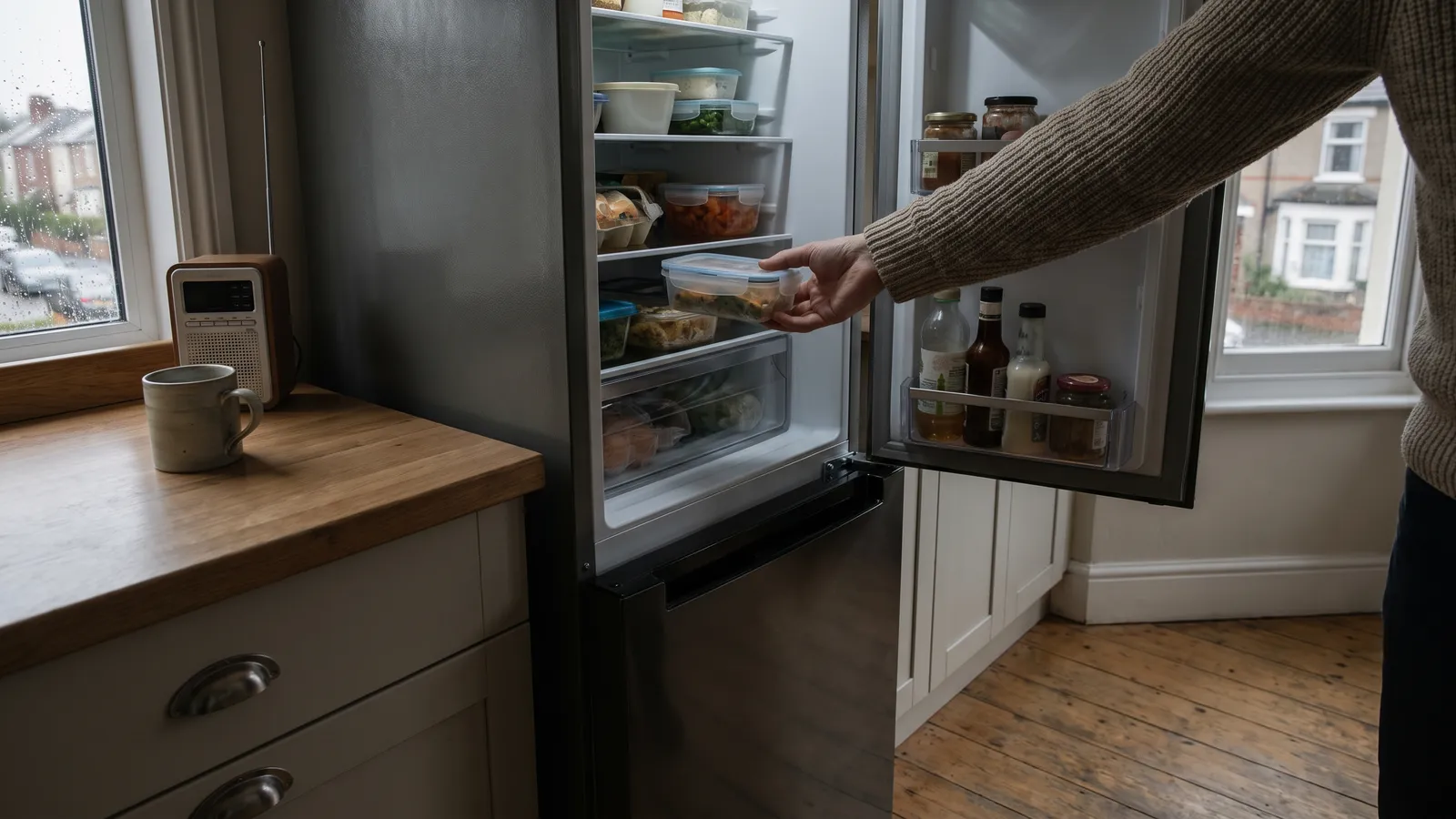
The golden rule underneath both: keep the fridge and freezer doors closed as much as possible. Every time you open the door you let cold air out and shorten the safe window — so resist the urge to keep checking.
Can you refreeze it? (the UK rule is stricter than you might have read)
This is where a lot of online advice is wrong for the UK. The FSA line is: don't refreeze food once it has fully defrosted. Raw meat, poultry and fish can be refrozen only after they've been thoroughly cooked. Use fully defrosted food within 24 hours — and once you've cooked-then-frozen something, you can only reheat it once more after that.
(The "if it still has ice crystals you can refreeze it" rule you may have seen is US guidance, not UK — so we've left it out.)
What to throw first — and who should be most careful
If you do have to make cuts, prioritise the highest-risk foods: meat, poultry, fish, and ready-to-eat pre-packaged items like sandwiches, salads and deli meats, plus anything labelled "keep refrigerated". Young children, pregnant women, older people and anyone with an underlying health condition should be especially cautious with high-risk foods such as deli meats and smoked fish.
And two principles the food-safety authorities are firm on: never taste food to decide if it's safe, and when in doubt, throw it out. A cheap fridge/freezer thermometer takes the guesswork out entirely — if you're prone to power cuts, it's worth having.
Keep the freezer full, keep a thermometer inside, and know that a full freezer buys you two days. A power bank keeps your phone alive to check for updates, and our power cut guide covers the rest.
Common questions
How long does food last in a fridge without power?
The Food Standards Agency says a fridge should stay cold for up to 4 hours if you keep the door shut. During a cut, food is fine stored under 8°C; if the temperature rises to 8°C or above, eat anything that needs refrigerating within 4 hours first.
How long does freezer food last in a power cut?
The FSA estimates food stays frozen for up to 48 hours in a full freezer, or 24 hours if it's half full — provided the door stays shut. These are safe-side estimates and vary by make and model, so treat them as a guide, not a guarantee.
Can I refreeze food after a power cut?
In the UK, don't refreeze food that has fully defrosted. Raw meat, poultry and fish can be refrozen only once they've been thoroughly cooked. Use fully defrosted food within 24 hours, and once you cook-then-refreeze, you can only reheat it once more after that.
What food should I throw away after a power cut?
Prioritise the highest-risk foods: meat, poultry, fish, and ready-to-eat pre-packaged items like sandwiches, salads and deli meats, plus anything labelled 'keep refrigerated' that's been too warm too long. When in doubt, throw it out — and never taste food to check.
How can I make my freezer last longer in a power cut?
Keep the door shut as much as possible — every opening lets cold air out and shortens the safe window — and keep the freezer full (even with containers of water), because a full freezer holds its temperature far longer than an empty one.
Who needs to be extra careful with food after a power cut?
Young children, pregnant women, older people and anyone with an underlying health condition should be especially cautious with high-risk foods like deli meats and smoked fish. If there's any doubt about a food's safety for a vulnerable person, throw it away.
Source: Food Standards Agency — Food safety in a power cut and FSA chilling and freezing guidance. This is general guidance, not a guarantee; the checker errs on the side of caution. PreparedBritain is independent and not affiliated with HM Government.
The Power Cut Action Card
One page for the kitchen drawer: what to do first, what to have ready, how long food keeps, and how to stay warm without risking carbon monoxide. Free, no catch.
Download it straight away. We'll also send the occasional briefing when something genuinely matters — severe weather, live incidents, real price drops. Nothing else.
Keep reading
All fire, gas & first aid guides →What to do in a house fire
The fire service's own advice: get out, stay out, call 999 — plus how to plan your escape, what to do if you're…
What to do if you smell gas
The correct, official steps if you smell gas or suspect a leak — the free 24-hour emergency number, what to do, what…
Run, Hide, Tell: the official advice for a weapons attack
The UK's official Run, Hide, Tell protocol for a firearms or weapons attack, what each step means, how to report…