What size portable power station do you actually need? A UK sizing guide
Plain watt-hour arithmetic for UK homes — fridge-freezer, combi boiler, CPAP, router — three sizing tiers, and when a £30 power bank is all you need.
By Tom Calder · Updated 12 August 2026 · Sourced to Ofgem, GOV.UK, the FSA & Ofcom
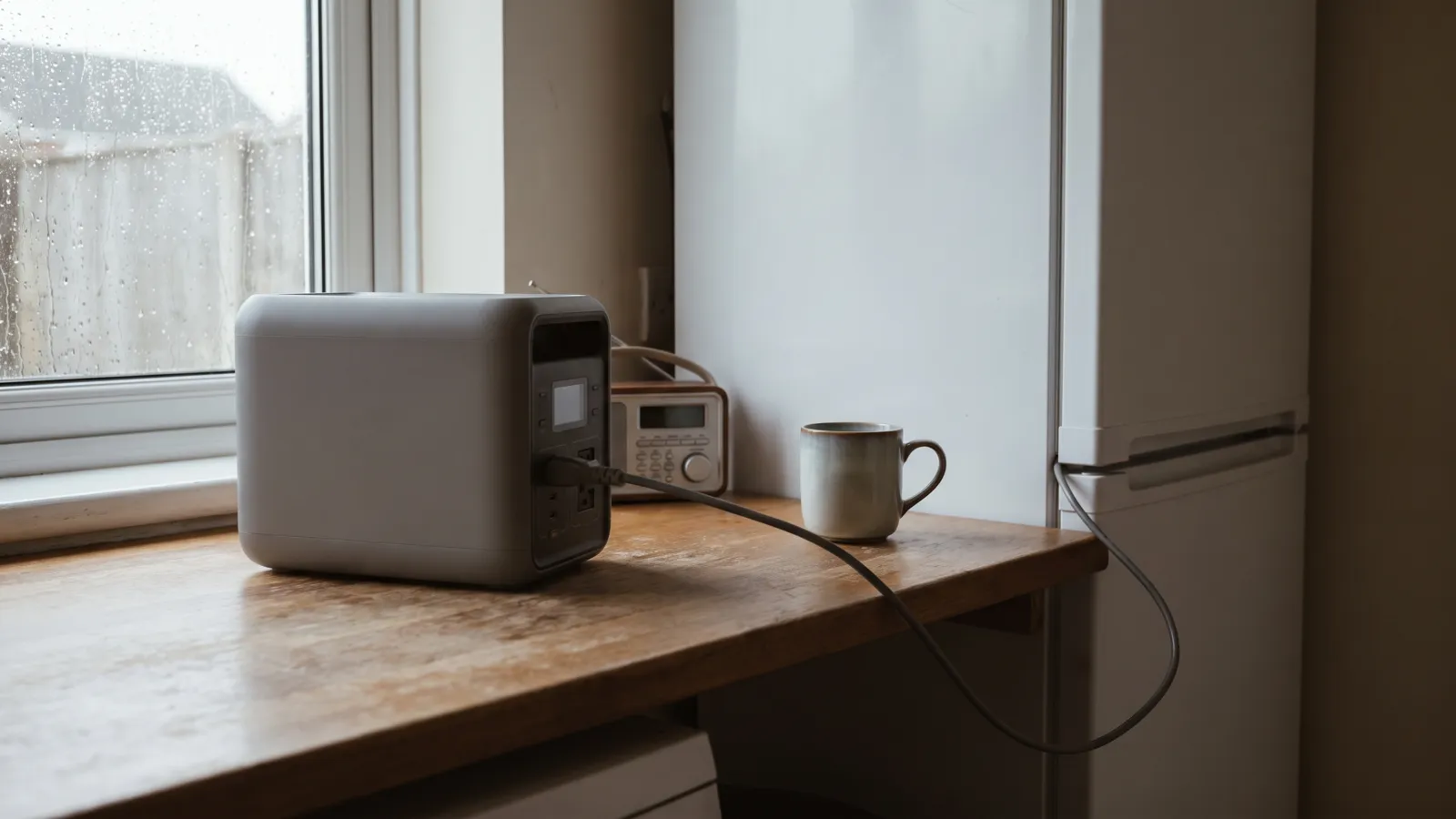
Watt-hours, watts and the 85% rule
Two numbers decide everything. Watts (W) are what a device draws moment to moment — printed on its label, its plug or its power brick. Watt-hours (Wh) are what a battery stores. Multiply a device's watts by the hours you need it and you have the watt-hours it will consume: a 15W broadband router for 12 hours is 180Wh. Portable power stations are sold by Wh capacity, and that one number tells you more than any marketing tier.
Two corrections before you add anything up. First, the three-pin sockets on a power station run through an inverter, which loses roughly 10–15% converting battery power to 230V mains — so treat a nominal 1,000Wh station as about 850Wh delivered. Second, size against a realistic outage, not a fantasy one. Under Ofgem's guaranteed standards, network operators must restore supply within 12 hours of a normal-weather fault (24 hours where 5,000 or more premises are affected) or pay you compensation, and most cuts are far shorter. '12 hours of essentials' is a sensible planning ceiling for most UK homes.
Worked example: the fridge-freezer over 12 hours
A fridge-freezer's label might say 150W, but the compressor cycles on and off, so the real average is typically 40–80W. Over 12 hours that is roughly 500–1,000Wh at the socket — which, after inverter losses, is why a nominal 1,000Wh (1kWh) station is the right ballpark for keeping a modern fridge-freezer cold through a half-day cut, with older or larger appliances at the top of that range.
Capacity is only half the check. When the compressor starts it briefly draws several times its running figure, so the station's surge (peak) rating needs to cover that moment, not just its continuous output. Most 1kWh-class stations manage this comfortably; very small units may not.
The honest arithmetic, though, is that you often don't need to power the fridge at all. Food Standards Agency guidance is that an unopened fridge keeps food safe for up to four hours, and a full, unopened freezer for up to 48 hours (around 24 if it's half full). For the typical cut of an hour or three, keeping the doors shut costs nothing and works. The fridge case for a power station is really about the long tail — storm damage and rural overhead lines.
The combi boiler: small load, big caveat
A gas combi boiler heats your home with gas; electricity only runs the pump, fan and controls — typically somewhere around 70–150W while firing (check your model's manual). An evening of heating, say five hours, is roughly 350–750Wh. That sits comfortably inside a mid-size station's budget, which is why central heating in a power cut is more achievable than most people assume.
The catch is the connection, not the consumption. Boilers are hard-wired into a fused spur — there is no plug to move. The safe arrangement is electrician-fitted: either converting the boiler's supply to a plug and socket, or installing a manual changeover switch, so the boiler is completely isolated from the mains before the power station feeds it. Never improvise a lead that pushes power back into your house wiring through a socket — backfeeding can energise the local network and endanger the engineers working to restore it. In England and Wales this work falls under Part P of the Building Regulations, and Scotland and Northern Ireland have their own equivalent rules: use a registered electrician, and budget for the visit as part of the cost of 'heating backup'.
CPAP, router and phones: the small loads
A CPAP machine draws about 30–60W with the heated humidifier switched off — leave the humidifier on and consumption can more than double. An eight-hour night is therefore roughly 240–500Wh, so a 500Wh station covers a full night with margin, and using the machine's DC lead (where it has one) skips the inverter loss altogether. If anyone in your home relies on powered medical equipment, join the free Priority Services Register before sizing any battery.
The rest of the comms load is small. A router and fibre terminal draw 10–20W, so 12 hours is 120–240Wh — worth having, because home broadband (and Wi-Fi calling) dies with the power even when the wider network stays up. A smartphone takes roughly 15–20Wh per full charge including losses, so charging four phones once barely dents even a small station. Add LED lighting at 5–10W a lamp and the whole phones-router-lights-CPAP bundle comes in under about 500Wh across 12 hours.
Three tiers, mapped to real outages
Tier 1 — around 250–500Wh, roughly £150–£300. Runs phones, the router, LED lights and a CPAP through a night. This matches the great majority of UK power cuts: a local fault fixed within hours. If your area's cuts are rare and short, this tier is the sensible ceiling.
Tier 2 — around 1,000Wh, roughly £400–£800. Adds the fridge-freezer for 12 hours or so, plus the boiler's pump and controls once the changeover wiring is in place. This is the tier that covers Ofgem's 12-hour normal-weather restoration standard with everything that genuinely matters running.
Tier 3 — 2,000Wh and up, £1,000-plus. For rural homes on overhead lines that see multi-day storm outages. At this scale the smarter spend is usually a Tier 2 station plus portable solar panels to recharge it in daylight, rather than ever-more battery — capacity you can refill beats capacity you carry.
What a power station won't do — and when not to buy one
Skip anything that makes heat. Kettles, toasters, ovens and electric heaters draw 2,000–3,000W: many stations cannot supply that at all, and even a big one is drained in minutes — a 2kW heater flattens 1,000Wh in about half an hour. Plan around those loads (flask, blankets, a gas hob you can light safely) rather than trying to power them.
And if your realistic need is phones and a lamp, don't buy a station at all. A 20,000mAh power bank stores about 74Wh — three to four full phone charges — for £25–£35, and battery lanterns and head torches run on their own cells. One genuine extra consideration: if you've moved to a digital landline, the handset stops working in a power cut, and Ofcom requires providers to offer a backup solution (such as battery back-up) so customers who depend on the landline can reach 999 for at least an hour — ask your provider if that's you. Otherwise, a charged mobile plus a power bank is the resilient answer.
Common questions
How long will a 1,000Wh power station run a fridge-freezer?
Roughly 10–20 hours for a modern fridge-freezer averaging 40–80W, once you allow for inverter losses — model, age and how often the door opens all move the figure. Remember the FSA baseline: an unopened fridge keeps food safe for up to four hours, and a full freezer for up to 48 hours (24 if half full), without any power at all — so run the station in bursts rather than continuously to stretch it further.
Can a portable power station run my gas central heating?
In principle yes for a combi boiler — it only needs roughly 70–150W of electricity for its pump, fan and controls, well within a mid-size station's budget. In practice the boiler is hard-wired, so you need an electrician to fit a plug-and-socket connection or a manual changeover switch first. Never feed a power station into your house wiring through a socket: backfeeding is dangerous to you and to network engineers.
What size power station do I need for a CPAP machine overnight?
About 300–500Wh covers a full eight-hour night for a typical 30–60W machine with the heated humidifier switched off. Use the DC lead if your machine has one — it avoids the inverter's 10–15% loss. If you use CPAP nightly, also register on the free Priority Services Register with your energy supplier and network operator.
Is the watt-hour figure on the box what I actually get?
No. The mains sockets run through an inverter that typically loses 10–15%, and cold weather reduces battery performance further. Treat around 85% of the advertised capacity as your realistic budget from the AC sockets, and add a margin on top when sizing.
Will a power station run a kettle or an electric heater?
Mostly no, and you shouldn't plan to. Kettles and heaters draw 2,000–3,000W — beyond many stations' output entirely, and even where a large unit can supply it, a 2kW heater empties 1,000Wh in about 30 minutes. In a cut, use a flask and warm layers, and boil water on a gas hob if you can light it safely.
Should I just buy the biggest one to be safe?
No. Match the tier to the outages you actually face — for most UK homes that's Tier 1 or 2. If long rural outages are your genuine worry, a 1,000Wh station plus a portable solar panel usually beats a 2,000Wh-plus station: capacity you can refill in daylight outlasts capacity you paid to carry.
Sources: Ofgem — Compensation rules for a power cut or supply problem · GOV.UK Prepare — Power cuts · GOV.UK / Food Standards Agency — Food safety in a power cut · GOV.UK — Electrical safety: Approved Document P · Ofcom — Protecting customers during the migration to digital landlines. PreparedBritain is independent and not affiliated with HM Government.
The Power Cut Action Card
One page for the kitchen drawer: what to do first, what to have ready, how long food keeps, and how to stay warm without risking carbon monoxide. Free, no catch.
Download it straight away. We'll also send the occasional briefing when something genuinely matters — severe weather, live incidents, real price drops. Nothing else.
Keep reading
All power cuts & energy guides →How to cook without power: safe hot food in a power cut
Safe ways to get hot food in a power cut: the one rule (never burn fuel indoors), a what-to-use decision guide, real…
Running medical equipment in a power cut: CPAP, oxygen, insulin fridges and stairlifts
What CPAP machines, oxygen concentrators, insulin fridges and stairlifts draw in a power cut, when a power station…
Power station vs generator: which home backup is right for you?
Power station or generator for UK home backup? A calm, sourced guide: most short power cuts need silent indoor…