Which power station will run a CPAP machine through a power cut?
The blower alone is a small load; the humidifier and heated tube decide the size. What an NHS sleep service says about a few nights without CPAP, nights per unit from maker figures, the DC route, switchover, restart behaviour, the Priority Services Register and why oxygen concentrators are a different case.
An NHS sleep service says most people on CPAP can manage a few nights without it and come to no harm, though you should not drive until you are back on it and your symptoms have settled. If you want cover anyway, a 286–288Wh power station runs the blower alone for about two to eight nights before losses, depending on pressure, and a 1,000Wh-class unit runs it with the humidifier and heated tube for roughly two nights before losses. Run it from the 12V socket through the maker’s DC lead rather than the mains socket, and switch off the power station’s ECO or auto-off mode so it does not cut a small load mid-night. Register on the Priority Services Register with your electricity network operator (NIE Networks’ Customer Care Register in Northern Ireland), and ask your sleep service for your set pressure and whether you can run without humidification in a long cut.
By Tom Calder · Updated 22 September 2026 · Sourced to ResMed, Philips, the NHS & Citizens Advice
What a CPAP actually draws
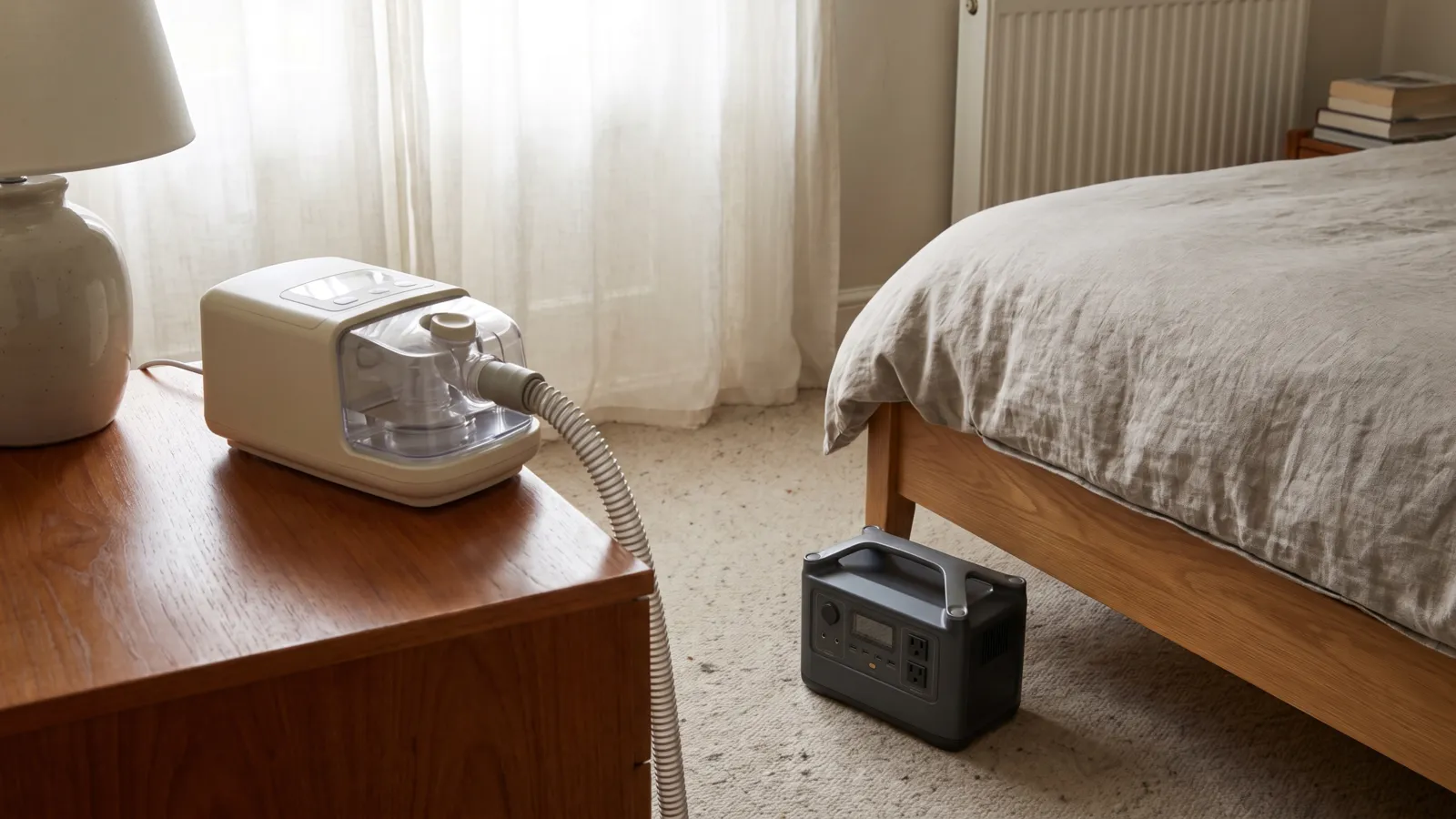
The blower on its own is a small load. ResMed’s battery guide lists the current each machine draws at 12V DC at each treatment pressure: converted to watts, the AirMini draws about 4.4–9W across 6–20 cmH2O and the AirSense 10 without a humidifier about 8–20W. Pressure sets the draw, so ask your sleep service what yours is set to. For the AirSense 11, ResMed publishes only whole-device figures, 56.1W typical and 73.2W peak, listed against its 65W mains power supply without saying which settings they assume.
The humidifier and heated tube are the real load. ResMed’s AirSense 10 table runs from about 21–50W with the humidifier at setting 4, to 41–55W at setting 8, and 56–67W with the humidifier at 8 plus a ClimateLineAir tube at 30°C: several times the blower alone. Philips publishes no per-mode figure for the DreamStation 2; its manual says an 80W power supply is needed to support humidification and gives an AC input rating of 100–240V at 2.0–1.0A, a ceiling rather than a running figure.
One more check for DreamStation 2 owners. Its manual describes a notification that appears when the attached power supply is running from a battery and does not support humidification, and tells you to use a compatible supply or run without humidification: on some battery sources it runs the blower but not the humidifier. Philips also states that the DreamStation 2 is not intended for life support. For anyone who has read about Philips recalls: the DreamStation 2 uses silicone foam, and the US FDA says some were sent out as replacements for recalled DreamStation 1 machines; it is not among the DreamStation Auto models in the 2025 US recall for programming errors. Separately, in November 2023 the FDA issued a safety communication after more than 270 reports of DreamStation 2 machines overheating, including fire, smoke and burns. It asked users to check the machine before and after each use and to unplug it and stop using it at any burning smell, smoke or unexplained change in performance, and did not advise stopping use otherwise. Philips said the reports related to possible thermal issues in the humidifier, and that the devices can continue to be used provided the safety instructions in the instructions for use are followed.
Run it from the 12V socket, not the inverter
A power station stores DC and turns it into 230V mains through an inverter; the CPAP’s plug-in supply then turns it back into DC. Each step loses something, and at a load this small the inverter’s own overhead can be the biggest loss. EcoFlow’s runtime guide suggests using 0.80–0.90 for the mains sockets only as a first pass, says very small or very large draws can lower efficiency, and tells you to use the DC ports for routers and phones to avoid inverter losses; for a CPAP it says that if the machine supports DC input, test DC to extend the runtime. Anker’s own internal tests, published through a sponsored article and not independently verified, put two EcoFlow models (the DELTA 2 Max and DELTA 3 Max) at roughly 32–36% efficiency on a 10W mains load, against 69% for Anker’s S2000. ResMed, separately, gives several reasons for preferring its DC-to-DC converters to inverters: it says they are more efficient, regulate the battery voltage, shut down before the battery is over-discharged, protect the machine if the leads are connected the wrong way round and isolate it electrically.
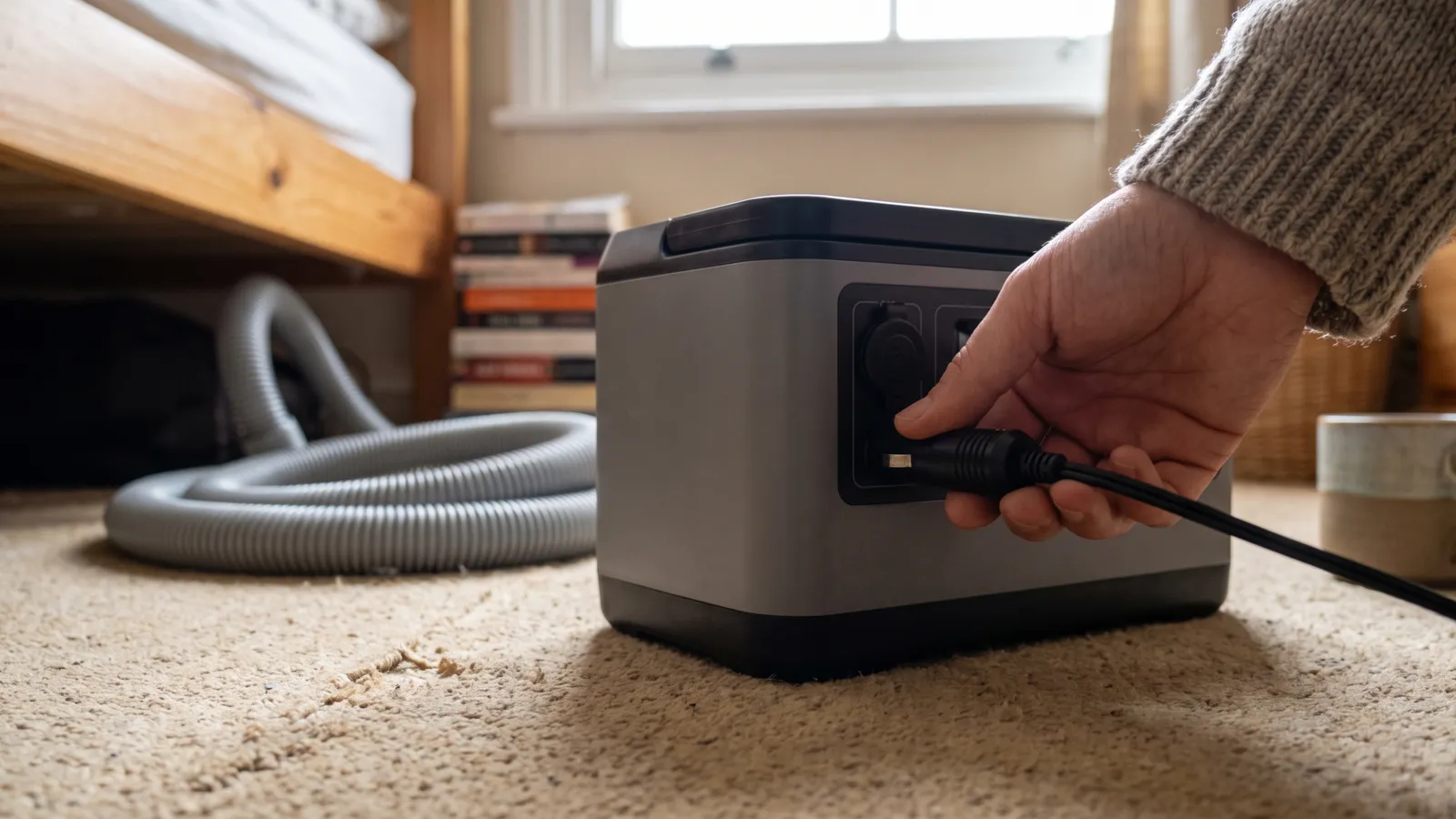
ResMed’s Air11 DC/DC converter takes 12V or 24V in and gives 24V at 3.75A out, about 90W; ResMed’s UK shop says it can power an AirSense 11 with the HumidAir humidifier and ClimateLineAir heated tube. ResMed describes it for a vehicle’s 12V or 24V auxiliary outlet and recommends connecting a deep-cycle battery. Philips says its DC power cord can run the DreamStation 2 in a stationary recreational vehicle, boat or motor home, and its battery adapter cable from a 12V free-standing battery; it says to use only its own leads and does not publish the draw through them. Neither maker mentions power stations, so confirm with the maker or your equipment provider before relying on one. ResMed’s converter is rated to draw up to 10A at 12V, so use a power station whose car-style 12V socket is rated 10A: every unit named here has one, except the EcoFlow DELTA 3 Classic, which has no 12V socket at all.
ResMed’s battery guide strongly recommends a DC-to-DC converter over an inverter. Its inverter instructions cover only the S9, VPAP III, AutoSet CS2, VPAP Adapt and Stellar series, and for those ask for a pure sine wave inverter rated 300W continuous and 500W peak. It warns that ResMed heated humidifiers other than the HumidAire 2i, H4i and H5i ‘must not be used with inverters. Damage to the unit or serious injury to the user may result’, and that the original HumidAire must not be used with inverters either. The AirSense 10 and AirMini appear only in its converter tables, and the AirSense 11 is not in the guide at all. A power station’s mains socket is an inverter, including in UPS mode once the mains fails, so if you use the humidifier, run the machine from the maker’s DC lead, or ask ResMed or your sleep service before using the mains socket.
One setting matters more than any of this. BLUETTI’s Elite 100 V2 and Elite 200 V2 manuals say to disable ECO mode when connecting devices under 60W (the Elite 30 V2 manual says under 10W), because the unit otherwise shuts off its outputs after a period of low or no load; AC-ECO and DC-ECO are both on by default, so the 12V socket can cut out too, not just the mains sockets. EcoFlow’s manuals say to set the AC output timeout to never (‘Never Turn Off’) in the app where continuous power matters, their example being a fridge holding medicines, and its runtime guide says to turn off eco or sleep features when testing. Jackery’s Energy Saving Mode is on by default and turns all outputs off after 12 hours at 25W or less on the mains sockets or 2W or less on the car port: a blower-only CPAP on the 12V socket sits above the 2W line, but on the mains sockets it does not, so turn the mode off. A blower-only CPAP at 4.4–20W sits under BLUETTI’s 60W line, and so do most humidifier settings. On any brand, turn off ECO, timeout or energy-saving mode for every output you use, then try a full night on the battery while the mains is still on.
How many nights: the working
The sum is: hours = capacity in Wh × efficiency ÷ the machine’s watts, and nights = hours ÷ 8, taking an eight-hour night as a planning assumption. ResMed’s AirMini and AirSense 10 figures are the current drawn at 12V through its converter, so they should already include the converter’s own loss; what no maker publishes is the power station’s own 12V-socket loss, so treat raw capacity as a ceiling (ResMed sizes its own battery tables with a 50% safety margin). Through the inverter expect noticeably less again, by an amount the makers do not publish for the units named here. The ranges below are raw.
Blower only, 4.4–20W. A 286–288Wh unit (EcoFlow RIVER 3 Plus, BLUETTI Elite 30 V2, Jackery Explorer 300 Plus) gives 14–65 hours, about 1.8–8 nights. The 512Wh EcoFlow RIVER 2 Max gives 26–115 hours, about 3–14 nights. A 1,024–1,229Wh unit (EcoFlow DELTA 3 Plus, BLUETTI Elite 100 V2, Anker SOLIX C1000, Jackery Explorer 1000 v2, Anker 757 PowerHouse) gives 51–277 hours, about 6–35 nights. The top of each range is the AirMini at its lowest pressure; an AirSense 10 without the humidifier draws 8–20W, so its owners should read the lower half of each range.
With the humidifier and heated tube on, taken as 56–73W. ResMed’s AirSense 10 table gives 56–67W at 12V through its converter with the humidifier at 8 and a ClimateLineAir tube at 30°C, and 37–52W with the ClimateLineAir tube and humidifier on Auto; the AirSense 11’s whole-machine figures, 56.1W typical and 73.2W peak, are listed against its mains supply without stating the settings, and fall in the same range. The 286–288Wh units give 4–5 hours, short of one night. The RIVER 2 Max gives 7–9 hours, about one night. The 1,024–1,229Wh class gives 14–22 hours, about 1.8–2.7 nights, and at the Auto figures 20–33 hours, about 2.5–4 nights. The 2,042–2,074Wh units (EcoFlow DELTA 3 Max Plus, Jackery Explorer 2000 v2, BLUETTI Elite 200 V2) give 28–37 hours, about 3.5–4.6 nights.
The humidifier setting moves these a long way: at setting 4 on an AirSense 10 the whole machine draws 21–50W, which is 20–49 hours from a 1,024Wh unit, about 2.5–6 nights. The humidifier setting you actually use, not the badge on the box, decides the size. For loads beyond the CPAP, see what size power station do I need or use the kit builder.
Which size to buy
For the CPAP on its own through a short cut, the 286–288Wh units do the job on the DC route with ECO off: nearly two nights at the highest published blower draw, more at a lower pressure.
For up to about two nights with the humidifier and heated tube, the 1,000–1,230Wh class is the core pick: 1.8–2.7 nights raw on the AirSense 11 figures, more at a lower humidifier setting or with it off. If humidification must stay on for several nights, the 2,000Wh class gives 3.5–4.6 nights raw and margin for losses. Whichever you choose, check it has a car-style 12V socket rated 10A: the EcoFlow DELTA 3 Classic, for one, has none, so it can only run a CPAP through its inverter, the route this guide advises against. Our power stations page carries live prices and stock, and our Black Friday power station page tracks prices daily up to Black Friday.
If you are weighing a generator instead, read power station vs generator first; for a bedside medical load a battery is the quieter, simpler answer, and generator safety has its own guide. Never run a generator indoors or in a garage, and never leave a car engine running to power a CPAP overnight: both are carbon monoxide risks (see carbon monoxide poisoning symptoms). Philips’s manual also says not to run the DreamStation 2 from a vehicle battery while the engine is running, as it can damage the device. The power-station makers draw their own line: EcoFlow’s RIVER 2 Max manual says the unit can power a home CPAP that does not need continuous professional monitoring, is not recommended for hospital-grade ventilators, and tells you to follow your doctor’s instructions, check the device maker’s restrictions and watch the charge so it does not run out.
Switchover, and whether the CPAP restarts by itself
Every power station named here offers a UPS or EPS mode: the CPAP plugs into the power station, which plugs into the wall, and when the mains fails it switches to battery. This matters only if the CPAP runs from the mains socket, which in a cut means the inverter, so ResMed’s humidifier warning above applies. On the makers’ figures the switch takes 10ms or less on EcoFlow’s RIVER 3 Plus and DELTA 3 range and BLUETTI’s Elite 30 V2 and Elite 100 V2, 15ms or less on the Elite 200 V2, 20ms or less on the Jackery and Anker units (Anker’s UK C1000 product page lists no figure; its UK user guide gives 20ms), and up to 30ms on the EcoFlow RIVER 2 Max. The RIVER 2 Max and Jackery manuals add that their EPS does not support 0ms switching and say to test compatibility first. Neither ResMed nor Philips states in the guides we checked how long a mains gap their machines will ride through, so none of these can be called guaranteed seamless; Philips’s manual does recommend that anyone who needs continued operation during mains interruptions power the device from an uninterruptible power supply or a battery. On BLUETTI units, keep the UPS mode on Standard: its Time Control and Customized modes run your devices from the battery on a schedule, so it may not be full when a cut comes.
If therapy is interrupted, the AirSense 11 user guide says the device automatically restarts therapy when power is restored. We found no equivalent statement in the DreamStation 2 manual, so ask Philips or your sleep service. On the DC route there should be no mains-to-battery switch at the CPAP’s end, but no maker states how its 12V socket behaves when the mains fails, so test it: with the CPAP running from the 12V socket during the day and the power station plugged in, switch off at the wall and check the machine carries on. The other way a CPAP can stop mid-night is the power station’s ECO, timeout or energy-saving mode, which can switch off a small load mid-night on some units and between nights on others.
The Power Cut Action Card
One page for the kitchen drawer: what to do first, what to have ready, how long food keeps, and how to stay warm without risking carbon monoxide. Free, no catch.
Download it straight away. We'll also send the occasional briefing when something genuinely matters — severe weather, live incidents, real price drops. Nothing else.
Register, and talk to your sleep service
The Priority Services Register is a free service across Great Britain for people who need extra support, and anyone who uses medical equipment that relies on electricity qualifies; Asthma + Lung UK’s power-cut guidance names CPAP machines, oxygen concentrators and nebulisers among the equipment priority services support. You register once, with your electricity network operator (the company that owns the wires, not the one that sends the bill), and Citizens Advice confirms it passes your details to your gas network and suppliers. Find yours by postcode at thepsr.co.uk. In Northern Ireland, NIE Networks runs its own Customer Care Register for people who rely on electricity for healthcare needs: sign up online or through its Customer Helpline on 03457 643 643.
What registration gets you varies by operator. UK Power Networks said in January 2024 that around 120,000 people on its register rely daily on medical equipment, and it trialled lending battery packs free (in London, Maidstone, Canterbury and Bury St Edmunds) when a cut runs past four hours. That is one operator’s trial, not a national promise, so ask yours. Our power cuts tracker shows what is happening now.
NHS sleep services are reassuring about short cuts. University Hospitals of North Midlands’ CPAP handbook says most people can manage without CPAP for a few nights: you may not sleep as well, but it will not be harmful, though it advises against driving until you are back on treatment and your symptoms have settled. If you wake in a power cut, it says to take the mask off and turn the machine off, and that sleeping with the mask on and the machine off is not dangerous, because CPAP masks have a valve that lets you breathe room air. The makers are more cautious about the mask itself: Philips warns that exhaled air may be rebreathed when the machine is not running and says a full-face mask used with it must have a safety valve, and ResMed says fitting the mask without the device blowing air can result in rebreathing, so the safe habit is the hospital’s: mask off if you wake to a cut.
The handbook also describes the heated humidifier as there for comfort, not to control sleep apnoea, which is why running without it for a few nights is a fair question to ask. If you use a ventilator or bilevel machine rather than CPAP for sleep apnoea, or your team has told you otherwise, follow their plan instead. Ask your sleep service three things: your set pressure, which fixes the blower draw; whether you can run without humidification for a few nights; and whether your machine has a maker-approved DC lead. If the machine is on loan from the NHS, check with the service before buying accessories for it. See also running medical equipment in a power cut.
Oxygen concentrators are a different case
A home oxygen concentrator is a compressor, not a fan. Maker figures put it at 275W to under 300W (Inogen At Home 275W maximum, Philips’s 230V EverFlo under 300W), and BLUETTI’s manuals say devices with compressors may start at two to four times their rated power, so a small unit with a 300–600W inverter may not start one at all. Even a 1,024Wh unit gives only 3–4 hours raw at that draw.
More to the point, NHS home oxygen services already plan for power cuts. NHS Norfolk and Waveney’s guidance describes static cylinders as the backup for home concentrators during power outages, sized for at least 4 litres a minute for 8 hours, and BOC’s handbook for NHS Home Oxygen Service patients supplies a back-up cylinder with the concentrator, tells patients to switch to it in a power cut, to ask their electricity company for priority status, and to phone BOC if the cut may outlast it. A power station is not a substitute for that route; if you want one as well, agree it with your supplier and prescribing team first.
Common questions
Will a small 300Wh power station run a CPAP?
For the blower alone, yes: at 4.4–20W a 286–288Wh unit gives 14–65 hours before losses, about two to eight nights, with the top of that range the AirMini at its lowest pressure. With the humidifier and heated tube on at 56–73W it gives 4–5 hours, short of one night, so for humidified nights look at the 512Wh class (about one night) or the 1,000Wh class (about two).
Is it better to run a CPAP from the 12V socket or the mains socket?
The 12V socket, through the maker’s DC lead. ResMed’s battery guide strongly recommends its DC-to-DC converters over inverters, and its Air11 converter gives 24V at 3.75A and can power the AirSense 11 with humidifier and heated tube. The guide also warns that ResMed heated humidifiers other than the HumidAire 2i, H4i and H5i must not be used with inverters, and a power station’s mains socket is an inverter. At loads this small the inverter’s own overhead can be the biggest loss, and makers do not publish it for the units we list.
Will my CPAP restart after a power cut?
The AirSense 11 user guide says it automatically restarts therapy when power is restored. The DreamStation 2 manual makes no such statement, so ask Philips or your sleep service. In UPS mode the power stations named here switch to battery within 10–30ms on the makers’ figures, but neither CPAP maker publishes what gap its machine can ride through, and UPS mode feeds the CPAP from the mains socket, so ResMed’s humidifier warning applies.
Why did my CPAP stop overnight when the battery was not flat?
Check the power station’s ECO, timeout or energy-saving mode first: it switches off a small load mid-night on some units and between nights on others. BLUETTI’s Elite 100 V2 and Elite 200 V2 manuals say to disable ECO for devices under 60W, the Elite 30 V2 manual under 10W, and a CPAP without humidification draws 4.4–20W. Turn the mode off on any brand and test a full night on battery while the mains is still on.
Can a power station run a home oxygen concentrator?
It is the wrong plan. Concentrators draw about 275–300W, compressors may start at two to four times their rated power, and a 1,024Wh unit gives only 3–4 hours raw. NHS home oxygen services plan for power cuts with a back-up cylinder; use that, and phone your oxygen supplier if the cut may outlast it.
Who do I register with for the Priority Services Register?
Your electricity network operator, once. Citizens Advice confirms it passes your details to your gas network and your suppliers. Find yours by postcode at thepsr.co.uk, and use 105 to report any power cut in Great Britain. In Northern Ireland, join NIE Networks’ Customer Care Register and report cuts to its Customer Helpline on 03457 643 643.
Sources: ResMed battery guide (198103): AirMini and AirSense 10 current at 12V DC; DC-to-DC converters strongly recommended, with reasons; inverter instructions for S9, VPAP III, AutoSet CS2, VPAP Adapt and Stellar only; heated-humidifier warning; 50% safety margin · ResMed AirSense 11 user guide (edition linked from ResMed’s UK shop): 65W supply, 56.1W typical, 73.2W peak; automatic restart of therapy; mask rebreathing warning · ResMed UK shop: Air11 DC/DC converter, 12V/24V 10A/5A input, 24V 3.75A output, vehicle auxiliary outlet, deep-cycle battery advice · Philips DreamStation 2 Instructions for Use: 80W supply for humidification, input rating, battery humidification notice, DC power cord and battery adapter cable, not intended for life support, rebreathing and safety-valve warnings, vehicle-engine warning, UPS or battery recommendation · Philips: silicone foam used in DreamStation 2 (June 2021 recall), and the ~270 reports of possible thermal issues in the DreamStation 2 humidifier · US FDA safety communication (28 November 2023): carefully monitor Philips DreamStation 2 CPAP machines for signs of overheating · US FDA: Philips Respironics DreamStation Auto CPAP and BiPAP recall for programming errors (June 2025) · EcoFlow: runtime guide, 0.80–0.90 for AC as a first pass, small draws lower efficiency, DC ports avoid inverter losses, test DC for a CPAP, turn off eco or sleep features · EcoFlow UK: DELTA 3 Classic product page (no 12V DC output; 10ms UPS) · EcoFlow UK: DELTA 3 series product page (DELTA 3 Plus 12.6V 10A car output; under 10ms UPS) · EcoFlow UK: DELTA 3 Max series product page (DELTA 3 Max Plus 12.6V 10A car output; 10ms UPS) · EcoFlow UK: RIVER 3 Plus product page (12.6V 10A car output; under 10ms UPS) · EcoFlow UK: RIVER 2 Max product page (12.6V 10A DC output) · EcoFlow RIVER 2 Max user manual V1.0 and RIVER 3 Plus user manual (via EcoFlow’s downloads centre): EPS within 30ms and no 0ms switching; home CPAP guidance; AC timeout ‘Never Turn Off’ · Android Authority (sponsored by Anker SOLIX): Anker’s internal low-load efficiency tests · BLUETTI Elite 100 V2 user manual (EU EN): AC-ECO and DC-ECO on by default, disable under 60W; UPS within 10ms; UPS modes; 12V/10A car port; compressors 2–4× rated power at start · BLUETTI Elite 30 V2 user manual (EU EN): disable ECO under 10W; switchover 10ms or less; 12V/10A car port · BLUETTI Elite 200 V2 user manual (US edition): disable ECO mode under 60W; switchover 15ms or less; 12V/10A car port · Jackery UK: Explorer 300 Plus product page (EPS, switching time under 20ms) · Jackery Explorer 300 Plus (JE-300B), 1000 v2 (JE-1000D) and 2000 v2 (JE-2000D) user manuals, via Jackery UK’s user guides page: Energy Saving Mode on by default, 12-hour cut-off at 25W or less on AC or 2W or less on the car port; car port 12V 10A; switch to battery within 20ms, no 0ms switching · Jackery UK: Explorer 1000 v2 product page (UPS 20ms or less) · Jackery UK: Explorer 2000 v2 product page (20ms UPS) · Anker SOLIX C1000 user guide (UK edition): UPS 20ms; car socket 12V 10A · Anker SOLIX UK: C1000 product page (no UPS switch time listed) · Anker 757 PowerHouse (A1770) user manual, Anker Japan edition (Japanese): car socket output 12V 10A; UPS under 20ms · Priority Services Register (thepsr.co.uk): eligibility includes medical equipment reliant on electricity; the PSR promise covers England, Wales and Scotland · Citizens Advice: tell your supplier if you need extra support (your electricity network passes your details to your gas network and suppliers) · Energy Networks Association: 105, the power cut number for England, Scotland and Wales · NIE Networks: Customer Care Register (for people who rely on electricity for healthcare needs; Customer Helpline 03457 643 643) · UK Power Networks (9 January 2024): extra support for people reliant on electricity for medical reasons; Power Protect battery-pack trial · Asthma + Lung UK: breathing easier during power cuts · University Hospitals of North Midlands NHS Trust: CPAP patient handbook (emergencies, power cuts, humidifier) · NHS Norfolk and Waveney ICB: home oxygen therapy provision guidance (static cylinders as backup in power outages) · BOC: The Home Oxygen Handbook (NHS Home Oxygen Service): back-up cylinder in a power cut · Inogen At Home user manual: 275W max · Philips EverFlo spec sheet: 230V version under 300W. PreparedBritain is independent and not affiliated with HM Government.
Keep reading
All power cuts & energy guides →Can a power station run a gas boiler in a power cut?
A gas combi boiler needs only about 35–123W of electricity on its makers’ figures, well within any 1kWh-class unit…
What will the January 2027 energy price cap be? The forecasts, dated
Ofgem has not set the cap for 1 January to 31 March 2027; its published schedule says it will announce it by 25…
Will ‘time-varying’ electricity prices slash your bill? What the IFS actually said
Headlines say bills could be ‘slashed’ with time-varying prices while experts warn costs will stay high for years.…