Power station vs generator: which home backup is right for you?
Power station or generator for UK home backup? A calm, sourced guide: most short power cuts need silent indoor battery power, not a fuel generator.
By Tom Calder · Updated 21 July 2026 · Sourced to gov.uk, the NHS & Ofgem
Start with the outage, not the kit
The right backup depends on the power cuts you actually face, not a worst-case fantasy. In Great Britain the great majority of cuts are short: a fault on the local network that your distribution operator clears within hours. Under Ofgem's guaranteed standards, operators must restore supply within 12 hours of a normal-weather fault or pay compensation (24 hours for very large faults affecting 5,000 or more premises), and in practice most interruptions are shorter still.
That reframes the question. For most homes the job is not 'run the house for a week' — it is 'keep a few essentials going for a few hours': a phone, the broadband router, a couple of lights, the fridge, and any medical device. A small, simple, indoor-safe solution usually covers that. Reserve the bigger decision for the minority of households — often rural — that genuinely see long or frequent outages.
What a portable power station actually does
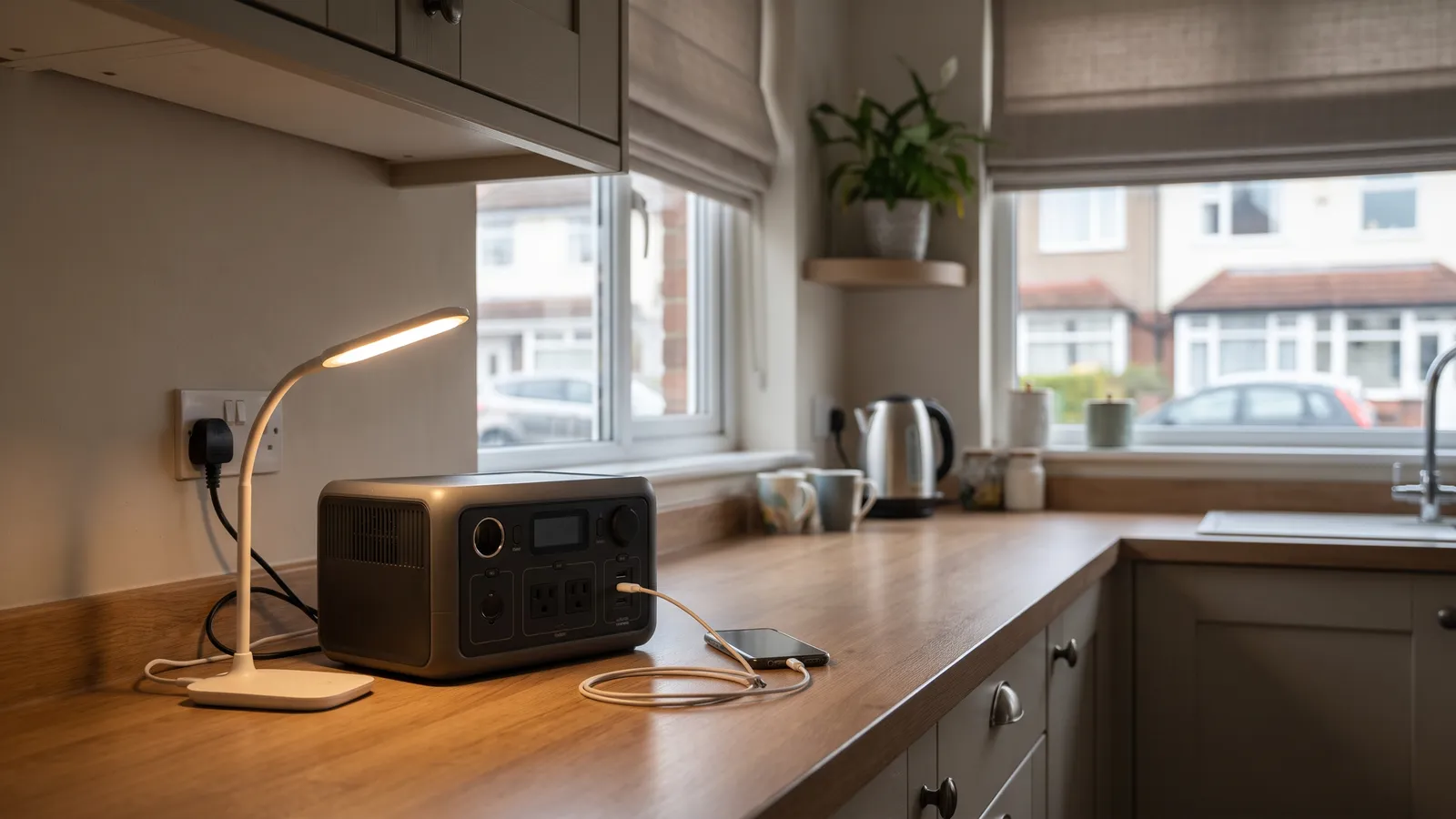
A portable power station is a large lithium battery with a built-in inverter and ordinary three-pin sockets, plus USB. It stores energy — rated in watt-hours (Wh) — and delivers it silently, with no fuel and no exhaust, so it is safe to use indoors. You charge it from the mains before a cut and top it up from a car or from portable solar panels afterwards.
That makes it ideal for the essentials most households want to protect: charging phones, keeping the router on, running LED lights, cooling a fridge-freezer in bursts, or powering low-draw medical equipment such as a CPAP machine. A unit of roughly 500–1,000Wh covers a typical short cut comfortably.
Its weakness is high-heat loads. Kettles, toasters, electric heaters, ovens and hair dryers draw 2,000–3,000W and will flatten even a large power station in minutes, or exceed its output entirely. Plan to go without those during a cut rather than to run them.
What a generator adds — and the strict conditions
A petrol or diesel generator makes its own electricity continuously, so with fuel it can run indefinitely and handle sustained high loads a battery cannot — heating a workshop, a water or sump pump, or a run of appliances at once. For genuinely long outages that is a real advantage.
It comes with a non-negotiable safety condition. Generators burn fuel and produce carbon monoxide (CO) — a gas you cannot see, smell or taste that can kill quickly. A generator must only ever be run outdoors, well away from doors, windows and air vents, and never in a garage, porch or other enclosed or partly enclosed space, even with a door or window open. Fit a carbon monoxide alarm, and if anyone develops headache, dizziness, nausea, breathlessness or confusion, get them into fresh air and seek medical help.
There are practical costs too: noise, storing flammable fuel safely, routine maintenance so it starts when you need it, and running cables safely in from outside.
The decision framework
For most people the choice is clear. A power station wins if you live in a flat or a suburban or urban home where cuts are short, if you need silent power you can use indoors, if you or someone at home relies on medical equipment, or if you simply want the essentials covered without fuel, fumes or noise.
A generator earns its place in narrower cases: rural or off-grid properties that see long or frequent outages, homes with high sustained demand you must maintain (electric heating, a well or sump pump), or a business that cannot pause. Even then, many households pair a small generator with a power station — the battery for silent indoor essentials, the generator outdoors for the heavy, occasional jobs.
Sizing it, and running costs
Size a power station by listing what you must keep on, adding up the watts, and picking capacity to match. A phone charger draws roughly 10W, a router 10–20W, an LED lamp 5–10W, and a modern fridge-freezer averages perhaps 40–80W across a day (though it surges when the compressor starts). Add a comfortable margin. To stretch backup across several days, add portable solar panels to recharge in daylight.
For a generator, factor in the running cost of fuel, safe fuel storage, and periodic test runs so it starts on demand. Match its output in watts to your heaviest simultaneous load, and remember that motors surge on start-up. Our kit-builder can turn your must-run list into a rough capacity target.
Before you buy: the safety and admin checklist
Whichever you choose, do three things first. Fit a working carbon monoxide alarm — essential alongside any fuel-burning generator, and sensible in any home with gas, oil or solid-fuel appliances. If you or someone in your home depends on electricity for medical equipment, or is elderly or has a disability, join your energy network's Priority Services Register for extra support and advance warning of planned cuts.
Know the basics for a real cut: call 105 free to reach your local electricity network operator to report or check on a power cut, and see whether you are owed compensation. Under Ofgem's guaranteed standards you can claim £95 if a normal-weather cut lasts more than 12 hours (or more than 24 hours for a very large fault affecting 5,000 or more premises), with further payments for longer outages and separate arrangements for severe weather.
Common questions
Can I run a portable power station indoors?
Yes. A battery power station produces no exhaust and no carbon monoxide, so it is safe to use inside — unlike a petrol or diesel generator, which must only ever be run outdoors.
Will a power station keep my fridge running in a power cut?
Usually, for a typical short cut. A fridge-freezer draws a modest average but surges when its compressor starts, so pick a unit whose continuous and surge outputs cover that, and a capacity of around 500–1,000Wh to see you through several hours.
Why can't I run a generator in my garage with the door open?
Because it still produces carbon monoxide, which builds up in enclosed and partly enclosed spaces and can be fatal. UK safety guidance is that generators must be run outdoors only, well away from doors, windows and vents — an open door is not enough ventilation.
How long do UK power cuts usually last?
Most are short — a local network fault cleared within hours. Under Ofgem's guaranteed standards, operators must restore supply within 12 hours of most normal-weather faults or pay compensation, and typical cuts are much shorter. Long outages are the exception, usually linked to severe weather.
Do I need a CO alarm if I only use a battery power station?
A battery power station doesn't produce carbon monoxide, so it doesn't need one for that reason. But a CO alarm is still sensible in any home with gas, oil or solid-fuel appliances — and essential if you ever run a fuel generator.
Can solar panels recharge my backup during a multi-day cut?
Yes. Portable solar panels can recharge a power station in daylight, extending backup across several days without fuel. A generator does the same job with petrol or diesel, but must stay outdoors.
Sources: Ofgem — Compensation rules for a power cut or supply problem · NHS — Carbon monoxide poisoning · GOV.UK — Carbon monoxide: general information · Energy Networks Association — What to do if you have a power cut (call 105). PreparedBritain is independent and not affiliated with HM Government.
The Power Cut Action Card
One page for the kitchen drawer: what to do first, what to have ready, how long food keeps, and how to stay warm without risking carbon monoxide. Free, no catch.
Download it straight away. We'll also send the occasional briefing when something genuinely matters — severe weather, live incidents, real price drops. Nothing else.
Keep reading
All power cuts & energy guides →How to prepare for a power cut
The free number to save today, what to have ready, food safety, staying warm safely, and the compensation you may be…
Which radio actually works in a UK power cut?
Long wave closed in June 2026, and half the wind-up radios on sale here advertise an American weather band that…
Can a power cut damage your appliances?
What really happens electrically when the power comes back on, which appliances are genuinely at risk, and how to…