Home battery storage in the UK: cost, power-cut backup and how long it runs a house
What a home battery costs, what it saves, why most UK systems don't power the house in a power cut without extra backup hardware, how long one runs a home, where it can be installed, and what's now legal for plug-in solar.
A home battery is a fixed battery, wired in by an installer, that stores solar power or cheap off-peak electricity to use later. The Energy Saving Trust puts the cost at about £1,500 to £10,000 (around £4,600 for a 5kWh system), with 0% VAT until 31 March 2027. A standard installation doesn't keep the house running in a power cut unless backup hardware, such as a backup gateway or an EPS circuit, was fitted, so ask before you buy. If power-cut backup is all you want, a portable power station costs far less.
By Tom Calder · Updated 4 November 2026 · Sourced to GOV.UK, Ofgem, the Energy Saving Trust, MCS, BSI & makers' datasheets
What a home battery is, and how it differs from a portable power station
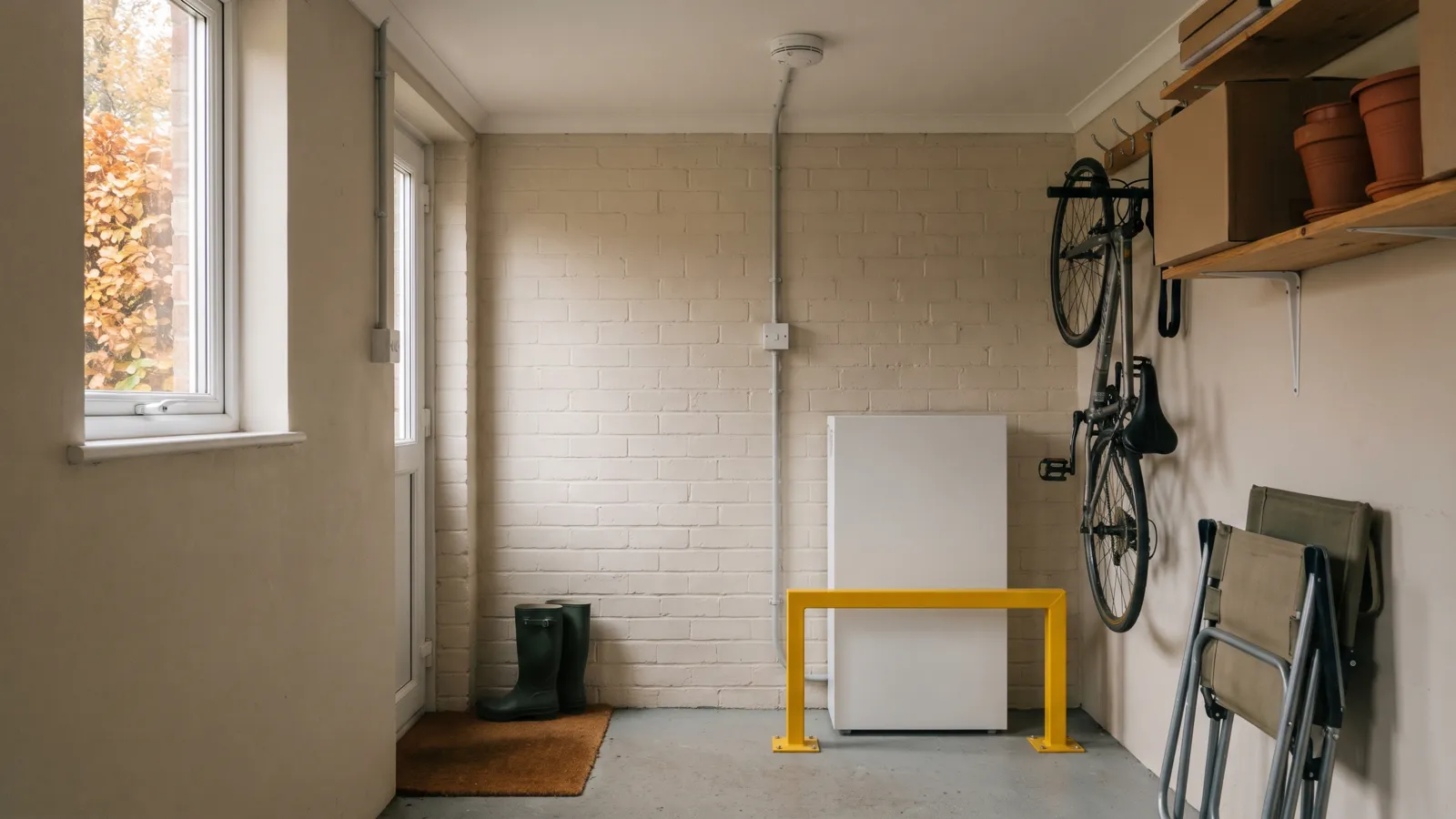
A home battery (often sold as solar battery storage) is a fixed unit that an installer wires into your home's electrics. It charges from your solar panels, from the grid at cheap times, or both, and then supplies the house when electricity is expensive or the sun has gone down. It works in the background: you don't plug anything into it. The Energy Saving Trust says a typical home system might be 10kWh, and a typical unit is about 100cm × 60cm × 25cm, a little taller and wider than a washing machine but much less deep.
A portable power station is a different thing. It is a box with its own sockets that you charge from a wall socket (or a solar panel) and plug appliances into directly. It isn't connected to your house wiring, so it can't power your lights or your boiler's fused spur without an electrician's changeover switch. It holds less (the models we compare mostly store about 1 to 2kWh), but it costs far less, needs no installer, and goes wherever you need it.
Home battery backup: will it power the house in a power cut?
This is the point many owners miss: a grid-connected home battery does not keep the house running in a power cut on its own. Under the network connection rules (the Energy Networks Association's G98 and G99), solar and battery systems connected to the grid must stop feeding power into it when it goes down, so they can't energise lines that engineers are working on. Unless the system has hardware to isolate your home from the grid and keep supplying it, a standard installation goes off with everything else, even with a full battery or in full sun.
Backup needs extra hardware that cuts your home off from the grid and then lets the battery supply it. The makers name it on their own pages. Tesla's UK Powerwall 3 datasheet lists Backup Gateway 2 as its supported islanding device. GivEnergy says its All in One can give whole-house backup with the additional Giv-Gateway, which switches over in 20 milliseconds; without a gateway, its inverters' EPS (emergency power supply) terminals can back up dedicated circuits only, with a short delay and a lower output limit. SolarEdge says backup needs its Home Backup Interface alongside its Home Batteries.
So there are three set-ups: no backup at all, partial backup (a few essential circuits, such as the fridge, lights and router), or whole-home backup. Whether the solar panels keep charging the battery during a cut also depends on how the system is wired; GivEnergy, for example, says its Gateway lets the solar keep generating with no grid supply. Ask the installer, in writing, which of the three you're getting, what it adds to the price, and the battery's usable capacity.
How long can a home battery run a house during a power cut?
It depends on three things: how much the battery holds, how full it is when the power goes, and what you run. Here's a worked example using the appliance figures behind our power station calculator: a fridge-freezer, broadband router and fibre box for 12 hours, four LED bulbs for five hours, a TV for four hours, a gas combi boiler's pump and controls for five hours, two phones charging for two hours and a laptop for three. At the plug that adds up to roughly 0.8 to 3kWh, about 1.9kWh for a typical mix of appliances. The wide range is mostly the TV, the boiler and the age of the fridge-freezer.
A full Tesla Powerwall 3, which its UK datasheet rates at 13.5kWh of usable energy, would cover that half-day several times over. A 5kWh battery covers it too, as long as it is reasonably full. That's the real catch: a battery that's being used to save money is often part-empty, for example on a winter evening after it has run the house through the peak, and the Energy Saving Trust notes that systems stop drawing on the battery at a set level, perhaps 20% of capacity. If backup matters to you, ask the installer whether you can keep a share of the battery in reserve for cuts.
For the whole house, Ofgem's typical household uses 2,500kWh of electricity a year, about 6.8kWh a day on average. On that average, a full 13.5kWh battery would run a typical home for around two days and a 5kWh battery for well under one, before allowing for any reserve. Output is the other limit: Tesla's UK datasheet lists Powerwall 3's continuous output at 3.68kW to 11.04kW depending on how it's configured, and a single kettle draws 2.2 to 3kW, so an electric shower, oven and kettle at once can be more than a backup system supplies. On partial backup, only the circuits you chose stay on.
For scale: under Ofgem's guaranteed standards, if your power is off for more than 12 hours in normal weather (24 hours if 5,000 or more properties are affected), your network operator automatically pays you £100, and longer limits apply in severe storms. That's why we plan the examples here around 12 hours of essentials.
NewSee this for your own homeHome Alerts: your postcode's power cuts, warnings and floods, on one screen. Free for your own home. Sign up in a minute.Start free →How much does solar battery storage cost in the UK?
The Energy Saving Trust puts home battery storage at anywhere from about £1,500 to £10,000, depending on the type and size, with a 5kWh battery system around £4,600. It says you should save money by fitting the battery at the same time as solar panels, and possibly a heat pump, because the installer is already on site. Backup hardware (a gateway or backup interface) is usually an extra, so ask for it to be priced separately.
VAT is currently 0%. Under HMRC's VAT Notice 708/6, batteries installed in homes have qualified for the temporary zero rate since 1 February 2024, including a standalone battery that stores electricity from the grid and a battery retrofitted to existing solar. The zero rate runs until 31 March 2027; from 1 April 2027, installations move to the reduced rate of 5%. It applies only when the same business supplies and installs the battery. A battery bought from a retailer, or supplied without installation, is standard-rated.
A battery also wears out sooner than solar panels: the Energy Saving Trust gives a typical lifespan of about 10 to 12 years, so it will need replacing before the panels do. Check the warranty, what it guarantees about remaining capacity, and who honours it if the installer stops trading. The Energy Saving Trust recommends at least three quotes from MCS-certified installers.
Help is on the way for some households: the Energy Saving Trust says the government's Warm Homes Plan will include fully funded battery storage for people on low incomes, and low and zero-interest loans for homeowners regardless of income. Details are still to come, so don't let a salesperson rush you on the strength of it.
What decides whether a home battery pays for itself
A battery saves money by moving when you use electricity. With solar, it stores the daytime surplus you would otherwise export cheaply and lets you use it in the evening. With a time-of-use tariff, it charges when electricity is cheap, often overnight, and runs the house through the expensive hours. The Energy Saving Trust says a battery saves more running a heat pump than just storing spare solar, and that savings can be significant but won't always be enough on their own to justify the cost.
The saving per unit is the gap between what it costs to fill the battery and what you would otherwise pay, minus the energy lost on the way in and out. Tesla rates Powerwall 3 at 89% efficiency from solar to battery to home, so roughly a tenth is lost; that figure is for solar charging, and charging from the grid may lose a little more. As a round-number illustration only, so treat it as a best case: on the average price cap unit rate of 26.32p per kWh for October to December 2026 (Direct Debit), a unit charged at a hypothetical 10p off-peak rate saves about 15p once that loss is counted. A battery that moves 4kWh a day would save about 60p a day, a little over £200 a year, which against a £4,600 battery and a 10 to 12-year life doesn't pay back. Bigger daily use, a heat pump, a wider gap between peak and off-peak rates or a lot of spare solar change that sum, so model your own numbers.
Be cautious of any sales pitch that promises the battery will 'pay for itself' by a set date, or that relies on today's tariff staying as it is. Tariffs change, and a battery's saving depends on them.
The safest place to install a home battery: garage, loft or outside?
The Energy Saving Trust says a battery can go in a garage, on an external wall or in a utility room, depending on the model. The detailed rules on location come from PAS 63100:2024, a BSI specification on protecting homes against fire from battery storage, sponsored by the Department for Energy Security and Net Zero and in effect since 31 March 2024. It says that where practicable, batteries shall be installed outdoors, which can include an outbuilding that isn't lived in and is detached, or separated from the home by a fire-resisting wall.
Its requirements say batteries shall not be installed in bedrooms; on escape routes such as landings, staircases and corridors; in storage cupboards or spaces opening into bedrooms; in voids, roof spaces or lofts; within 2 metres of stored flammable materials or fuel tanks or cylinders; in cellars or basements with no access to the outside; or outdoors within 1 metre of escape routes, doors, windows or ventilation openings. An indoor location needs fire-resisting walls, ceilings and floors between it and those places, and ventilation to the outside. Where a battery sits somewhere rarely visited, such as a store cupboard, it needs a smoke alarm or multi-sensor fire alarm there, interlinked with the rest of the home's alarms.
A garage is a common choice, but PAS 63100 also requires protection against impact in garages and next to driveways, so a car can't hit the unit; keep petrol, paint and other flammable stores well away from it. PAS 63100 doesn't cover homes over 200m² of floor area, and it is voluntary: MCS says it has no standing in UK regulations such as the Building Regulations and isn't directly referenced in its battery standard. The IET Code of Practice for Electrical Energy Storage Systems, which MCS installers read alongside that standard, recommends using it for battery location. In practice, expect a reputable installer to follow it, and question one who suggests the loft.
LFP (lithium iron phosphate) batteries, in plain words
LFP stands for lithium iron phosphate (LiFePO4). It is one type of lithium-ion battery, named after the material used for one of its electrodes. It is common in home batteries and in many portable power stations: GivEnergy, for example, uses LiFePO4 in its expansion battery.
Makers sell LFP on its long working life, and the warranty tells you what that means for your unit: check how many years and how much remaining capacity it guarantees. It is still a lithium battery, though. Have it installed by a certified installer, put it where the rules above allow, and follow the maker's manual. If a battery ever smokes, hisses or catches fire, get everyone out, stay out and call 999; our lithium battery guide has more.
Plug-in solar (balcony solar) in the UK: what is legal now
On 24 March 2026 the government announced it would make plug-in solar panels of under 800W available in shops within months, plugged into an ordinary socket without an electrician. The law that allows it, SI 2026/848, was made on 16 July 2026 and came into force on 27 August 2026. Since that date plug-in solar has been legal across Great Britain. The change to the electricity safety rules doesn't extend to Northern Ireland.
The legal definition is narrow. A plug-in kit must have a maximum rated AC output of no more than 800 watts, connect through a standard plug and socket, work alongside the grid, and meet the government's Plug-in Solar Device Interim Product Specification. It must not be designed to draw electricity from your home's wiring to store for later use (beyond small control functions the specification allows), so a kit whose battery charges from your sockets falls outside the definition. The government says a kit can provide up to 20% of an average home's electricity use and estimates savings of up to £110 a year.
Before you buy, check you are allowed to fit it: the government says you may need permission from your landlord, building owner or freeholder, planning permission, or listed building consent. Buy a kit sold as meeting the UK specification. GOV.UK links to a list of compliant devices, and Currys, B&Q, Screwfix and Amazon worked with the government on the launch. Plug-in solar is a modest bill-saver designed to work alongside the grid, so don't count on it as a power-cut backup.
If you only want power-cut backup, a power station is far cheaper
A home battery is mainly a money-saving and solar tool, and backup is an add-on. If all you want is to keep the fridge, router, lights and phones going through a cut, a portable power station does it for a fraction of the price, needs no installer, and you can buy one today.
On the same appliance figures, a pared-back set (fridge-freezer, router and fibre box for 12 hours, four LED bulbs for five hours, two phones charged) uses about 0.4 to 1.3kWh at the plug. Allowing for what a power station loses converting to mains and uses itself, that's about 1.25kWh of power station for typical appliances and 1.8kWh for older, hungrier ones. So a 2kWh unit covers a 12-hour cut, and a 1kWh unit covers an efficient fridge and the router. The picks below are on today's prices.
Common questions
Does a home battery work in a power cut?
Only if it was installed with backup hardware. Grid-connected solar and battery systems must stop feeding the grid when it goes down, so without hardware to isolate the home, a standard installation goes off too. Backup needs a device such as Tesla's Backup Gateway 2, GivEnergy's Gateway or EPS circuit, or SolarEdge's Home Backup Interface. Ask your installer whether you have no backup, partial backup or whole-home backup.
How much does a home battery cost in the UK?
The Energy Saving Trust puts it at about £1,500 to £10,000, with a 5kWh battery system around £4,600. Backup hardware is usually extra. VAT is 0% on batteries installed in homes until 31 March 2027, then 5%.
How long can a home battery power a house?
On Ofgem's typical household use of 2,500kWh a year (about 6.8kWh a day), a full 13.5kWh battery such as a Powerwall 3 would run an average home for around two days and a 5kWh battery for well under one. Running only essentials such as the fridge-freezer, router, lights and boiler, a battery lasts much longer. A battery used to save money is often part-empty when a cut starts, so you can't count on a full one.
Can I have a home battery without solar panels?
Yes. You can charge it from the grid on a cheap time-of-use rate and use it at peak times. The Energy Saving Trust says it saves more if it's running a heat pump. A standalone battery installed in a home also gets the 0% VAT rate until 31 March 2027.
Can a home battery go in the loft or the garage?
Not the loft. PAS 63100:2024 says batteries shall not be installed in voids, roof spaces or lofts, bedrooms or escape routes, and prefers outdoors where practicable. A garage can be suitable with fire separation from the house and protection from being hit by a car; keep flammable materials more than 2 metres away.
Is plug-in solar legal in the UK?
Yes, in Great Britain since 27 August 2026. Kits with an AC output of up to 800W that meet the government's Plug-in Solar Device Interim Product Specification can be plugged into an ordinary socket. Check whether you need permission from your landlord or freeholder, planning permission or listed building consent first.
What is an LFP battery?
LFP means lithium iron phosphate (LiFePO4), a type of lithium-ion battery that's common in home batteries and power stations. Makers sell it on its long working life. It still needs installing and using as the maker's manual says.
Sources (18)
- Energy Saving Trust: Battery storage (cost £1,500–£10,000, 5kWh about £4,600, typical 10kWh, 10–12 year lifespan, install locations, MCS quotes, Warm Homes Plan), read 4 November 2026
- GOV.UK: VAT on energy-saving materials and heating equipment (Notice 708/6), batteries zero-rated from 1 February 2024 to 31 March 2027, read 4 November 2026
- Tesla: Powerwall 3 datasheet, UK (13.5kWh usable, 3.68–11.04kW output, 89% solar-to-battery-to-home efficiency, Backup Gateway 2 islanding device), read 4 November 2026
- GivEnergy: Giv-Gateway UK datasheet (whole-house backup, 20ms switchover), read 4 November 2026
- GivEnergy: Connecting emergency power supply (EPS) for inverters, read 4 November 2026
- GivEnergy: All in One (Gateway 2 whole-home backup, LiFePO4 expansion battery), read 4 November 2026
- SolarEdge UK: Home Backup Interface, read 4 November 2026
- Energy Networks Association: Engineering Recommendations G98 and G99
- BSI: PAS 63100:2024, protection against fire of battery energy storage systems for use in dwellings (scope, clauses 6.5 and 6.6), read 4 November 2026
- MCS: Update on PAS 63100 and IET Code of Practice 3rd edition (9 May 2024)
- MCS: MIS 3012 Battery Storage Systems installation standard
- Ofgem: Energy price cap unit rates and standing charges (26.32p per kWh, 1 October to 31 December 2026), read 4 November 2026
- Ofgem: Price cap update from 1 July 2026typical household 2,500kWh of electricity a year
- Ofgem: Check if you can get a payment after a power cut (guaranteed standards)
- GOV.UK: Government to make plug-in solar available within months (24 March 2026)
- GOV.UK: Households can save as plug-in solar panels come to market (26 August 2026)
- legislation.gov.uk: SI 2026/848, plug-in microgenerator definitionmade 16 July 2026, in force 27 August 2026
- GOV.UK: Plug-in solar consultation, regulatory amendment and interim product specification
PreparedBritain is independent and not affiliated with HM Government.
The Power Cut Action Card
One page for the kitchen drawer: what to do first, what to have ready, how long food keeps, and how to stay warm without risking carbon monoxide. Free, no catch.
Download it straight away. We'll also send the occasional briefing when something genuinely matters — severe weather, live incidents, real price drops. Nothing else.
Latest from our live data
All stories → News · 3 NovVampire devices: the '£200' is 13 gadgets added up; turning a home off standby saves about £45
 News · 2 NovCold Weather Payment opens: £25 a freezing week; last winter 40 of 71 stations triggered none
 News · 31 OctEarliest polar vortex breakdown on record forecast for November: what it means for the UK
Keep reading
All power cuts & energy guides →When the mobile network goes down: how to stay in contact in the UK
In a long power cut the local mast can go quiet. What still works, how long masts last on Ofcom's own figures, and…
Off-peak electricity times in the UK: Economy 7, Economy 10 and smart tariffs
There is no off-peak on a standard single-rate tariff: a unit costs the same at 3am as at 6pm. Off-peak times only…
How to read your electricity and gas meter: smart, digital, dial and Economy 7
Which numbers to write down from every common British meter: smart meters and their in-home displays, digital and…
