Can a power station run a gas boiler in a power cut?
A gas combi boiler needs only about 35–123W of electricity on its makers’ figures, well within any 1kWh-class unit we pick, but it is hard-wired through a fused double-pole isolator. Here is what a qualified electrician has to fit before you can use one, how many hours of firing a 1kWh or 2kWh unit gives on a maker’s published formula, what the boiler manuals do and don’t say about the guarantee, and when a battery is the wrong answer.
Yes, electrically: on Vaillant, Worcester Bosch and Ideal figures a gas combi boiler draws roughly 35–123W while firing, so a 1kWh power station has power to spare. The catch is the connection: boilers are hard-wired through a fused double-pole isolator, so a qualified electrician must first fit a changeover switch that keeps the boiler on its fixed, double-pole isolated supply (a plug-and-socket conversion is only an option where the boiler maker’s instructions allow it; Vaillant’s require a fixed connection), and you must never do it yourself or backfeed through a socket. Once that is done, expect roughly 4½–6 hours of hard firing from a 1kWh unit, or 9½–13 hours from a 2kWh unit, and more on light firing.
By Tom Calder · Updated 22 September 2026 · Sourced to Vaillant, Worcester Bosch & Ideal manuals, BLUETTI’s UK manuals, the Electricity Safety Regulations, Approved Document P, GOV.UK & the HSE
Why the boiler stops when the power does
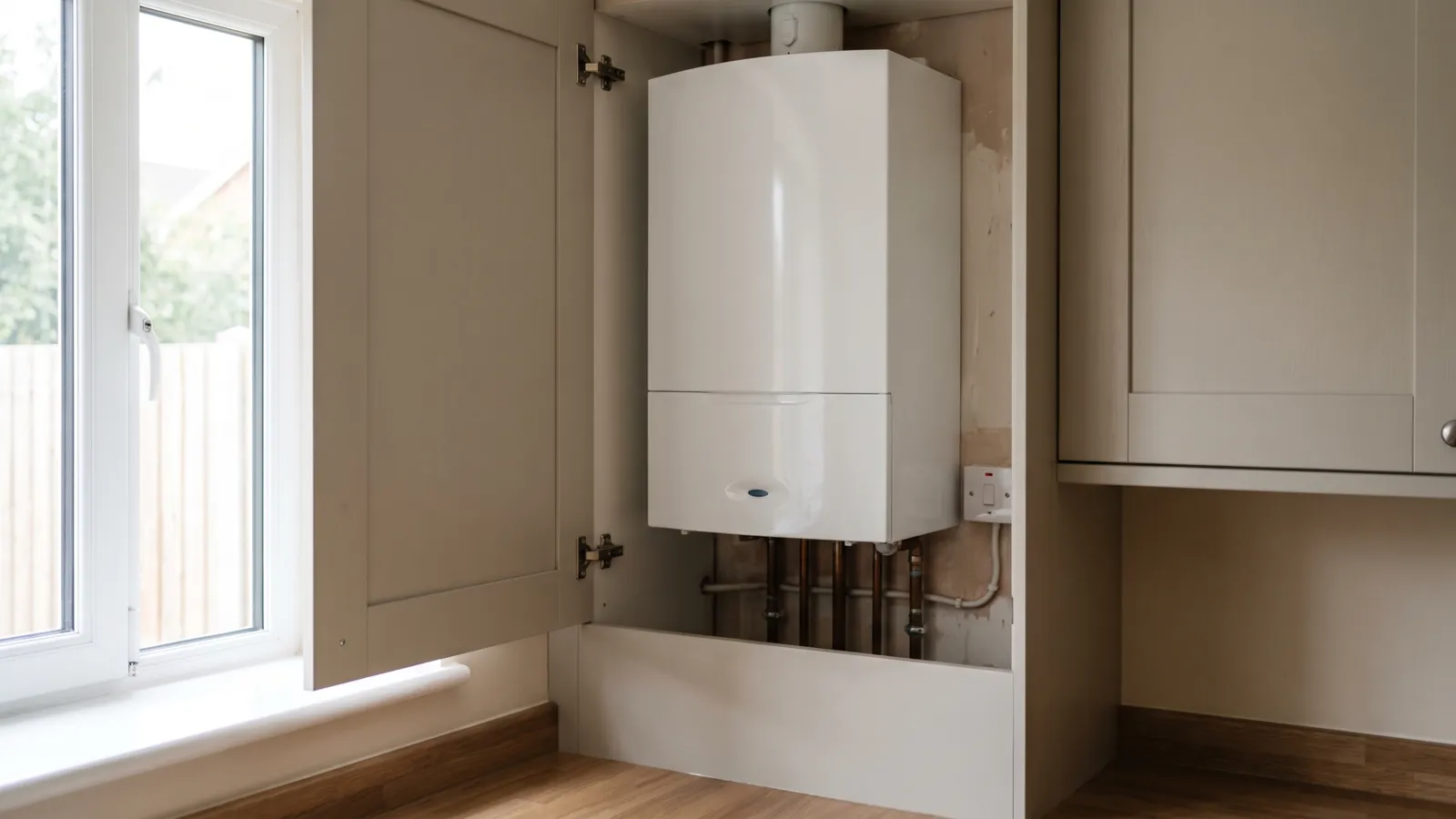
A gas boiler burns gas, but it cannot run without electricity. The printed circuit board, ignition, fan, motorised valves and pump all need mains power, so when the supply drops the boiler shuts down and stays off. Gas may still be there, but nothing lights and nothing moves heat to the radiators or taps.
The good news is how little electricity it needs. Vaillant’s ecoTEC plus combis draw 35–55W at minimum output and 80–120W at maximum; the Worcester Bosch Greenstar 4000 is rated at up to 94W on heating and 123W on hot water, and Ideal lists its Logic Max Combi at 93–110W depending on size. Standby is 3W or less on all three. That puts a combi at roughly 35–123W while firing, and the efficiency (ErP) tables in the Worcester and Ideal manuals list lower ‘auxiliary electricity’ figures at part load (13W and 9–26W), so light firing may take less than 35W. A system boiler has its pump built in, like a combi: Vaillant lists its ecoTEC plus system boilers at 35–55W minimum and 55–95W maximum. A regular (heat-only) boiler uses a separate circulating pump, which adds 2–53W for Grundfos’s common UPM3 xx-70 models (the xx-75 reaches 60W) or 4–20W for Wilo’s Yonos PICO 25/1-4; we found no manual figure for the heat-only boiler itself, and its zone valves, programmer and wiring centre need power too.
None of the three manuals gives a start-up figure, and we do not invent one: this is control electronics, a fan and a small pump, not a compressor. Every 1kWh-class unit in our picks is rated at 1,500–1,800W, so wattage is never the limit: runtime and wiring are.
The wiring is the problem, not the wattage
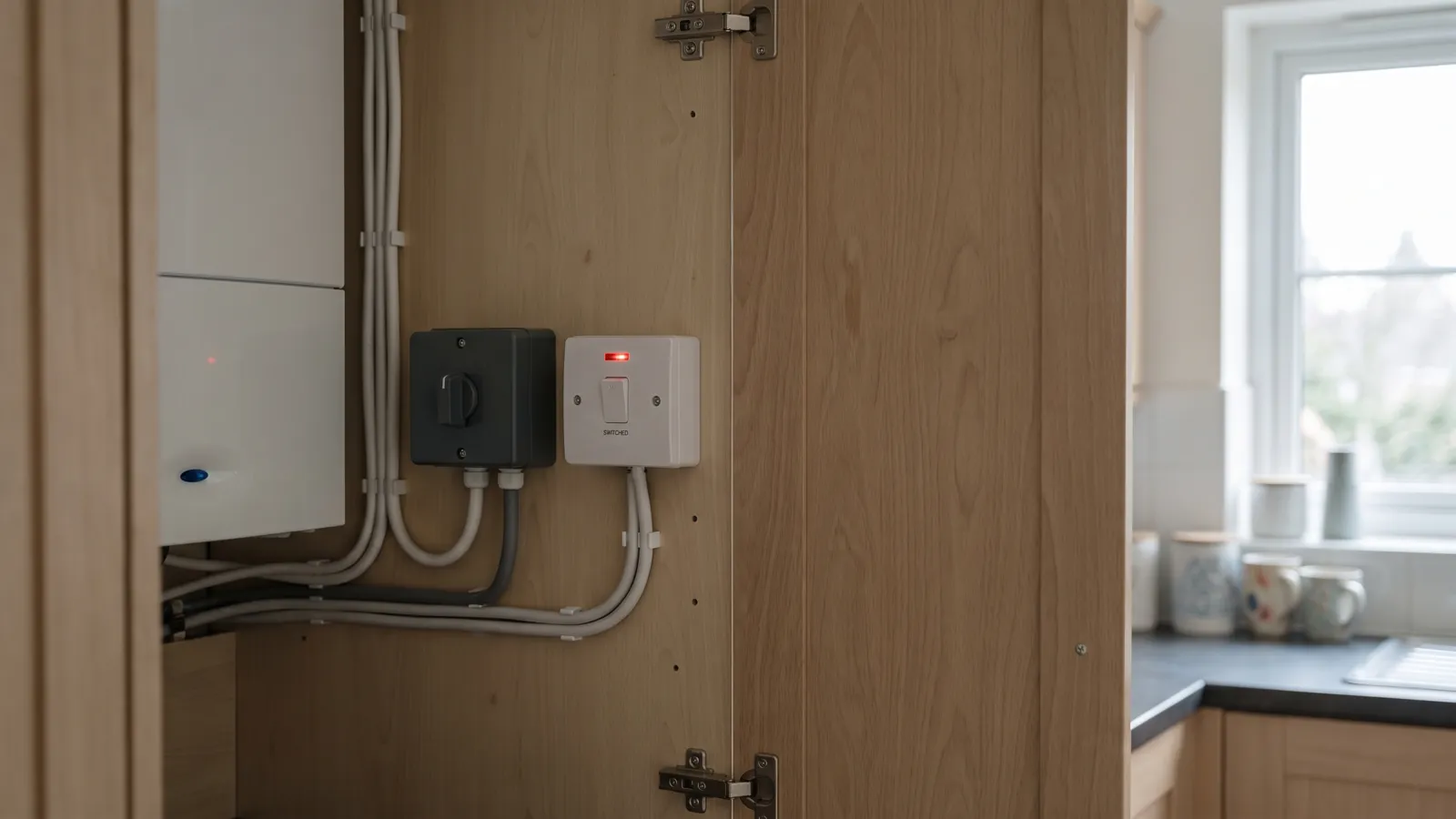
Here is the catch. A boiler is a fixed appliance. Its installation manual sets how it is connected, and the wiring outside it has to meet BS 7671, the IET Wiring Regulations. Vaillant’s ecoTEC plus manual says to connect it with a fixed connection, preferably through a double-pole switched fused spur. Worcester Bosch and Ideal both require a fused double-pole isolator, and Vaillant and Worcester specify at least 3mm between the contacts. There is no plug to move to a power station.
A qualified electrician can install a way to move the boiler’s circuit from the mains to an alternative supply without the two ever being connected. Usually that is a manual changeover switch, which isolates the mains before the backup can feed the boiler and keeps the boiler on its fixed, double-pole isolated supply, often with a dedicated inlet for the power station’s lead. A plug-and-socket conversion is only an option where the boiler maker’s instructions allow it, and Vaillant’s require a fixed connection, so check with the maker before anyone suggests it. Either way it is fixed wiring. In Great Britain the Electricity Safety, Quality and Continuity Regulations 2002 say that anyone running a source of energy as a switched alternative to the mains must make sure it cannot run in parallel with the network, and that the installation must meet British Standard requirements, which means BS 7671. Expect the changeover to switch the neutral as well as the live, in keeping with the double-pole isolation the boiler makers ask for, and the electrician to check that RCD protection still works on the backup supply. In England and Wales the work also comes under Part P of the Building Regulations: in England it has to be notified to building control if it involves a new circuit, which a registered electrician can self-certify, while Wales sets its own list and Scotland and Northern Ireland have their own rules. Notified or not, the electrician should inspect and test it and give you a certificate.
Two things follow. Never feed a power station or generator into your house wiring through a socket: it can energise the local network and endanger engineers working to restore your supply, which is why the changeover exists. And never do this yourself: boiler makers say the appliance must be earthed, so the electrician also has to make sure the boiler stays properly earthed when it runs from the backup.
Gas Safe engineer or electrician?
Fitting the changeover involves no gas work, so it is an electrician’s job, unless your heating engineer is also qualified for the electrical side. The Gas Safety (Installation and Use) Regulations 1998 (Northern Ireland has its own 2004 version) say no one may work on a gas fitting unless competent to do so, which in practice means Gas Safe registered, and they cover work on the boiler itself and its gas supply. The boiler’s electrical supply, the fused spur and any changeover switch sit under the wiring regulations and, in England and Wales, Part P, which is an electrician’s job. If anything inside the boiler casing has to be changed, that is work on a gas appliance and should be done by a Gas Safe registered engineer. Ask who is doing which part, and for the certificate.
Then there is the guarantee. We found nothing in the Vaillant, Worcester Bosch or Ideal installation manuals permitting or ruling out a generator or battery supply, or saying what it does to the guarantee. Worcester Bosch’s manual, for one, says its guarantee is subject to terms and conditions and that using the appliance outside its intended use may invalidate it. So none of the three makers we checked gives guidance either way; ask your installer or the maker’s technical line before you rely on it, and do not assume it is covered.
Pure sine wave, and the setting that catches people out
We treat pure sine wave output as the minimum for boiler electronics, as a precaution; no manual we opened states the requirement either way. Check the specification of whichever unit you choose: EcoFlow’s UK page for the DELTA 3 Classic, for one, says it “delivers a steady 1800W pure sine wave output with grid-level stability”, and BLUETTI’s UK page lists the Elite 200 V2’s inverter as pure sine wave.
The other trap is the power station’s energy-saving mode. A boiler on standby draws 3W or less, and Vaillant’s figure at minimum output is only 35W. BLUETTI’s UK manuals say its ECO mode is on by default, shuts the output off after a period of low or no load, and should be turned off for devices under 60W or critical appliances; EcoFlow’s own runtime-testing advice also says to turn off eco or sleep features for AC loads. Leave it on and the unit can switch its sockets off while the boiler waits for the thermostat: a dead boiler and a full battery.
How long a battery keeps the boiler firing
The arithmetic is short, but it has one term more than most runtime rules. BLUETTI’s manuals give it as battery capacity × depth of discharge (the share of the battery the unit lets you use) × inverter efficiency, divided by the load plus the power the unit uses itself. For the 1,024Wh BLUETTI Elite 100 V2 its UK manual gives 90%, over 90% and about 10W: about 830Wh usable. At 123W, the hardest hot-water demand, that is about 6 hours of firing. A heat-only boiler with its external pump, about 175W at the very worst (the highest combi figure plus a Grundfos UPM3 xx-70 flat out), comes down to about 4½ hours. At 35W light firing, about 18 hours.
A 2kWh unit such as the 2,073.6Wh Elite 200 V2, whose UK manual gives 95%, over 90% and about 13W, has about 1,770Wh usable: roughly 13 hours of hard firing on a combi, 9½ hours for a heat-only boiler plus pump, and about 37 hours, a day and a half, on light firing. The simpler rules from Jackery (capacity × 0.85) and EcoFlow (0.80–0.90) leave out the unit’s own draw, so they read higher, most of all at low loads: on a 1,024Wh unit they give 6.7–7.5 hours at 123W and 23–26 hours at 35W.
Two honest caveats. First, these are hours of firing, not hours of warmth: the boiler only draws its running watts while the burner is on, and how much of each hour that is depends on the weather and the house. We found no UK figure for a typical winter duty cycle, so we have not converted firing hours into evenings of heat, though a real evening usually uses less than the worst case. Second, the light-firing figure is the least certain: EcoFlow notes that very small loads can lower efficiency, a boiler ticking over may draw less than 35W, and the unit’s own 10–13W carries on between firings, so with a boiler on standby 12–16W leaves the battery the whole time the sockets are on.
Thermostats and wireless receivers
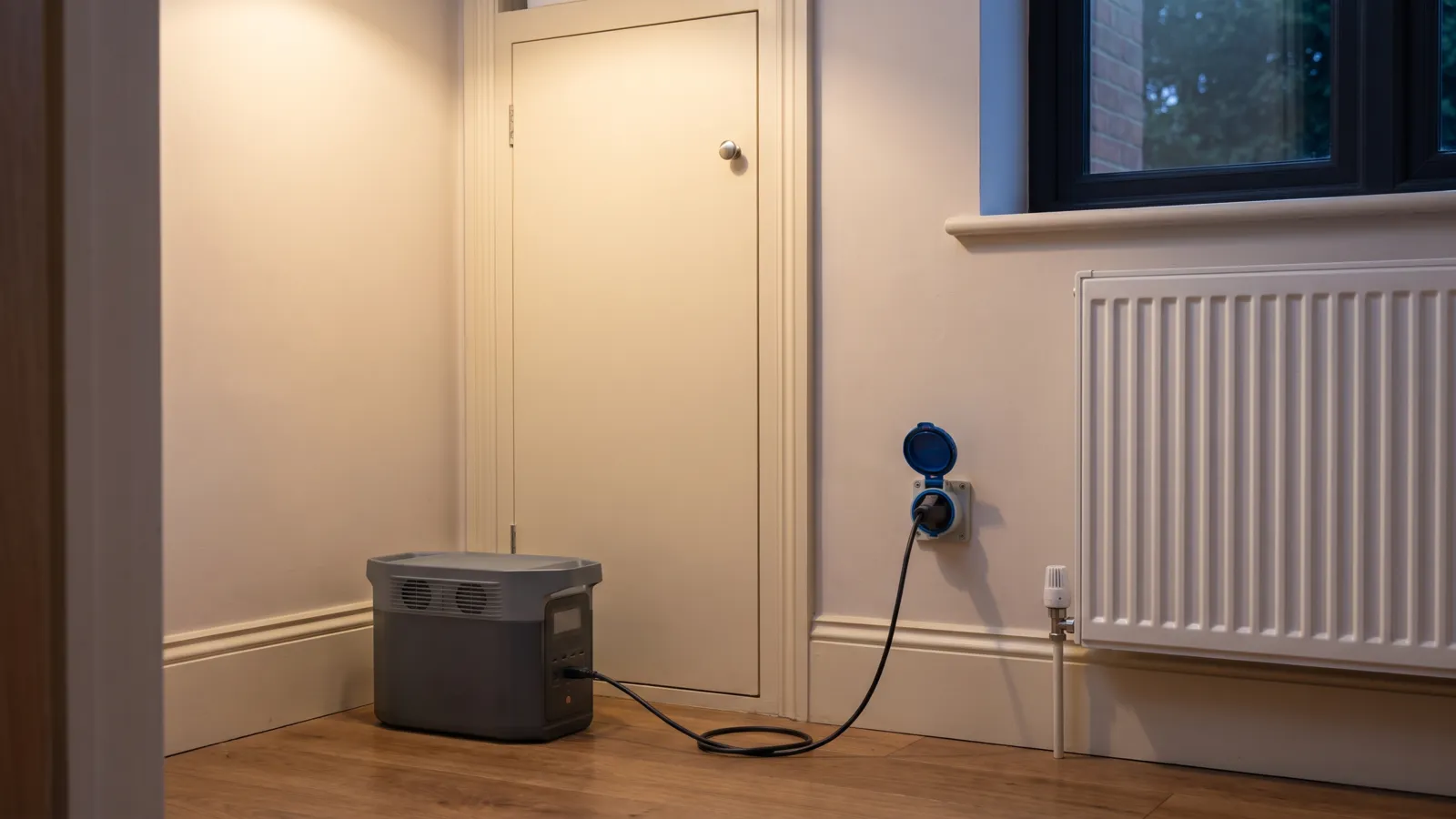
One detail catches people out once the wiring is done. Wireless and smart thermostats such as Hive and Nest use a receiver or heat-link module wired near the boiler, and it needs mains power to pass on the call for heat. Google’s specifications for the Nest Heat Link list a mains input (100–240V AC) and say it powers the thermostat at 12V DC, so when the Heat Link loses power the heating loses its instructions. Hive lists its thermostat on AA batteries but its receiver on 230V mains: the thermostat keeps its display, but if the receiver is dead the boiler has power and no instruction.
The three makers’ manuals say the controls should share the boiler’s supply, so the receiver usually comes back with it. If it, or a wiring centre, zone valves or programmer on a heat-only or system boiler, is on a separate spur, tell the electrician so everything the heating needs is on the backup side of the changeover.
The Power Cut Action Card
One page for the kitchen drawer: what to do first, what to have ready, how long food keeps, and how to stay warm without risking carbon monoxide. Free, no catch.
Download it straight away. We'll also send the occasional briefing when something genuinely matters — severe weather, live incidents, real price drops. Nothing else.
What size makes sense, and when it doesn’t
For a gas boiler the choice is about capacity, not power. A 1kWh-class unit gives about 4½–6 hours of hard firing and most of a day on light firing; a 2kWh unit roughly doubles that, and is the step-up if you have a heat-only boiler with a separate pump or simply want more margin. If long cuts are the worry, a portable solar panel can top a unit up between cuts, but winter light is weak, so for a boiler it extends a battery rather than replacing capacity. See what size power station you need for the wider household sums, and power station vs generator.
When it does not make sense: electric heating. Storage heaters draw about 1kW for a small one and nearer 3kW for a large one while they charge, on EDF’s figures, and EDF’s worked example has one charging at full power for seven off-peak hours. A 2kWh battery would give a 1kW heater roughly an hour and three-quarters of charging and a 2kW heater under an hour, a fraction of one night’s charge; a 3kW heater is beyond some 2kWh units’ rating altogether. Heat pumps are a different job again: the compressor is a far bigger load than a boiler’s controls, so a portable power station is not the answer there either. Read keeping warm without heating and check whether you qualify for the Priority Services Register.
If your cuts are short and rare, you may not need any of this: layers, a hot drink and one warm room can see you through a short cut for nothing. Wiring a boiler for backup is a project for households with long or frequent outages, or someone vulnerable to the cold.
Carbon monoxide: the generator warning
A battery power station produces no exhaust, which is the main reason it suits a boiler better than a petrol generator. If you are tempted by a generator instead, the UK Chief Medical Officers’ advice is clear: do not run a petrol or diesel generator indoors, because the exhaust contains carbon monoxide, and place it outdoors at least 6 metres away with the exhaust facing away from windows and doors. The HSE’s guidance for construction sites says the same of petrol-powered equipment: never indoors or in enclosed spaces without fully assessed ventilation, and generators outside in well-ventilated spaces so fumes cannot gather or drift into building openings, because even a few minutes can create carbon monoxide levels that kill.
If you do go the generator route for a longer cut, read how to use a generator safely first and know the symptoms of carbon monoxide poisoning. A battery does the boiler’s 35–175W quietly, indoors, with none of that risk, provided the wiring is done properly.
Common questions
Will a portable power station run my combi boiler?
Electrically, yes. The Vaillant, Worcester Bosch and Ideal manuals put a combi’s draw at roughly 35–123W while firing and 3W or less on standby, and every 1kWh-class unit in our picks is rated at 1,500W or more. The obstacle is that the boiler is hard-wired through a fused double-pole isolator, so a qualified electrician has to fit a changeover switch that keeps it on its fixed, isolated supply before you can connect anything.
Can I just plug my boiler into a power station?
No. A boiler’s installation instructions say it must be connected through a fused double-pole isolator, usually a switched fused spur, so there is no plug. Converting it is fixed wiring: an electrician must do it to BS 7671, and you should get a certificate for it. A plug-and-socket conversion is only an option where the boiler maker’s instructions allow it; Vaillant’s require a fixed connection. Never feed a power station or generator into your house wiring through a socket.
How long will a 1kWh power station run a gas boiler?
On BLUETTI’s published formula for its 1,024Wh Elite 100 V2 (capacity × 90% usable × inverter efficiency, divided by the load plus about 10W the unit uses itself), about 6 hours at 123W hard firing, about 4½ hours for a heat-only boiler plus its pump at about 175W, and about 18 hours at 35W light firing. These are hours the burner is actually running, not hours of warmth, and the boiler only draws its running watts while firing.
Do I need a Gas Safe engineer or an electrician?
An electrician, as long as the work stays outside the boiler. The Gas Safety (Installation and Use) Regulations 1998 govern work on gas fittings, which is where Gas Safe registration applies. The boiler’s electrical supply, fused spur and any changeover switch fall under the IET Wiring Regulations and, in England and Wales, Part P, which is electrical work. If anything inside the boiler casing has to be changed, that is work on a gas appliance and should be done by a Gas Safe registered engineer. Ask who is doing which part and ask for the certificate.
Will running my boiler from a power station void the warranty?
The manuals we checked don’t say. We found nothing in the Vaillant, Worcester Bosch or Ideal installation manuals permitting or ruling out a generator or battery supply, or saying what it does to the guarantee. Worcester Bosch’s manual says its guarantee is subject to terms and conditions and that using the appliance outside its intended use may invalidate it, so ask your installer or the maker’s technical line before you rely on it, and do not assume it is covered.
Can a power station run storage heaters or a heat pump?
Not sensibly. A storage heater draws 1–3kW while charging on EDF’s figures, so a 2kWh unit gives it between about half an hour and an hour and three-quarters of charging, against the seven off-peak hours in EDF’s example, and a 3kW heater is beyond some 2kWh units’ rating altogether. A heat pump’s compressor is a far bigger load than a boiler’s controls. Both are a different job from a boiler’s control electronics; read keeping warm without heating instead.
Sources: Vaillant — ecoTEC plus combi and system installation instructions (fixed connection; 3mm contact gap; electrical power consumption; internal pump; common supply for controls) · Worcester Bosch — Greenstar 4000 combi installation manual, current release (fused double-pole isolator, 3mm; power consumption and ErP data; controls on the same supply; appliance must be earthed; guarantee subject to terms) · Ideal — Logic Max Combi installation and servicing (power consumption and ErP data; wiring to BS 7671; common fused double-pole isolator; appliance must be earthed) · Grundfos — UPM3 data booklet, hosted by a UK retailer (2W minimum; 52–53W for xx-70 models; 60W for xx-75) · Wilo UK — Yonos PICO 25/1-4 (P1 min 4W, max 20W) · legislation.gov.uk — Gas Safety (Installation and Use) Regulations 1998, Regulation 3 (competence to work on gas fittings) · legislation.gov.uk — Gas Safety (Installation and Use) Regulations 1998, Regulation 2 (definition of work on a gas fitting) · legislation.gov.uk — Gas Safety (Installation and Use) Regulations (Northern Ireland) 2004 · legislation.gov.uk — Electricity Safety, Quality and Continuity Regulations 2002, Regulation 21 (switched alternative sources of energy) · GOV.UK — Approved Document P: Electrical safety, dwellings (England; notifiable work, self-certification, certification of non-notifiable work) · legislation.gov.uk — Building Regulations 2010, Regulation 12(6A) (notifiable electrical work, England) · In Balance Energy — an installer’s generator changeover specification (switched neutral; earthing and RCD checks) · GOV.UK — Public health advice from the UK CMOs during a national power outage (generator placement) · HSE — Carbon monoxide (guidance for construction sites; accessed 22 September 2026) · EDF Energy — Electric storage heaters explained · EcoFlow UK — DELTA 3 Classic (pure sine wave output) · BLUETTI UK — Elite 200 V2 product page (inverter type: pure sine wave; links the EU/UK manual) · Jackery — runtime formula (capacity × 0.85) · EcoFlow — testing power station runtime (0.80–0.90 for AC loads; small loads lower efficiency; turn off eco features) · BLUETTI — Elite 100 V2 user manual, EU/UK edition (runtime formula: 90% DoD, inverter efficiency over 90%, ~10W self-consumption; ECO mode on by default) · BLUETTI — Elite 200 V2 user manual, EU/UK edition (runtime formula: 95% DoD, inverter efficiency over 90%, ~13W self-consumption; 2,600W at 230V; ECO mode on by default) · Google Store UK — Nest Learning Thermostat (3rd gen) tech specs (Heat Link mains input, 12V DC output to thermostat) · Hive — Hive Thermostat specifications (thermostat on 4 × AA batteries; receiver on 230V mains). PreparedBritain is independent and not affiliated with HM Government.
Keep reading
All power cuts & energy guides →What will the January 2027 energy price cap be? The forecasts, dated
Ofgem has not set the cap for 1 January to 31 March 2027; its published schedule says it will announce it by 25…
Will ‘time-varying’ electricity prices slash your bill? What the IFS actually said
Headlines say bills could be ‘slashed’ with time-varying prices while experts warn costs will stay high for years.…
Will there be power cuts in the UK this winter?
Winter 2026/27: the system operator expects enough electricity to meet demand, with a 5.5 GW cushion over peak. The…