Will a power station run a fridge freezer, and for how long?
What a fridge freezer really draws, why a power station’s output rating decides whether the compressor starts, 1kWh and 2kWh runtimes that count the power station’s own consumption, and the FSA timings that mean you often don’t need to power it at all.
Yes, a power station will run a fridge freezer, provided its output clears the compressor’s start-up and its auto-off setting is switched off. Allowing for the power station’s own consumption, a 1kWh unit gives roughly 13 to 36 hours and a 2kWh unit roughly 26 to 71 hours, depending on the fridge. For a short cut you usually don’t need to power it at all: the Food Standards Agency says a shut fridge should stay cold for up to 4 hours and a full freezer should stay frozen for up to 48 hours. A power station earns its place mainly for cuts that run into days.
By Tom Calder · Updated 22 September 2026 · Sourced to the FSA, Bosch spec sheets & maker manuals
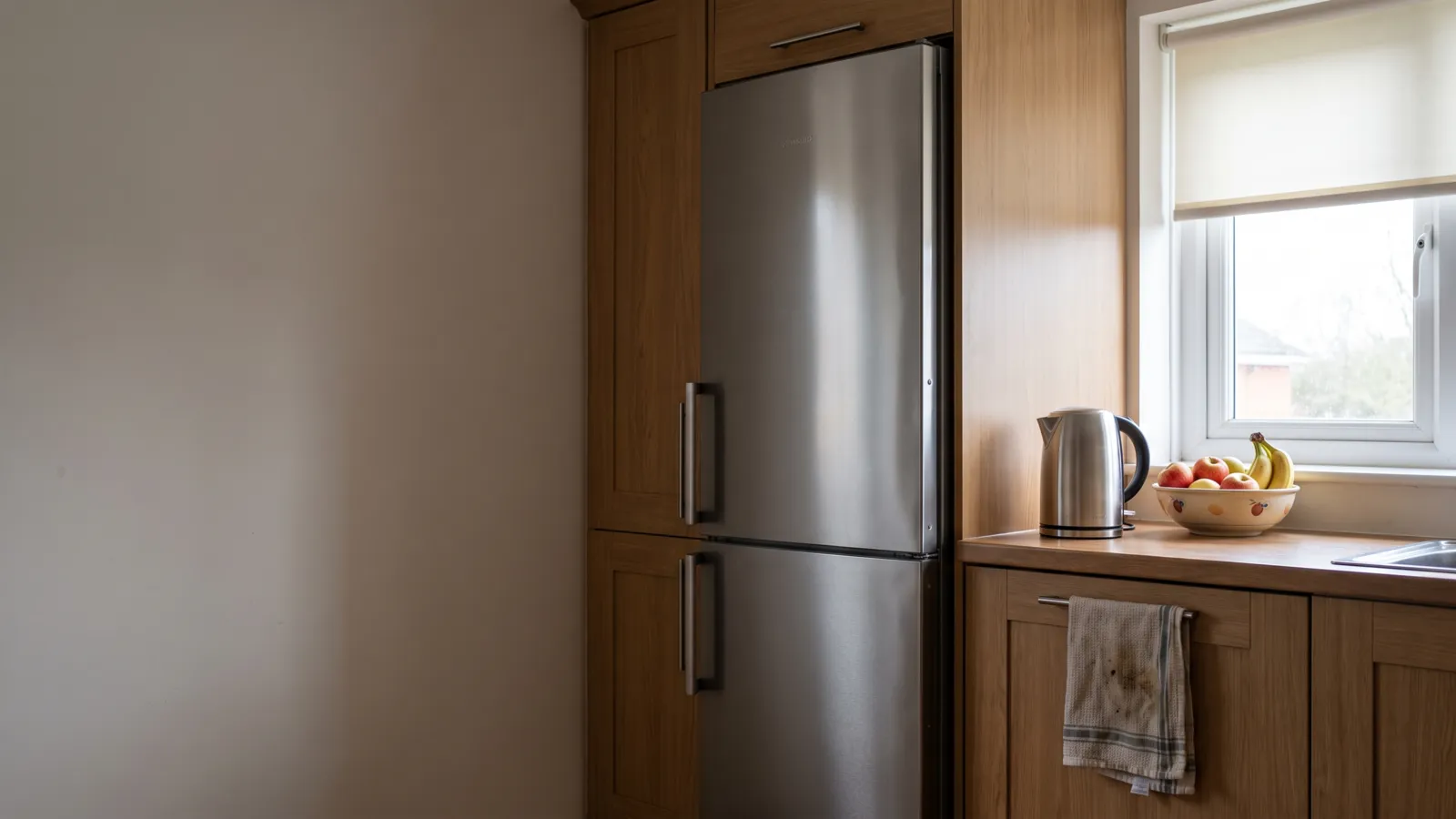
What a fridge freezer actually draws
Two numbers matter. The running or nameplate figure is the maker’s connection rating, the power the appliance is rated to draw while running: Bosch’s spec sheets give 100W for a 60cm fridge freezer (the KGN34VW35G) and 240W for an American-style model (the KAD93AIERG). That is the number to hold against a power station’s continuous output. It is not what the fridge uses over a day, and starting the compressor briefly takes more, as the next section explains.
The average is what the compressor’s on-and-off cycling works out to, and it comes from the energy label: kWh per annum divided by 8,760 hours. Bosch’s A-rated KGN392LAF is 104 kWh a year, about 12W; its E-rated American-style KAD93AIERG is 323 kWh, about 37W. Older stock uses more: European Commission estimates put the average fridge freezer sold in 1990 at 477 kWh a year, roughly 54W, against 181 kWh for one sold in 2020.
The runtimes below use 100 to 240W running and 12 to 51W average. The top figure, about 450 kWh a year, sits a little under that 1990 average, so a fridge freezer older or thirstier than that will use more. Efficiency class, size and age all move the figure, and the label is a lab test with the doors shut; a warm kitchen and frequent opening push real use higher. Your own label is the place to start.
The start surge: why the output rating decides it
A compressor draws a brief burst as it starts, and none of the fridge spec sheets we checked says how big. BLUETTI’s manuals say some devices with motors or compressors may start at two to four times their rated power, so we plan on 960W for a fridge freezer (four times 240W) and 480W for a chest freezer rated at 120W. These are planning figures, not measurements, but they explain why a unit whose continuous rating easily covers a fridge’s running watts can still fail to start it.
Small units are the problem. The Jackery Explorer 300 Plus is rated at 300W with a 600W surge peak, below the planning figure. The EcoFlow RIVER 3 Plus is rated at 600W with a 1,200W surge, only a quarter above 960W, and the RIVER 2 Max (500W, 1,000W surge) has essentially no margin. The 1kWh and 2kWh classes are different: every one we list is rated for at least 1,500W continuously, so the continuous rating alone clears 960W. The EcoFlow DELTA 3 Classic is rated at 1,800W with a 3,600W surge, the BLUETTI Elite 100 V2 at 1,800W with a 3,600W surge, the Anker SOLIX C1000 at 1,800W, the Jackery Explorer 2000 v2 at 2,200W, the BLUETTI Elite 200 V2 at 2,600W, and the EcoFlow DELTA 3 Max Plus at 3,000W with a 6,000W surge.
One caveat on the bigger numbers makers print. BLUETTI’s ‘Power Lifting’ (2,700W on the Elite 100 V2, 3,900W on the Elite 200 V2) and Anker’s ‘SurgePad’ (2,400W on the SOLIX C1000) are for heating appliances such as kettles: BLUETTI’s manuals say Power Lifting is only for pure resistive loads and that actual output stays at the rated wattage, and Anker says SurgePad works better with devices that generate heat and does not support devices with voltage protection. Ignore them for a fridge. It makes no difference here, because those units’ continuous ratings of 1,800W, 2,600W and 1,800W already clear the 960W planning figure. The principle is explained in what size power station do I need.
Two settings matter more than any spec. EcoFlow’s RIVER 2 Max manual warns that a fridge’s fluctuating draw can make the unit shut off, and recommends setting AC to ‘Never Turn Off’ in the EcoFlow app when the fridge holds medicines or other high-value items. BLUETTI’s manuals for the Elite 100 V2 and Elite 200 V2 say ECO mode, which shuts off AC output after a period of low or no load, is on by default, and to disable it for critical appliances such as refrigerators. Left at the default, a setting like this can cut the fridge off long before the battery is empty, so check the auto-off or ECO setting whatever the model. Every runtime below assumes you have changed it.
Honest runtimes: 1kWh and 2kWh units
The makers’ simple sum is hours ≈ capacity in Wh × inverter efficiency ÷ the fridge’s watts, at 80 to 90 per cent efficiency: Jackery’s formula multiplies capacity by 0.85, and EcoFlow’s guide says to use 0.80 to 0.90 for AC as a first pass. BLUETTI’s UK page for the Elite 200 V2 goes further: capacity × 90 per cent depth of discharge × 85 per cent inverter efficiency ÷ (the load + the unit’s own consumption, about 10W). That last term matters most for a fridge, because its average draw is so small: 10W nearly doubles a 12W fridge’s draw.
On BLUETTI’s fuller formula, a 1kWh unit (1,024Wh) runs an efficient fridge freezer averaging 12W for about 36 hours, a day and a half, and an older one averaging 51W for about 13 hours (Bosch’s 37W American-style model would get about 17). A 2kWh unit (2,048Wh) manages about 71 hours, roughly three days, and about 26 hours. Leave out the unit’s own consumption and the simple sum gives 16 to 77 hours and 32 to 154 hours: treat that as a ceiling, because every power station uses some power itself.
Treat even the lower figures as estimates. BLUETTI’s UK pages put the Elite 100 V2’s and Elite 200 V2’s own consumption at about 10W; EcoFlow support has put the DELTA 2 Max, a model we don’t list, at 23W with AC on, which would cut the efficient-fridge figures by roughly another third. If the compressor ran flat out at its nameplate rating, the same formula gives a 1kWh unit only about 3 to 7 hours and a 2kWh unit about 6 to 14; a tired door seal or warm shopping pushes a fridge towards that floor. Plan on the low end.
Chest freezers: the lid does most of the work
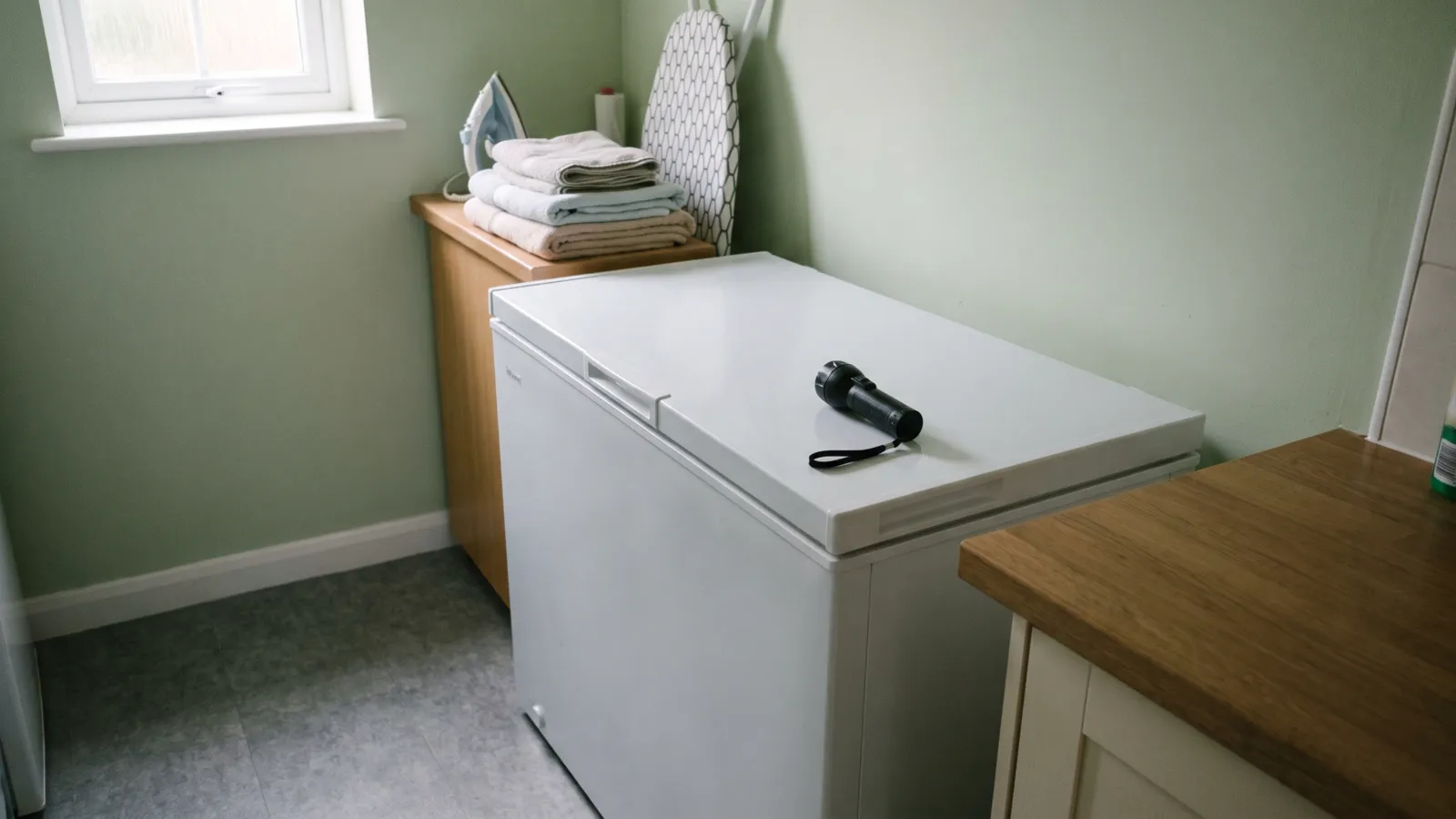
A chest freezer’s load varies more than you might expect, so check yours: Gorenje rates its 248-litre FH25EAW at 120W, while Liebherr gives its 497-litre CFe 2500 a 1.5A connection rating, which at 230V allows for up to about 345W. On their labels they use 215 and 295 kWh a year, about 25 and 34W on average. Allowing for the power station’s own consumption, a 1kWh unit runs one for roughly 18 to 22 hours and a 2kWh unit for roughly 36 to 45. The Gorenje’s 480W planning start is within reach of more units than a fridge freezer’s, but on the same four-times rule the Liebherr could need more to start than a fridge freezer, so check your own rating plate.
Now the part that changes the decision. Makers rate how long a loaded chest freezer holds its temperature with the lid shut and no power at all: Gorenje gives the FH25EAW a power cut safe time of 39 hours, and the CFe 2500 is listed at 40. That hold time comes on top of whatever a power station adds, not instead of it. On those ratings, a shut lid covers a cut of up to about a day and a half on its own; for a longer one, a 1kWh unit adds most of another day and a 2kWh unit roughly another day and a half to two.
The Power Cut Action Card
One page for the kitchen drawer: what to do first, what to have ready, how long food keeps, and how to stay warm without risking carbon monoxide. Free, no catch.
Download it straight away. We'll also send the occasional briefing when something genuinely matters — severe weather, live incidents, real price drops. Nothing else.
You often don’t need to power the fridge at all
Before sizing anything, check whether the problem exists. The Food Standards Agency’s guidance on food safety in a power cut (July 2023, for England, Wales and Northern Ireland) says a fridge should stay cold for up to 4 hours with the door shut, and a full freezer should stay frozen for up to 48 hours, or 24 hours if half full. The FSA normally recommends keeping a fridge at 5°C or below, but says food can be kept under 8°C during a cut; once it reaches 8°C or above, eat the food that normally needs refrigeration within 4 hours first. The FSA calls these timings estimates. Makers’ own figures for fridge freezers are shorter: Bosch’s spec sheets give a power-failure storage time of 16 hours for the KGN34VW35G, a temperature rise time of 21 hours for the KGN392LAF, and 3 hours for the American-style KAD93AIERG. These are lab tests under set conditions, and even the two chest freezers above are rated below 48 hours, so treat the FSA’s figure as a best case. The ‘temperature rise time’ on your model’s product information sheet is the number to check.
The FSA adds that the timings vary by make and model, and that a warm room or frequent opening pushes the temperature up faster. Even so, a cut fixed within 4 hours sits inside the fridge window, and a full freezer usually holds for longer, so for a short cut a power station would be solving a spoilage problem that has not yet started. In practice: keep the doors shut, check your network operator’s live map or call 105 (England, Scotland and Wales; in Northern Ireland, contact NIE Networks) for its estimated restoration time, and decide then. Our power cuts tracker shows live faults on the networks it covers. What to keep and what to bin is in power cut food safety.
When a power station is worth it, and when it isn’t
Worth it: a cut that will clearly outrun the FSA windows or a chest freezer’s hold time, such as a multi-day storm outage, where a full freezer is genuinely at stake and a 2kWh unit can carry an efficient fridge freezer for around three days. If you keep fridge medicines, a power station is rarely the first answer: for a cut of up to about 4 hours, keeping the fridge door shut is usually enough, a cool bag covers a longer one, and your pharmacist, not this guide, decides what is safe for your product. See fridge medicines in a power cut, and join the Priority Services Register with your energy supplier and your network operator so you get priority updates during a fault. If your likely outages run longer than any of these units can honestly cover, read power station vs generator first; a generator must only ever run outdoors, never in the house, a garage or a porch, as how to use a generator safely explains.
Not worth it: a cut of under 4 hours, which the FSA says is unlikely to affect the safety of chilled or frozen food; a loaded chest freezer for a cut shorter than its rated hold time (39 and 40 hours on the two we checked); and a small unit such as the Explorer 300 Plus, RIVER 3 Plus or RIVER 2 Max, whose surge ratings of 600 to 1,200W sit below or only just above a fridge freezer’s 960W planning start. Use a small unit for phones, lights and the router, and leave the fridge shut.
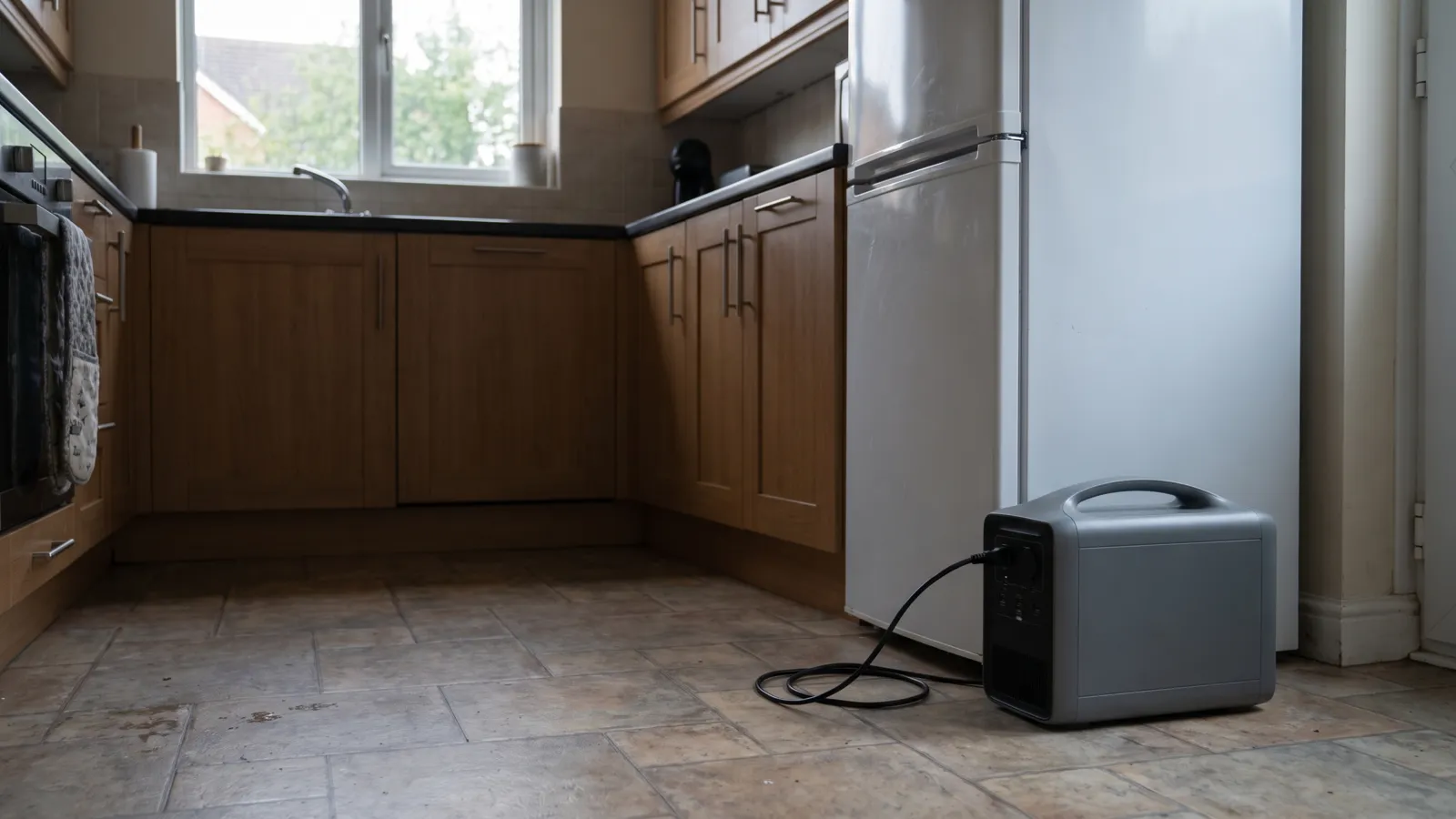
If you do run one: change the auto-off setting first, keep the doors closed as if the fridge were unpowered, and put phones and the router on the USB and DC ports, as EcoFlow suggests, so the inverter serves the fridge alone. Plug the fridge’s own plug straight into the power station. Never run a double-ended lead from the power station into a wall socket to power the kitchen circuit: backfeeding can put power back onto the network and electrocute engineers working to restore it. If your fridge freezer is integrated and its plug is out of reach, or it is wired into a fused spur with no plug, don’t cut or rewire it: a registered electrician can fit an accessible socket.
Use a pure sine wave power station for a compressor appliance. EcoFlow’s UK pages confirm pure sine output for the DELTA 3 Classic and DELTA 3 Max Plus, and BLUETTI’s UK page lists the Elite 200 V2’s inverter as pure sine wave; for any other model, check the maker’s UK page or manual before you buy. In a long cut a portable solar panel can top it up by day, though UK winter light is weak, so treat it as an extender rather than a full recharge; the kit builder sizes a unit from your own appliances.
Common questions
How many watts does a fridge freezer use?
Two figures. The nameplate or connection rating, 100 to 240W on the Bosch spec sheets we checked, is what it is rated to draw while running; starting the compressor briefly takes more. The average, once the compressor’s cycling is counted, is about 12 to 51W: the energy label’s kWh per annum divided by 8,760, so an A-rated 104 kWh model is about 12W.
Will a 1kWh power station run a fridge freezer?
Usually, yes, if its output clears the start-up (we plan on 960W, and every 1kWh unit we list is rated for at least 1,500W continuously) and its ECO or auto-off mode is disabled. From 1,024Wh expect roughly 13 hours for an older fridge freezer and 36 hours for an efficient one, allowing for the power station’s own consumption; the simple sum without it, 16 to 77 hours, is a ceiling.
How long will a 2kWh power station run a fridge?
About 26 hours for an older fridge freezer averaging 51W, and about 71 hours, roughly three days, for an efficient 12W model, from 2,048Wh on the formula BLUETTI publishes for the Elite 200 V2 (90 per cent depth of discharge, 85 per cent inverter efficiency, about 10W of the unit’s own consumption). If the compressor never cycled off, the floor would be about 6 to 14 hours.
Why does my power station keep switching the fridge off?
EcoFlow and BLUETTI units have an auto-off or ECO mode that can cut AC output when the load is low, and a fridge’s draw rises and falls as the compressor cycles on and off. EcoFlow’s RIVER 2 Max manual recommends setting AC to ‘Never Turn Off’ when a fridge holds medicines or other high-value items, and BLUETTI says to disable ECO mode for refrigerators; check your own unit’s manual for the equivalent setting.
How long does food last in a fridge or freezer during a power cut?
The Food Standards Agency says a fridge should stay cold for up to 4 hours and a full freezer should stay frozen for up to 48 hours (24 if half full) with the doors shut, and calls these estimates. The two chest freezers we checked are rated at 39 and 40 hours lid-shut, and the three Bosch fridge freezers we checked at 3 to 21 hours, so check your own model’s spec sheet.
Do I need a pure sine wave power station for a fridge?
We treat it as the minimum for any compressor appliance. EcoFlow’s UK pages confirm pure sine output for the DELTA 3 Classic and DELTA 3 Max Plus, and BLUETTI’s UK page lists the Elite 200 V2’s inverter as pure sine wave. For any other model, check the maker’s UK page or manual.
Sources: Food Standards Agency — Food safety in a power cut: advice for consumers (GOV.UK, 26 July 2023; under 4 hours unlikely to affect food safety; fridge up to 4 h, full freezer up to 48 h, ‘these are estimates’) · Bosch — KGN392LAF specification sheet (class A, 104 kWh/annum, temperature rise time 21 h) · Bosch — KAD93AIERG specification sheet (class E, 323 kWh/annum, 240W connection rating, storage period in event of power failure 3 h) · Bosch — KGN34VW35G specification sheet (60cm, 100W connection rating, storage period in event of power failure 16 h) · European Commission — Fridges and freezers (Ecodesign Impact Accounting estimates: average fridge freezer sold in 1990 477 kWh/a, in 2020 181 kWh/a) · BLUETTI UK — Elite 200 V2 product page (2,073.6Wh, 2,600W, 3,900W Power Lifting, pure sine wave inverter; runtime formula with DoD 90%, η 85%, self-consumption about 10W) · BLUETTI — Elite 200 V2 user manual, EU edition (some motors or compressors start at 2–4× rated power; Power Lifting only for pure resistive loads, actual output still 2,600W; ECO on by default, disable for refrigerators) · BLUETTI UK — Elite 100 V2 product page (1,800W continuous, 3,600W surge, 2,700W Power Lifting; self-consumption about 10W) · BLUETTI — Elite 100 V2 user manual, EU edition (some motors or compressors start at 2–4× rated power; Power Lifting only for pure resistive loads, actual output still 1,800W; ECO on by default, disable for refrigerators; self-consumption about 10W) · EcoFlow — RIVER 2 Max user manual, ZA/AU edition (a refrigerator’s power fluctuation may shut the unit off; set AC to ‘Never Turn Off’ for medicines or high-value items) · EcoFlow UK — RIVER 2 Max product page (pure sine wave, 500W total, 1,000W surge, 230V) · EcoFlow UK — RIVER 3 Plus product page (600W total, 1,200W surge) · Jackery UK — Explorer 300 Plus product page (300W pure sine wave inverter, 600W surge peak) · EcoFlow UK — DELTA 3 Classic product page (1,024Wh, 1,800W rated, 3,600W surge, pure sine wave) · EcoFlow UK — DELTA 3 Max Plus product page (2,048Wh, 3,000W, 6,000W surge, pure sine wave) · EcoFlow — DELTA 3 pure sine wave output (blog, 20 March 2026: DELTA 3 Classic, DELTA 3 Max, DELTA 3 Max Plus) · Jackery UK — Explorer 2000 v2 product page (2,042Wh, 2,200W output) · Anker SOLIX UK — C1000 product page (1,056Wh, 1,800W; SurgePad activates above rated output) · Anker — SOLIX C1000 UK user guide (SurgePad up to 2,400W; works better with devices that generate heat; not for devices with voltage protection) · Jackery UK — runtime formula (capacity × 0.85 ÷ device watts) · EcoFlow — How to test power station runtime (use 0.80–0.90 for AC as a first pass; try DC ports for routers and phones) · Gorenje — FH25EAW chest freezer (248 l, 120W connected load, 215 kWh/annum, 39 h power cut safe time; EPREL 900975) · Liebherr CFe 2500 retailer listing (497 l total volume, 1.5A connection rating, 295 kWh/annum, 40 h storage time in case of fault) · The Electricity Safety, Quality and Continuity Regulations 2002, regulation 21 — switched alternative sources of energy (must not operate in parallel with the network; legislation.gov.uk) · GOV.UK — Electrical safety: Approved Document P (Building Regulations guidance for electrical work in dwellings) · Wind in My Face blog — EcoFlow support figures for DELTA 2 Max AC conversion efficiency and 23W AC-on overhead (secondary source). PreparedBritain is independent and not affiliated with HM Government.
Keep reading
All power cuts & energy guides →Which power station will run a CPAP machine through a power cut?
The blower alone is a small load; the humidifier and heated tube decide the size. What an NHS sleep service says…
Can a power station run a gas boiler in a power cut?
A gas combi boiler needs only about 35–123W of electricity on its makers’ figures, well within any 1kWh-class unit…
What will the January 2027 energy price cap be? The forecasts, dated
Ofgem has not set the cap for 1 January to 31 March 2027; its published schedule says it will announce it by 25…