How many watts does it use? Running costs for 30 household appliances
What everyday appliances draw, what they cost per hour or per use at the current Ofgem price cap, and how long a 1kWh or 2kWh power station would run each one in a power cut. Every figure comes from makers’ spec sheets, energy label data, official sources or consumer testers such as Which?, linked on each appliance’s page.
By Tom Calder · Figures checked 4 November 2026 · Costs at 26.32p per kWh (Ofgem cap, 1 October to 31 December 2026)
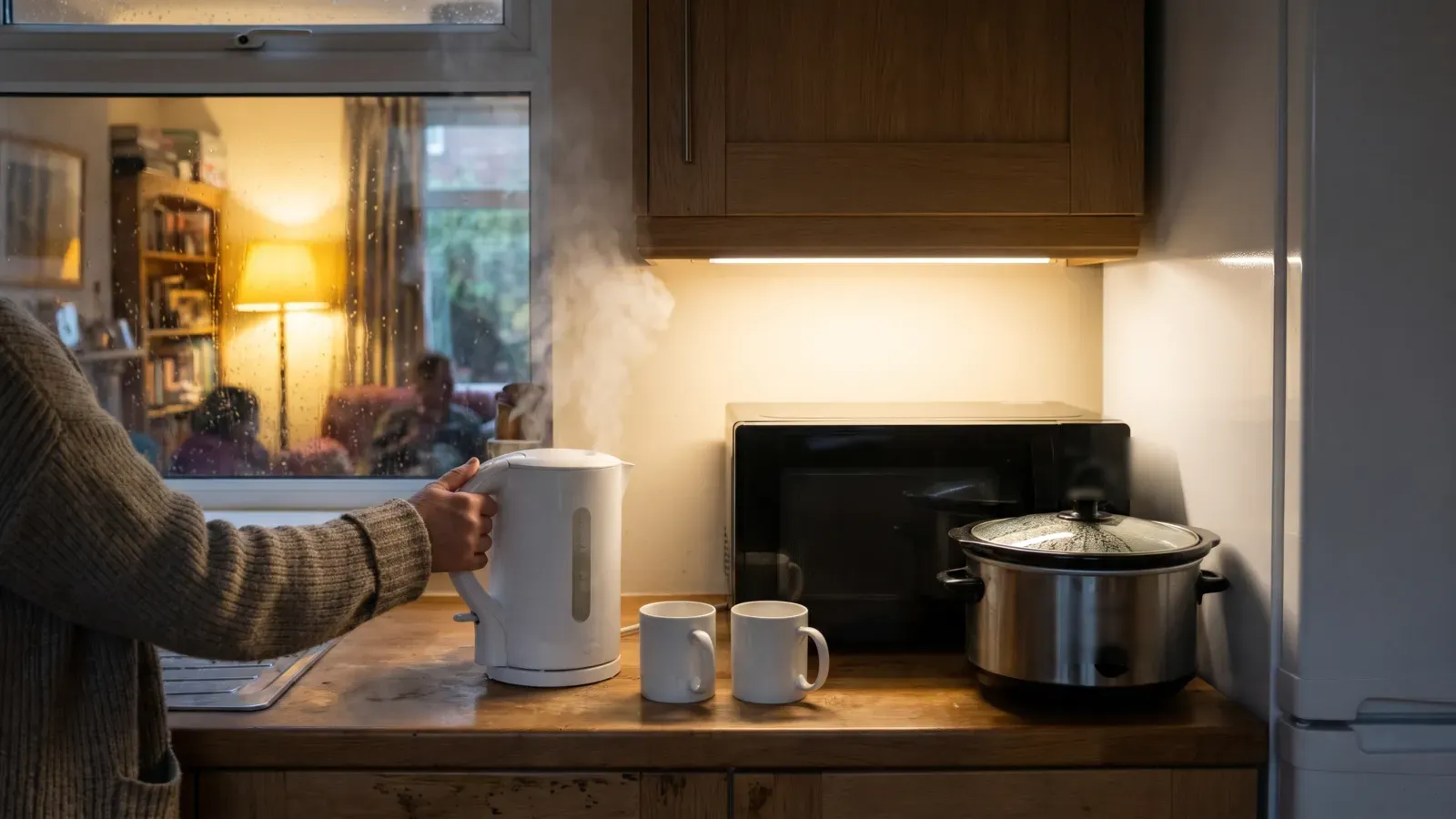
Cost = watts ÷ 1,000 × hours × your unit rate. At 26.32p per kWh, every 1,000W running for an hour costs about 26p. Heating appliances draw the most; fridges, routers, LED bulbs and chargers draw little but some run all day. On a power station, small loads run for hours or days, and anything that heats water or air empties it fast.
Every appliance, side by side
Fridges and freezers
| Appliance | Running watts | Energy and cost | Per hour at full power | 1kWh power station | 2kWh power station |
|---|---|---|---|---|---|
| Fridge-freezer | 100W to 240W | 0.28 to 1.23 kWh a day: 7p to 32p | Cycles: see per day | 13 to 35 hours | 25 hours to 3 days |
| Fridge (no freezer) | 90W to 120W | 0.25 to 0.32 kWh a day: 7p to 8p | Cycles: see per day | 33 to 38 hours | about 3 days |
| Chest freezer | 75W to 120W | 0.5 to 0.81 kWh a day: 13p to 21p | Cycles: see per day | 17 to 25 hours | 35 hours to 2 days |
Kitchen
| Appliance | Running watts | Energy and cost | Per hour at full power | 1kWh power station | 2kWh power station |
|---|---|---|---|---|---|
| Kettle | 2,200W to 3,000W | 0.09 to 0.11 kWh per litre boiled: 2p to 3p | 58p to 79p | Too much for the units around 1kWh we list (1,500W to 2,000W output) | 14 to 17 litres boiled (only 1 of the 6 units around 2kWh we list can supply 3,000W) |
| Microwave | 1,250W to 1,450W | 0.1 to 0.12 kWh for 5 minutes: 3p | 33p to 38p | 6.4 to 7.7 five-minute heats | 13 to 15 five-minute heats |
| Slow cooker | 160W to 200W | 0.08 to 0.2 kWh an hour: 2p to 5p | 4p to 5p | 3.5 to 8.5 hours | 7.5 to 17 hours |
| Air fryer | 2,400W | 0.29 to 0.54 kWh per cook: 8p to 14p | 63p | Too much for the units around 1kWh we list (1,500W to 2,000W output) | 2.8 to 5.3 cooks (only 5 of the 6 units around 2kWh we list can supply 2,400W) |
| Electric oven | 2,990W | 0.81 to 1.16 kWh per cook: 21p to 30p | 79p | Wired in by an electrician, so it can’t be plugged into a power station | Wired in by an electrician, so it can’t be plugged into a power station |
| Induction hob | 1,400W to 3,700W | 1.4 to 3 kWh an hour on one zone at full power: 37p to 79p | 37p to 97p | Too much for the units around 1kWh we list (1,500W to 2,000W output) | Too much for the units around 2kWh we list (2,200W to 3,000W output) |
| Dishwasher | 2,400W | 0.75 to 0.94 kWh per Eco cycle: 20p to 25p | 63p | Too much for the units around 1kWh we list (1,500W to 2,000W output) | 1.6 to 2 Eco cycles (only 5 of the 6 units around 2kWh we list can supply 2,400W) |
Laundry and drying
| Appliance | Running watts | Energy and cost | Per hour at full power | 1kWh power station | 2kWh power station |
|---|---|---|---|---|---|
| Washing machine | 2,300W | 0.46 to 0.69 kWh per Eco 40-60 wash: 12p to 18p | 61p | Too much for the units around 1kWh we list (1,500W to 2,000W output) | 2.2 to 3.3 Eco washes (only 5 of the 6 units around 2kWh we list can supply 2,300W) |
| Tumble dryer (condenser or vented) | 2,600W | 2.61 to 4.63 kWh per load: 69p to £1.22 | 68p | Too much for the units around 1kWh we list (1,500W to 2,000W output) | 0.3 to 0.6 of a load (only 2 of the 6 units around 2kWh we list can supply 2,600W) |
| Heat pump tumble dryer | 1,000W | 1.24 to 2.06 kWh per load: 33p to 54p | 26p | 0.4 to 0.6 of a load | 0.7 to 1.2 loads |
| Heated airer | 300W to 850W | 0.3 to 0.85 kWh an hour: 8p to 22p | 8p to 22p | 55 minutes to 2.5 hours | 2 to 5 hours |
| Steam iron | 2,800W to 3,100W | 1.4 to 1.55 kWh for 30 minutes at most: 37p to 41p | 74p to 82p | Too much for the units around 1kWh we list (1,500W to 2,000W output) | Too much for the units around 2kWh we list (2,200W to 3,000W output) |
Heating and hot water
| Appliance | Running watts | Energy and cost | Per hour at full power | 1kWh power station | 2kWh power station |
|---|---|---|---|---|---|
| Electric blanket | 40W to 150W | 0.04 to 0.15 kWh an hour: 1p to 4p | 1p to 4p | 5 to 15 hours | 9.5 to 31 hours |
| Fan heater (2kW) | 1,000W to 2,000W | 1 to 2 kWh an hour: 26p to 53p | 26p to 53p | 25 to 45 minutes (only 1 of the 7 units around 1kWh we list can supply 2,000W) | 45 minutes to 1.5 hours |
| Oil-filled radiator | 700W to 1,500W | 0.7 to 1.5 kWh an hour: 18p to 39p | 18p to 39p | 30 minutes to 1 hour | 1 to 2 hours |
| Electric shower | 7,000W to 10,500W | 0.93 to 1.4 kWh for an 8-minute shower: 25p to 37p | £1.84 to £2.76 | Hard-wired on its own circuit, so it can’t run from a power station | Hard-wired on its own circuit, so it can’t run from a power station |
| Immersion heater (3kW) | 3,000W | 3 kWh an hour while heating: 79p | 79p | Hard-wired to the hot water cylinder, so it can’t run from a power station | Hard-wired to the hot water cylinder, so it can’t run from a power station |
Fans and damp
| Appliance | Running watts | Energy and cost | Per hour at full power | 1kWh power station | 2kWh power station |
|---|---|---|---|---|---|
| Dehumidifier | 125W to 330W | 0.13 to 0.33 kWh an hour: 3p to 9p | 3p to 9p | 2.5 to 5.5 hours | 4.5 to 11 hours |
| Desk or pedestal fan | 30W to 35W | 0.03 to 0.035 kWh an hour: 0.8p to 0.9p | 0.8p to 0.9p | 17 to 19 hours | 34 to 38 hours |
| Ceiling fan | 4W to 33W | 0.004 to 0.033 kWh an hour: 0.1p to 0.9p | 0.1p to 0.9p | Wired into the ceiling, so not a power station load | Wired into the ceiling, so not a power station load |
TV, computers and lights
| Appliance | Running watts | Energy and cost | Per hour at full power | 1kWh power station | 2kWh power station |
|---|---|---|---|---|---|
| TV (LED/LCD) | 33W to 217W | 0.033 to 0.22 kWh an hour: 0.9p to 6p | 0.9p to 6p | 3.5 to 18 hours | 6.5 to 36 hours |
| Broadband router | 8.5W to 14.1W | 0.2 to 0.34 kWh a day: 5p to 9p | Cycles: see per day | 32 to 41 hours | 2.5 to 3.5 days |
| Laptop | 30W to 70W | 0.03 to 0.07 kWh an hour: 0.8p to 2p | 0.8p to 2p | 9.5 to 19 hours | 19 to 38 hours |
| Games console | 122W to 219W | 0.12 to 0.22 kWh an hour of gaming: 3p to 6p | 3p to 6p | 3.5 to 6 hours | 6.5 to 12 hours |
| Phone charging | 5W to 45W | 0.005 to 0.045 kWh an hour of charging at most: 0.1p to 1p | 0.1p to 1p | 14 hours to 2 days | 28 hours to 4.5 days |
| LED light bulb | 5W to 12W | 0.005 to 0.012 kWh an hour, per bulb: 0.1p to 0.3p | 0.1p to 0.3p | 35 hours to 2 days | 3 to 4.5 days |
Personal care and cleaning
| Appliance | Running watts | Energy and cost | Per hour at full power | 1kWh power station | 2kWh power station |
|---|---|---|---|---|---|
| Vacuum cleaner (corded) | 620W to 900W | 0.62 to 0.9 kWh an hour: 16p to 24p | 16p to 24p | 50 minutes to 1 hour | 1.5 to 2.5 hours |
Costs use 26.32p per kWh, the Ofgem price cap's average Direct Debit electricity unit rate for 1 October to 31 December 2026. Power station times use BLUETTI’s UK planning formula (capacity × 90% × 85% ÷ the load plus about 10W the unit uses itself), as our power station pages do. Where a load is quoted per use, the count leaves out the unit’s own draw. The 7 units around 1kWh we list supply 1,500W to 2,000W, and the 6 around 2kWh supply 2,200W to 3,000W.
How the figures are worked out
Watts are the power an appliance draws while it runs, from the rating plate or the maker’s spec sheet. Kilowatt-hours (kWh) are what you’re billed for: 1,000 watts for one hour. For fridges and freezers, which cycle on and off all day, we use the energy label’s kWh a year. For washing machines and dishwashers, the label’s kWh per cycle. For things with a thermostat, such as heaters, the full-power figure is the most an hour can cost, not what it usually does.
The unit rate is Ofgem’s, and it changes every three months. Ofgem is due to announce the rate for 1 January to 31 March 2027 by 25 November 2026.
A power station is for keeping a few small, important things going: the fridge-freezer, the router, lights, phones and any medical equipment. It is not a way to run a heater, a kettle or a tumble dryer through a power cut, and it will not run a whole house. If cutting your bill is the aim, our guide to lowering your electricity bill sets out what each step is worth.
Common questions
How do I work out what an appliance costs to run?
Take the watts on its rating plate, divide by 1,000 to get kilowatts, multiply by the hours it runs to get kWh, then multiply by your unit rate. At 26.32p per kWh, a 2,000W heater on full for an hour uses 2 kWh and costs about 53p. Appliances with a thermostat or a compressor cycle on and off, so they use less than the full-power figure over a day.
What uses the most electricity in a house?
Anything that heats. An electric shower draws by far the most (7kW to 10.5kW), then an induction hob at full power, then irons, kettles, immersion heaters and ovens at around 3kW. What you pay depends on how long each runs: a kettle draws about 3kW but only for minutes, while a fridge-freezer draws little but never stops.
What is the price cap unit rate now?
26.32p per kWh for electricity, the average for a Direct Debit customer on a standard variable tariff from 1 October to 31 December 2026, across England, Scotland and Wales. Rates vary by region and payment method. Ofgem is due to announce the rate for 1 January to 31 March 2027 by 25 November 2026.
How long can a home battery or power station run a house in a power cut?
It depends on what you plug in, not the size of the house. On our planning method a 1kWh power station keeps a fridge-freezer going for many hours, and a router for more than a day, but even a 2kWh unit runs a 2kW heater or a kettle for under an hour, if it can supply that much at all. Choose the few things that matter and use the sizer on our power station pages.
Free alerts for your home
Home Alerts emails you when a power cut, a Met Office warning or a flood warning covers your postcode. Free for your own home. Sign up in a minute.
Start free →Sources (6)
- Ofgem: Energy price cap unit rates and standing charges, 1 October to 31 December 2026electricity 26.32p per kWh, Direct Debit; no VAT on electricity from 1 October 2026 to 31 March 2027
- Ofgem: Changes to the energy price cap between 1 October and 31 December 2026, with the price cap level dates
- BLUETTI UK — Elite 200 V2 (runtime formula: DoD 90%, η 85%, self-consumption about 10W)
- BLUETTI UK — Elite 100 V2 (self-consumption about 10W)
- Jackery UK — runtime formula (capacity × 0.85 ÷ watts)
- EcoFlow — test runtime before an emergency0.80–0.90 for AC; DC ports for routers and phones
PreparedBritain is independent and not affiliated with HM Government.
