Are electric heaters safe to leave on, and what do they cost to run this winter?
What fire services and Electrical Safety First say about leaving a heater on, and what 1, 2 and 3 kW heaters cost to run at the October 2026 price cap.
Not while you are out or asleep: fire safety advice is to unplug heaters when you go out or go to bed, plug them into a wall socket rather than an extension lead, and keep anything that can burn at least a metre away. At the October to December 2026 price cap’s average electricity rate of 26.32p per kWh for Direct Debit, a heater at full power costs 26.32p an hour for 1 kW, 52.64p for 2 kW and 78.96p for 3 kW, and a thermostat often brings that down. Gas, at 7.97p per kWh, is cheaper per unit, so a plug-in heater suits one room for a while rather than the whole house.
By Tom Calder · Updated 24 September 2026 · Sourced to Ofgem, HMRC, Electrical Safety First, the NFCC, London Fire Brigade, UKHSA, HSENI, the Energy Saving Trust & GOV.UK
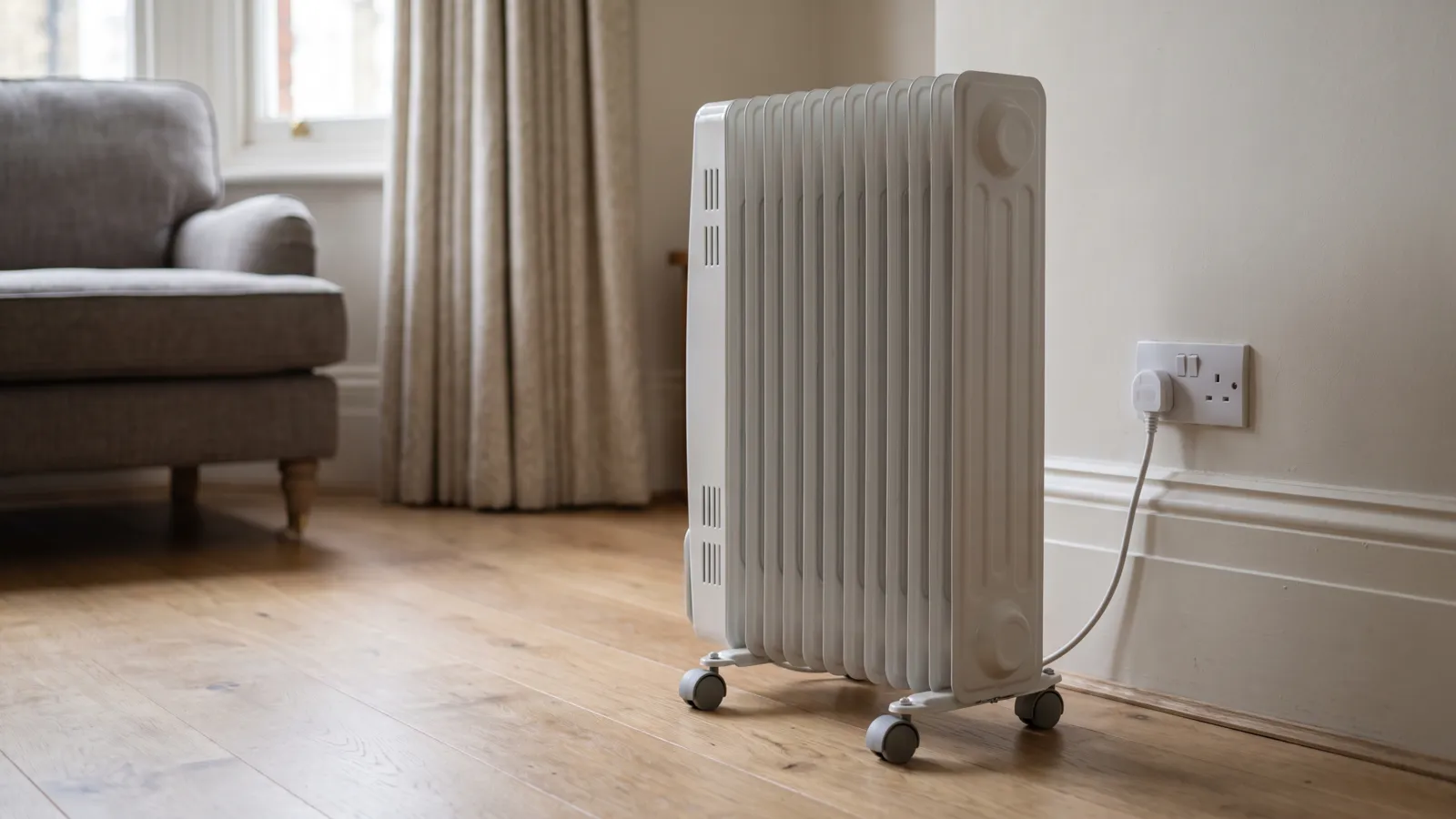
The short answer: not while you are out or asleep
Used with care, a plug-in electric heater is a reasonable way to warm one room. Fire safety advice draws the line at leaving it on with nobody there. The National Fire Chiefs Council (NFCC) says to unplug heaters when you go out or go to bed, and Electrical Safety First says never to leave a heater unattended while it is in use or while you are asleep. London Fire Brigade says heater fires typically start when bedding, blankets or clothes are placed too close.
Electrical Safety First does not recommend running a portable heater overnight. For a warm bedroom, it suggests warming the room before bedtime: an oil-filled radiator keeps a room warm for quite a while after it is switched off.
The rules for any plug-in heater
Plug it straight into a wall socket. The NFCC says electric heaters are high powered and belong in a wall socket, not an extension lead, which is easily overloaded. Electrical Safety First says extension leads are rated at 13 amps, some older ones at 10, and that an overloaded lead, or the plug in the wall, can overheat and cause a fire.
Keep a clear metre around it. Electrical Safety First’s distance is at least one metre from anything that can burn, such as paper, furniture and curtains, and London Fire Brigade says to sit at least a metre away, as a heater could set light to your clothes or chair. The NFCC asks for extra care if anyone at home uses emollient skin products, which can make clothing and soft furnishings more flammable.
Never dry clothes on or close to it. Stand it on a level surface where it won’t be knocked over or block your way out. The NFCC says standard portable heaters must not be used in bathrooms or shower rooms, and must only be moved once switched off and cooled down. Keep a working smoke alarm on every floor.
Check for a recall before the first cold night
Heaters often come out of storage after a long time unused, the NFCC notes, so check yours hasn’t been recalled. The Office for Product Safety and Standards publishes recalls and safety notices on GOV.UK in its Product Safety Alerts, Reports and Recalls list, which you can search by product. Manufacturers can also announce recalls themselves, so check the maker’s website too, using the model number on the label. For an electric heater that is getting older, London Fire Brigade’s advice is to have it tested by a qualified electrician or buy a new one.
Register the heater with its manufacturer so you can be contacted about a recall. When buying, Electrical Safety First advises using a reputable retailer rather than a third-party online seller, and avoiding second-hand heaters, which may not meet current safety standards.
Fan, convector, oil-filled or halogen: what differs
Electrical Safety First describes four common types. A fan heater blows air over a heated coil: usually small, it gives instant heat but can be noisy. Its vents need keeping clear of dust and fluff, and its hot air can be intense, so keep it away from curtains, bedding, furniture and people. A convector heater warms the air, which rises and circulates until the room reaches the set temperature; it is usually larger, warms the room more slowly and needs clear space above and around it, and it can overheat if its grilles are blocked or dust builds up inside.
An oil-filled radiator heats a reservoir of oil that warms metal fins. It is slower to warm up but keeps giving out heat after it is switched off, and Electrical Safety First calls it generally more economical to run; keep children away from the fins until they cool. A halogen heater radiates infrared light that heats objects directly rather than the air: keep it well away from curtains, bedding, furniture and people, and choose one with a tip-over switch.
Whatever the type, wattage sets the most a heater can cost in an hour: at full power, a 2 kW fan heater and a 2 kW oil-filled radiator use the same electricity.
What it costs to run this winter
The sum is the heater’s power in kilowatts (kW) times the price of a kilowatt hour (kWh) of electricity. The power is on the heater’s label or in its instructions: 2,000W is 2 kW. Ofgem’s price cap for 1 October to 31 December 2026, announced on 26 August, gives an average of 26.32p per kWh on a standard variable tariff paid by Direct Debit, across England, Scotland and Wales. That figure includes no VAT: the government has cut VAT on household electricity in England, Scotland and Wales to zero from 1 October 2026 to 31 March 2027, HMRC confirms. In Northern Ireland, electricity stays at 5% VAT.
At full power, for a four-hour evening (say 6pm to 10pm):
1 kW: 26.32p an hour, or £1.05 an evening.
2 kW: 52.64p an hour, or £2.11 an evening.
3 kW: 78.96p an hour, or £3.16 an evening.
Rates vary by region and payment method, so on a fixed deal, another payment method or in Northern Ireland, use the unit rate on your bill; on Economy 7, use the rate for the hours the heater runs. The standing charge is paid either way, so it doesn’t change these sums. The next cap period starts on 1 January 2027, and Ofgem will announce its level by 25 November (what we know about January).
Why real use is often lower
Those figures assume the heater runs flat out all evening, so treat them as a ceiling. If your heater has a thermostat, it works much the way the Energy Saving Trust describes a room thermostat: it heats until the room reaches the temperature you chose, then switches off until the room cools slightly. Once the room is warm, the heater is off for part of each hour, so real use is often lower, by an amount that depends on the room, the weather and the setting.
Set it to a comfortable temperature rather than the maximum. The Energy Saving Trust suggests the lowest comfortable temperature, for most people between 18°C and 21°C, and UKHSA advises trying to heat the rooms you spend a lot of time in to at least 18°C.
Electric heater or gas central heating?
Unit for unit, gas is cheaper. The same cap sets gas at an average of 7.97p per kWh, including 5% VAT, so a unit of electricity costs about 3.3 times as much.
A plug-in heater loses no heat up a flue and a boiler loses some, but that doesn’t close the gap: even if a boiler turned only 80% of its gas into heat, a unit of heat from it would cost about 10p, against 26.32p from a plug-in heater. As the Energy Saving Trust puts it, even though electric heating is more efficient than a boiler, “the higher cost of electricity more than offsets this”, and those costs are especially noticeable when electric heating warms an entire home. That is why heating a whole house with plug-in heaters usually costs more.
One room for a few hours is a different sum, because you pay for how many units you use as well as their price, and a plug-in heater warms only the room you are in while central heating warms every room with a radiator on. The heater comes out cheaper only when the boiler would burn more than 3.3 times as many kWh of gas as the heater uses in electricity, which is likelier for one person in one room than for a whole household. The Energy Saving Trust says a portable heater can be useful when you want to warm up just one room for a little while, but adds that although these heaters warm a single room rather than the whole home, they “can be expensive to run”, because the electricity they use costs more per unit of heat than main heating such as gas. A smart meter’s in-home display lets you compare an evening each way.
Carbon monoxide: a gas and paraffin heater risk
UKHSA describes carbon monoxide as a by-product of fuel burning without enough oxygen. An electric heater burns no fuel, so it produces none; the NFCC’s carbon monoxide alarm advice is for rooms with fuel-burning heating that doesn’t run off electricity.
Portable gas and paraffin heaters burn fuel in the room. The NFCC says to use them only in well-ventilated areas, having checked they are suitable for indoor use, with a carbon monoxide alarm in the same room, and never to use a portable gas heater in a bedroom; outdoor heaters must never be used indoors. Know the symptoms of carbon monoxide poisoning: if an alarm sounds or you suspect a leak, UKHSA’s advice is to stop using all appliances, leave the property, call the National Gas Emergency Service on 0800 111 999, stay out until the emergency services say it is safe, and get medical help. In Northern Ireland, the gas emergency number is 0800 002 001.
If the bill is the worry
Check what you are owed before you ration heat. The Warm Home Discount is a one-off £150 off your electricity bill; the scheme reopens in October 2026 and is usually applied automatically if you are eligible, though in Scotland you may need to apply to your supplier. It isn’t available in Northern Ireland. A Cold Weather Payment of £25 is paid automatically to people on certain benefits for each seven-day spell of very cold weather between 1 November 2026 and 31 March 2027; it isn’t available in Scotland, where you might get a Winter Heating Payment instead.
If you are struggling to pay, tell your supplier: Ofgem says suppliers must help if you ask, for example with a repayment plan or emergency credit. If you have reached State Pension age, are pregnant or have young children, or live with a disability or long-term medical condition, among other reasons Ofgem lists, ask your supplier to add you to its Priority Services Register, which UKHSA calls a free support service. And the cheapest warmth costs nothing to run: how to stay warm without the heating on.
Common questions
Is it safe to leave an electric heater on overnight?
Fire safety advice is not to. The NFCC says to unplug heaters when you go to bed, and Electrical Safety First does not recommend running a portable heater overnight. If you choose to, it suggests a type with a relatively low risk of igniting things nearby, such as an oil-filled radiator, with everything that can burn at least a metre away, the heater placed where you won’t trip over it, and a working smoke alarm. Warming the bedroom before bedtime is the simpler option.
How much does a 2 kW heater cost to run per hour?
At the average electricity rate in Ofgem’s price cap for 1 October to 31 December 2026, 26.32p per kWh on a standard variable tariff paid by Direct Debit in England, Scotland and Wales, a 2 kW heater costs 52.64p an hour at full power, or £2.11 for a four-hour evening. With a thermostat it will often cost less, because it switches off once the room is warm. If your unit rate is different, multiply 2 by your own rate.
Is an oil-filled radiator cheaper to run than a fan heater?
At full power, heaters of the same wattage cost the same per hour. Electrical Safety First describes oil-filled radiators as generally more economical to run: they take longer to warm up but keep giving out heat after being switched off. A fan heater gives instant heat. What you pay depends on the wattage, the thermostat setting and how long the heater runs.
Is an electric heater cheaper than gas central heating?
Per unit, no: at the October to December 2026 cap averages, electricity costs 26.32p per kWh and gas 7.97p, so heating a whole house with plug-in heaters usually costs more. Warming one room for a few hours can cost less than heating rooms nobody is using, but only if the boiler would otherwise burn more than 3.3 times as many kWh of gas as the heater uses in electricity. The Energy Saving Trust notes that even when they warm a single room, plug-in heaters can be expensive to run.
Can I plug an electric heater into an extension lead?
No. Fire services advise plugging electric heaters straight into a wall socket. Heaters are high powered, extension leads are rated at 13 amps or less, and an overloaded lead can make the lead or the plug in the wall overheat and cause a fire.
Do electric heaters give off carbon monoxide?
No. Carbon monoxide comes from burning fuel, and an electric heater burns none. Portable gas and paraffin heaters can produce it: the NFCC says to use them only in well-ventilated areas, with a carbon monoxide alarm in the same room, and never to use a portable gas heater in a bedroom.
Sources (17)
- Ofgem — Changes to energy price cap between 1 October and 31 December 2026 (26 August 2026)
- Ofgem — Energy price cap unit rates and standing charges
- HMRC — Revenue and Customs Brief 10 (2026): Temporary zero rate of VAT for domestic electricity in Great Britain (8 September 2026)
- Ofgem — Join your supplier’s Priority Services Register
- Electrical Safety First — Portable heaters usage and safety
- Electrical Safety First — Extension leads, cable reels and block adaptors
- NFCC — Cost of living: steps to stay fire safe (England leaflet, 2023)
- NFCC — Cost of living: steps to stay fire safe (toolkit, 2023)
- London Fire Brigade — Portable heaters, gas fires and open fires
- GOV.UK (Office for Product Safety and Standards) — Product Safety Alerts, Reports and Recalls
- Energy Saving Trust — Electric heating
- Energy Saving Trust — Heating controls
- UKHSA — Carbon monoxide: general information
- HSENI — Carbon monoxide (Northern Ireland Gas Emergency Service, 0800 002 001)
- UKHSA — Keeping warm and well: staying safe in cold weather
- GOV.UK — Warm Home Discount Scheme
- GOV.UK — Cold Weather Payment
PreparedBritain is independent and not affiliated with HM Government.
The Emergency Kit Checklist
The GOV.UK Prepare essentials on one printable page — tick them off as you go and keep it with the kit. Free, no catch.
Download it straight away. We'll also send the occasional briefing when something genuinely matters — severe weather, live incidents, real price drops. Nothing else.
Keep reading
All weather, storms & flooding guides →Is it illegal to leave your car running to defrost it? The law, fines and insurance
What the Highway Code and the regulations say about running the engine to defrost your car, idling fines, insurance…
Can you be sued for clearing snow and ice outside your house?
GOV.UK says you’re unlikely to be sued if you clear snow and ice carefully. The council’s legal duty, how to clear a…
Is a ‘snow bomb’ heading for the UK? How to read winter weather headlines
Every winter brings maps of Britain turned blue and an “exact date” snow will hit. The maps are automated…