Can you be sued for clearing snow and ice outside your house?
GOV.UK says you’re unlikely to be sued if you clear snow and ice carefully. The council’s legal duty, how to clear a path well, grit bins and your own drive.
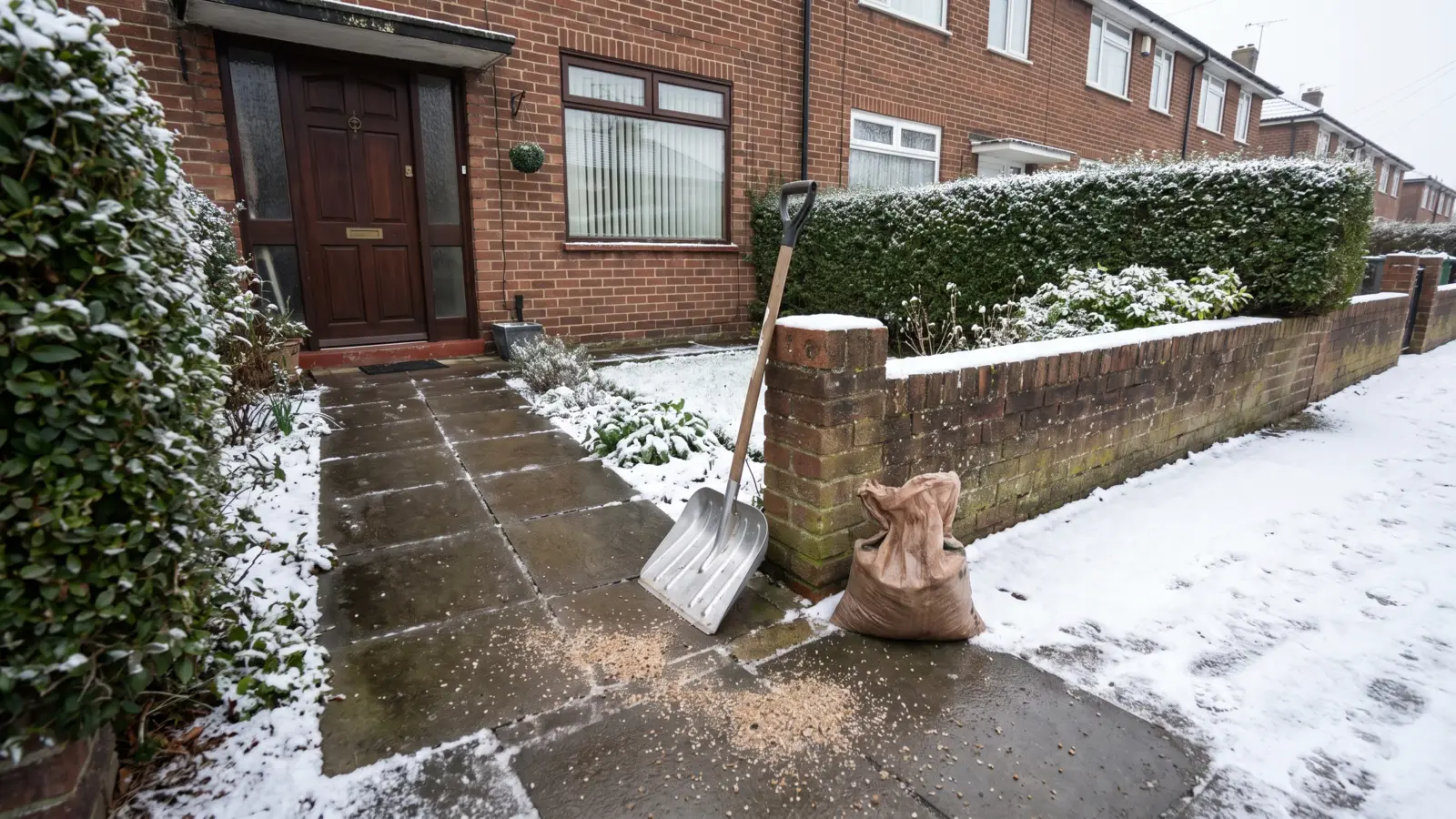
Unlikely, if you do it carefully. GOV.UK says it’s unlikely you’ll be sued or held responsible if someone is injured on a path or pavement you have cleared carefully, and nidirect says the same for Northern Ireland. In England, Wales and Scotland the legal duty over snow and ice on public roads and pavements sits with the highway or roads authority, usually your council, and it is a qualified duty: in England and Wales, it applies so far as is reasonably practicable. Clear early, use salt rather than water, keep the snow off paths and drains, and don’t use council grit-bin salt on your own drive.
By Tom Calder · Updated 24 September 2026 · Sourced to GOV.UK, nidirect, mygov.scot, the Met Office, UKHSA, HSE, councils & legislation.gov.uk
The official answer
GOV.UK’s answer is reassuring: “You can clear snow and ice from pavements yourself. It’s unlikely that you’ll be sued or held responsible if someone is injured on a path or pavement if you’ve cleared it carefully.” nidirect gives the same answer for Northern Ireland, adding that the Attorney General for Northern Ireland advised in 2010 that careful clearing is unlikely to make you liable.
On 20 December 2010 the then Transport Secretary, Philip Hammond, told Parliament the government had published a ‘snow code’ “to give common-sense advice to householders and businesses to help them safely clear snow and ice from pavements and public spaces, without fear of legal action”. The code is advice, not law. GOV.UK’s page, checked on 24 September 2026, carries a shorter version; the Met Office still publishes a fuller one, credited to the Department for Transport. It says “don’t believe the myths”, and that people walking on snow and ice have a responsibility to be careful themselves.
What ‘carefully’ means
Everything turns on that word. Scottish Borders Council puts the limit plainly: “if by clearing or gritting the pavement you create a new or greater risk you may be held liable”, and the person who fell would have to prove your actions directly caused it. Tower Hamlets Council in London makes the same point: it calls liability “very unlikely” as long as you are careful and use common sense not to make the pavement or path “clearly more dangerous than before”.
The official advice steers you away from the usual ways clearing can leave a path worse: water that refreezes as black ice, which the Met Office calls invisible and very slippery; a cleared path left unsalted to freeze overnight; snow shovelled where it blocks someone’s path or a drain.
What the council has to do
The legal duty sits with the highway authority (in Scotland, the roads authority), which for most local roads and pavements is your council. In England and Wales, section 41(1A) of the Highways Act 1980, added in 2003, says “a highway authority are under a duty to ensure, so far as is reasonably practicable, that safe passage along a highway is not endangered by snow or ice”. In Scotland, section 34 of the Roads (Scotland) Act 1984 says a roads authority “shall take such steps as they consider reasonable to prevent snow and ice endangering the safe passage of pedestrians and vehicles over public roads”.
Both duties are qualified, and in practice councils treat priority routes first. Scottish Borders Council, for example, salts pavements after snow or ice has fallen rather than in advance, and prioritises primary routes covering some 13% of a path network almost 780 miles long.
Northern Ireland differs. Article 9 of the Roads (Northern Ireland) Order 1993 gives the Department for Infrastructure a power, not a duty: it “may take such steps as it considers reasonable and practicable” against snow and ice, and the article gives no one a right to sue it for not doing so. Article 10 does oblige it to remove obstructions caused by accumulated snow. nidirect says it does not normally salt footways, though, where resources allow, it will work with councils in longer spells of snow and ice to clear footways in busy town centres.
How to clear it: the snow code
Start early. GOV.UK says “it’s easier to move fresh, loose snow”; once it has been walked on, the Met Office notes, it packs hard, and the Health and Safety Executive (HSE) says compacted snow that turns to ice is difficult to treat with grit. Wear shoes with good grip, as the UK Health Security Agency (UKHSA) advises for slippery or icy surfaces.
Clear a strip down the middle first so you have a clear surface to walk on, then shovel from the centre to the sides, putting the snow, in the Met Office’s words, where it “doesn’t block people’s paths or drains”. Steps and steep paths need extra attention; GOV.UK says using more salt there may help.
Don’t use water, even hot water: GOV.UK warns it “might refreeze and turn to black ice”. Lift the top layer in the morning and any sunshine will help melt the ice beneath, the Met Office adds; salt the path before nightfall to stop it refreezing overnight.
Salt, sand or ash
Salt is the first choice: GOV.UK says it “will melt the ice or snow and stop it from refreezing overnight”. The Met Office’s version of the snow code says ordinary table or dishwasher salt works, about a tablespoon for each square metre, kept off plants and grass, which it may damage. Rock salt, the usual ‘grit’, is sold by builders’ merchants, HSE notes.
Salt needs time to dissolve into the moisture on the ground, and heavy rain washes it away, HSE says; it suggests gritting early in the evening before frost settles, or early in the morning. If you run short, GOV.UK says ash and sand “will provide grip underfoot”, though the Met Office notes they won’t stop a path icing over as well as salt.
Grit bins are for the street, not your drive
Grit bins hold council salt, and the national advice is to leave it for the roads: GOV.UK says not to use the salt from salting bins “as this is used to keep roads clear”, and the Met Office’s snow code adds “unless your council advises otherwise”.
Council rules vary. Coventry City Council lets anyone use its community bins on public roads, paths and pavements, but “not for private use on driveways or garden paths”, and says half a tablespoon (10 grams) of its salt treats a square metre of road or pavement: overuse can leave piles of salt that people can slip or trip on. Derbyshire County Council says its grit is for public pavements and roads only, and that anyone caught taking it for private property such as a driveway may be prosecuted. Check your council’s page first.
Your own drive and path
Your drive and front path are private property, so a different law applies. In England and Wales, the Occupiers’ Liability Act 1957 says an occupier owes visitors a “common duty of care”: to take such care as in all the circumstances of the case is reasonable to see that the visitor will be reasonably safe in using the premises. Scotland’s 1960 Act and Northern Ireland’s 1957 Act set similar duties. All three set a standard of reasonable care in the circumstances, not a list of jobs.
The Met Office heads its snow code ‘Clearing your path or driveway’, and the method is the same: clear and salt the route to your door that postal workers, carers and deliveries use, with salt you have bought. For businesses, HSE’s guidance is to grit the outdoor areas most likely to ice, such as entrances, car parks, walkways and slopes, when frost, ice or snow is forecast, and nidirect says commercial property owners should keep enough salt in stock for the safety of employees and visitors.
Look out for the neighbours
The snow code asks you to offer to clear snow and ice around the home of a neighbour who will have difficulty getting in and out, and to check that elderly or disabled neighbours are all right in the cold, contacting their relatives, friends or, if necessary, the council if you are worried.
In its advice for England, UKHSA lists older people, people at risk of falls and people who are housebound or have low mobility among those particularly at risk from the cold, and names snow and ice among the reasons. It suggests keeping in touch, helping neighbours stock up on food and medication when bad weather is forecast, and calling NHS 111 if you think someone may have hypothermia, or 999 in an emergency. See our guide to cold-health alerts and the health alerts tracker for England.
The car and the road
Snow cleared off the car deserves the same care: the snow code’s advice is to put it where it doesn’t block people’s paths or drains. For the car itself, including what the Highway Code requires before you set off and when not to travel, see driving in snow and ice, and use the car kit builder to plan a winter boot kit. The weather warnings tracker shows any Met Office snow or ice warning in force across the UK.
Common questions
Can I be sued if someone slips on a pavement I have cleared?
It is unlikely if you cleared it carefully. GOV.UK says it’s unlikely you’ll be sued or held responsible if someone is injured on a path or pavement you have cleared carefully, and nidirect says the same for Northern Ireland. The risk lies in making things worse: Scottish Borders Council notes you may be held liable if clearing or gritting creates a new or greater risk. So follow the official advice: no water, which can refreeze as black ice, and salt on what you clear.
Do I have to clear the pavement outside my house?
The legal duty sits with the highway or roads authority, usually your council, and it is a qualified one: in England and Wales, section 41(1A) of the Highways Act 1980 applies “so far as is reasonably practicable”; in Scotland, section 34 of the Roads (Scotland) Act 1984 requires the steps the authority considers reasonable. GOV.UK describes clearing the pavement as something you can do, and Scottish Borders Council tells its residents they have no obligation to clear or grit the public pavement outside their house. In Northern Ireland the Department for Infrastructure has a power, not a duty, to treat roads, and does not normally salt footways.
Can I use salt from the council grit bin on my drive?
No. GOV.UK says not to use salt from salting bins because it is there to keep roads clear, and the Met Office’s snow code adds “unless your council advises otherwise”. Coventry, which lets anyone use its community bins, limits them to public roads, paths and pavements, not driveways or garden paths, and Derbyshire County Council says that anyone caught taking grit for private property may be prosecuted. Buy your own: table or dishwasher salt works on a path, and builders’ merchants sell rock salt.
What can I use if I don’t have rock salt?
Ordinary table or dishwasher salt, about a tablespoon for each square metre, according to the Met Office’s version of the snow code; keep it off plants and grass. If you don’t have enough salt, GOV.UK says ash and sand will provide grip underfoot, though the Met Office notes they won’t stop the path icing over as well as salt.
Should I pour hot water on an icy path or step?
No. GOV.UK’s advice is not to use water because it might refreeze and turn to black ice, which the Met Office describes as invisible and very slippery. Clear what you can early in the day, then salt; on steps and steep paths, GOV.UK says using more salt may help.
How do I find out which roads and pavements the council grits?
In England and Wales, GOV.UK’s ‘Find out which roads your council will grit’ service takes you to your council’s gritting information. In Scotland, mygov.scot sends you to your council for roads and pavements; check its website for its winter service, as the snow code advises. In Northern Ireland, nidirect lets you report an ice or snow problem, or request a salt bin or pile, online.
Sources (19)
- GOV.UK — Clear snow from a road, path or cycleway (checked 24 September 2026)
- GOV.UK — Find out which roads your council will grit (England and Wales)
- Met Office — Clearing your path or driveway: the snow code (Department for Transport advice)
- Department for Transport — Severe winter weather, oral statement to Parliament by Philip Hammond, 20 December 2010, GOV.UK
- nidirect — Clearing ice and snow from footways
- Highways Act 1980, section 41 (duty to maintain; subsection 1A, snow and ice), legislation.gov.uk
- Roads (Scotland) Act 1984, section 34 (clearance of snow and ice), legislation.gov.uk
- Roads (Northern Ireland) Order 1993, article 9 (treatment of roads affected by snow and ice), legislation.gov.uk
- Roads (Northern Ireland) Order 1993, article 10 (duty to remove snow, soil etc.), legislation.gov.uk
- mygov.scot — Roads and pavements
- Scottish Borders Council — Winter and gritting FAQs: pavements
- Tower Hamlets Council — Clearing snow and ice from pavements and public spaces
- Coventry City Council — Gritting: self help grit bins
- Derbyshire County Council — Grit bins and salt heaps
- Health and Safety Executive — Slips and trips: frequently asked questions (icy conditions, gritting)
- Occupiers’ Liability Act 1957, section 2, legislation.gov.uk
- Occupiers’ Liability (Scotland) Act 1960, section 2, legislation.gov.uk
- Occupiers’ Liability Act (Northern Ireland) 1957, section 2, legislation.gov.uk
- UKHSA — Keeping warm and well: staying safe in cold weather, GOV.UK
PreparedBritain is independent and not affiliated with HM Government.
The Emergency Kit Checklist
The GOV.UK Prepare essentials on one printable page — tick them off as you go and keep it with the kit. Free, no catch.
Download it straight away. We'll also send the occasional briefing when something genuinely matters — severe weather, live incidents, real price drops. Nothing else.
Keep reading
All weather, storms & flooding guides →Is a ‘snow bomb’ heading for the UK? How to read winter weather headlines
Every winter brings maps of Britain turned blue and an “exact date” snow will hit. The maps are automated…
What this record El Niño means for a UK winter (and what it doesn't)
The Met Office says this El Niño is now the strongest on record. For Britain that means a wetter, stormier autumn…
Driving in snow and ice: the Highway Code rules, technique and when not to travel
Highway Code rules 228–231 explained: clearing snow and ice legally, tyres, gentle-input technique, black ice, and…