How to lower your electricity bill: what each step is really worth, and when power is cheapest
An electricity unit costs 26.32p and the standing charge 54.83p a day from 1 October 2026, and the price cap limits those rates, not your bill. What each everyday step is worth on Energy Saving Trust figures, why a standard tariff costs the same at midnight as at teatime, how Economy 7 and smart tariffs differ, and the tariff choices and help that matter this winter.
From 1 October 2026 the average electricity price in Great Britain for a household paying by Direct Debit is 26.32p a kWh plus a standing charge of 54.83p a day, with no VAT on electricity until 31 March 2027 (Ofgem). The price cap limits those two rates, not your bill: in Ofgem’s words, “The more energy you use, the higher your bill will be.” The biggest easy wins, on Energy Saving Trust figures updated on 6 October 2026, are switching appliances off standby (around £45 a year), drying clothes on a line or airer instead of in a tumble dryer (£50), replacing halogen spotlights with LEDs (£45), washing at 30°C and running one fewer wash a week (£26 for the two together) and not overfilling the kettle (£10). On a standard tariff electricity costs the same at every hour, so moving the washing to midnight saves nothing; night is cheaper only on Economy 7, other two-rate meters and smart time-of-use tariffs, where the dear window is typically around 4pm to 7pm. Ofgem sets the January 2027 cap by 25 November, and the forecasts point to a rise.
By Tom Calder · Updated 16 October 2026 · Sourced to Ofgem, the Energy Saving Trust, Citizens Advice, NESO and GOV.UK
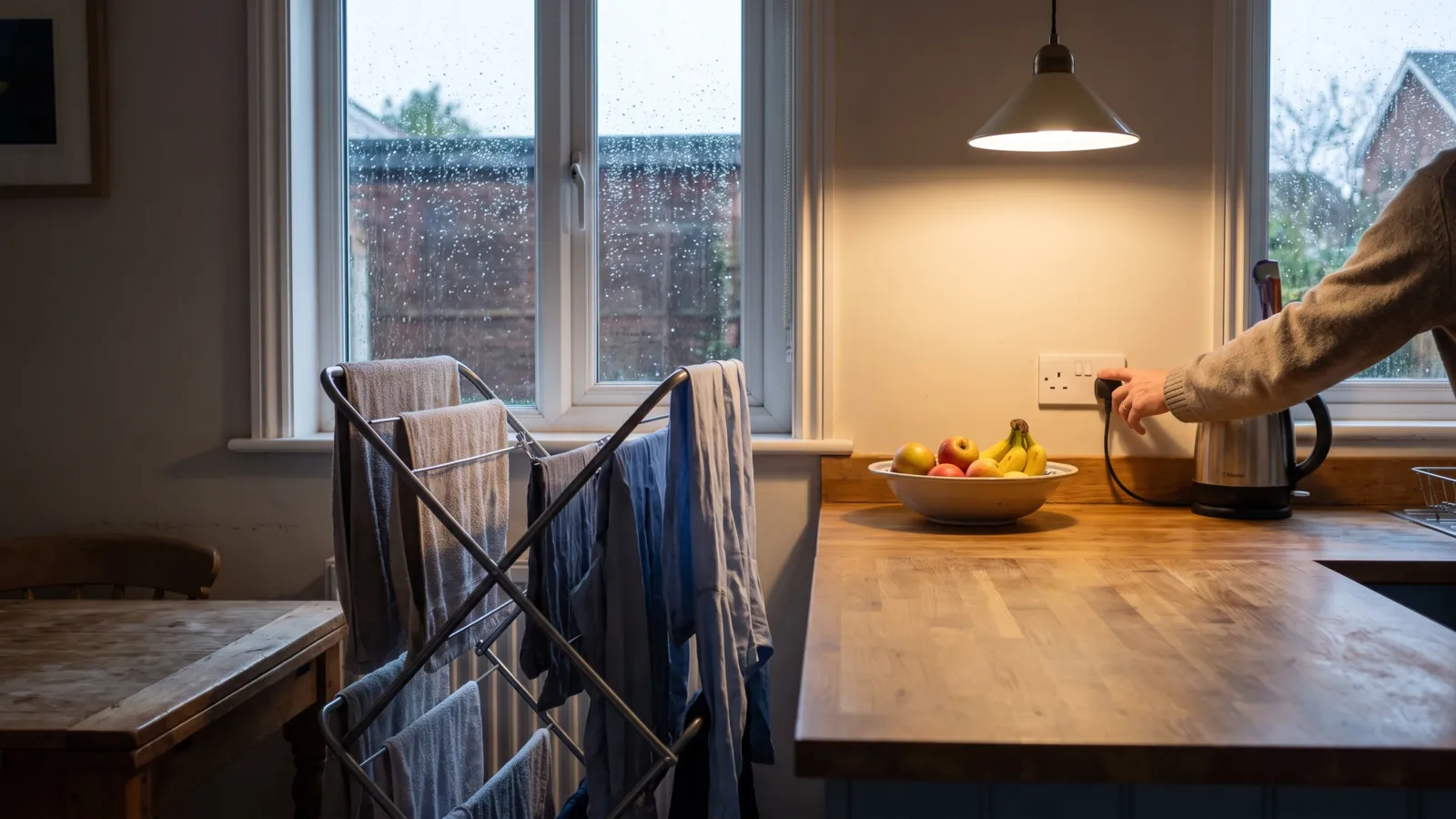
What you are paying for
An electricity bill has two parts: the unit rate, the price of each kilowatt hour (kWh) you use, and the standing charge, which Ofgem describes as the amount “you pay every day even if you do not use any energy on that day”. From 1 October 2026 the average for a household in England, Scotland or Wales paying by Direct Debit is 26.32p a kWh and 54.83p a day, with no VAT on household electricity from 1 October 2026 to 31 March 2027.
The price cap limits those two figures, not the total. Ofgem: “This is the maximum amount your supplier can charge for a unit of energy and standing charge together.” And: “It does not limit the cost of your total bill.” The headline £1,723 a year for 1 October to 31 December 2026, announced on 26 August and up 4% from £1,663, is a typical dual-fuel Direct Debit bill, not a ceiling on yours. The cap covers Great Britain and does not apply in Northern Ireland.
Both figures vary by where you live, how you pay and your meter type. Worked out from Ofgem’s cap tables for Direct Debit, the standing charge runs from about 42.9p a day in London to about 67.7p in Merseyside and Northern Wales, and the unit rate from about 25.4p a kWh in the East Midlands to about 27.9p in Merseyside and Northern Wales. Ofgem’s postcode finder gives your own region’s figures.
What each step is really worth
The Energy Saving Trust (EST) puts a yearly figure on each everyday step, last updated on 6 October 2026, for Great Britain. Switch appliances off standby: around £45. Dry clothes on a line or an indoor airer instead of in a tumble dryer: £50. Replace the remaining halogen spotlights with LEDs: £45. Wash at 30°C and run one fewer wash a week: £26 for the two together (EST gives no separate 30°C figure). Run the dishwasher one fewer time a week: £10. Avoid overfilling the kettle: £10. Turn lights off when you leave a room: around £7.
Two caveats come from EST itself. “You can turn almost all electrical appliances off at the plug without upsetting their programming”, but “some appliances, like fridges and freezers, need to be on all the time.” And the lighting saving is in the LED, not the app: smart bulbs “aren’t likely to save energy”.
EST does not price these at today’s cap. Its methodology page (22 September 2026) says its tariffs are “calculated using an average of recent Ofgem energy price cap periods”, so your own saving depends on your tariff. Its “up to £313” a year is for all ten of its quick tips together, hot water included, not for electricity alone; its hot-water figures only come off the electricity bill if your water is heated by electricity, and in most GB homes it is gas. A home energy monitor shows what is drawing power at any moment.
When is electricity cheapest?
On a standard tariff, there is no cheap hour. EST: “If you’re on a standard electricity tariff, the price is the same whatever the time of day or night.” And: “So, running your washing machine at midnight won’t make a difference.” Ofgem calls this a single rate tariff.
Night is cheaper only if your tariff says so. Economy 7, in Citizens Advice’s words, gives “a lower rate for 7 hours at night - the off-peak price”; Economy 10 gives ten hours. The hours are not fixed nationally: “The exact times depend on your supplier, your tariff and where you live”, and “Your off-peak times might change when the clocks change.” Ofgem caps these tariffs: “Together, they cannot be more than the price cap.”
Your bill tells you which you are on: Citizens Advice says a time-of-use bill shows two or more prices per kWh and two or more sets of meter readings. One price means your electricity costs the same at 3am as at 6pm.
NewSee this for your own homeHome Alerts: your postcode's power cuts, warnings and floods, on one screen. Free for your own home. Opening in October; the first 100 on the list get in first.Join the list →Smart time-of-use tariffs: cheaper overnight, dearer at teatime
The newer tariffs change price through the day. EST: “The price you pay for electricity can change every half hour, reflecting real-time demand and supply.” They need a smart meter that reports every half hour. One example: on Agile Octopus, “Between 4-8pm every day (usually nearer 4pm), your unit rates are updated for the next 24 hours”; its rates change daily, so we do not quote them.
The costly window is the early evening. EST: “When demand is low (usually overnight), electricity is cheaper. When demand is high (early evening), it’s more expensive.” NESO, the system operator, puts the peak at “usually between 4 and 7 pm”. So typically around 4pm to 7pm, but check your own tariff, because the windows differ.
Two cautions. EST: “If you use most of your energy during peak times and can’t shift that, it could even cost a little more.” And fixed-term smart time-of-use tariffs sit outside the price cap, so check the peak rate as well as the off-peak rate. Our guide to time-varying electricity prices covers who these tariffs suit.
Tariff choices and help, one line each
Fixed deals. Ofgem: “You are not protected by the price cap if you: agreed a fixed tariff with your supplier”, and Citizens Advice notes that if prices fall you could end up paying more than on a standard variable tariff. Compare the deal’s unit rate and standing charge against the cap’s; “If you have 49 days or less left on a fixed tariff, you can switch for free.” Our energy switch guide has the checks.
Warm Home Discount. GOV.UK: “The Warm Home Discount Scheme is a one-off £150 discount off your electricity bill.” Your supplier applies it, and “You’ll usually get the discount automatically if you’re eligible.” It is not available in Northern Ireland. Our Warm Home Discount guide has the detail.
Demand Flexibility Service. Some suppliers pay smart-meter customers to shift use at busy times through NESO’s Demand Flexibility Service; ask your supplier whether it is offering it this winter.
Priority Services Register. For households that need extra support, it brings help including, wherever possible, advance notice of scheduled power cuts. Ofgem: “Get in touch with your supplier or network operator directly and give them as much information as you can about your needs.” Our Priority Services Register guide explains it, and energy bill help lists every scheme.
Myths
“Electricity is cheaper at night.” Only on Economy 7, other two-rate meters and time-of-use tariffs. On a standard tariff, EST says, the price “is the same whatever the time of day or night”.
“The price cap limits my bill.” It limits the unit rate and the standing charge. Ofgem: “It does not limit the cost of your total bill.”
“Smart bulbs will cut my bill.” LEDs do; the smart part does not. EST: “they aren’t likely to save energy.”
“Switching supplier will cut my standing charge.” Citizens Advice: “You might get a cheaper standing charge from a different supplier, but it won’t change much.” It depends on your postcode and network operator, not your supplier.
“A fixed deal always protects me.” Only against rises. Citizens Advice: if prices fall, “you could end up paying more than if you were on a standard variable tariff.”
What is next for prices
Ofgem sets the cap for January to March 2027 by 25 November 2026, and the forecasts point upward: Cornwall Insight’s forecast on 30 September was £1,999 for a typical dual-fuel Direct Debit household, against £1,723 now. Our January 2027 price cap guide follows it. VAT is off household electricity until 31 March 2027. For the heating side, see our guide to keeping warm without the heating on.
Common questions
What is the cheapest time to use electricity?
On a standard tariff there is no cheap time: EST says the price is the same whatever the time of day or night, so running the washing machine at midnight makes no difference. On Economy 7 the cheap rate runs for seven hours at night, at times set by your supplier, tariff and area that can move when the clocks change. On smart time-of-use tariffs electricity is usually cheapest overnight and dearest in the early evening, typically around 4pm to 7pm on EST and NESO’s descriptions; check your own tariff’s windows.
Does turning things off standby save money?
Yes. The Energy Saving Trust puts it at around £45 a year in Great Britain (updated 6 October 2026), and says you can turn almost all electrical appliances off at the plug without upsetting their programming. Fridges and freezers need to stay on. EST’s figures use an average of recent price-cap periods, so your own saving depends on your tariff.
Is electricity cheaper at night?
Only if your tariff has a night rate. Economy 7, Economy 10 and other two-rate meters charge less for seven to ten hours overnight; smart time-of-use tariffs are usually cheapest overnight too. On a standard single-rate tariff the price is the same at 3am as at 6pm. Your bill shows which you are on: two or more prices per kWh and two or more sets of readings mean a time-of-use tariff.
What is the electricity unit rate now?
For 1 October to 31 December 2026, Ofgem’s average for a household in England, Scotland or Wales paying by Direct Debit is 26.32p a kWh and a standing charge of 54.83p a day, with no VAT on electricity until 31 March 2027. Your own figures depend on region and payment method: worked out from Ofgem’s cap tables, the Direct Debit standing charge runs from about 42.9p a day in London to about 67.7p in Merseyside and Northern Wales. Ofgem’s postcode finder gives the exact rates for your area.
Should I fix my energy tariff?
A fixed deal is not protected by the price cap, so it only helps if its unit rate and standing charge beat the cap’s for your region over the term. It protects you against rises, and Citizens Advice notes that if prices fall you could end up paying more than on a standard variable tariff. The January 2027 cap is set by 25 November and Cornwall Insight’s 30 September forecast was £1,999, against £1,723 now. If you have 49 days or less left on a fix, you can switch free. Our energy switch guide has the checks.
How do I know if I am on Economy 7?
Look at your bill. Citizens Advice says a time-of-use bill shows two or more prices per kWh for your electricity and two or more sets of meter readings. If you are unsure of your off-peak hours, ask your supplier: they depend on your supplier, tariff and where you live, and they can shift when the clocks change. Citizens Advice’s example is midnight to 7am from October to March and 1am to 8am from March to October.
Sources (17)
- Ofgem — Energy price cap: unit rates and standing charges, 1 October to 31 December 2026 (no date shown; read 16 October 2026)
- Ofgem — Changes to the energy price cap between 1 October and 31 December 2026 (26 August 2026)
- Ofgem — Energy price cap and standing charges explained (no date shown; read 16 October 2026)
- Ofgem — Summary of changes to the energy price cap, 1 October to 31 December 2026 (PDF, 26 August 2026)
- Ofgem — Benchmark maximum charges for charge restriction period 17a, cap tables (PDF, August 2026)
- Ofgem — Energy price cap: technical approach to market-wide half-hourly settlement, call for input (25 March 2026)
- Ofgem — Join your supplier’s Priority Services Register (no date shown; read 16 October 2026)
- Energy Saving Trust — Quick tips to save energy (last updated 6 October 2026)
- Energy Saving Trust — Lighting (last updated 6 October 2026)
- Energy Saving Trust — How do we calculate our energy saving data? (last updated 22 September 2026)
- Energy Saving Trust — Should I switch to a time of use tariff? (23 January 2026)
- Citizens Advice — Using storage heaters efficiently (page last reviewed 5 July 2023)
- Citizens Advice — Choosing an energy tariffpage last reviewed 24 August 2023; carries 2026 content
- NESO — Nearly 2 million households and businesses registered for the Demand Flexibility Service last winter (5 July 2025)
- NESO — Demand Flexibility Service explained (no date shown; read 16 October 2026)
- GOV.UK — The Warm Home Discount Scheme (read 16 October 2026)
- Octopus Energy — Agile Octopus (undated; read 16 October 2026)
PreparedBritain is independent and not affiliated with HM Government.
The Power Cut Action Card
One page for the kitchen drawer: what to do first, what to have ready, how long food keeps, and how to stay warm without risking carbon monoxide. Free, no catch.
Download it straight away. We'll also send the occasional briefing when something genuinely matters — severe weather, live incidents, real price drops. Nothing else.
Latest from our live data
All stories → News · 21 OctOnly 4 in 100 adults have three days of bottled water at home, the government's survey shows
 News · 21 OctFood inflation held at 1.3%. Wholesale cabbage and cauliflower are up a third. Both are true
 News · 21 OctAldi recall: shoppers warned of hairdryer electric shock or fire risk. How to check yours
Keep reading
All power cuts & energy guides →Power cut on Christmas Day: how to finish dinner and keep the food safe
What to do if the power goes off while Christmas dinner is cooking: the first calls, how long the fridge and freezer…
Jackery vs EcoFlow: which power station brand for a UK home?
Jackery or EcoFlow for UK power cuts? The Explorer 1000 v2 and 2000 v2 against the DELTA 3 Plus and DELTA 3 Max Plus…
BLUETTI vs Jackery: which power station brand for a UK home?
BLUETTI or Jackery for a UK home? The Elite 100 V2 and 200 V2 against the Explorer 1000 v2 and 2000 v2 on output,…
