Power cut on Christmas Day: how to finish dinner and keep the food safe
What to do if the power goes off while Christmas dinner is cooking: the first calls, how long the fridge and freezer hold, whether a gas hob or oven will work, how to finish the turkey to the Food Standards Agency’s 70°C for 2 minutes, what a portable power station can and cannot run, why camping stoves and barbecues stay outside, and Ofgem’s compensation amounts for 2026/27.
Call 105, keep the fridge and freezer shut, and work to the Food Standards Agency’s clock: a fridge holds for up to 4 hours and a full freezer for up to 48. Electric and induction cookers are off; a gas hob can often be lit by hand with a long match, but GOV.UK Prepare says gas ovens won’t work without power while the FSA says gas cookers may, so check your own manual and do not plan the roast around the oven. The turkey is safe only at 70°C for 2 minutes in the thickest part, or an equivalent, with juices running clear; there is no official guidance on a part-cooked bird, so if in doubt, don’t serve it. A portable power station can run a slow cooker (a few hundred watts) or, if it is rated at 2,100 W or more, a single plug-in induction hob for a short while; built-in ovens are not the target. Camping stoves and barbecues are for the open air only, well clear of doors and windows; in the NHS’s words, “do not use a barbecue or camping stove indoors or inside a tent”. Ofgem’s 2026/27 payments start at £100 once a normal fault has run 12 hours (24 hours when 5,000 or more premises are off, and £90 after 24 or 48 hours in a storm), and “You do not need to make a claim”.
By Tom Calder · Updated 14 October 2026 · Sourced to the Food Standards Agency, GOV.UK Prepare, the NHS, Ofgem, London Fire Brigade, Gas Safe Register, Which? and manufacturers’ manuals
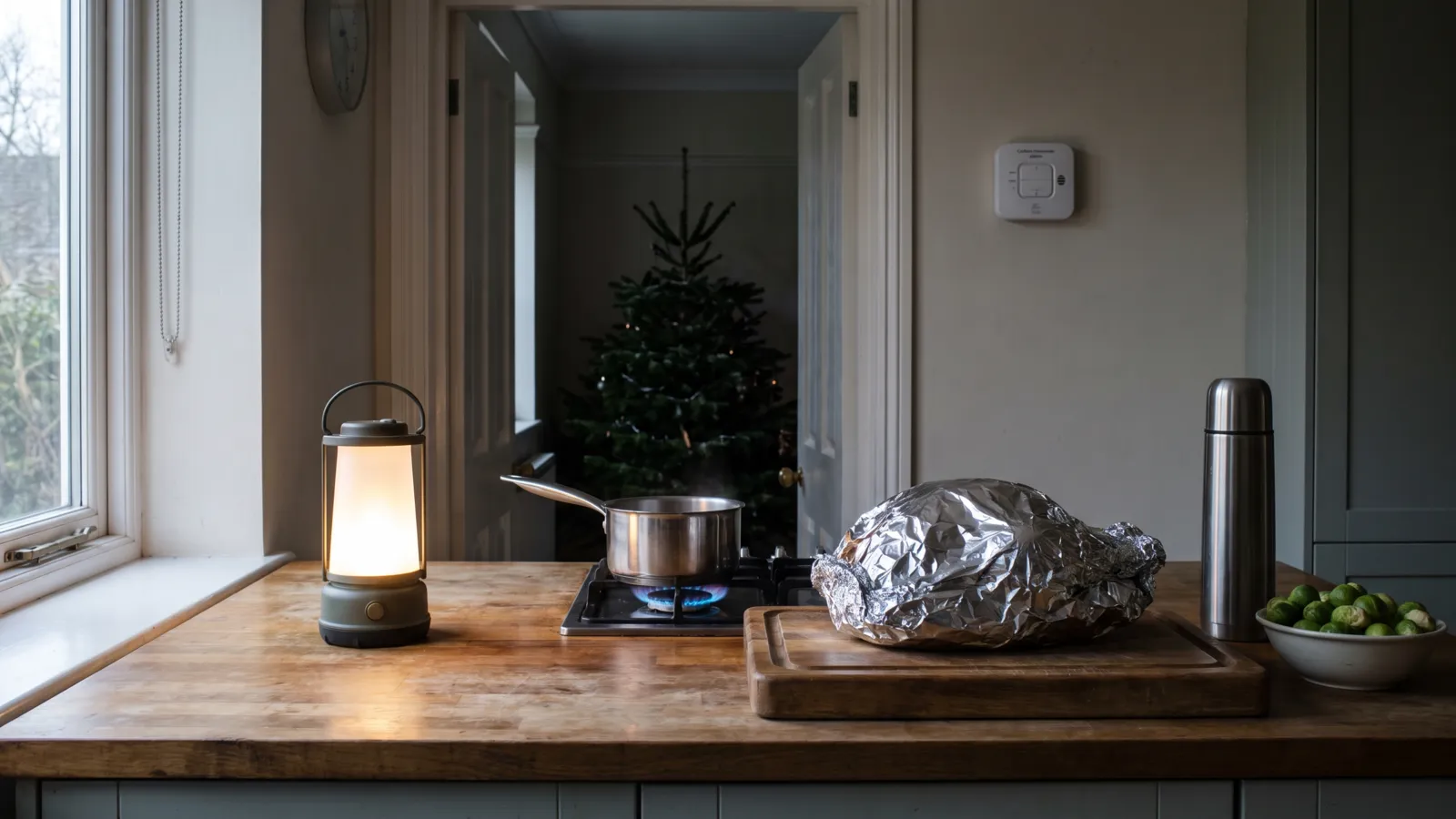
First steps when the power goes mid-cook
Check the fuse box first, so you know whether it is a trip in your house or a cut in the street, then call 105. It is free in England, Scotland and Wales and connects you to your electricity network operator, which fixes the fault whoever you pay your bill to; in Northern Ireland the number is 03457 643643. Keep the fridge and freezer doors shut while you do it.
The Food Standards Agency’s power-cut guidance is the clock you are working to: “Your fridge should stay cold for up to 4 hours. The food in your freezer should stay frozen for up to 48 hours in a full freezer (or 24 hours if it’s half full), but these are estimates.” The FSA says a cut of under four hours is unlikely to affect the safety of chilled or frozen food. Normally a fridge should be at 5°C or below, but in a power cut the FSA allows food to be kept under 8°C; once the fridge reaches 8°C or above, eat food that normally needs refrigeration within 4 hours, and throw away what is left after 4 hours unless the power has come back within that time. A fridge thermometer is how you know, and our power cut food safety guide has the full keep-or-bin list.
If anyone in the house has reached state pension age, is pregnant or has young children, has a disability or long-term condition, struggles with speaking or reading English, or is going through a temporary change such as injury, bereavement or job loss, they can join the Priority Services Register. Ofgem says it brings priority support in an emergency and, “wherever possible, advanced notice of scheduled power cuts”; GOV.UK Prepare calls it “a free service”. Your supplier and your network operator each keep their own register, so contact both, and re-register if you switch supplier. It gets you extra help during a cut, such as battery packs, but Ofgem is clear that “You will not receive extra payments” for being on it. Our Priority Services Register guide explains how to join.
Will your cooker work? The honest split
Official sources do not agree, so we will not pretend they do. The government’s Prepare campaign says: “Gas ovens, boilers, heat pumps and your home internet won’t work without power.” The Food Standards Agency says: “Electric/induction cookers will not work during a power cut, but gas cookers may continue to function.” Both agree on electric: an electric oven, including a fan oven, and an induction hob are off until the power returns.
A gas hob is the appliance most likely to keep working. Which? said on 4 June 2026: “If you have a gas hob, you can use it as usual.” Most modern hobs use electricity for the spark, but “you can still light the flame by turning the gas onto the lowest setting and holding a long match or gas lighter to the burner instead”. Bosch’s own manual for its PC.6A, PC.7A and PC.9A gas hobs allows manual lighting too: “Hold an igniter or a naked flame (such as a lighter or a match) against the burner”, then hold the knob down firmly for four seconds so the safety cut-off does not close the gas; if the flame is blown out, switch the knob off and wait at least a minute before relighting; and “If the burner does not switch on after 15 seconds, switch off the control knob and open the door or window in the room.”
Two cautions. The Bosch manual says to turn the knob to the highest setting before lighting, where Which? says the lowest, and Bosch UK’s own support page says “Your gas hob requires electricity to operate, so if the power source is down, your hob will not work.” Hobs differ, so the only reliable answer is your own manual, and the time to test it is a quiet evening before Christmas, not Christmas Day. A long-reach lighter or stormproof matches in the kitchen drawer is the whole kit.
A gas oven is the weak point. Prepare says it won’t work; the FSA says gas cookers may; we found no UK manufacturer or Gas Safe statement either way, and Which?’s advice about lighting by hand is about hobs, not ovens. Unless your manual says the oven can be lit without power, treat it as off and do not plan the roast around it.
Two safety points apply whatever you light. The NHS says “do not use oversized cooking pots on your stove that cover up more than 1 gas ring”, and advises a carbon monoxide alarm for each room of your home containing appliances that burn gas, oil, coal or wood. If you think a gas appliance is leaking carbon monoxide, the free National Gas Helpline is 0800 111 999, 24 hours a day. Our carbon monoxide alarms page compares the alarms.
One more thing to know before you think about batteries: some built-in electric ovens have no plug. Bosch’s specification sheet for its Series 4 HBS534BS0B built-in oven lists a 2,990 W connection rating, 13 A fuse protection and “no plug (electrical connection by electrician)”. An oven like that cannot be plugged into anything, which matters two sections down.
Finishing the turkey safely
The rule for the bird does not change because the power did. The Food Standards Agency says the middle of the food should reach 70°C for 2 minutes, or an equivalent combination: 60°C for 45 minutes, 65°C for 10 minutes, 75°C for 30 seconds or 80°C for 6 seconds. Poultry can have bacteria all the way through, so it must be cooked all the way through. In a whole bird the thickest part is between the leg and the breast; if you have no probe, cut into the thickest part and check that the juices run clear and there is no pink meat. Clean a probe after each use. In Scotland, Food Standards Scotland asks for 75°C or above in the thickest part.
For reference, the FSA’s oven timings for an unstuffed bird with no pack instructions, in an oven preheated to 180°C (160°C fan, Gas Mark 4), are 45 minutes per kilogram plus 20 minutes under 4.5 kg, 40 minutes per kilogram from 4.5 to 6.5 kg, and 35 minutes per kilogram above 6.5 kg, with the stuffing cooked in a separate tin and the raw bird never washed. Those are oven times. The FSA has no timings for a camping stove, a gas hob or an oven run from a battery.
There is no official guidance on a turkey whose cooking was interrupted part-way. We looked at the FSA and Food Standards Scotland and found none, and we will not invent a rule. What the FSA’s principles do give you is this: the bird is safe to serve only when the thickest part has reached 70°C for 2 minutes or an equivalent and the juices run clear with no pink meat. Whenever you finish it, check it to that standard before serving.
If the power stays off, there is no FSA rule written for this, so these are its general principles, not a ruling on your bird. Food between 8°C and 63°C is in what the FSA calls the “Danger Zone”, where bacteria may grow, and a part-cooked bird cooling in an oven that has gone off is in that range. Cooked food is meant to be cooled and in the fridge within one to two hours, and in a power cut chilled food should be thrown away once it has been at 8°C or above for 4 hours, unless the power is back within those 4 hours. Nothing in the FSA’s guidance says a part-cooked bird that has sat in that range can be made safe later, so if in doubt, don’t serve it. A half-cooked turkey is not a reason to light anything indoors: the options are a gas hob lit by hand (above), a slow cooker run from a battery or a camping stove in the open air (below), or the cold parts of the meal.
NewSee this for your own homeHome Alerts: your postcode's power cuts, warnings and floods, on one screen. Free for your own home. Opening in October; the first 100 on the list get in first.Join the list →A slow cooker or hob from a portable power station
What you can run depends on the appliance’s draw, and Christmas appliances span a tenfold range. A slow cooker draws a few hundred watts; Morphy Richards lists its Sear & Stew 6.5 litre at 290 W. A plug-in induction hob is a different order: Tefal’s Everyday Induction Hob IH201840 is rated 2,100 W, so it needs a unit rated at or above 2,100 W. A built-in oven is not the target: the Bosch HBS534BS0B above is rated 2,990 W and is wired in by an electrician, with no plug.
On the power stations we track, that means: a small unit such as the EcoFlow River 2 Max (512 Wh, 500 W rated, with X-Boost to 1,000 W for one device at a time and “not suitable for appliances with voltage protection”) will run a 290 W slow cooker and not an induction hob. A 2 kWh-class unit, such as the Jackery Explorer 2000 v2 (2,042 Wh, “2200W Rated Output”) or the BLUETTI Elite 200 V2 (2,073.6 Wh, 2,600 W), can carry a single 2,100 W induction hob and nothing else large at the same time. BLUETTI’s Power Lifting mode “effortlessly supports pure resistive loads of up to 3,900W”, but an induction hob is not a pure resistive load, so that is not a basis for running one. None of these is for an oven: the Bosch built-in oven draws more than any of them is rated for, and with no plug there is nothing to connect.
Runtime is the other half, and the figures here are estimates, not measurements. By the planning method our sizing pages use (capacity, less 10 per cent depth-of-discharge and 15 per cent inverter loss, divided by the load plus about 10 W), a 2,042 Wh unit running a 2,100 W hob flat out would last about 45 minutes, and a 512 Wh unit running a 290 W slow cooker about 80 minutes. That is our arithmetic on the makers’ figures. Real hobs and slow cookers cycle on and off, so real runtimes are longer. Even so, it is enough for a pan of vegetables or to keep a stew going, not for a roast. What size power station do I need does the sums for your own kit.
Most homes do not need a power station for this. It is for people who already own one, for homes with powered medical equipment, or for rural homes on long overhead lines where multi-day cuts are a known risk. If that is you, power stations compared has the current prices; if it is not, a flask and a gas hob you can light by hand do the job.
Never cook indoors with a camping stove or barbecue
This is the rule the rest of the page sits under. The NHS says: “do not use a barbecue or camping stove indoors or inside a tent”. Carbon monoxide is colourless and has no smell, and the NHS lists using barbecues or camping stoves inside among the ways it builds up. London Fire Brigade puts it the same way: “Never take portable or disposable BBQs, grills or charcoal fuel burners into your home or any confined spaces such as a tent, houseboat or caravan”, and “An extinguished BBQ can continue to produce CO for many hours after it has been extinguished.” Gas Safe Register’s barbecue leaflet adds: “Never take a gas stove, light or heater into a tent, caravan or cabin unless it is a permanent fixture, installed and maintained correctly.”
In the open air, well clear of doors and windows, a camping stove can boil water or finish vegetables on Christmas Day. That means outside, not in a garage, porch, tent or caravan, and not indoors with a door or window open: neither the NHS nor London Fire Brigade makes an exception for ventilation. The FSA says camping stoves, barbecues or bottled gas stoves can be used if available, but “most are designed for outdoor use only”, and that food cooked this way can take longer, so make sure it is steaming hot and cooked through. Which?’s version is the practical one: “Don’t use camping stoves indoors - head outside to use them to boil water or cook small meals”, and pour the hot water into a flask so you are not lighting the stove each time. Cook outside, bring the food in. Portable generators, which the NHS lists among appliances that can produce carbon monoxide, belong in the open air too, well away from doors and windows and never in a garage or shed; see how to use a generator safely.
Know the symptoms. The NHS lists headache, dizziness, feeling sick, weakness, tiredness and confusion, chest and muscle pain, shortness of breath, flushing and loss of vision, and says they may come and go and ease when you are outside. If you suspect it, stop using the appliance if you can, go outside, get medical advice and do not go back in until you have got advice: call 111 for suspected symptoms, and 999 or go to A&E if someone is finding it hard to breathe, is suddenly confused, has lost consciousness, is weak or has chest or muscle pain, and do not drive to A&E. London Fire Brigade says to “Only buy alarms that have been certified to British Standard EN50291”. Our carbon monoxide poisoning symptoms guide has the detail, and camping stoves compares the stoves, all for outdoor use.
A no-cook Christmas, warm drinks in flasks, and leftovers
A Christmas dinner that does not need an oven is a perfectly good Christmas dinner, and for a cut of a few hours it is the sensible one. The government’s Prepare advice for power cuts is to keep “bottled water and non-perishable food that doesn’t need cooking”, and most of the Christmas table is already cold: ham, cheese, smoked salmon, bread, pickles, cake, mince pies and the chocolates. Our how to cook without power guide has the no-cook list and the flask routine.
Flasks are the warm part. If a storm warning is in force, fill a vacuum flask from the kettle while the power is on; if a stove is going outside, fill it from that. Which?’s tip is to pour hot water into a thermos so you do not fire up the stove each time. A drinks flask covers tea, coffee and instant soup; a wide-mouth food flask holds stew, gravy or custard. Our vacuum flasks page compares them.
Light the room with torches or LED candles rather than wax. Prepare says “Torches are safer than candles”, and London Fire Brigade said on 28 December 2025 that candles were believed to have caused four fires in four days over Christmas 2025, among them a maisonette fire in Peckham on 24 December started by a candle left unattended, and a Croydon flat fire on 25 December in which a candle set bedding alight. Its advice is LED candles, or real ones in a heat-resistant holder on a stable surface, never left unattended and out before bed, and to “Keep candles well away from any Christmas decorations.” Our candles in a power cut guide goes further.
Leftovers are where a power cut bites after the meal. The FSA’s normal rules are to cool cooked food quickly at room temperature and refrigerate or freeze it within one to two hours, to eat leftovers within 48 hours or freeze them, to reheat only once until steaming hot throughout, and once defrosted to eat within 24 hours and not refreeze. The FSA has no wording for cooling leftovers when the fridge itself is off; the nearest rule is its power-cut one, that once the fridge is at 8°C or above, food that normally needs refrigeration should be eaten within four hours. Our reading: if the fridge is off and warming, serve what will be eaten and do not count on keeping the rest. In cold weather the FSA does allow food to be kept outside, below 8°C, in a clean, dry, sealed box out of direct sun and away from animals. A fridge and freezer thermometer tells you which side of 8°C you are on.
The Power Cut Action Card
One page for the kitchen drawer: what to do first, what to have ready, how long food keeps, and how to stay warm without risking carbon monoxide. Free, no catch.
Download it straight away. We'll also send the occasional briefing when something genuinely matters — severe weather, live incidents, real price drops. Nothing else.
Compensation if the cut is long
Long winter cuts are rare but real. In December 2013, which the Department of Energy and Climate Change’s weather review suggested was “the most stormy December on record for more than 40 years”, over two million customers lost power at some point, nearly one million had a cut lasting longer than three minutes, and almost 16,000 customers were left without electricity for more than 48 hours, according to Ofgem’s review of 6 March 2014. Storm Arwen, on 26 to 28 November 2021, cut power to over one million customers; 82 per cent were reconnected within 24 hours, but around 40,000 were without supply for more than three days and nearly 4,000 for over a week, and three network operators paid £29.64 million in compensation and agreed a further £10.28 million of alternative action, per Ofgem’s final report of 9 June 2022.
If it happens to you, the Guaranteed Standards of Performance set what your network operator owes. For the 2026/27 year, from Ofgem’s letter of 13 March 2026 and in force from 1 April 2026: for a normal fault affecting fewer than 5,000 premises, £100 once you have been off for 12 hours, then £45 for each further 12 hours; where 5,000 or more premises are off, £100 at 24 hours, then £45 for each further 12 hours, capped at £400. In a Category 1 storm it is £90 at 24 hours and in a Category 2 storm £90 at 48 hours, then £45 for each further 6 hours, capped at £2,235. A rota disconnection pays £100 at 24 hours, and four periods off supply of at least three hours each in a year pay £100.
Ofgem says of the standard payments: “You do not need to make a claim.” The network operator pays automatically where it has your bank details, by cheque, cash, bank transfer or a credit to your energy account. The exception is the payment for four or more cuts in a year, which you must claim from your network operator. Being on the Priority Services Register gets you extra help during the cut but no extra payment. 105 is free and reaches your network operator; our power cut compensation guide tracks the figures, and the live power-cut tracker shows what is off now.
Common questions
Can I cook a turkey in a power cut?
Not in an electric oven, and do not count on a gas oven: the government’s Prepare campaign says gas ovens won’t work without power, while the Food Standards Agency says gas cookers may continue to function. A gas hob can often be lit by hand with a long match, which cooks vegetables, gravy and sliced meat but not a whole roast. A camping stove or barbecue is for the open air only, well clear of doors and windows. Whatever you use, the FSA standard is 70°C for 2 minutes in the thickest part, or an equivalent, with the juices running clear and no pink meat.
Does a gas oven work in a power cut?
Official sources disagree. GOV.UK Prepare says “Gas ovens, boilers, heat pumps and your home internet won’t work without power.” The Food Standards Agency says “gas cookers may continue to function.” We found no UK manufacturer or Gas Safe statement either way, and Which?’s advice about lighting by hand is about hobs. Unless your own manual says the oven can be lit without power, treat it as off, and test before Christmas.
Can I light my gas hob with a match in a power cut?
Often, yes. Which? says you can light the flame by turning the gas to the lowest setting and holding a long match or gas lighter to the burner. Bosch’s manual for its PC.6A, PC.7A and PC.9A hobs allows manual lighting and says to hold the knob down for four seconds, to wait at least a minute before relighting if the flame goes out, and to switch off and open a door or window if a burner has not lit after 15 seconds. The two differ on whether to start at the lowest or the highest setting, and Bosch UK’s support page says its hobs need electricity, so follow your own manual and test it on a normal day.
How long will my turkey keep in the fridge without power?
The Food Standards Agency says a closed fridge should stay cold for up to 4 hours, and a full freezer frozen for up to 48 hours (24 hours if half full), “but these are estimates”. A cut of under four hours is unlikely to affect the safety of chilled or frozen food. Once the fridge reaches 8°C or above, eat food that normally needs refrigeration within 4 hours, and throw away what is left after 4 hours unless the power has come back within that time. A fridge thermometer tells you which side of 8°C you are on.
The power went off while my turkey was half-cooked. Is it safe to finish it later?
There is no official Food Standards Agency or Food Standards Scotland guidance on a part-cooked bird, and we will not invent one. The FSA’s principles are these: poultry must be cooked all the way through, to 70°C for 2 minutes in the thickest part or an equivalent, with juices running clear and no pink meat; food between 8°C and 63°C is in its “Danger Zone”, where bacteria may grow; and in a power cut, chilled food that has been at 8°C or above for 4 hours should be thrown away unless the power is back within those 4 hours. Whenever you finish the bird, check it to the 70°C standard. If it has sat part-cooked and cooling for hours, nothing in the FSA’s guidance says it can be made safe later: if in doubt, don’t serve it.
Can a power station run a slow cooker?
A small one can. A slow cooker draws a few hundred watts (Morphy Richards lists its Sear & Stew 6.5 litre at 290 W), within the 500 W rating of a unit such as the EcoFlow River 2 Max. A plug-in induction hob is different: Tefal’s Everyday Induction Hob is rated 2,100 W, so it needs a unit rated at or above that, such as the Jackery Explorer 2000 v2 (2,200 W) or the BLUETTI Elite 200 V2 (2,600 W), and on a 2 kWh battery it runs for well under an hour flat out, by our estimate. Built-in ovens are not the target: some, such as Bosch’s HBS534BS0B, are wired in by an electrician with no plug.
Can I use a camping stove or barbecue indoors if I open a window?
No. The NHS says “do not use a barbecue or camping stove indoors or inside a tent”, and London Fire Brigade says never to take portable or disposable BBQs, grills or charcoal fuel burners into your home or any confined space; an extinguished barbecue can keep producing carbon monoxide for many hours. Use them in the open air, well clear of doors and windows, and bring the food in. If you suspect carbon monoxide, get outside, call 111 for suspected symptoms, or 999 if someone is finding it hard to breathe or has lost consciousness, and call the National Gas Helpline on 0800 111 999 if you think a gas appliance is leaking it.
Will I get compensation if the power is off on Christmas Day?
If the cut is long enough. For 2026/27, a normal fault pays £100 once you have been off for 12 hours (24 hours if 5,000 or more premises are affected, capped at £400), then £45 for each further 12 hours; in a Category 1 storm it is £90 at 24 hours and in a Category 2 storm £90 at 48 hours, then £45 for each further 6 hours, capped at £2,235. Ofgem says “You do not need to make a claim”: your network operator pays automatically if it has your details. The exception is the £100 for four periods off supply of three hours or more in a year, which you must claim. Call 105 to report the cut.
Sources (24)
- Food Standards Agency (on GOV.UK) — Food safety in a power cut: advice for consumers (read 14 October 2026)
- Food Standards Agency (on GOV.UK) — Cooking your food: temperatures and using your leftovers (read 14 October 2026)
- Food Standards Agency (on GOV.UK) — Christmas food hygiene: turkey timings, the thickest part of a bird, cooling leftovers (read 14 October 2026)
- Food Standards Scotland — Turkey cooking guide (read 14 October 2026)
- GOV.UK Prepare — Power cuts (read 14 October 2026)
- NHS — Carbon monoxide poisoning (reviewed 16 December 2025; read 14 October 2026)
- London Fire Brigade — Carbon monoxide safety (read 14 October 2026)
- Gas Safe Register — BBQ safety leaflet, copy hosted by Leicestershire Fire and Rescue Service (undated; read 14 October 2026)
- Which? — What to do in a power cut (4 June 2026; read 14 October 2026)
- Bosch — Instruction manual, gas hob PC.6A / PC.7A / PC.9A (read 14 October 2026)
- Bosch UK — Gas hob won’t stay lit: your gas hob requires electricity to operate (read 14 October 2026)
- Bosch — Series 4 built-in oven HBS534BS0B specification sheet, en-GB (read 14 October 2026)
- Morphy Richards UK — Sear & Stew 6.5L Hinged Lid Slow Cooker, wattage 0.29 kW (read 14 October 2026)
- Tefal UK — Everyday Induction Hob IH201840, 2100 W (read 14 October 2026)
- BLUETTI UK — Elite 200 V2 portable power station (read 14 October 2026)
- Jackery UK — Explorer 2000 v2 portable power station (read 14 October 2026)
- EcoFlow — RIVER 2 Max user manual V1.0, March 2023 (read 14 October 2026)
- Ofgem — Guaranteed Standards of Performance payment update 2026, Annex 2 (13 March 2026; read 14 October 2026)
- Ofgem — Adjustments to Guaranteed Standards of Performance 2026 (13 March 2026; read 14 October 2026)
- Ofgem — Check if you can get a payment for a power cut (read 14 October 2026)
- Ofgem — Join your supplier’s Priority Services Register (read 14 October 2026)
- Ofgem — December 2013 storms review: impact on electricity distribution customers (6 March 2014; read 14 October 2026)
- Ofgem — Final report on the review into the networks’ response to Storm Arwen (9 June 2022; read 14 October 2026)
- London Fire Brigade — Warning after spate of candle fires over festive period (28 December 2025; read 14 October 2026)
PreparedBritain is independent and not affiliated with HM Government.
See our checks first on Google. Add PreparedBritain as a preferred source and Google will show our stories to you more often in Top Stories.

Latest from our live data
All stories → News · 21 OctOnly 4 in 100 adults have three days of bottled water at home, the government's survey shows
 News · 21 OctFood inflation held at 1.3%. Wholesale cabbage and cauliflower are up a third. Both are true
 News · 21 OctAldi recall: shoppers warned of hairdryer electric shock or fire risk. How to check yours
Keep reading
All power cuts & energy guides →Jackery vs EcoFlow: which power station brand for a UK home?
Jackery or EcoFlow for UK power cuts? The Explorer 1000 v2 and 2000 v2 against the DELTA 3 Plus and DELTA 3 Max Plus…
BLUETTI vs Jackery: which power station brand for a UK home?
BLUETTI or Jackery for a UK home? The Elite 100 V2 and 200 V2 against the Explorer 1000 v2 and 2000 v2 on output,…
BLUETTI Elite 200 V2 vs EcoFlow DELTA 3 Max: which 2kWh power station should you buy?
Three 2kWh power stations compared on what actually differs: output, solar, charging, expansion, cycle rating,…