Best dehydrators & freeze dryers for preserving food (2026)
Drying is the oldest preservation trick there is: take the water out and most spoilage stops. A £50 dehydrator turns a glut of apples, tomatoes or herbs into jars of shelf-stable food, and it's the natural next step once your growing outpaces your eating. At the other end sit £3,000+ home freeze dryers promising 25-year storage. Here's what each actually does, and who should buy which — including the honest answer that some households need neither.
By Tom Calder · Updated 20 September 2026 · 5 products, 3 of 5 price-tracked
Before you buy
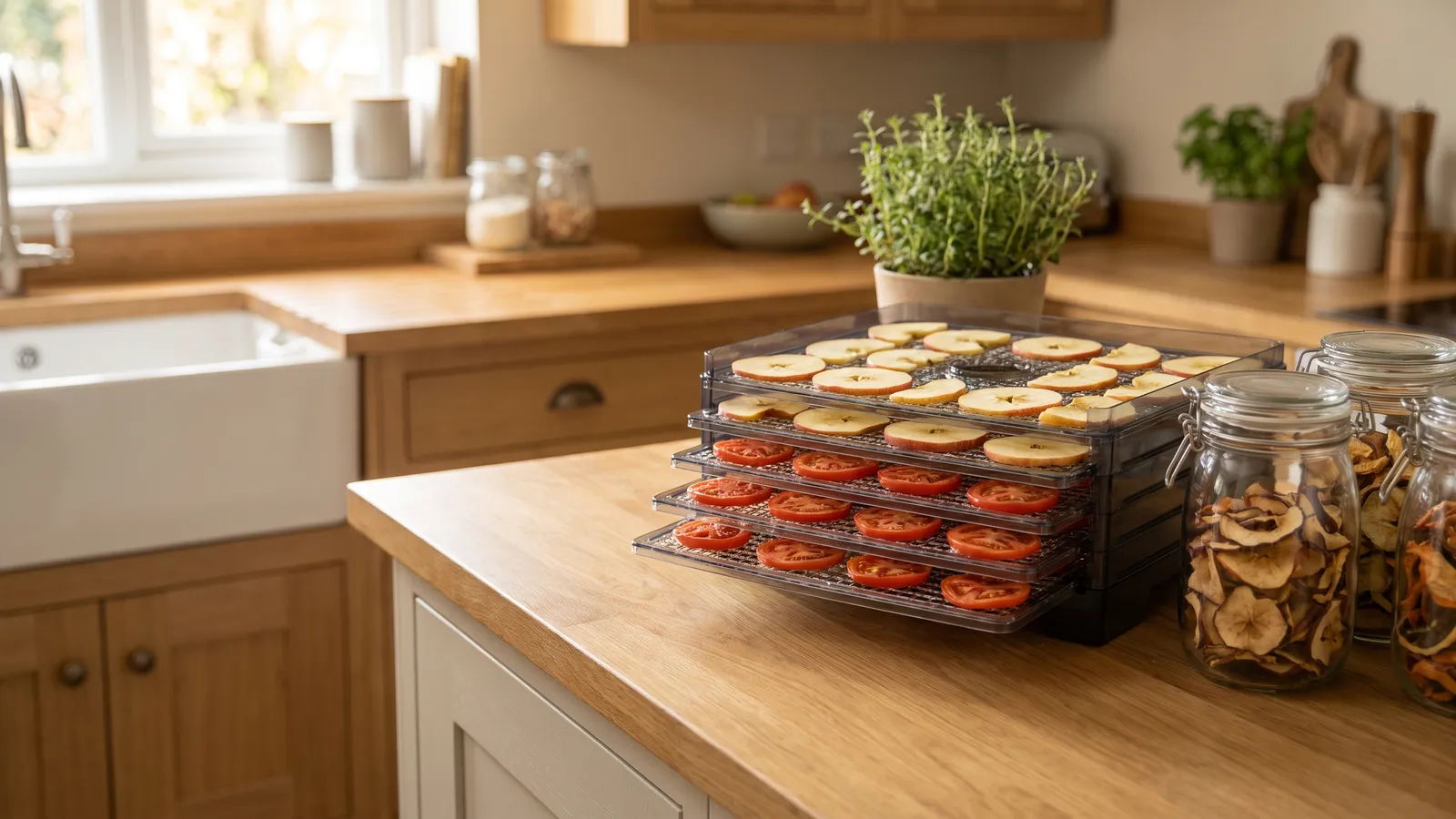
Start with what you'll actually dry. Herbs, apple rings and the odd batch of jerky: a 5–6 tray unit around £50–£65 is plenty. Regular gluts from a productive garden: the 9-tray Excalibur's even horizontal airflow earns its price. Only genuine long-term storage of meals, meat and dairy justifies freeze-drying money.
Watch three specs on dehydrators: wattage (under ~300W means slow going on anything thick), a real timer (48h+ lets you run overnight without babysitting), and stacking height (shallow trays can't take chunky pieces). Temperature range matters if you'll dry meat — you want 70°C+ available for food-safety.
On freeze dryers, be ruthless about the maths. A Harvest Right runs £3,100–£3,700, isn't on Amazon (UK importer, often pre-order), cycles for 20–40 noisy hours and needs pump maintenance. It's transformative for smallholding-scale volumes — and idle furniture for a just-in-case household. Tins plus a vacuum sealer deliver most of the resilience for a fiftieth of the money.
Top pick: Andrew James Digital Food Dehydrator (6-tray). The cheapest genuinely capable dehydrator we'd put in a kitchen: 550W, six trays and a real 48-hour timer, from a UK small-appliance brand with a long track record. One thing to know that Amazon's own listing gets wrong: the title calls it a 'Freeze Drier' and it isn't one — it's a hot-air dehydrator. For drying a garden glut, fruit leathers and jerky it's exactly right; just don't buy it expecting freeze-dried results.
| Dryer | Type | Capacity | Power | Timer | Price | |
|---|---|---|---|---|---|---|
| Andrew James Digital Food Dehydrator (6-tray)TOP PICK | Hot-air dehydrator | 6 trays | 550W | 48-hour digital | £52.99as of 20 Sep 2026, 12:29 BST · DetailsProduct prices and availability are accurate as of the date/time indicated and are subject to change. Any price and availability information displayed on Amazon.co.uk at the time of purchase will apply to the purchase of this product. | Check price → |
| Harvest Right Medium Home Freeze Dryer | Vacuum freeze dryer | 5 trays · 4.5–6.8kg per batch | 110V via supplied transformer | 20–40hr cycles | — | See price at Harvest Right → |
| Aigostar Crispy 5-Tier Food Dehydrator | Hot-air dehydrator | 5 trays (adjustable heights) | 240W | 99-hour digital | £63.99as of 20 Sep 2026, 12:29 BST · DetailsProduct prices and availability are accurate as of the date/time indicated and are subject to change. Any price and availability information displayed on Amazon.co.uk at the time of purchase will apply to the purchase of this product. | Check price → |
| Harvest Right Large Home Freeze Dryer | Vacuum freeze dryer | 6 trays · 8.2–12.2kg per batch | 110V via supplied transformer | 20–40hr cycles | — | See price at Harvest Right → |
| Ninja Foodi Dual Zone AF300UK (dehydrate mode) | Air fryer with dehydrate mode | 2 drawers (7.6L total) | 2,470W | Per-programme | £159.99as of 20 Sep 2026, 12:29 BST · DetailsProduct prices and availability are accurate as of the date/time indicated and are subject to change. Any price and availability information displayed on Amazon.co.uk at the time of purchase will apply to the purchase of this product. | Check price → |
ⓘ As an Amazon Associate, PreparedBritain earns from qualifying purchases. We may earn a commission when you buy, or a fee when you request a quote, through our links — it never affects what we recommend. Amazon prices come from Amazon's own product data and show the date and time they were retrieved. Prices at other retailers are checked by us, less often. Prices and stock can change at any time, so always check the retailer's price before you buy.
Andrew James Digital Food Dehydrator (6-tray)
4.5Who it's for: The best-value proper dehydrator — 6 trays and a 48-hour timer for overnight batches.
The cheapest genuinely capable dehydrator we'd put in a kitchen: 550W, six trays and a real 48-hour timer, from a UK small-appliance brand with a long track record. One thing to know that Amazon's own listing gets wrong: the title calls it a 'Freeze Drier' and it isn't one — it's a hot-air dehydrator. For drying a garden glut, fruit leathers and jerky it's exactly right; just don't buy it expecting freeze-dried results.
- Six trays and a 48-hour timer at a price most rivals can't touch
- Simple digital controls with a 40–70°C range that covers herbs to jerky
- UK-focused brand with spares and support
- It's plastic, not steel — expect a faint warm-plastic smell on the first few runs
- Despite the Amazon listing title, it is not a freeze drier
as of 20 Sep 2026, 12:29 BST · Details
Product prices and availability are accurate as of the date/time indicated and are subject to change. Any price and availability information displayed on Amazon.co.uk at the time of purchase will apply to the purchase of this product.Who it's for: True freeze-drying at home — 25-year shelf life, at a price that suits very few households.
The real thing: genuine vacuum freeze-drying, not hot-air dehydrating, from the brand that effectively owns the home market. Properly packaged output keeps for up to 25 years and rehydrates close to fresh — nothing else on this page can do that. Now the honest bit: it costs around £3,100, isn't sold on Amazon (you buy from a specialist UK importer, often on pre-order), runs noisy 20–40-hour cycles, needs pump-oil maintenance, and is the size of a large dishwasher. Unless you're processing serious volumes from a garden, a smallholding or bulk buys, the payback is years-to-never — for most households, tins plus a vacuum sealer do more for far less.
- Genuine 25-year storage — the only true long-term preservation tech here
- Handles meals, dairy and meat that dehydrators can't
- Dominant brand with a dedicated UK importer for support
- ~£3,100, and that's the medium size
- Noisy day-plus cycles, pump maintenance, dishwasher-sized footprint
- Payback only makes sense at genuine volume
Aigostar Crispy 5-Tier Food Dehydrator
4.2Who it's for: Long, slow, low-temperature drying — the 99-hour timer is the standout.
A steel-bodied budget pick whose 99-hour timer is genuinely useful for slow low-temperature runs that preserve more nutrients — and the adjustable tray heights take chunky pieces the flat-stack rivals can't. The trade-off is power: at 240W, thick cuts like tomato halves or jerky strips take noticeably longer, so plan overnight runs rather than a quick afternoon batch.
- 99-hour timer for slow, low-heat drying
- Stainless body with BPA-free trays and two stacking heights
- 35–70°C range reaches lower than most budget units
- 240W is slow on anything thick
- No viewing window — checking progress means opening the door and losing heat
as of 20 Sep 2026, 12:29 BST · Details
Product prices and availability are accurate as of the date/time indicated and are subject to change. Any price and availability information displayed on Amazon.co.uk at the time of purchase will apply to the purchase of this product.Who it's for: Nearly double the batch size for ~20% more money — but only if you'll actually fill it.
One step up for smallholders, large extended families or a farmers'-market sideline: nearly twice the Medium's per-batch capacity for roughly 20% more money, from the same UK importer. Every caveat on the Medium applies here amplified — £3,700, a genuinely large appliance, and even harder to justify unless you're regularly filling 8kg+ batches. Most home buyers don't; be honest with yourself before choosing this over the Medium, because the smaller model already sits idle between uses in most kitchens that have one.
- Twice the throughput for a modest price step
- Same 25-year storage capability as the Medium
- The right size for genuine smallholding volumes
- £3,700 and physically bigger again
- Most households never fill the batches that justify it
Ninja Foodi Dual Zone AF300UK (dehydrate mode)
4.0Who it's for: The honest answer if you already own one — don't buy a dehydrator for the odd apple ring.
This is here for an honest reason: one of the UK's best-selling air fryers has a dehydrate mode, and if it's already on your worktop you may not need to buy anything else. Two flat drawers dry a snack batch of apple rings or a few jerky strips perfectly well. What it can't do is volume — there are no stacking racks, so anyone actually preserving a glut or building a store cupboard should buy a real dehydrator above instead. Don't buy this specifically to dehydrate; use the mode if you own one.
- Zero extra cost or worktop space if you already own one
- Handles small snack batches genuinely well
- Obviously also an excellent air fryer
- A fraction of the batch size of any dedicated dehydrator
- Useless for serious preserving volumes
as of 20 Sep 2026, 12:29 BST · Details
Product prices and availability are accurate as of the date/time indicated and are subject to change. Any price and availability information displayed on Amazon.co.uk at the time of purchase will apply to the purchase of this product.Get price-drop alerts on these
Prices for 364 tracked products are refreshed daily — last sweep 20 September 2026. Tell us which and we'll email you when one drops.
We verify every product's specifications against at least two independent sources, re-check its UK price and stock on a schedule where we can track it automatically, and cross-check safety-relevant claims against official guidance. Where we've bought and used a product ourselves we say so on its review; where we haven't, our verdict is a considered spec-and-evidence comparison, not a hands-on test — and commissions never change a ranking either way. Read our full methodology →
Guides that go with this
The calm, honest case for growing some of your own food in the UK — what a garden can and can't do, and the hi…
The maths done for you: turn about 2,000 kcal and 3 litres of water per person per day into concrete food and …
What UK food security actually looks like, why shelves occasionally gap, and the calm two-week larder that mak…
Common questions
What's the difference between a dehydrator and a freeze dryer?
A dehydrator removes moisture with warm air over hours — cheap, simple, and right for fruit, herbs, veg crisps and jerky, with months-to-a-year storage. A freeze dryer freezes food then removes the ice under vacuum, keeping structure and nutrition and enabling 25-year storage when packaged properly — at £3,000+ and a much noisier, longer process. They are not interchangeable, whatever some listings imply.
Are home freeze dryers worth it in the UK?
For most households, honestly, no — the maths only works at volume. A Harvest Right costs £3,100–£3,700 from a UK importer, runs day-long cycles, and needs maintenance. It makes sense for smallholders, very large gardens, or anyone seriously building decades-stable stores. For everyone else, a £50 dehydrator plus tins and a vacuum sealer covers the realistic cases for a fraction of the cost.
What can I preserve with a cheap dehydrator?
A surprising amount: apple and pear rings, tomato halves, mushrooms, courgette and kale crisps, every herb you grow, fruit leathers from windfalls, and jerky (dry meat at 70°C+ for safety). Vacuum-sealed and kept dark, most dried produce keeps 6–12 months.
Can I dehydrate food in an air fryer?
If it has a dehydrate mode, yes — for small batches. Two flat drawers dry a snack run of apple rings or a few jerky strips well, but there are no stacking racks, so real preserving volume needs a dedicated dehydrator. Use the mode if you own the machine; don't buy an air fryer to dehydrate.
How long does dehydrated food last?
Kept genuinely dry — airtight jars or vacuum bags, somewhere dark and cool — most fruit and veg keeps 6–12 months and herbs about a year. Jerky is shorter: a few weeks in a cupboard, a few months vacuum-sealed in the fridge. Freeze-dried food properly packed in mylar with oxygen absorbers is the only route to decade-plus storage.
Is dried food as nutritious as fresh?
Mostly. Drying concentrates calories and preserves minerals and fibre well; you lose some vitamin C and other heat-sensitive vitamins, with lower temperatures preserving more. Freeze-drying retains the most nutrition of any home method — one reason it commands the price.