Home freeze dryers in the UK: cost, running cost, and are they worth it?
What a home freeze dryer does and doesn't do, what one costs in the UK to buy and to run, how big and loud it is, what you can't freeze dry, and the sums on whether it's worth it compared with a dehydrator or ready-made freeze-dried meals.
A home freeze dryer freezes food and then removes the ice under vacuum, so the food keeps its shape and, sealed in Mylar bags with oxygen absorbers, can keep for up to 25 years by the maker's own claim. In the UK a Harvest Right costs from about £2,500 for the Small to £3,700 for the Large at Freeze Dryers UK (prices read 4 November 2026). A typical 24-hour batch in the Medium uses roughly £6 to £8 of electricity at the current Ofgem cap. For most households, a dehydrator or ready-made freeze-dried meals cost far less.
By Tom Calder · Updated 4 November 2026 · Sourced to Harvest Right's specifications, UK dealers' price pages, Ofgem & the Food Standards Agency
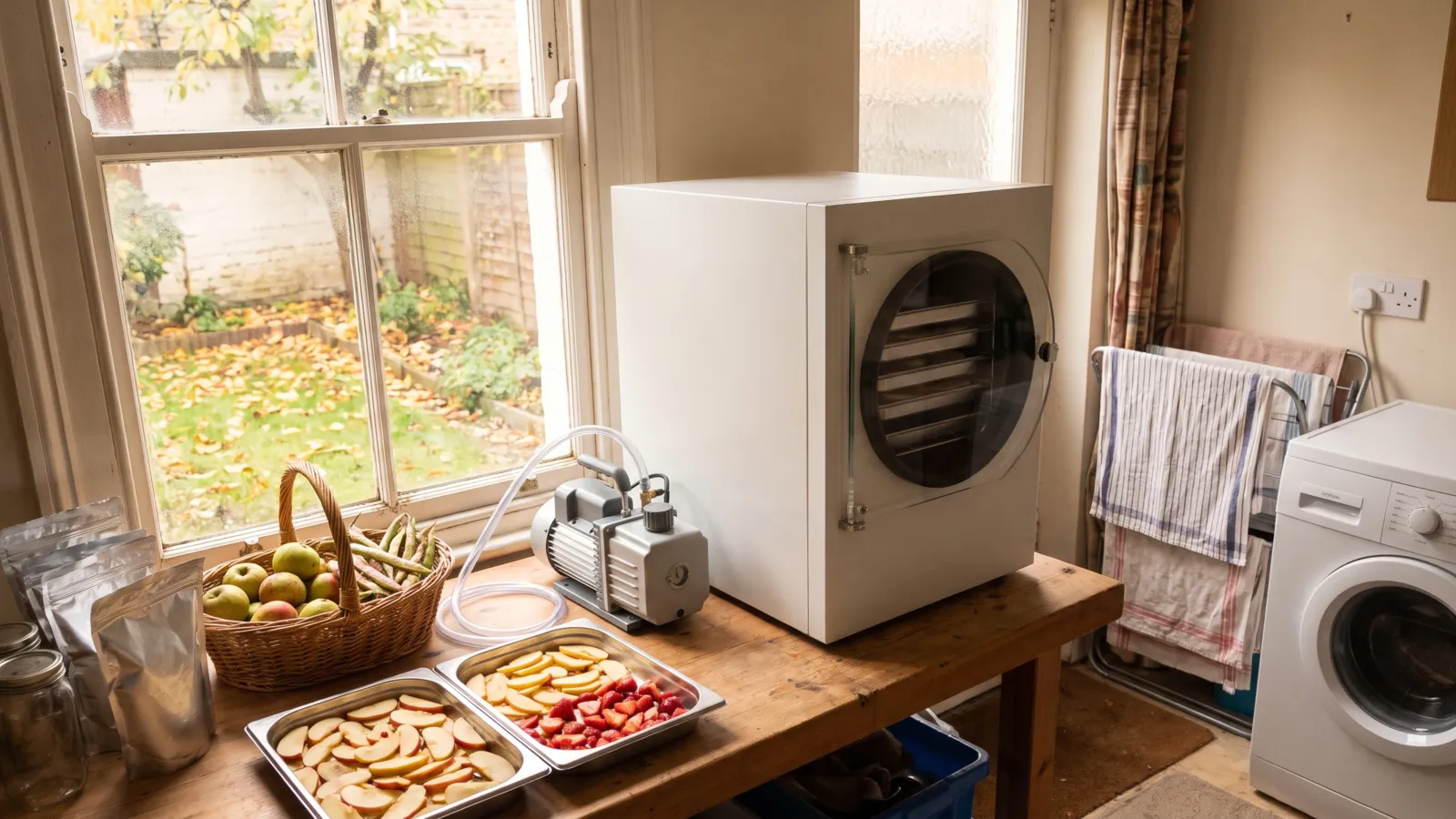
What a freeze drying machine does, and how it differs from a dehydrator
A freeze dryer first freezes the food solid inside its chamber, then pulls a vacuum so the ice turns straight to vapour without melting, and gently warms the trays to finish the job. Because the food is never cooked or shrunk by heat, it keeps its shape and rehydrates close to how it started. That is why a freeze dryer can handle whole cooked meals, meat and dairy, which a hot-air machine can't turn into long-keeping food.
A dehydrator is a much simpler thing: a heater and a fan blowing warm air over trays for hours. It suits fruit, vegetables, herbs and jerky, the results are chewy or crisp rather than airy, and they keep for months rather than decades. The two are often blurred in online listings, so check the word 'vacuum' and the price: a real freeze dryer runs to thousands of pounds, and a dehydrator to tens or low hundreds.
Home freeze dryer prices in the UK
Harvest Right, an American maker, dominates the home market. Its machines reach UK buyers through specialist sellers. On 4 November 2026 Freeze Dryers UK listed the Small Home Pro at £2,500, the Medium at £3,100 on sale (from £3,500), the Large at £3,700 and the XL at £5,300 on sale (from £5,700), with the Small and XL showing as out of stock. Squish Tech listed the Medium at £3,750 and the Large at £4,450, the Large sold out and backordered. Prices and stock move, and some machines are pre-order only, so ask what the price includes (VAT, pallet delivery, the pump) before paying a deposit.
Both sellers list their Harvest Right machines for UK 230V mains; Freeze Dryers UK says the Small comes with a UK plug adaptor. Harvest Right's UK warranty covers machines bought and delivered in the UK from 2 July 2026 for two years from the ship date, and excludes damage from improper voltage, so don't import a 110V US unit. Harvest Right's FAQ also lists a smaller Countertop 360, which Freeze Dryers UK shows as pre-order with no UK price yet.
Other makers do sell in the UK, but at a higher price: Freeze Dryers UK lists the Leosmak LEO-004 Compact, a 4kg-a-batch machine, at £4,999. The other machines on the same site start at about £7,000 and run to six figures, well beyond household use.
Size, noise and where it can go
These are big, heavy appliances. Freeze Dryers UK gives the Small as about 44 × 55 × 68cm and 41kg. Harvest Right's specifications put the Medium at roughly 48 × 64 × 74cm and 54kg, and the Large at roughly 54 × 70 × 80cm and 65kg; the XL is about 62 × 95 × 90cm and 117kg. The vacuum pump sits beside the machine on its own, so allow room for it too. They need a sturdy bench or trolley, not a kitchen worktop corner.
Harvest Right says the machines work best in a room at 10 to 24°C (50 to 75°F), and running one above 105°F (about 40°C) voids the warranty; its warranty terms give a narrower operating range of 35 to 95°F (about 2 to 35°C). A heated utility room suits; a garden shed in July or a frosty garage in January doesn't. On power, Harvest Right says the Small, Medium and Large need a dedicated circuit in the US, and Freeze Dryers UK says its XL needs a dedicated 16A or 13A connection. Ask an electrician before you buy, and don't run one from an extension lead.
Harvest Right publishes noise figures for its pumps rather than the machines: about 64 decibels for its standard oil pump, 62 for the oil-free pump and 52 for the Premier oil pump. Freeze Dryers UK gives about 60dB for the Leosmak LEO-004. It runs for a day or more at a time, so a bedroom wall or an open-plan kitchen is a poor spot.
Vacuum pump oil vs oil-free
The pump is the part that needs looking after. Harvest Right says its standard oil pump needs its oil drained and filtered every four to five batches, and its Premier oil pump, the type Freeze Dryers UK lists with its Small and XL, needs an oil change every 20 to 30 batches, or straight away if the oil turns cloudy or dirty.
An oil-free pump is sold as an upgrade. Harvest Right says it needs no oil changes and no regular user upkeep, but at about 62 decibels it is louder than the Premier's 52.
How long does freeze drying take?
Longer than most people expect. Harvest Right says most foods take 13 to 35 hours, depending on the food, how much is on the trays and how thickly it's sliced; sweets are the exception at about two hours. A typical batch runs overnight and well into the next day; Harvest Right's own yearly figures assume four batches a week.
Once the cycle ends, the food has to go straight into airtight, moisture-proof packaging, because freeze-dried food takes up moisture from the air quickly. Harvest Right ships its machines with Mylar bags, oxygen absorbers and an impulse sealer for this, and you'll keep buying more.
NewSee this for your own homeHome Alerts: your postcode's power cuts, warnings and floods, on one screen. Free for your own home. Sign up in a minute.Start free →What a home freeze dryer costs to run
Harvest Right gives the average draw over a cycle, measured on its US 110V machines, as about 990 to 1,210 watts for the Small and Medium, about 1,500 watts for the Large and about 1,700 watts for the XL. At the Ofgem price cap's average electricity unit rate of 26.32p per kWh for October to December 2026 (Direct Debit), the Medium costs about 26p to 32p an hour. That's roughly £3.40 to £4.15 for a short 13-hour batch, £6.25 to £7.65 for a 24-hour one and £9.10 to £11.15 for a 35-hour one. The Large costs about £9.50 for a 24-hour batch and £13.80 for a 35-hour one.
Harvest Right's own yearly capacity figure for the Medium assumes four batches a week for 50 weeks. At 24 hours a batch, that much use would add roughly £1,250 to £1,530 a year to the electricity bill at today's rate. For comparison, a 550-watt dehydrator running flat out for ten hours uses 5.5kWh, about £1.45, and less in practice because its heater cycles on and off.
The cap changes every three months: Ofgem is due to announce the rate for January to March 2027 by 25 November 2026. To redo the sums for your own tariff, multiply the watts by the hours, divide by 1,000 and multiply by your unit rate.
What you can't freeze dry, and the food safety rules
Harvest Right says to skip peanut butter, pure chocolate, butter, honey, syrup and jam: freeze drying takes out water but not oil, and foods with a lot of natural or added oil don't preserve well.
Freeze drying is not a way of making food safe. Harvest Right says plainly that it doesn't kill bacteria, so raw meat, fish and eggs that go in raw come out raw and must be labelled, handled and cooked like the fresh version. The Food Standards Agency doesn't publish guidance specifically on freeze drying at home, so its general rules apply: cook poultry, pork, mince, burgers, sausages and rolled joints until steaming hot all the way through, with no pink meat and juices running clear (the middle of the food should reach 70°C for two minutes); whole cuts of beef or lamb can be served pink in the middle. Reheat leftovers only once, until steaming hot throughout.
If you plan to sell what you make, at a market stall or from home, the rules for food businesses apply. In England, Wales and Northern Ireland, GOV.UK says you must register with your local authority at least 28 days before you start trading.
Shelf life: what the 25-year claim means
Harvest Right says freeze-dried food lasts up to 25 years if it's packaged properly in an airtight container, such as a Mylar bag with an oxygen absorber. That is the maker's claim, not a guarantee for every food: Harvest Right ties it to proper packaging in an airtight container. Our advice is to keep the bags somewhere cool, dark and dry, label each with what's in it and the date, and eat the oldest first.
If decades-long storage is the goal, it's worth reading what a 25-year date on a commercial kit actually promises before spending thousands to make your own.
Is a home freeze dryer worth it? The break-even maths
A freeze dryer pays for itself only by replacing food you would otherwise buy, so the sum is: what the machine costs, divided by what each batch saves you. Here's a worked example using round numbers, so change them to fit your own household. Take a Medium at £3,100. Say one batch makes the equivalent of 20 servings of a ready-made freeze-dried kit; at roughly £2.75 a serving (a ReadyWise one-month kit was about £330 for 120 servings on 4 November 2026), buying that would cost about £55. Take off about £20 for the ingredients and about £7 of electricity, and each batch saves you roughly £28. That means about 110 batches to break even.
At one batch a week, that's a little over two years, just beyond the two-year UK warranty, which runs from the ship date. At one batch a month, it's about nine years, before counting replacement bags, oxygen absorbers, pump oil or a repair. If your ingredients are free, from a garden glut or your own livestock, the saving rises to nearer £48 a batch and break-even falls to around 65 batches. Compared with tinned and dried food from the supermarket, which is cheaper per calorie than freeze-dried kits, the machine may never pay back at all.
The other comparison is the size of the outlay. £3,100 would buy about nine of those one-month kits, over 1,000 small servings with the same 25-year shelf life claim, with no electricity, no work and nothing to maintain. A dehydrator from about £45 (Amazon, 4 November 2026) covers fruit, vegetables and herbs from a garden for about £1.45 a batch or less.
Common questions
How much is a home freeze dryer in the UK?
On 4 November 2026 Freeze Dryers UK listed Harvest Right's Small at £2,500, the Medium at £3,100 on sale, the Large at £3,700 and the XL at £5,300 on sale, with some sizes out of stock. Squish Tech listed the Medium at £3,750 and the Large at £4,450. Check what's included, especially delivery and the pump.
How much does a freeze dryer cost to run?
Harvest Right gives the Small and Medium an average draw of about 990 to 1,210 watts. At the Ofgem cap rate of 26.32p per kWh for October to December 2026, that's about £6.25 to £7.65 for a 24-hour batch, and up to about £11 for a 35-hour one. The Large, at about 1,500 watts, costs about £9.50 for 24 hours.
What's the difference between a freeze dryer and a dehydrator?
A dehydrator dries food with warm air; it suits fruit, vegetables, herbs and jerky, which keep for months. A freeze dryer freezes food and removes the ice under vacuum, so it can handle cooked meals, meat and dairy, and Harvest Right says properly packed food lasts up to 25 years. A dehydrator costs tens of pounds; a freeze dryer, thousands.
How long does a freeze dryer cycle take?
Harvest Right says most foods take 13 to 35 hours, depending on the food, the amount and the slice thickness. Sweets take about two hours.
Are home freeze dryers noisy?
Harvest Right gives about 64 decibels for its standard oil pump, 62 for the oil-free pump and 52 for its Premier oil pump, The catch is that it runs for a day or more at a time, so keep it out of bedrooms and living space.
Do I need an oil-free pump?
Not necessarily. Harvest Right says its Premier oil pump needs an oil change every 20 to 30 batches, or sooner if the oil turns cloudy, while its oil-free pump needs no oil changes or regular upkeep but, at about 62 decibels, is louder than the Premier's 52.
What foods can't you freeze dry?
Harvest Right says to skip peanut butter, pure chocolate, butter, honey, syrup and jam, because foods high in oil don't preserve well. Freeze drying doesn't kill bacteria, so raw meat, fish and eggs must still be cooked properly before eating.
Is a home freeze dryer worth it?
For most households, no. On our worked example, a £3,100 Medium takes about 110 batches to pay back against buying ready-made freeze-dried food: about two years at a batch a week, about nine at a batch a month. It makes sense if you'll fill it every week from a smallholding, a big garden or a food business.
Sources (14)
- Freeze Dryers UK: freeze dryers (Harvest Right Small £2,500, Medium £3,100 sale, Large £3,700, XL £5,300 sale, Countertop 360 pre-order; Leosmak LEO-004 £4,999), read 4 November 2026
- Freeze Dryers UK: Harvest Right Small Home Pro (230V with UK plug adaptor, 2.7–4.5kg a batch, 44.2 × 54.6 × 68.1cm, 41kg), read 4 November 2026
- Freeze Dryers UK: Harvest Right XL Home Pro (dedicated 16A or 13A connection, 61.7 × 95 × 90.4cm, 117kg), read 4 November 2026
- Freeze Dryers UK: Leosmak LEO-004 Compact (£4,999, 4kg a batch, about 60dB), read 4 November 2026
- Squish Tech: Harvest Right Home Pro Large (£4,450, sold out, 220–240V) and Medium (£3,750), read 4 November 2026
- Harvest Right: FAQs (average power draw per size, 13–35 hour cycles, 50–75°F room, dedicated circuit, pump oil intervals), read 4 November 2026
- Harvest Right: vacuum pump options compared (standard oil about 64dB, Premier about 52dB, oil-free about 62dB; maintenance), read 4 November 2026
- Harvest Right: what foods can you freeze-dry (foods to skip; doesn't kill bacteria; up to 25 years in Mylar with an oxygen absorber), read 4 November 2026
- Harvest Right: Home Pro freeze dryer bundleper-size dimensions, weights, batch sizes and what's in the box
- Harvest Right: warranty (UK purchases from 2 July 2026, two years from ship date), read 4 November 2026
- Ofgem: Energy price cap unit rates and standing charges, 1 October to 31 December 2026electricity 26.32p per kWh, Direct Debit
- Ofgem: Changes to the energy price cap between 1 October and 31 December 2026, with the price cap level dates
- Food Standards Agency: Cooking your food (70°C for 2 minutes; poultry, pork, mince and rolled joints steaming hot with no pink; reheat only once), read 4 November 2026
- GOV.UK: Food business registration (England, Wales and Northern Ireland: register at least 28 days before trading, including from home or a stall), read 4 November 2026
PreparedBritain is independent and not affiliated with HM Government.
The Emergency Kit Checklist
The GOV.UK Prepare essentials on one printable page — tick them off as you go and keep it with the kit. Free, no catch.
Download it straight away. We'll also send the occasional briefing when something genuinely matters — severe weather, live incidents, real price drops. Nothing else.
Latest from our live data
All stories → News · 3 NovVampire devices: the '£200' is 13 gadgets added up; turning a home off standby saves about £45
 News · 2 NovCold Weather Payment opens: £25 a freezing week; last winter 40 of 71 stations triggered none
 News · 31 OctEarliest polar vortex breakdown on record forecast for November: what it means for the UK
Keep reading
All food & growing guides →Survival seeds in the UK: are seed vaults worth it?
What survival seed kits and ‘seed vaults’ are, heirloom and open-pollinated seed versus F1, how long seeds really…
UK inflation picks up more than expected to 3.5%: food held at 1.3%, wholesale veg up a third
UK inflation rose to 3.5% in September from 3.1%, with motor fuels the biggest push. Food inflation did not move:…
England's barley and oat harvests are the smallest since 2012, Defra figures show
Defra's provisional estimates give England its smallest barley and oat harvests since 2012 after a hot, dry growing…
